
Can government deny permanent status to long-serving workers by blaming its own mistakes?
Rupesh R. Gaonkar vs State of Goa
Case: Rupesh R. Gaonkar vs State of GoaCitation: 2026 INSC 792Decided on: 04 August 2026
“The Supreme Court ruled that the government cannot deny permanent jobs to long-serving temporary workers by blaming its own internal administrative mistakes.”
Case Quick Facts
- Case Title
- Rupesh R. Gaonkar vs State of Goa
- Neutral Citation
- 2026 INSC 792
- Bench
- Justice Sanjay Karol, Justice Nongmeikapam Kotiswar Singh
- Date of Judgment
- 04 August 2026
- Area of Law
- Service Law / Employment
Outcome: The Supreme Court ruled that the government cannot deny permanent jobs to long-serving temporary workers by blaming its own internal administrative mistakes.
Story Slides
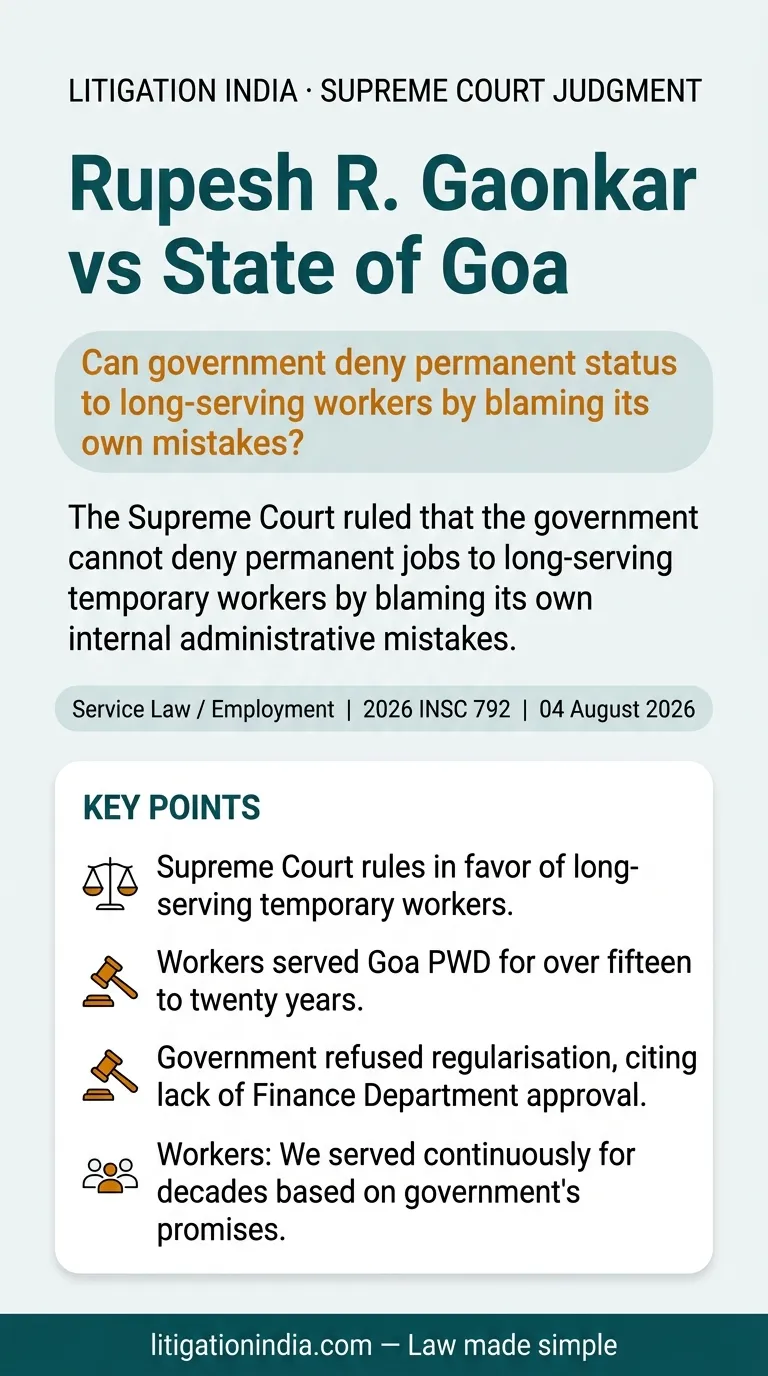
In short
The Supreme Court of India ruled in favor of temporary workers of the Goa Public Works Department (PWD). These workers had served the department for decades, first through private contractors and later through a government-run society created to end their exploitation. In 2014, the state government granted them 'temporary status' and promised to absorb them into permanent roles as vacancies arose. However, the government later backed out of this promise, arguing that the 2014 order was invalid because it lacked the formal approval of the Finance Department. The High Court agreed with the government, stating their appointments were irregular. The Supreme Court reversed the High Court's decision. It held that a welfare state must act as a 'model employer.' The Court declared that the government cannot exploit workers' labor for decades and then discard them by pointing out internal procedural mistakes created by the government itself. It clarified that previous judgments, like the famous Umadevi case, cannot be used as a shield by the state to continue unfair labor practices indefinitely. The Court ordered the Goa government to regularize these workers' services from February 9, 2021. If vacant posts are unavailable, the state must create special temporary posts to accommodate them, ensuring they receive their seniority and pension benefits.
Need clarity on a similar legal issue?
Request free pro bono guidance from a Supreme Court Advocate.
Background
The appellants worked for Goa's Public Works Department for decades, initially through private contractors and later through a government-backed welfare society. In 2014, the government officially granted them 'temporary status' and promised to make them permanent as vacancies arose, but later refused to fulfill this promise, citing internal procedural paperwork issues.
The Decision
The Supreme Court set aside the High Court's order and directed the Goa government to regularize the workers from February 9, 2021. The Court ordered the state to create special temporary posts if normal vacant posts are not available, ensuring they get seniority and retirement benefits.
Why it matters for you
This judgment establishes that the government cannot escape its commitments to temporary workers by blaming its own administrative mistakes. It prevents government departments from exploiting contract labor for decades without giving them job security.
Frequently Asked Questions
AI-assisted summary, reviewed and verified by our editorial team.
Need help with your case?
Facing a similar legal challenge in the Supreme Court or High Court? Connect with our pro bono volunteer advocates today.
Related Supreme Court services
Related Questions of Law
- Can the government force a high-performing officer to retire early shortly after promoting them?
- Can a qualified professor keep his job if his PhD is fake?
- Can local school committees hire government-funded staff without open competition and fair rules?
- Can employers delay processing medical retirement applications to deny compassionate jobs to dependents?
- Can the government cancel a worker's promotion using rules made years later?