
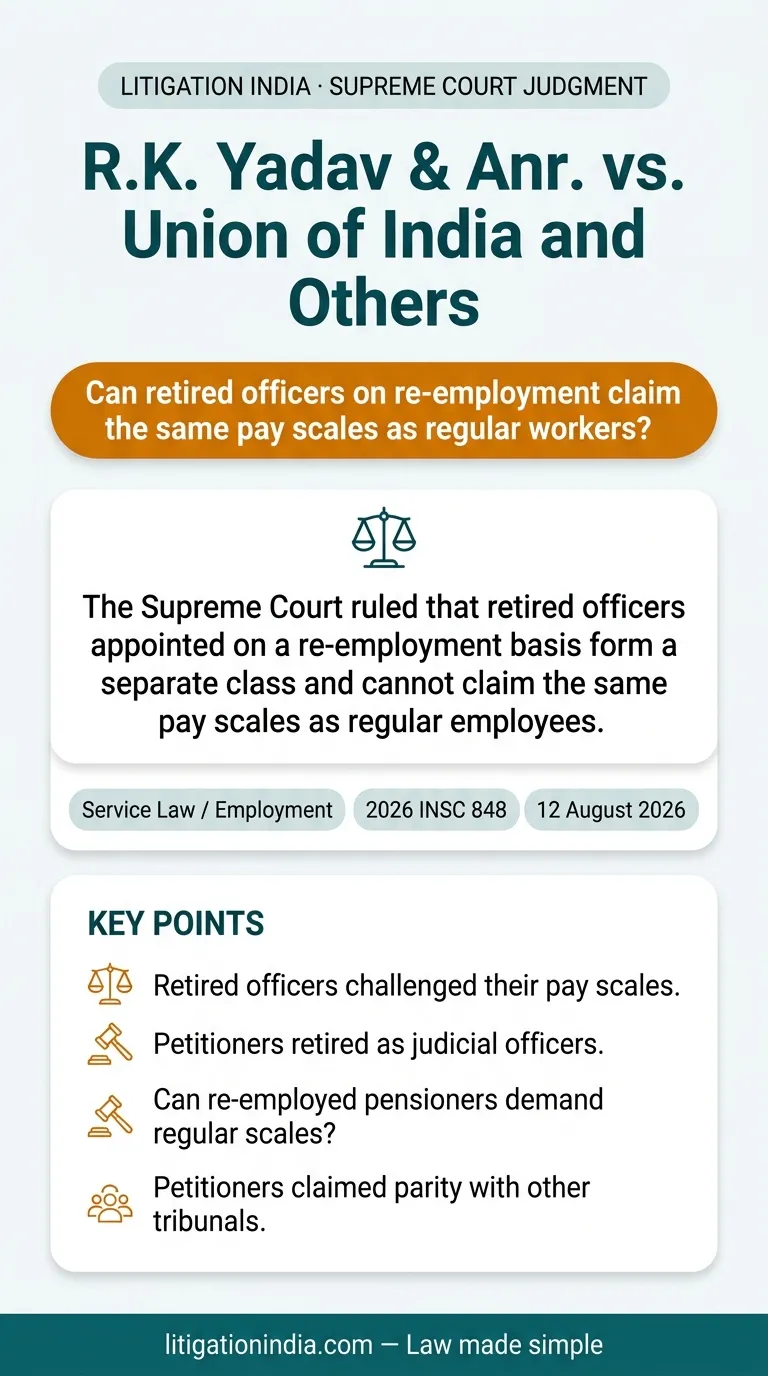
Can retired officers on re-employment claim the same pay scales as regular workers?
R.K. Yadav & Anr. vs. Union of India and Others
Case: R.K. Yadav & Anr. vs. Union of India and OthersCitation: 2026 INSC 848Decided on: 12 August 2026
“The Supreme Court ruled that retired officers appointed on a re-employment basis form a separate class and cannot claim the same pay scales as regular employees.”
Case Quick Facts
- Case Title
- R.K. Yadav & Anr. vs. Union of India and Others
- Neutral Citation
- 2026 INSC 848
- Bench
- Justice S.V.N. Bhatti, Justice N.V. Anjaria
- Date of Judgment
- 12 August 2026
- Area of Law
- Service Law / Employment
Outcome: The Supreme Court ruled that retired officers appointed on a re-employment basis form a separate class and cannot claim the same pay scales as regular employees.
Story Slides
In short
The petitioners, retired judicial officers, were appointed as Presiding Officers of the Central Government Industrial Tribunals-cum-Labour Courts (CGIT-cum-LCs) on a re-employment basis. They approached the Supreme Court seeking the 6th Central Pay Commission's pay scales, arguing that they should be treated at par with other tribunals like the Central Administrative Tribunal (CAT). Instead, the Government had fixed their pay based on the recommendations of the Justice E. Padmanabhan Committee, which equated them with the District Judiciary. Dismissing the petition, the Supreme Court held that the fixation of pay scales is an executive function that must be left to expert bodies, and courts have limited powers of judicial review in such matters. The Court clarified that Article 14 of the Constitution allows reasonable classification. Retired officers working on a re-employment basis do not belong to the same category as regular, permanent employees. Thus, they can be classified separately for pay determination. Furthermore, the Court found nothing arbitrary in equating CGIT Presiding Officers with District Judges, as this was recommended by expert bodies like the Shetty Commission and the Padmanabhan Committee. Therefore, the separate pay rules governing re-employed pensioners are valid and do not violate fundamental rights.
Need clarity on a similar legal issue?
Request free pro bono guidance from a Supreme Court Advocate.
Background
The petitioners were appointed as Presiding Officers in Central Government Industrial Tribunals on a re-employment basis after retiring from active service. They challenged the government's decision to equate their pay scales with State District Judges instead of granting them the higher 6th Central Pay Commission scales.
The Decision
The Supreme Court dismissed the petition, ruling that re-employed retired officers form a separate legal class from regular employees. The Court held that their pay scale fixation was validly based on expert committee recommendations and did not violate any fundamental rights.
Why it matters for you
This judgment clarifies that retired employees who are re-employed cannot automatically demand the same pay scales or benefits as regular, permanent employees. It reinforces that designing pay structures is a complex policy matter belonging to the executive and expert commissions, not the courts.
Frequently Asked Questions
AI-assisted summary, reviewed and verified by our editorial team.
Need help with your case?
Facing a similar legal challenge in the Supreme Court or High Court? Connect with our pro bono volunteer advocates today.
Related Supreme Court services
Related Questions of Law
- Can the government force a high-performing officer to retire early shortly after promoting them?
- Can a qualified professor keep his job if his PhD is fake?
- Can local school committees hire government-funded staff without open competition and fair rules?
- Can employers delay processing medical retirement applications to deny compassionate jobs to dependents?
- Can the government cancel a worker's promotion using rules made years later?