
Can employers deny your promotion because they wrongfully kept you out of work?
Rajasthan High Court vs Abhay Jain
Case: Rajasthan High Court vs Abhay JainCitation: 2026 INSC 762Decided on: 29 July 2026
“The Court ruled that an employer cannot deny promotions or higher pay scales to an employee by using the excuse of missing performance reports caused by the employer's own wrongful termination of the employee.”
Case Quick Facts
- Case Title
- Rajasthan High Court vs Abhay Jain
- Neutral Citation
- 2026 INSC 762
- Bench
- Justice J.B. Pardiwala, Justice Manoj Misra
- Date of Judgment
- 29 July 2026
- Area of Law
- Service Law / Employment
Outcome: The Court ruled that an employer cannot deny promotions or higher pay scales to an employee by using the excuse of missing performance reports caused by the employer's own wrongful termination of the employee.
Story Slides
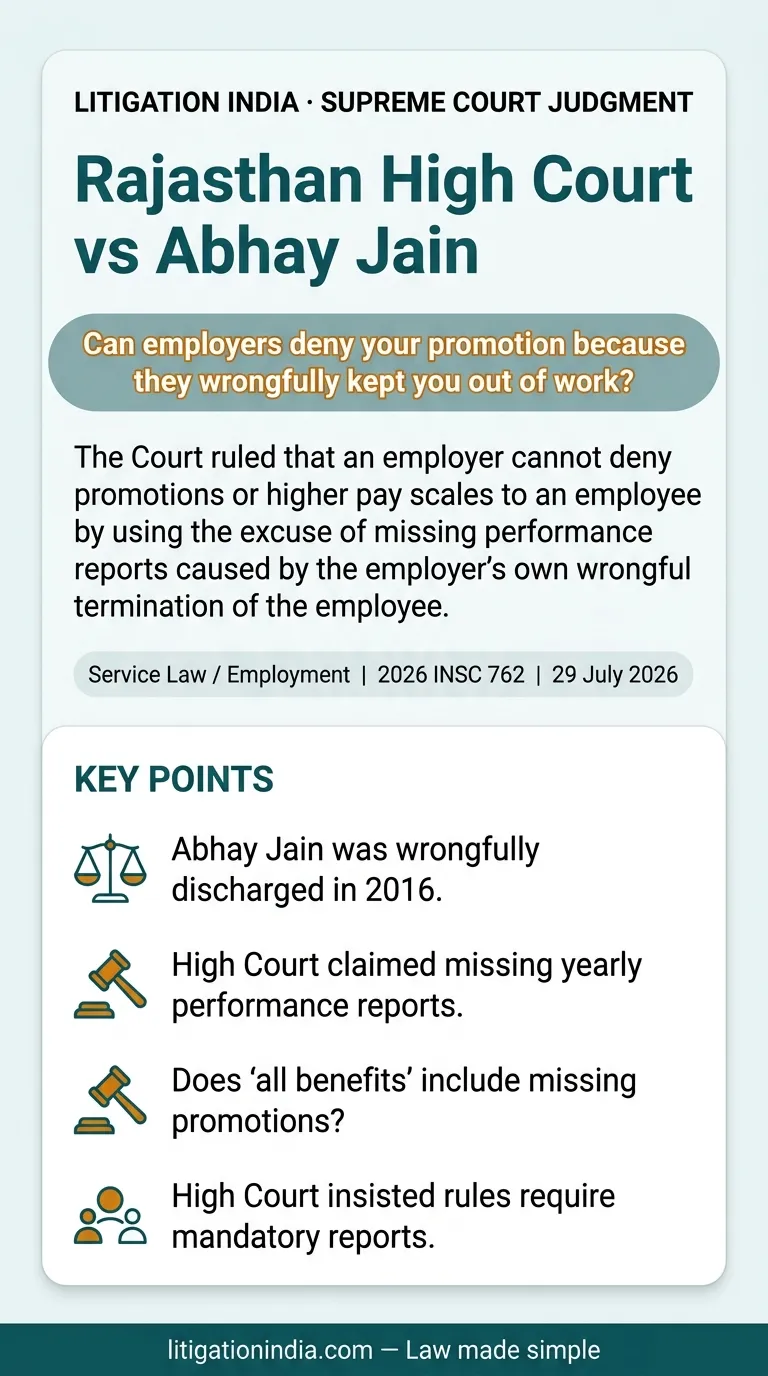
In short
In this case, the Supreme Court of India addressed a critical question: Can an employer deny promotions or higher pay scales to an employee because they lack performance reports (ACRs) for the years they were kept out of service due to wrongful termination? The employee, Abhay Jain, was wrongfully discharged from his job as a judicial officer in 2016. In 2022, the Supreme Court ordered his reinstatement with continuity of service, seniority, and all consequential benefits. When the time came to grant him higher pay scales (Selection Scale and Super Time Scale), the Rajasthan High Court administration refused, arguing that he did not have the mandatory performance reports for six out of the last seven years. The Supreme Court rejected this argument. The Court held that an employer cannot take advantage of its own wrongdoing. Since the High Court itself wrongfully terminated Jain and kept him away from work, it was responsible for the missing reports. The Court ruled that in such situations, the employee's promotion must be evaluated using their remaining valid performance reports. Consequently, the Supreme Court directed the High Court to grant Abhay Jain the Selection Scale starting from July 2018 and the Super Time Scale from July 2021, along with his calculated arrears, within three months.
Need clarity on a similar legal issue?
Request free pro bono guidance from a Supreme Court Advocate.
Background
Abhay Jain, a judicial officer, was wrongfully discharged from service in 2016. In 2022, the Supreme Court ordered his reinstatement with full benefits, but the High Court administration denied him promotions, claiming he lacked the required yearly performance reports for the years he was out of service.
The Decision
The Supreme Court ruled that the employer was responsible for the missing reports and ordered the High Court to grant Jain his promotions and higher scales from his original dates of eligibility (2018 and 2021). The Court also ordered that all resulting arrears must be paid within three months.
Why it matters for you
This judgment establishes that a worker cannot be punished twice: first by being wrongfully terminated, and second by losing promotions due to a lack of work records during that period. It forces employers to act fairly and take responsibility for their own mistakes.
Frequently Asked Questions
AI-assisted summary, reviewed and verified by our editorial team.
Need help with your case?
Facing a similar legal challenge in the Supreme Court or High Court? Connect with our pro bono volunteer advocates today.
Related Supreme Court services
Related Questions of Law
- Can the government force a high-performing officer to retire early shortly after promoting them?
- Can a qualified professor keep his job if his PhD is fake?
- Can local school committees hire government-funded staff without open competition and fair rules?
- Can employers delay processing medical retirement applications to deny compassionate jobs to dependents?
- Can the government cancel a worker's promotion using rules made years later?