
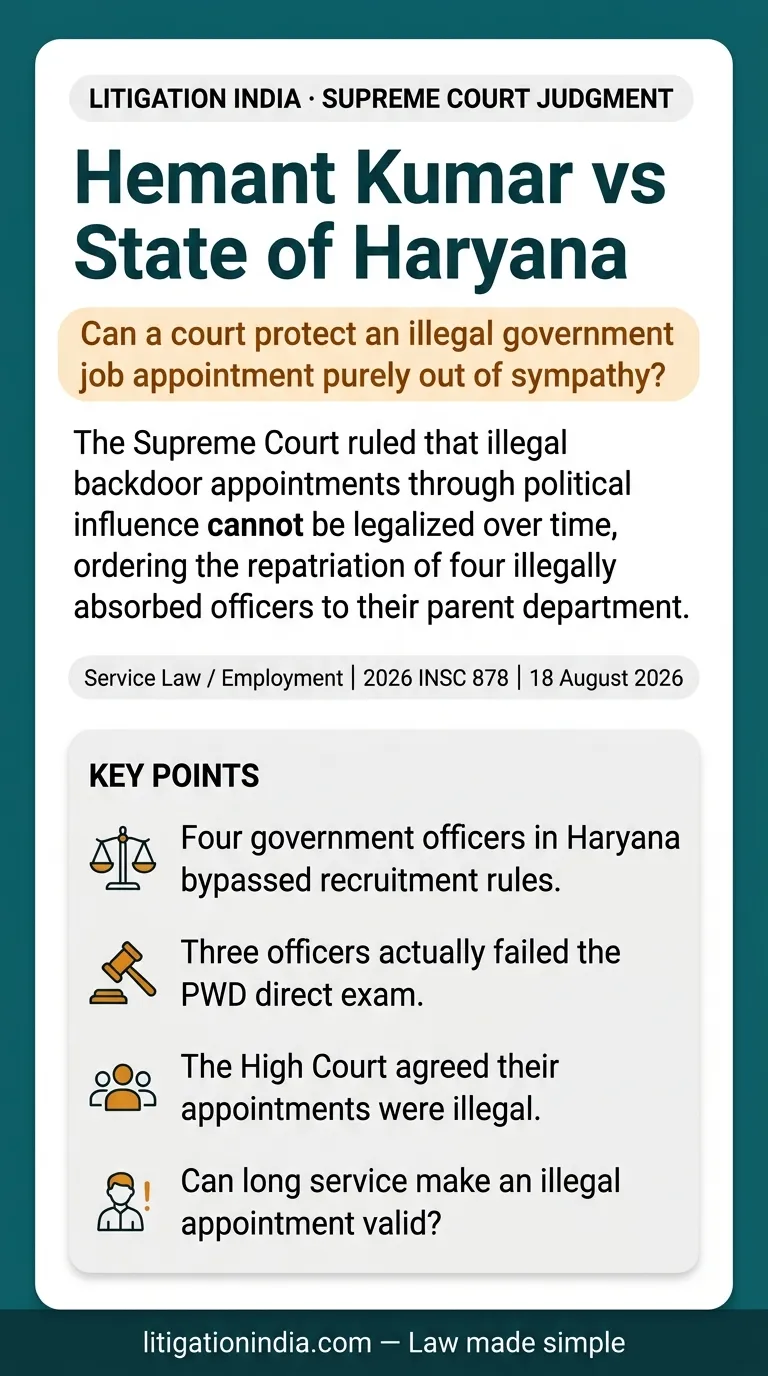
Can a court protect an illegal government job appointment purely out of sympathy?
Hemant Kumar vs State of Haryana
Case: Hemant Kumar vs State of HaryanaCitation: 2026 INSC 878Decided on: 18 August 2026
“The Supreme Court ruled that illegal backdoor appointments through political influence cannot be legalized over time, ordering the repatriation of four illegally absorbed officers to their parent department.”
Case Quick Facts
- Case Title
- Hemant Kumar vs State of Haryana
- Neutral Citation
- 2026 INSC 878
- Bench
- Justice Manoj Misra, Justice Ujjal Bhuyan
- Date of Judgment
- 18 August 2026
- Area of Law
- Service Law / Employment
Outcome: The Supreme Court ruled that illegal backdoor appointments through political influence cannot be legalized over time, ordering the repatriation of four illegally absorbed officers to their parent department.
Story Slides
In short
The Supreme Court of India has held that appointments made through the 'backdoor'—such as illegal transfers or deputations influenced by political pressure—cannot be regularized or protected by courts on grounds of sympathy. The case involved four officers originally appointed in Haryana's Development and Panchayat Department who managed to transfer to the Public Works Department (PWD) on deputation and get permanently absorbed. They did this shortly after joining, while still on probation, and with the help of recommendation letters from politicians and ministers. Remarkably, three of these officers had failed the PWD's competitive exam, and one had not even attempted it. Regularly recruited direct engineers challenged this backdoor entry. The High Court found the transfers illegal but allowed the officers to stay in PWD out of sympathy because they had served there for 18 years. Rejecting this, the Supreme Court ruled that a clear illegality cannot be ignored due to the passage of time. Sympathy cannot override statutory rules. The Court set aside the High Court's relief and ordered that all four officers be repatriated (sent back) to their parent department with their original service rights revived, emphasizing that fairness and merit must prevail in public employment.
Need clarity on a similar legal issue?
Request free pro bono guidance from a Supreme Court Advocate.
Background
Four officers joined Haryana's Panchayat Department but quickly transferred to the PWD using recommendations from politicians, even though three of them had failed the competitive exam for PWD. Honest engineers who passed the exam later challenged this backdoor entry.
The Decision
The Supreme Court declared the officers' permanent absorption in PWD illegal and void. It set aside the High Court's sympathetic order and directed their repatriation back to their parent Panchayat Department.
Why it matters for you
This judgment protects honest job seekers and employees who clear tough exams from being bypassed by influential people using political favors. It confirms that courts cannot use 'sympathy' to reward backdoor entries in government jobs.
Frequently Asked Questions
AI-assisted summary, reviewed and verified by our editorial team.
Need help with your case?
Facing a similar legal challenge in the Supreme Court or High Court? Connect with our pro bono volunteer advocates today.
Related Supreme Court services
Related Questions of Law
- Can the government force a high-performing officer to retire early shortly after promoting them?
- Can a qualified professor keep his job if his PhD is fake?
- Can local school committees hire government-funded staff without open competition and fair rules?
- Can employers delay processing medical retirement applications to deny compassionate jobs to dependents?
- Can the government cancel a worker's promotion using rules made years later?