Dinesh Kumar vs. The State of Haryana
The big legal question
Can a minor convict be spared from life imprisonment if proven underage later?
“The Supreme Court kept the murder conviction but cancelled the life sentence because the accused was a minor when the crime happened and had already spent three years in custody.”
Story Slides
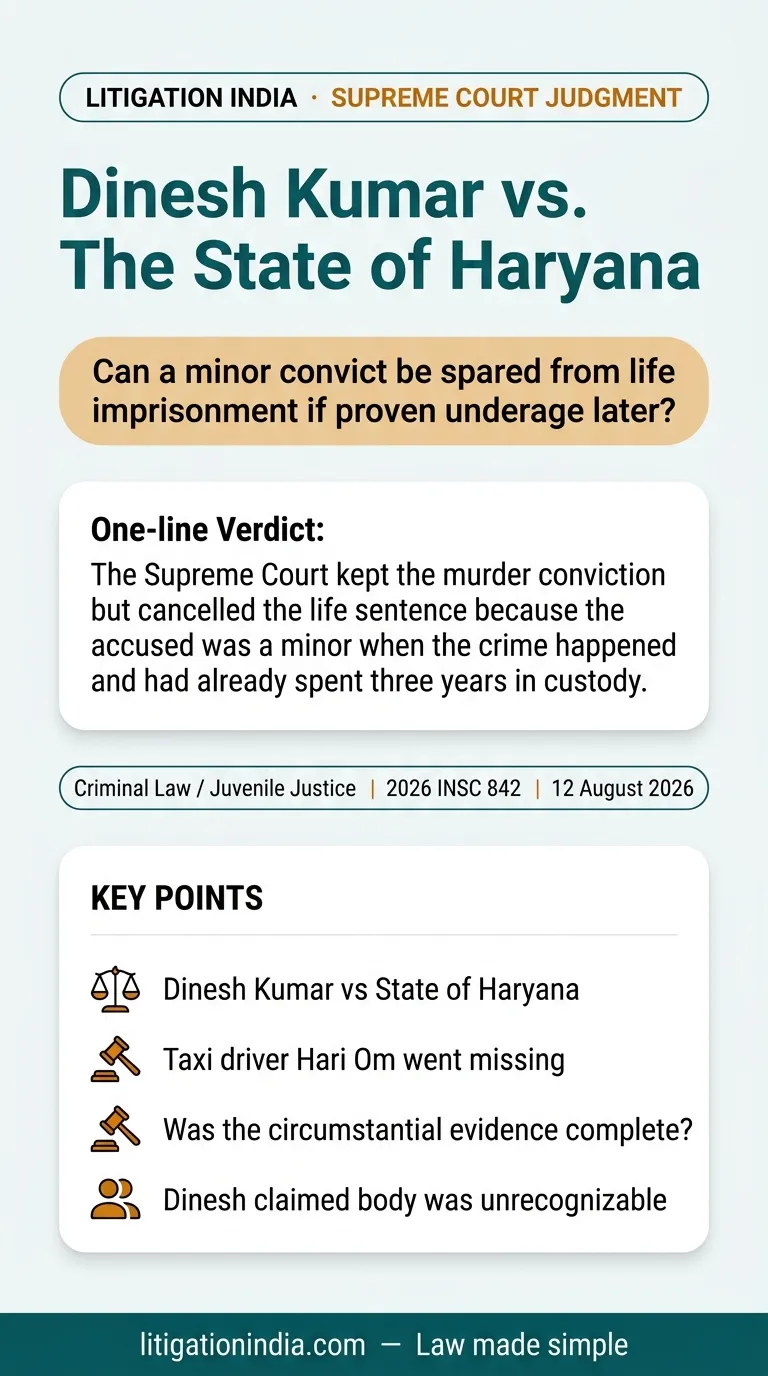
In short
In August 1998, a taxi driver named Hari Om was hired by three men, including the appellant Dinesh Kumar. Hari Om went missing, and his highly decomposed body was later found in a sugarcane field. The police caught Dinesh and the other co-accused trying to sell the taxi. Based on clues provided by them, the police also found the deceased driver's license and tiffin box. The trial court and High Court sentenced Dinesh to life imprisonment for murder. While his appeal was pending in the Supreme Court, the Juvenile Justice Board conducted an inquiry and found that Dinesh was seventeen years and six months old at the time of the crime, making him a minor (juvenile) under the law. The Supreme Court analyzed the evidence and agreed that the chain of circumstances proved Dinesh was guilty of the crime. However, the Court ruled that under the Juvenile Justice Act, a minor cannot be given an adult sentence like life imprisonment. Since Dinesh had already spent more than three years in custody—which is the maximum correction period allowed for minors—the Court cancelled his life sentence and ordered that he did not have to surrender or go back to jail. He was also protected from any future disqualifications linked to a criminal record.
Background
In August 1998, a taxi driver went missing after three men hired his car. Days later, his decomposed body was found, and the accused were caught with his stolen car and personal items.
The Decision
The Supreme Court upheld the conviction but cancelled the adult life sentence because Dinesh was a minor during the incident. Since he had already served the maximum three years of detention allowed for minors, he was set free.
Why it matters for you
This judgment ensures that the rights of underage offenders are protected. It confirms that if a person is proven to be a minor on the date of the crime, their adult prison sentence must be cancelled, no matter how many years have passed.
AI-assisted summary, reviewed and verified by our editorial team.
Need help with your case?
Facing a similar legal challenge in the Supreme Court or High Court? Connect with our pro bono volunteer advocates today.
Related Supreme Court services