Mahavir @ Avnish vs The State of Madhya Pradesh
The big legal question
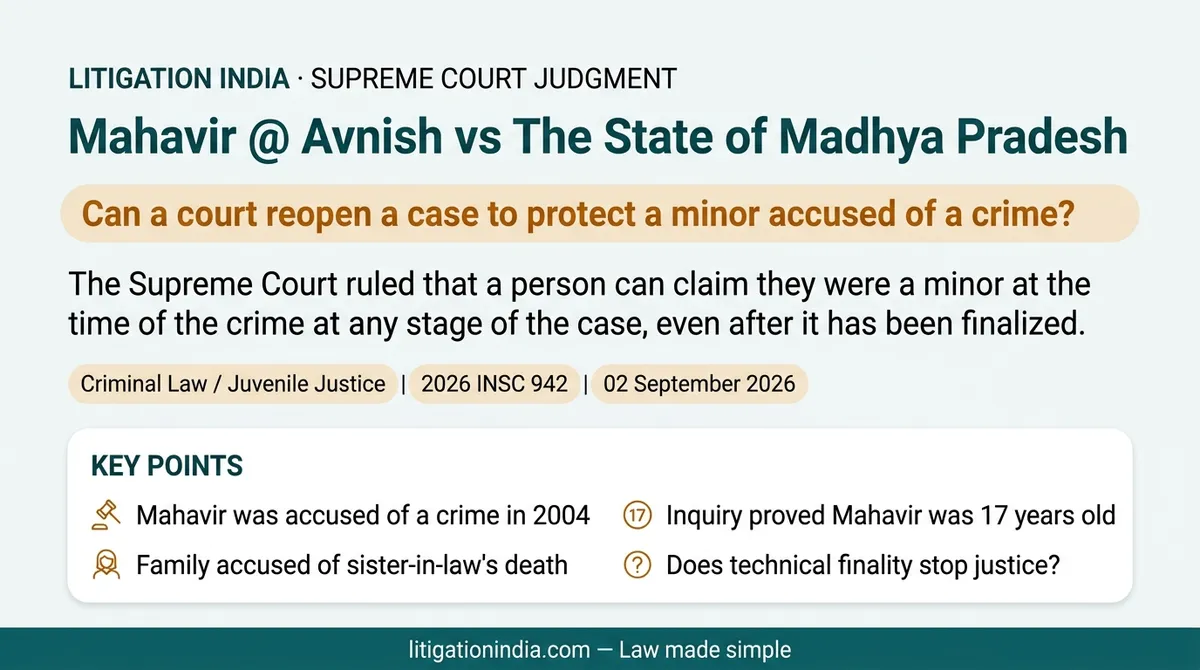
Can a court reopen a case to protect a minor accused of a crime?
“The Supreme Court ruled that a person can claim they were a minor at the time of the crime at any stage of the case, even after it has been finalized.”
Story Slides
In short
In this landmark decision, the Supreme Court of India protected the rights of a child in conflict with law under the Juvenile Justice Act. The case involved Mahavir, who was accused in 2004 alongside his family members for the murder and dowry death of his sister-in-law. Although the trial court acquitted them of murder and dowry death because the main witnesses turned hostile, they were convicted under Section 201 of the Indian Penal Code (IPC) for destroying evidence by cremating the bodies. Mahavir was sentenced to three years in prison. Years later, Mahavir filed a petition under Section 482 of the Code of Criminal Procedure (CrPC) before the Madhya Pradesh High Court, claiming he was a minor (under 18 years of age) when the incident occurred. An inquiry by the Juvenile Justice Board confirmed he was indeed a juvenile on the date of the offense. However, the High Court rejected his plea, ruling that it had no jurisdiction to reopen the case because his earlier appeal before the Supreme Court had already been dismissed as withdrawn. The Supreme Court reversed this decision. It ruled that the plea of juvenility is a fundamental right and can be raised at any stage, even after the case is finalized. The Court clarified that Section 362 of the CrPC, which restricts courts from altering their judgments, does not limit the inherent powers of the High Court under Section 482 to correct its own mistakes and prevent a miscarriage of justice. On merits, the Court observed that since the main offences of murder and dowry death were not proved, a conviction for destroying evidence under Section 201 IPC was illegal. The Supreme Court set aside his conviction, highlighting that children should be protected and rehabilitated, not permanently stigmatized by adult jail terms.
Background
In 2004, Mahavir was convicted for destroying evidence (cremating bodies) after being accused of his sister-in-law's death. Though acquitted of murder, he was sentenced to three years in prison. Years later, he claimed he was actually a minor at the time of the incident, which was confirmed by a formal inquiry.
The Decision
The Supreme Court allowed the appeal and set aside Mahavir's conviction and sentence. The Court held that a claim of being a minor can be raised at any stage of a case, and High Courts have the inherent power to reopen finalized cases to correct mistakes and do justice.
Why it matters for you
This judgment is crucial because it ensures that a person who committed an offense as a child will not lose their legal protections due to procedural delays or court mistakes. It establishes that technical rules cannot block the delivery of justice and the protection of children's rights.
AI-assisted summary, reviewed and verified by our editorial team.
In the Court's words
“the claim of juvenility may be raised before any Court, and it shall be recognized at any stage even after final disposal of the case.”
“No man should suffer because of the mistake of the Court. No man should suffer a wrong by technical procedure of irregularities.”
“The crime of murder and dowry death having not been proved... the appellant could not have been convicted under section 201 Part II of the Indian Penal Code.”
Need help with your case?
Facing a similar legal challenge in the Supreme Court or High Court? Connect with our pro bono volunteer advocates today.
Request Free Callback