Bijendra vs Rekha
The big legal question
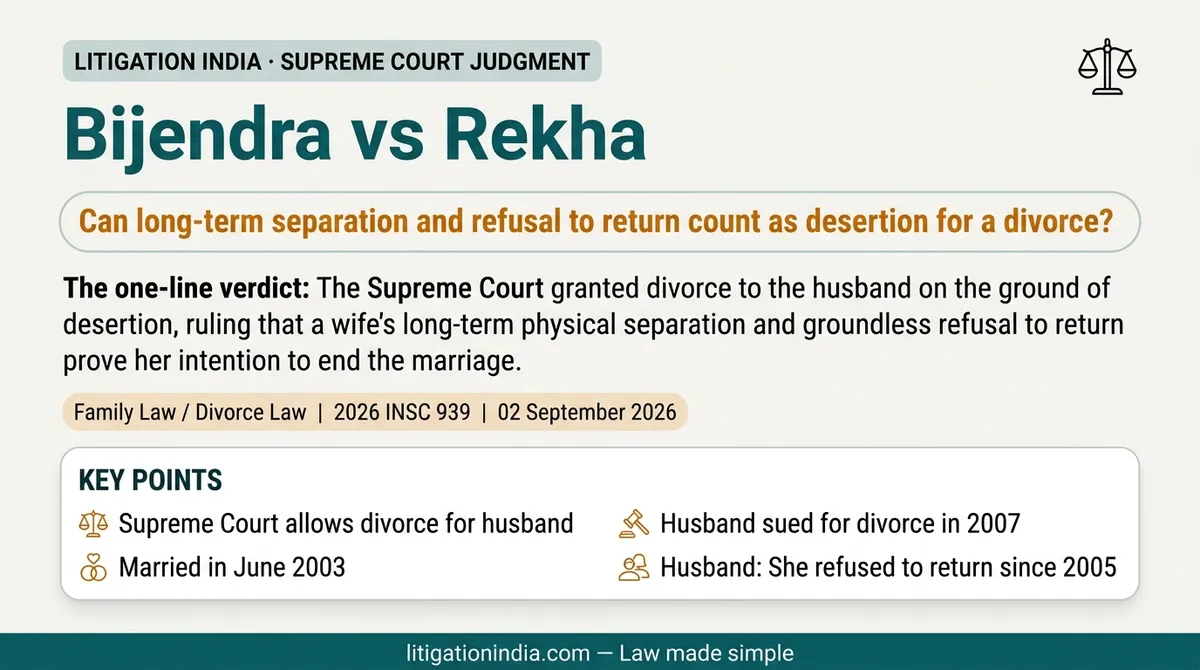
Can long-term separation and refusal to return count as desertion for a divorce?
“The Supreme Court granted divorce to the husband on the ground of desertion, ruling that a wife's long-term physical separation and groundless refusal to return prove her intention to end the marriage.”
Story Slides
In short
The Supreme Court of India resolved a long-standing matrimonial dispute under the Hindu Marriage Act, 1955, by granting a decree of divorce to the appellant-husband on the ground of desertion. The couple had married in 2003 but lived separately since December 2005, with no children. The husband filed for divorce in 2007, alleging mental cruelty and desertion. The Trial Court and High Court dismissed his petition, holding that while separation was proven, the wife's verbal statements in court that she accepted him as her husband showed she had no "animus deserendi" (the legal term for an intention to permanently abandon the marriage). The Supreme Court overturned these findings on the issue of desertion. It held that courts must look at actual conduct rather than mere verbal assertions in court. The evidence showed that the husband and witnesses had made active efforts to bring the wife back, but she refused to return without any reasonable cause. Referring to landmark judgments like Savitri Pandey v. Prem Chandra Pandey and Naveen Kohli v. Neelu Kohli, the Court explained that "desertion" requires physical separation coupled with the clear intent to permanently end cohabitation. The Court observed that forcing the couple to remain legally bound after more than twenty years of living apart would be unfair and a "fiction supported by a legal tie." To ensure justice, the Court dissolved the marriage under Section 13(1)(ib) of the Hindu Marriage Act but ordered the husband to pay permanent alimony of Rs. 7,00,000 (Seven Lakhs) to the wife within three months, failing which a 9% annual interest rate would apply.
Background
The couple married in June 2003 but separated in December 2005 after the wife allegedly refused to return to her husband's home. The husband filed for divorce on grounds of cruelty and desertion, but both the trial court and High Court rejected his petition, prompting him to appeal to the Supreme Court.
The Decision
The Supreme Court granted the husband a divorce on the ground of desertion, finding that the wife had permanently abandoned the marriage without reasonable cause. The Court also ordered the husband to pay her Rs. 7 Lakhs as permanent alimony within three months.
Why it matters for you
This judgment highlights that courts will assess a spouse's actual behavior, not just verbal claims in court, to determine desertion. It confirms that forcing couples to sustain dead marriages after decades of separation serves no legal or social purpose.
AI-assisted summary, reviewed and verified by our editorial team.
In the Court's words
“For the offence of desertion so far as the deserting spouse is concerned, two essential conditions must be there (1) the factum of separation, and (2) the intention to bring cohabitation permanently to an end (animus deserendi).”
“Where there has been a long period of continuous separation, it may fairly be surmised that the matrimonial bond is beyond repair. The marriage becomes a fiction, though supported by a legal tie.”
Need help with your case?
Facing a similar legal challenge in the Supreme Court or High Court? Connect with our pro bono volunteer advocates today.
Related Supreme Court services