All insights

Can a public servant be convicted of bribery on tainted-money recovery alone?

Tehsildar Acquitted: Demand of Bribe Not Proved Without Complainant's Evidence

A Tehsildar convicted for bribery was acquitted because neither the complainant nor the panch witness could testify — both died before trial — and the trap officer's account of what the panch witness

Litigation India Editorial 17 November 2026 1 min read 2026 INSC 1230

Story

Case at a glance1 / 6

Supreme Court of India

Bribery Conviction Overturned: Demand Must Be Proved

Har Parsad Gaur vs State (NCT of Delhi) — 2026 INSC 1230

Court: Supreme Court of India; decided November 17, 2026Bench: Justice Ujjal Bhuyan and Justice Atul S. ChandurkarArea of law: Prevention of Corruption Act 1988 — Sections 7, 13(1)(d), 20Outcome: Tehsildar acquitted; conviction by Special Judge and High Court set aside
Tehsildar Acquitted: Demand of Bribe Not Proved Without Complainant's Evidence · 2026 INSC 12302026-11-17T12:18:41.223651+00:00
The legal question2 / 6

Can Recovery of Tainted Money Alone Convict a Public Servant?

Core legal issue in this appeal

  • Appellant: Both complainant and panch witness died; no direct evidence of demand; PW-10's account of transaction is inadmissible hearsay.
  • Appellant: Official records show cheques were dispatched on 28.12.2002 — no motive to demand bribe on 06.01.2003.
  • Respondent: Recovery of tainted notes and positive chemical wash tests prove conscious acceptance; Section 20 presumption applies.
  • Respondent: Complaint Ex. P-10/A contained detailed particulars of demand; prosecution proved its case through circumstantial evidence.
Tehsildar Acquitted: Demand of Bribe Not Proved Without Complainant's Evidence · 2026 INSC 12302026-11-17T12:18:41.223651+00:00
Statutory comparison3 / 6

What Must Be Proved: Section 7 vs Section 13(1)(d)

As clarified by the Constitution Bench in Neeraj Dutta-1

ProvisionWhat must be provedRole of Section 20 presumption
Section 7 PC Act 1988Offer by bribe-giver accepted by public servant (demand not essential if bribe-giver offers)Applies: once acceptance proved, court presumes it was for a motive/reward under Section 7
Section 13(1)(d)(i)&(ii) PC Act 1988Prior demand by public servant AND acceptance by bribe-giver AND payment receivedDoes NOT apply to Section 13(1)(d)(i) and (ii)
Section 20 PC Act 1988Foundational facts of demand and acceptance must first be provedRebuttable presumption; accused can rebut on preponderance of probabilities
Section 20 presumption cannot be a shortcut to skip proof of demand.
Tehsildar Acquitted: Demand of Bribe Not Proved Without Complainant's Evidence · 2026 INSC 12302026-11-17T12:18:41.223651+00:00
The Court's reasoning4 / 6

How the Court Reached Acquittal: Step by Step

The Court's reasoning in sequence

  1. 1Step 1: Both complainant and panch witness died before trial — no direct oral evidence of demand.
  2. 2Step 2: PW-10's account of what panch witness told him after the signal is inadmissible hearsay — cannot prove demand.
  3. 3Step 3: Official records (Ex. P-7/A, P-7/F, PW-4, PW-7) show cheques were dispatched 28.12.2002 and received 01.01.2003 — no pending work on 06.01.2003.
  4. 4Step 4: Without proved demand, Section 20 presumption cannot be invoked — mere recovery of tainted notes is insufficient.
  5. 5Step 5: Appellant's Section 313 CrPC explanation — money thrust into his pocket as gratitude — is plausible on preponderance of probabilities. Acquittal follows.
Tehsildar Acquitted: Demand of Bribe Not Proved Without Complainant's Evidence · 2026 INSC 12302026-11-17T12:18:41.223651+00:00
The verdict5 / 6

The Court's Final Verdict

Criminal Appeal No. 571 of 2015 — allowed

  • The Fact: Tainted notes recovered from appellant's coat pocket; chemical tests positive; but complainant and panch witness died before trial.
  • The Law: Proof of demand is a sine qua non for Sections 7 and 13(1)(d) PC Act; Section 20 presumption requires foundational facts first; hearsay is inadmissible.
  • The Result: Neither demand nor conscious acceptance proved; conviction by Special Judge and High Court set aside; appellant acquitted and bail bonds discharged.
High Court judgment dated 19.12.2014 and Special Judge judgment dated 28.08.2008 are hereby set aside. Appellant Har Parsad Gaur is acquitted.
Tehsildar Acquitted: Demand of Bribe Not Proved Without Complainant's Evidence · 2026 INSC 12302026-11-17T12:18:41.223651+00:00
Why it matters6 / 6

What This Means for Everyone

Practical significance of the judgment

  • A government employee cannot be jailed for bribery solely because tainted notes were found in their possession — demand must be independently proved.
  • If the main witness (complainant) dies before trial, prosecution can still prove its case through other evidence — but hearsay from a trap officer is not enough.
  • Official records that contradict the alleged motive for a bribe can be decisive in securing acquittal.
  • Citizens and government employees should know that anti-corruption prosecutions require strict, complete proof — not just suspicion or recovery.
Proof of demand is the foundation of every bribery case — without it, no conviction can stand.
Tehsildar Acquitted: Demand of Bribe Not Proved Without Complainant's Evidence · 2026 INSC 12302026-11-17T12:18:41.223651+00:00
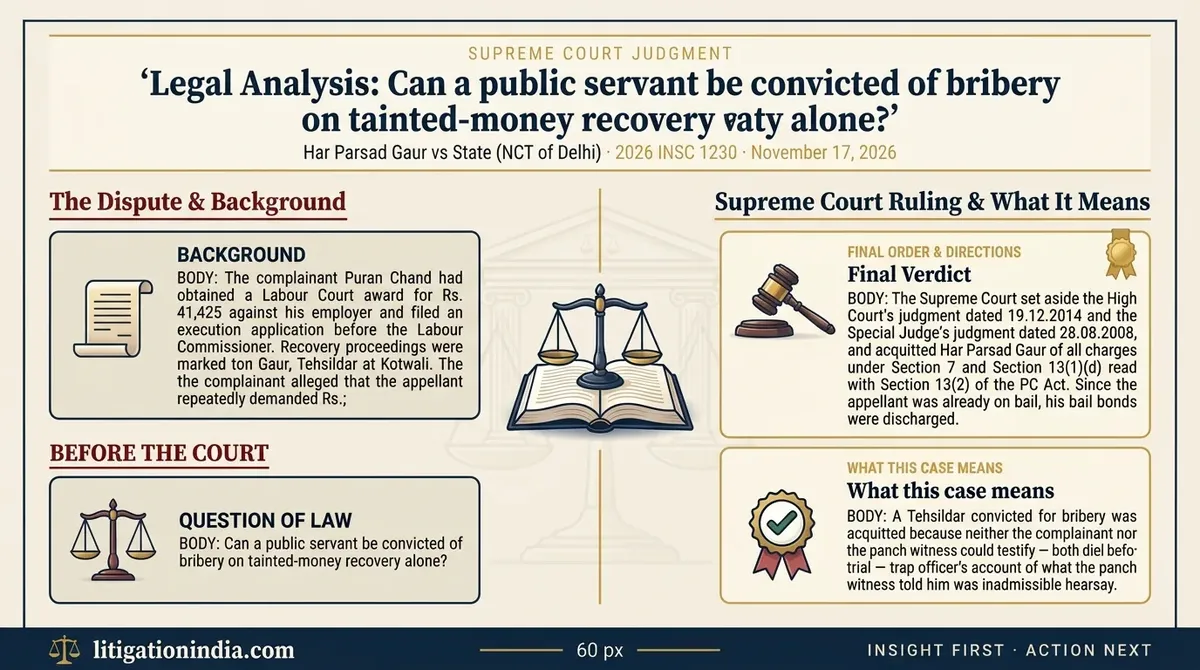
Tehsildar Acquitted: Demand of Bribe Not Proved Without Complainant's Evidence — infographic summary

What this case means

A Tehsildar convicted for bribery was acquitted because neither the complainant nor the panch witness could testify — both died before trial — and the trap officer's account of what the panch witness told him was inadmissible hearsay. The Court held that proof of demand is a sine qua non for conviction under the PC Act and mere recovery of tainted money is insufficient.

What the Supreme Court held

The Supreme Court set aside the High Court's judgment dated 19.12.2014 and the Special Judge's judgment dated 28.08.2008, and acquitted Har Parsad Gaur of all charges under Section 7 and Section 13(1)(d) read with Section 13(2) of the PC Act. Since the appellant was already on bail, his bail bonds were discharged.

Case: Har Parsad Gaur vs State (NCT of Delhi) (2026) Citation: 2026 INSC 1230

Want the full legal reasoning, citations and case documents?

Read the full judgment analysis
Har Parsad Gaur
Prevention of Corruption Act 1988
Section 7 PC Act
Section 13(1)(d) PC Act
Section 20 PC Act
demand of illegal gratification
sine qua non
hearsay evidence
trap case
acquittal
Neeraj Dutta
public servant bribery
Section 7, Prevention of Corruption Act, 1988
Section 13(1)(d) read with Section 13(2), Prevention of Corruption Act, 1988

More in Criminal Law / Anti-Corruption / Prevention of Corruption Act