
All insights

Does Section 17A PC Act shield a public servant accused of demanding a bribe?

Section 17A PC Act Not Applicable to Bribery Demand by Public Servant

A constable accused of demanding a bribe of Rs. 1.5 lakh argued that investigation without prior government approval under Section 17A of the Prevention of Corruption Act was illegal. The Supreme Cour

Litigation India Editorial 17 October 2026 1 min read 2026 INSC 1147

Story

Case at a glance1 / 6

Supreme Court of India

Bribery Demand by Cop: No Shield Under Section 17A PC Act

Tejaram vs State of Rajasthan — 2026 INSC 1147

Court: Supreme Court of India; Date: October 16, 2026Bench: Justice S.V.N. Bhatti and Justice N.V. AnjariaArea of law: Anti-Corruption / Prevention of Corruption Act, 1988Appellant (constable) accused of demanding Rs. 1.5 lakh bribe; charge framed under Section 7 PC Act
Section 17A PC Act Not Applicable to Bribery Demand by Public Servant · 2026 INSC 11472026-10-17T16:59:10.857782+00:00
The legal question2 / 6

Does Section 17A PC Act Require Prior Approval Before Investigating Bribery?

Core legal issue decided by the Court

  • Appellant: Section 17A mandates prior government approval before any investigation against a public servant.
  • Appellant: Failure to obtain such approval vitiates all proceedings including the charge framing.
  • Respondent: Section 17A applies only to offences relatable to official recommendations or decisions, not to bribery demands.
  • Respondent: Demanding a bribe is a criminal act unconnected to official duty; Section 17A is not attracted.
Section 17A PC Act Not Applicable to Bribery Demand by Public Servant · 2026 INSC 11472026-10-17T16:59:10.857782+00:00
Statutory comparison3 / 6

Section 17A PC Act: When It Applies vs When It Does Not

As interpreted by the Supreme Court

Legal SubjectSection 17A AppliesSection 17A Does NOT Apply
Nature of actRecommendation made or decision taken by public servant in official capacityDemand or acceptance of illegal gratification (bribe)
Connection to dutyAlleged offence must be relatable to official functions or dutiesAct is purely criminal, unconnected to official functions
Prior approval needed?Yes — from competent government authorityNo — Section 17A is not attracted at all
First Proviso exceptionNot applicable (no on-the-spot trap)Arrest on-the-spot for accepting undue advantage: no approval needed
Section 17A PC Act Not Applicable to Bribery Demand by Public Servant · 2026 INSC 11472026-10-17T16:59:10.857782+00:00
The Court's reasoning4 / 6

Court's Step-by-Step Reasoning

From legal question to final conclusion

  1. 1Step 1: Read Section 17A — protection applies only if offence relates to an official recommendation or decision.
  2. 2Step 2: Identify that demanding a bribe is a pure criminal act with no link to any official duty.
  3. 3Step 3: Consistent precedents (Santosh Karnani 2023, Anil Daima 2026) confirm Section 17A is inapplicable to bribery.
  4. 4Step 4: Section 19 sanction obtained before cognizance — any delay is a mere irregularity, not fatal to proceedings.
  5. 5Step 5: Pending larger-bench reference on Section 17A validity is irrelevant since Section 17A is not attracted here.
Section 17A PC Act Not Applicable to Bribery Demand by Public Servant · 2026 INSC 11472026-10-17T16:59:10.857782+00:00
The verdict5 / 6

The Court's Verdict

Fact / Law / Result

  • Fact: Constable Tejaram accused of demanding Rs. 1.5 lakh bribe; charge framed under Section 7 PC Act.
  • Law: Section 17A PC Act applies only to offences relatable to official recommendations or decisions, not to bribery demand.
  • Result: Appeal dismissed; High Court order upheld; charge framing and criminal proceedings stand valid.
Section 17A of the PC Act is not attracted in bribery demand cases; want of prior sanction did not vitiate the proceedings.
Section 17A PC Act Not Applicable to Bribery Demand by Public Servant · 2026 INSC 11472026-10-17T16:59:10.857782+00:00
Why it matters6 / 6

What This Means for Ordinary People

Practical significance

  • Public servants who demand bribes cannot hide behind Section 17A to avoid investigation or prosecution.
  • Section 17A protects only those accused of acts done as part of their official duties, not corrupt acts.
  • Citizens reporting bribery by government officials need not fear that procedural technicalities will derail the case.
  • Anti-corruption law must be interpreted purposively; protective provisions cannot become a shield for wrongdoers.
Demanding a bribe is a pure criminal act — no prior approval law can shield a public servant who does so.
Section 17A PC Act Not Applicable to Bribery Demand by Public Servant · 2026 INSC 11472026-10-17T16:59:10.857782+00:00
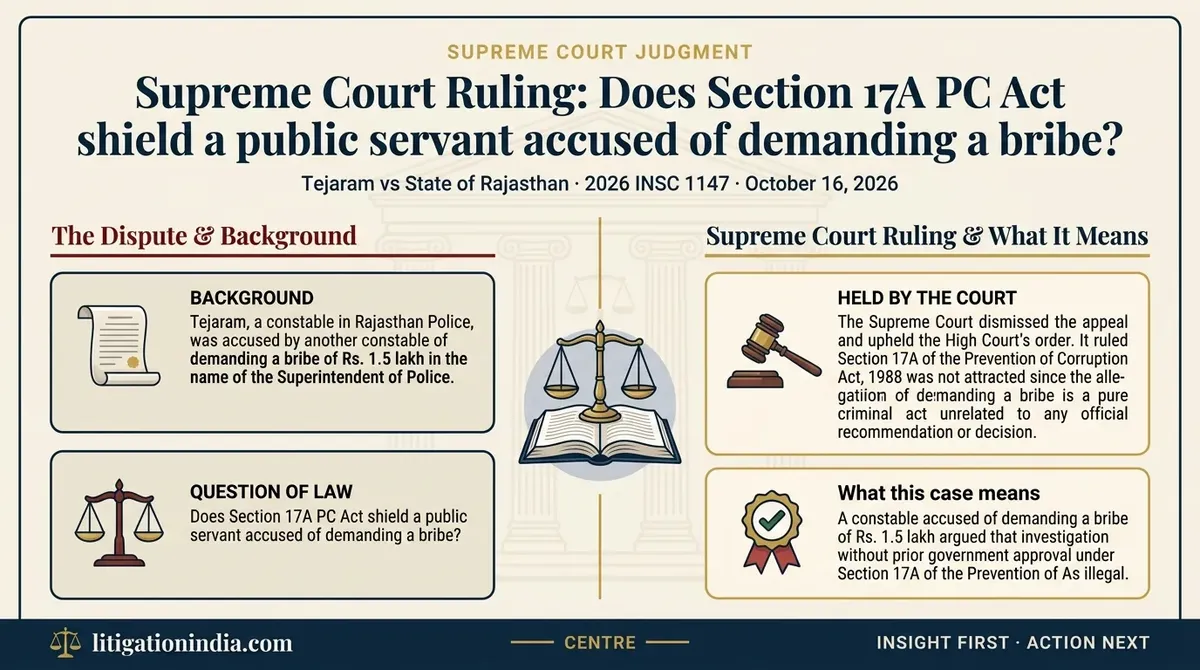
Section 17A PC Act Not Applicable to Bribery Demand by Public Servant — infographic summary

What this case means

A constable accused of demanding a bribe of Rs. 1.5 lakh argued that investigation without prior government approval under Section 17A of the Prevention of Corruption Act was illegal. The Supreme Court dismissed the appeal, ruling that Section 17A applies only where the alleged offence relates to a recommendation or decision taken in official duties, not to a pure criminal act like bribery demand.

What the Supreme Court held

The Supreme Court dismissed the appeal and upheld the High Court's order. It ruled that Section 17A of the Prevention of Corruption Act, 1988 was not attracted since the allegation of demanding a bribe is a pure criminal act unrelated to any official recommendation or decision. The Court further held that any delay in obtaining Section 19 sanction before cognizance amounted to a mere irregularity and did not vitiate the criminal proceedings.

Case: Tejaram vs State of Rajasthan (2026) Citation: 2026 INSC 1147

Want the full legal reasoning, citations and case documents?

Read the full judgment analysis
Tejaram
State of Rajasthan
Section 17A
Prevention of Corruption Act 1988
prior approval
public servant
illegal gratification
bribery
Section 7 PC Act
anti-corruption
2026 INSC 1147
charge framing
Section 7, Section 7A, Section 17A, Section 19, Prevention of Corruption Act, 1988
Section 120B, Section 384, Section 201, Indian Penal Code, 1860

More in Criminal Law / Anti-Corruption / Prevention of Corruption Act