
All insights

Can a public servant be convicted for bribery on tainted-money recovery alone?

Supreme Court Acquits Public Servant as Bribe Demand Not Proved Beyond Reasonable Doubt

A government office assistant was convicted for demanding a bribe to release a peon's salary. The Supreme Court acquitted him because the prosecution failed to prove the demand and acceptance of illeg

Litigation India Editorial 5 October 2026 1 min read 2026 INSC 1084

Story

Case at a glance1 / 5

Supreme Court of India

Bribe Conviction Overturned: Demand Must Be Proved

Ajit Kumar vs State of Jharkhand | 2026 INSC 1084

Court: Supreme Court of India | Date: 05 October 2026Bench: Justice Ujjal Bhuyan and Justice Atul S. ChandurkarArea of law: Criminal Law / Prevention of Corruption Act, 1988Appellant convicted under Sections 7 and 13(2) PC Act; sentenced to 4 years RI and fine of Rs. 10,000
Supreme Court Acquits Public Servant as Bribe Demand Not Proved Beyond Reasonable Doubt · 2026 INSC 10842026-10-05T11:38:56.944468+00:00
The legal question2 / 5

Is Tainted-Money Recovery Alone Enough to Convict for Bribery?

Core legal question decided by the Supreme Court

  • Appellant: No witness saw the demand or handing over of bribe; transaction happened in accused's private residence away from trap team.
  • Appellant: Recovery of tainted money alone cannot prove demand; uncorroborated testimony of complainant is insufficient.
  • Respondent: Trial court correctly appreciated evidence; mere discrepancies do not dislodge conviction affirmed by the High Court.
  • Respondent: Appellant has served his sentence; appeal has become an academic exercise.
Supreme Court Acquits Public Servant as Bribe Demand Not Proved Beyond Reasonable Doubt · 2026 INSC 10842026-10-05T11:38:56.944468+00:00
The Court's reasoning3 / 5

How the Court Reached Acquittal: Step by Step

Reasoning steps from evidence analysis to final order

  1. 1Step 1: No trap team member witnessed the demand or payment of bribe; transaction occurred in accused's residence without any observer.
  2. 2Step 2: Independent witnesses PW-8 and PW-9 admitted signing documents on police direction without personal knowledge.
  3. 3Step 3: Sole evidence of demand was uncorroborated testimony of complainant PW-1 — insufficient in law.
  4. 4Step 4: Settled law (Satyanarayana Murthy, Neeraj Dutta, Aman Bhatia) requires proof of demand as sine qua non; mere tainted recovery is not enough.
  5. 5Step 5: Charges under Sections 7 and 13 PC Act not proved; both lower court and High Court orders set aside; appellant acquitted.
Supreme Court Acquits Public Servant as Bribe Demand Not Proved Beyond Reasonable Doubt · 2026 INSC 10842026-10-05T11:38:56.944468+00:00
The verdict4 / 5

The Court's Final Decision

Acquittal under Sections 7 and 13 of the PC Act

  • The Fact: Bribe money recovered from accused's residence after trap operation; no one witnessed demand or payment.
  • The Law: Proof of demand of illegal gratification is sine qua non; mere tainted-money recovery cannot sustain conviction under Sections 7 and 13 PC Act.
  • The Result: Special Judge's conviction order and High Court's affirmation both set aside; Ajit Kumar acquitted and cleared of charges.
Charge under Sections 7 and 13 PC Act could not be proved. Ajit Kumar is cleared of the said charges. Appeal allowed.
Supreme Court Acquits Public Servant as Bribe Demand Not Proved Beyond Reasonable Doubt · 2026 INSC 10842026-10-05T11:38:56.944468+00:00
Why it matters5 / 5

What This Means for Ordinary People

Practical significance of the judgment

  • A public servant cannot be jailed for bribery based only on tainted-money recovery; the demand must also be independently proved.
  • Bribery complaints should be structured so that the trap team can witness or corroborate both the demand and the payment.
  • Persons who serve their sentence still have the right to appeal for acquittal to protect their reputation.
  • Independent witnesses must genuinely observe events — signing papers on police direction without knowledge has no evidentiary value.
Proof of demand is the sine qua non for bribery conviction; tainted money alone is never enough.
Supreme Court Acquits Public Servant as Bribe Demand Not Proved Beyond Reasonable Doubt · 2026 INSC 10842026-10-05T11:38:56.944468+00:00
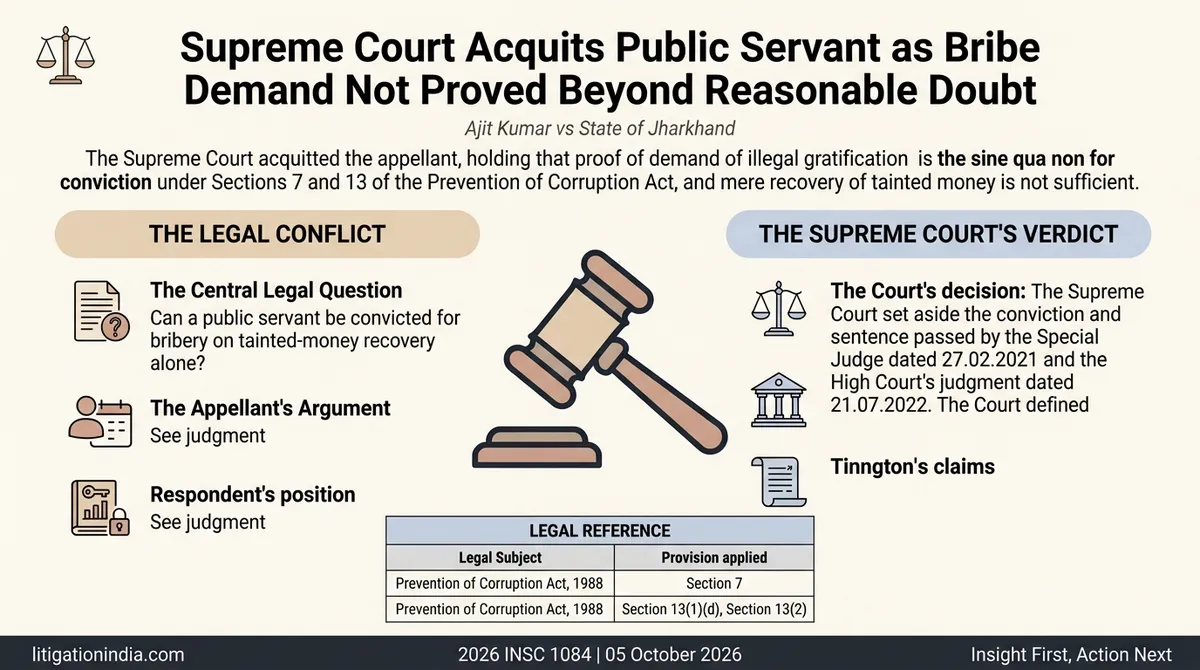
Supreme Court Acquits Public Servant as Bribe Demand Not Proved Beyond Reasonable Doubt — infographic summary

What this case means

A government office assistant was convicted for demanding a bribe to release a peon's salary. The Supreme Court acquitted him because the prosecution failed to prove the demand and acceptance of illegal gratification beyond reasonable doubt, holding that mere recovery of tainted money is insufficient for conviction under the Prevention of Corruption Act.

What the Supreme Court held

The Supreme Court set aside the conviction and sentence passed by the Special Judge dated 27.02.2021 and the High Court's judgment dated 21.07.2022. The Court declared that the charges framed against Ajit Kumar under Sections 7 and 13 of the Prevention of Corruption Act, 1988 could not be proved, and he was accordingly acquitted and cleared of all charges. The appeal was allowed.

Case: Ajit Kumar vs State of Jharkhand (2026) Citation: 2026 INSC 1084

Want the full legal reasoning, citations and case documents?

Read the full judgment analysis
Ajit Kumar
State of Jharkhand
Prevention of Corruption Act 1988
Section 7 PC Act
Section 13 PC Act
demand of illegal gratification
sine qua non
trap operation
bribe recovery
acquittal
tainted money
public servant
Section 7, Prevention of Corruption Act, 1988
Section 13(1)(d), Section 13(2), Prevention of Corruption Act, 1988

More in Criminal Law / Anti-Corruption / Prevention of Corruption Act