All insights

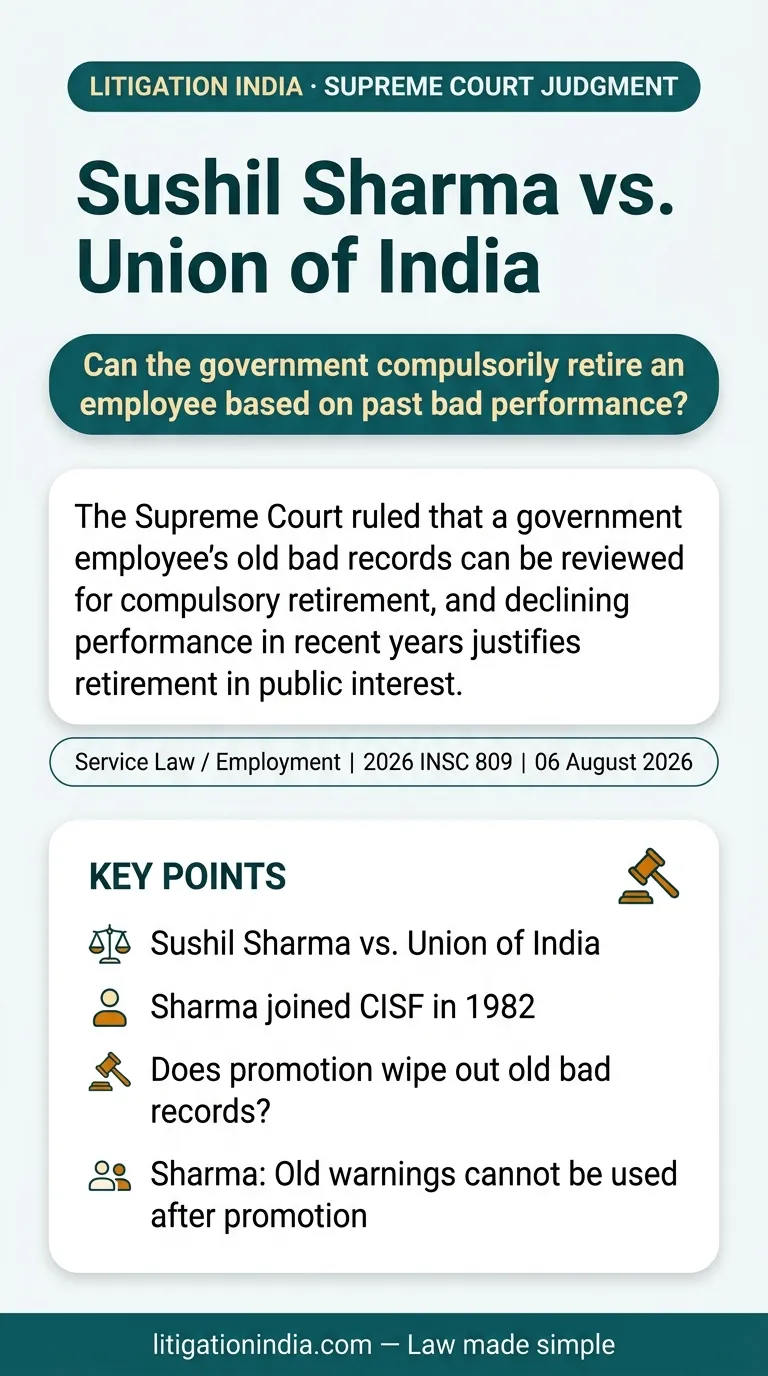
Can the government compulsorily retire an employee based on past bad performance?

Sushil Sharma vs. Union of India

The Supreme Court ruled that a government employee's old bad records can be reviewed for compulsory retirement, and declining performance in recent years justifies retirement in public interest.

Litigation India Editorial 6 August 2026 1 min read 2026 INSC 809

Story

Key points1 / 6

Case at a Glance

  • Sushil Sharma vs. Union of India
  • Decided on 06 August 2026
  • Focuses on compulsory retirement rules
Sushil Sharma vs. Union of India · 2026 INSC 8092026-08-06T20:39:58.808271+00:00
Key points2 / 6

Why the Dispute Arose

  • Sharma joined CISF in 1982
  • Promoted to Inspector in 2003
  • Retired compulsorily in 2010 at age 50
  • His performance declined in recent years
Sushil Sharma vs. Union of India · 2026 INSC 8092026-08-06T20:39:58.808271+00:00
Key points3 / 6

The Big Legal Question

  • Does promotion wipe out old bad records?
  • Can the government retire inefficient employees?
  • How is suitability evaluated?
Sushil Sharma vs. Union of India · 2026 INSC 8092026-08-06T20:39:58.808271+00:00
Key points4 / 6

Arguments of Both Sides

  • Sharma: Old warnings cannot be used after promotion
  • Government: Whole career record is relevant for retirement
  • Government: Security forces need highly efficient officers
Sushil Sharma vs. Union of India · 2026 INSC 8092026-08-06T20:39:58.808271+00:00
Key points5 / 6

What the Court Decided

  • Promotion does not erase history for retirement
  • Entire service history can be reviewed
  • Recent years are given more weight
  • Sharma's retirement was fully legal
Sushil Sharma vs. Union of India · 2026 INSC 8092026-08-06T20:39:58.808271+00:00
Key points6 / 6

Why This Matters for You

  • Compulsory retirement is not a punishment
  • It is done in public interest
  • Good performance must be maintained consistently
  • Uniformed forces have higher discipline standards
Sushil Sharma vs. Union of India · 2026 INSC 8092026-08-06T20:39:58.808271+00:00
Sushil Sharma vs. Union of India — infographic summary

What this case means

The Supreme Court ruled that a government employee's old bad records can be reviewed for compulsory retirement, and declining performance in recent years justifies retirement in public interest.

What the Supreme Court held

The Supreme Court dismissed the appeal and upheld the compulsory retirement order. The Court ruled that looking at the employee's entire career history, including past warnings and recent declining performance, was completely lawful. It concluded that there was no unfairness or illegality in the government's decision to retire him.

Case: Sushil Sharma vs. Union of India (2026) Citation: 2026 INSC 809

Want the full legal reasoning, citations and case documents?

Read the full judgment analysis
Compulsory Retirement
CISF
Service Record
Washed-Off Theory
Service Law / Employment
Supreme Court legal news
Supreme Court judgment today
latest Supreme Court news
More in Service Law / Employment

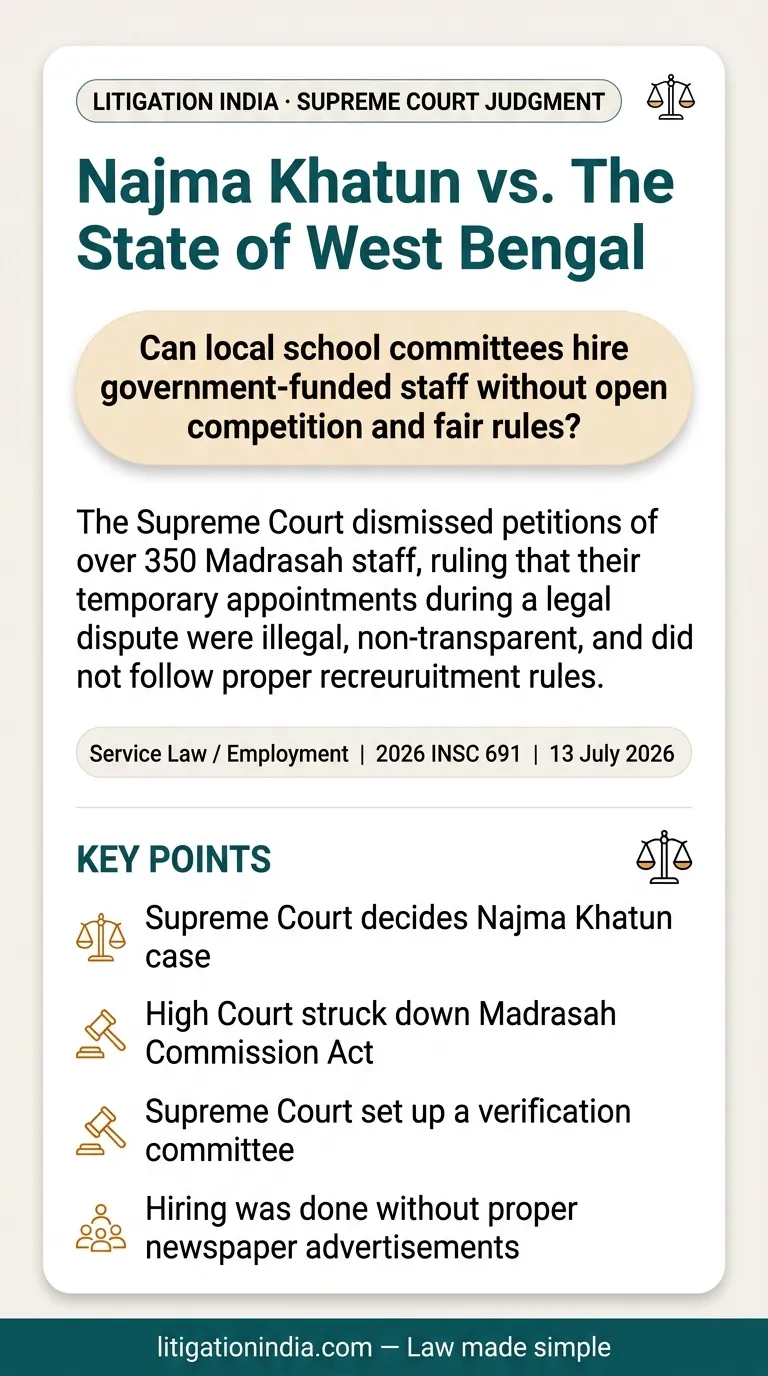
Najma Khatun vs. The State of West Bengal
Service Law / Employment
28 Aug 2026

Najma Khatun vs. The State of West Bengal

The Supreme Court dismissed petitions of over 350 Madrasah staff, ruling that their temporary appointments during a legal dispute were illegal, non-transparent, and did not follow proper recruitment r