All insights

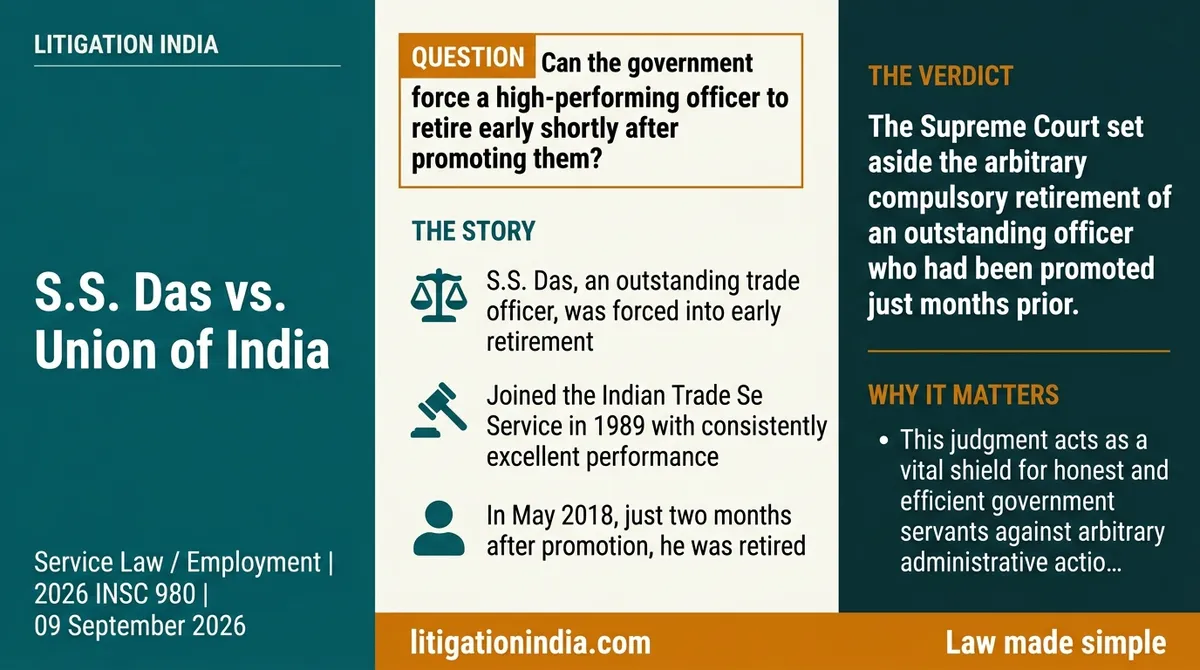
Can the government force a high-performing officer to retire early shortly after promoting them?

Government cannot compulsorily retire an outstanding officer shortly after promoting them

This case was about an outstanding government officer who was suddenly forced to retire early under Rule 56(j). The Supreme Court cancelled the retirement because the officer had just been promoted an

Litigation India Editorial 9 September 2026 1 min read 2026 INSC 980

Story

Key points1 / 7

Case Overview: Das v. India

  • S.S. Das, an outstanding trade officer, was forced into early retirement
  • He was retired under Rule 56(j) just after a major promotion
  • The Supreme Court reviewed if this forced retirement was lawful
Government cannot compulsorily retire an outstanding officer shortly after promoting them · 2026 INSC 9802026-09-09T19:13:10.495459+00:00
Key points2 / 7

A Stellar 30-Year Career

  • Joined the Indian Trade Service in 1989 with consistently excellent performance
  • Graded 'Outstanding' or 'Very Good' in almost all yearly evaluations
  • UPSC and Cabinet promoted him to Joint Secretary in February 2018
Government cannot compulsorily retire an outstanding officer shortly after promoting them · 2026 INSC 9802026-09-09T19:13:10.495459+00:00
Key points3 / 7

Sudden Ouster Post-Promotion

  • In May 2018, just two months after promotion, he was retired
  • Government used Rule 56(j) to retire him early in 'public interest'
  • The action was based on unverified, old complaints of alleged misconduct
Government cannot compulsorily retire an outstanding officer shortly after promoting them · 2026 INSC 9802026-09-09T19:13:10.495459+00:00
Key points4 / 7

What Both Sides Argued

  • Government claimed forced retirement is not a punishment and needs minimal proof
  • Das argued that promoting him and retiring him immediately is contradictory
  • Lower courts sided with the government, limiting their own review powers
Government cannot compulsorily retire an outstanding officer shortly after promoting them · 2026 INSC 9802026-09-09T19:13:10.495459+00:00
Key points5 / 7

The Court's Direct Verdict

  • Promoting an officer and calling them 'dead wood' cannot co-exist
  • A recent merit-based promotion validates an officer's competence and integrity
  • The forced retirement was highly arbitrary and suffered from legal malice
Government cannot compulsorily retire an outstanding officer shortly after promoting them · 2026 INSC 9802026-09-09T19:13:10.495459+00:00
Key points6 / 7

Honorable Exit and Benefits

  • Court ordered payment of all back wages and service benefits
  • Directed the department to hold a formal, honorable farewell ceremony
  • Awarded Rs 6 lakh as costs and Rs 9 lakh for loss of reputation
Government cannot compulsorily retire an outstanding officer shortly after promoting them · 2026 INSC 9802026-09-09T19:13:10.495459+00:00
Key points7 / 7

Protection for Honest Officers

  • Rule 56(j) cannot be used as a shortcut to bypass disciplinary inquiries
  • Government must evaluate the entire record, prioritizing the immediate past
  • Discretionary powers must be exercised with complete fairness and reason
Government cannot compulsorily retire an outstanding officer shortly after promoting them · 2026 INSC 9802026-09-09T19:13:10.495459+00:00
Government cannot compulsorily retire an outstanding officer shortly after promoting them — infographic summary

What this case means

This case was about an outstanding government officer who was suddenly forced to retire early under Rule 56(j). The Supreme Court cancelled the retirement because the officer had just been promoted and had an excellent track record. It shows that governments cannot use forced retirement arbitrarily to target honest, high-performing employees.

What the Supreme Court held

The Supreme Court set aside the compulsory retirement order, declaring it arbitrary, perverse, and malicious. Since the officer had already reached the age of superannuation, the Court directed the government to pay him all back wages and service benefits, hold an honorable farewell ceremony, and pay Rs 15 lakh as litigation costs and compensation.

Case: S.S. Das vs. Union of India (2026) Citation: 2026 INSC 980

Want the full legal reasoning, citations and case documents?

Read the full judgment analysis
fr 56 j
compulsory retirement
service rules
premature retirement of central government employee
can i be forced to retire after promotion
challenging premature retirement
rule 56 j guidelines
reputation of government servant
is forced retirement a punishment
Rule 56(j), Fundamental Rules
Article 311, Constitution of India, 1950
Article 226, Constitution of India, 1950
Service Law / Employment
Supreme Court legal news

More in Service Law / Employment

Najma Khatun vs. The State of West Bengal
Service Law / Employment
28 Aug 2026

Najma Khatun vs. The State of West Bengal

The Supreme Court dismissed petitions of over 350 Madrasah staff, ruling that their temporary appointments during a legal dispute were illegal, non-transparent, and did not follow proper recruitment r