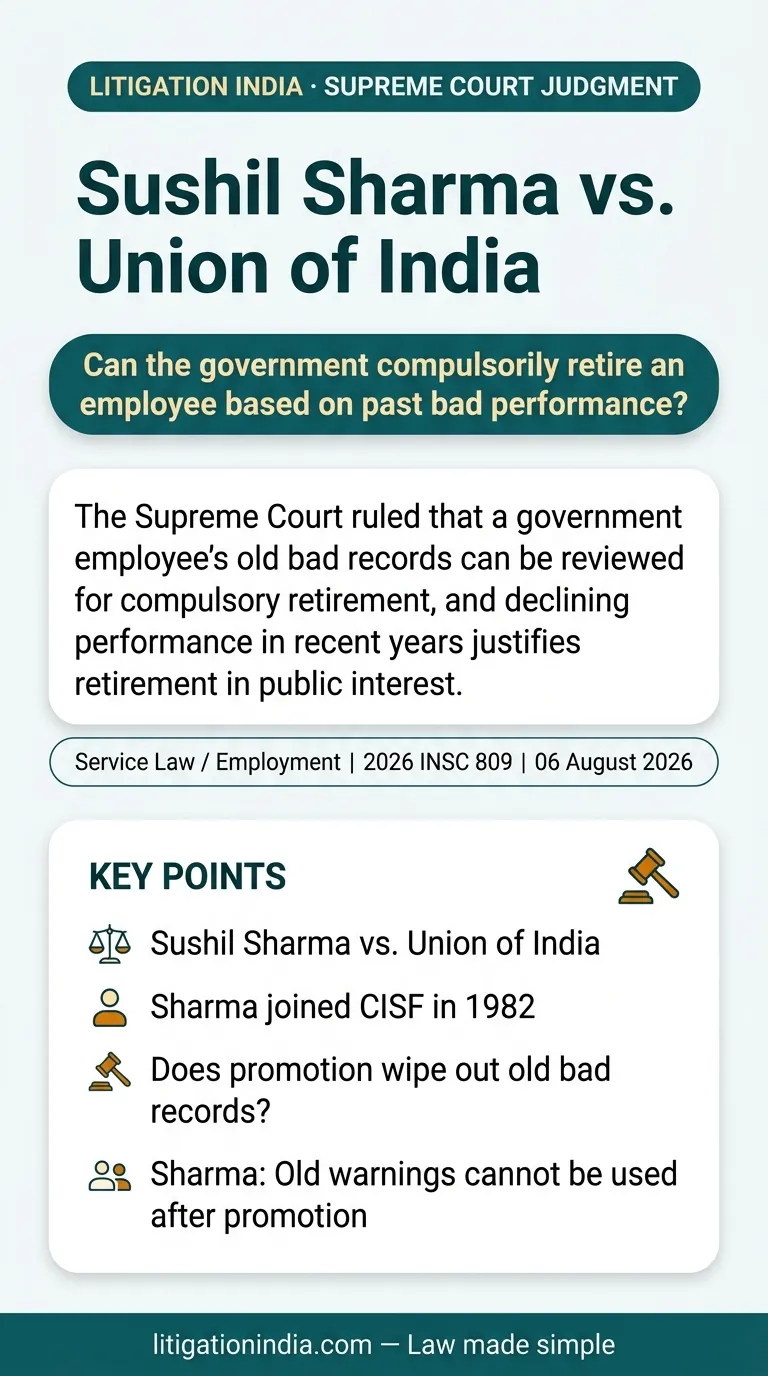
Sushil Sharma vs. Union of India
The big legal question
Can the government compulsorily retire an employee based on past bad performance?
“The Supreme Court ruled that a government employee's old bad records can be reviewed for compulsory retirement, and declining performance in recent years justifies retirement in public interest.”
Story Slides
In short
The Supreme Court of India dismissed an appeal filed by Sushil Sharma, a former Inspector in the Central Industrial Security Force (CISF), who was compulsorily retired from service at the age of 50. The Court clarified that the 'washed-off theory'—which suggests that older negative remarks are wiped clean after an employee receives a promotion—does not apply when deciding whether to compulsorily retire someone. While this theory holds true for future promotions, a committee evaluating an employee for compulsory retirement is fully entitled to look at their entire service record, including bad records from before their promotion. However, the Court noted that the immediate past years of service must be given greater weight. In this case, Sharma's performance records showed a clear decline in his last two years, dropping from 'Good' to 'Average'. He also had a history of penalties for giving false reasons for leave, warnings for negligence, and cautions for a lazy attitude. The Court emphasized that compulsory retirement is not a punishment and carries no stigma. It is done in the public interest to remove inefficient workers, especially in a disciplined uniformed force like the CISF, where high standards of vigilance and duty are expected. Therefore, the order retiring him was completely legal and justified.
Background
Sushil Sharma joined the CISF in 1982 and was promoted to Inspector in 2003. When he turned 50, a review committee assessed his service record and ordered his compulsory retirement in 2010 due to poor performance. Sharma challenged this retirement, but the Delhi High Court dismissed his petition, leading him to appeal to the Supreme Court.
The Decision
The Supreme Court dismissed the appeal and upheld the compulsory retirement order. The Court ruled that looking at the employee's entire career history, including past warnings and recent declining performance, was completely lawful. It concluded that there was no unfairness or illegality in the government's decision to retire him.
Why it matters for you
This judgment reminds government employees that getting a promotion does not permanently erase past bad conduct or warnings. If an employee's performance declines in later years, the department can still use their whole service history to retire them early in the public interest. It highlights that maintaining high efficiency is crucial, especially in security and police forces.
AI-assisted summary, reviewed and verified by our editorial team.
Need help with your case?
Facing a similar legal challenge in the Supreme Court or High Court? Connect with our pro bono volunteer advocates today.
Related Supreme Court services