
All insights

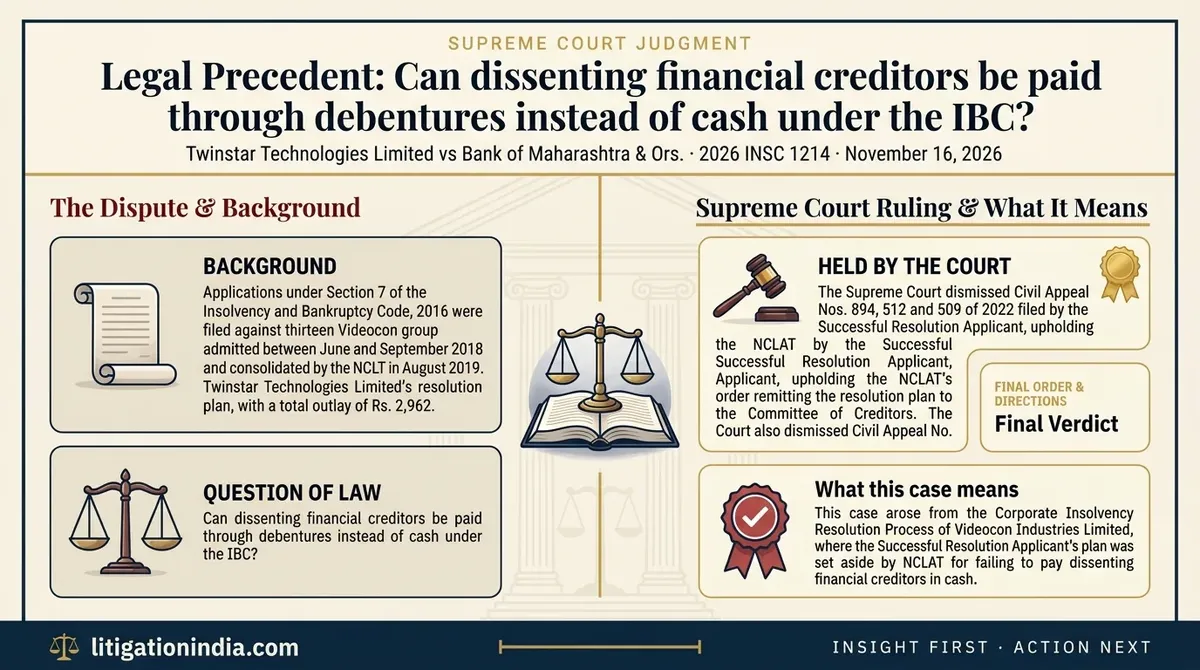
Can dissenting financial creditors be paid through debentures instead of cash under the IBC?

Supreme Court Upholds NCLAT Remand of Videocon Resolution Plan to Committee of Creditors

This case arose from the Corporate Insolvency Resolution Process of Videocon Industries Limited, where the Successful Resolution Applicant's plan was set aside by NCLAT for failing to pay dissenting f

Litigation India Editorial 16 November 2026 1 min read 2026 INSC 1214

Story

The Court's reasoning1 / 7

Videocon CIRP: Resolution Plan Sent Back for Cash Payment to Dissenters

Twinstar Technologies Ltd. v. Bank of Maharashtra & Ors. | 2026 INSC 1214

  1. 1Court: Supreme Court of India | Date: November 16, 2026
  2. 2Bench: Justice P.S. Narasimha and Justice Alok Aradhe
  3. 3Area: Insolvency and Bankruptcy Law — Corporate Insolvency Resolution Process
  4. 4All appeals by Successful Resolution Applicant and promoter dismissed
Rs. 2,962 crore plan against Rs. 64,838 crore admitted claims — plan found non-compliant and remitted to Committee of Creditors.
Supreme Court Upholds NCLAT Remand of Videocon Resolution Plan to Committee of Creditors · 2026 INSC 12142026-11-16T12:48:05.137492+00:00
The legal question2 / 7

Can NCDs Replace Cash Payment to Dissenting Financial Creditors Under IBC?

Core dispute in Group I appeals

  • Appellant (SRA): Plan's Clause 3.5.7 expressly committed to comply with Section 30(2)(b); NCDs with coupon of 6.65% represent equivalent value.
  • Appellant (SRA): NCLT's cash direction was itself an impermissible modification; CoC became functus officio on approval of plan.
  • Respondent (Bank of Maharashtra): Section 30(2)(b) requires payment in money only, as held in Jaypee Kensington; NCDs defer discharge to six years.
  • Respondent (CoC): Plan failed mandatory statutory safeguards; CoC retained power to reconsider in public interest after NCLAT's stay order.
Jaypee Kensington held: 'payment' under Section 30(2)(b) means money only — not debentures or equity instruments.
Supreme Court Upholds NCLAT Remand of Videocon Resolution Plan to Committee of Creditors · 2026 INSC 12142026-11-16T12:48:05.137492+00:00
Statutory comparison3 / 7

Statutory Framework: What Plan Must Provide vs. What Plan Provided

Section 30(2)(b) IBC and Regulation 38(1)(b) CIRP Regulations

RequirementWhat the Law RequiresWhat the Plan Provided
Payment to dissenting financial creditorsNot less than liquidation value, in money (Section 30(2)(b) IBC)NCDs of face value Rs. 2,700 crore, redeemable in instalments over six years
Priority of paymentDissenting creditors paid in priority over assenting creditors (Regulation 38(1)(b) CIRP Regulations)No specific provision carving out priority cash payment for dissenters
Compliance mechanismSpecific provision in the plan itselfGeneral undertaking in Clause 3.5.7 to comply with Section 30(2)(b)
NCLT's correction powerMust remit to CoC if plan defective (Sections 31(1) and 31(2) IBC)NCLT directed upfront cash payment — held to be impermissible modification
A general undertaking to comply with law cannot substitute for a specific provision showing how, when and in what form dissenters will be paid.
Supreme Court Upholds NCLAT Remand of Videocon Resolution Plan to Committee of Creditors · 2026 INSC 12142026-11-16T12:48:05.137492+00:00
The Court's reasoning4 / 7

NCLAT's Remand Power: When and How It Must Be Used

Court's guardrails for remanding approved resolution plans

  1. 1Step 1: NCLAT finds legal non-compliance under Section 61(3) — contravention of Section 30(2) or other law.
  2. 2Step 2: Neither NCLAT nor NCLT can modify the plan — commercial wisdom belongs exclusively to the CoC.
  3. 3Step 3: Remand to CoC is the only lawful course; avoids liquidation, which the Code treats as a last resort.
  4. 4Step 4: Remand must be exercised sparingly and only where it advances the Code's objectives of going concern, fair recovery, and asset maximisation.
  5. 5Step 5: Any remand order must carry strict time-bound directions to prevent delay defeating the Code's purpose.
Remand is the connecting link: appellate authority checks legality; CoC retains exclusive domain over commerciality.
Supreme Court Upholds NCLAT Remand of Videocon Resolution Plan to Committee of Creditors · 2026 INSC 12142026-11-16T12:48:05.137492+00:00
Key points5 / 7

Foreign Oil and Gas Assets: Why They Cannot Enter VIL's CIRP Estate

Part B — Group II analysis under Section 18, Explanation (b) and Section 36(4)(d), IBC

  • Explanation (b) to Section 18 IBC expressly excludes assets of any Indian or foreign subsidiary from the CIRP estate — no exception for beneficial ownership arrangements.
  • A holding company and its subsidiary are distinct legal persons; the holding company does not own assets of the subsidiary (Vodafone International Holdings B.V. v. Union of India, (2012) 6 SCC 613).
  • Lifting the corporate veil prevents fraud or evasion of a statute; here the statute itself excludes subsidiary assets, leaving no room for a substance-over-form override.
  • The promoter was estopped: he himself requested VIL's release as co-obligor, kept offshore assets out of his Section 12A proposal, and allowed related applications to be dismissed for non-prosecution.
Statutory exclusion in Section 18 Explanation (b) admits of no qualification — it cannot be overridden by beneficial ownership agreements or group treatment arguments.
Supreme Court Upholds NCLAT Remand of Videocon Resolution Plan to Committee of Creditors · 2026 INSC 12142026-11-16T12:48:05.137492+00:00
The verdict6 / 7

The Court's Final Verdict

Part A and Part B — all appeals dismissed

  • The Fact: Videocon's resolution plan paid dissenting financial creditors through NCDs redeemable over six years, not in cash, violating Section 30(2)(b) IBC and Regulation 38(1)(b) CIRP Regulations.
  • The Law: NCLAT has implied power to remit a non-compliant plan to CoC; CoC is not functus officio and may reconsider; foreign subsidiary assets are excluded from parent's CIRP estate by Section 18 Explanation (b) IBC.
  • The Result: All appeals by Twinstar (SRA) and by the promoter dismissed; NCLAT's remand to CoC upheld; CIRP of VOVL and BPRL's concluded transaction not interfered with.
Civil Appeal Nos. 894, 512, 509, 1307 of 2022 and related 2026 appeals dismissed; no order as to costs.
Supreme Court Upholds NCLAT Remand of Videocon Resolution Plan to Committee of Creditors · 2026 INSC 12142026-11-16T12:48:05.137492+00:00
Why it matters7 / 7

What This Judgment Means for Creditors and Businesses

Practical significance of the ruling

  • If you dissent from a resolution plan in insolvency proceedings, you must receive actual cash — not deferred bonds or shares — protecting minority creditors' exit rights.
  • Courts and tribunals cannot rewrite commercial terms of an insolvency resolution plan; only the Committee of Creditors, by the required voting share, can do so.
  • Subsidiaries' assets belong to the subsidiary, not the parent — lenders and investors can rely on corporate separateness even in group insolvencies.
  • NCLAT's power to send a plan back to creditors is confirmed but must be used sparingly, with time-bound directions to prevent endless delays.
Dissenting creditors in insolvency must receive cash, not deferred instruments — Section 30(2)(b) IBC guarantees a clean exit in money.
Supreme Court Upholds NCLAT Remand of Videocon Resolution Plan to Committee of Creditors · 2026 INSC 12142026-11-16T12:48:05.137492+00:00
Supreme Court Upholds NCLAT Remand of Videocon Resolution Plan to Committee of Creditors — infographic summary

What this case means

This case arose from the Corporate Insolvency Resolution Process of Videocon Industries Limited, where the Successful Resolution Applicant's plan was set aside by NCLAT for failing to pay dissenting financial creditors in cash. The Supreme Court confirmed that the resolution plan violated Section 30(2)(b) of the Insolvency and Bankruptcy Code and that NCLAT rightly remitted the matter to the Committee of Creditors. The Court also held that foreign oil and gas assets held by Videocon's subsidiaries could not be included in Videocon's own insolvency estate.

What the Supreme Court held

The Supreme Court dismissed Civil Appeal Nos. 894, 512 and 509 of 2022 filed by the Successful Resolution Applicant, upholding the NCLAT's order remitting the resolution plan to the Committee of Creditors. The Court also dismissed Civil Appeal No. 1307 of 2022 and the remaining appeals concerning foreign oil and gas assets filed by the promoter and VIL Vendors Association. The VIL Vendors Association was granted liberty to pursue such remedies as may be available under law, and pending interlocutory applications were disposed of.

Case: Twinstar Technologies Limited vs Bank of Maharashtra & Ors. (2026) Citation: 2026 INSC 1214

Want the full legal reasoning, citations and case documents?

Read the full judgment analysis
Twinstar Technologies
Videocon Industries
CIRP
Insolvency and Bankruptcy Code 2016
Committee of Creditors
dissenting financial creditors
resolution plan
Section 30(2)(b)
foreign oil and gas assets
NCLAT remand
functus officio
non-convertible debentures
Section 30(2)(b), Insolvency and Bankruptcy Code, 2016
Section 30(4), Insolvency and Bankruptcy Code, 2016

More in Insolvency and Bankruptcy Law / Corporate Insolvency Resolution Process