
All insights

What evidence is needed to prove debt default for insolvency admission under IBC?

Supreme Court Upholds CIRP Admission Against Hotel Companies on Debt Default

Two hotel companies challenged insolvency proceedings initiated by an asset reconstruction company, arguing no default had occurred. The Supreme Court dismissed both appeals, holding that the evidenti

Litigation India Editorial 15 October 2026 1 min read 2026 INSC 1134

Story

Case at a glance1 / 7

Supreme Court of India

Default Proof Standard Under IBC Section 7 Decided

Deepak Raheja & Anr. v. Omkara Assets Reconstruction Pvt. Ltd. & Anr. — 2026 INSC 1134

Court: Supreme Court of India; Date: 15 October 2026Bench: Justice Dipankar Datta and Justice Augustine George MasihArea of law: Insolvency and Bankruptcy Law — CIRP admission under Section 7 IBCTwo hotel companies challenged CIRP initiated by an asset reconstruction company on debt default
Supreme Court Upholds CIRP Admission Against Hotel Companies on Debt Default · 2026 INSC 11342026-10-15T12:35:04.813277+00:00
The legal question2 / 7

What Must a Financial Creditor Prove to Trigger CIRP?

Two questions of law framed and answered by the Supreme Court

  • Appellant: CMA and DSRA would cure any default; ECLGS not due on 15.11.2022; companies are profitable with positive EBITDA.
  • Appellant: Remand order findings attained finality as res judicata; assignment was invalid.
  • Respondent: Default is admitted in substance; quantum disputes do not negate occurrence of default.
  • Respondent: Assignment upheld by Karnataka High Court and Supreme Court; issue estoppel bars re-litigation.
Supreme Court Upholds CIRP Admission Against Hotel Companies on Debt Default · 2026 INSC 11342026-10-15T12:35:04.813277+00:00
Statutory comparison3 / 7

Hierarchy of Evidence for Default Under Section 7 IBC

Two tiers established by the Supreme Court

ProvisionWhat it saysHow the Court applied it
Section 7(3)(a) and 7(4) IBC — First Tier: Information Utility RecordRecord of default with IU is primary basis; self-sufficient for ascertainment of defaultFour Form-D filings with NeSL went unchallenged; deemed authenticated; carried presumption of high evidentiary value
Part V of Form 1, IBC (Application to Adjudicating Authority) Rules, 2016 — Second TierOther documents including loan agreements, account statements, acknowledgements, correspondenceStatement of Accounts, BK Ramadhyani review reports, recall notice and Corporate Debtor's own letters collectively established default of Rs.17.16 crores
Section 3(12) IBC — Definition of DefaultNon-payment of any part or instalment of debt when dueCourt held default is a static historical event; disputes on quantum do not negate its occurrence
Explanation II to amended Section 7(5) IBC (2026 Amendment)Record of Default from IU is sufficient for Adjudicating Authority to ascertain defaultCourt held this clarified, not created, pre-existing law
An Information Utility Record of Default is self-sufficient at Tier 1; rebuttal requires clear, cogent, credible and compelling material — not bare denial.
Supreme Court Upholds CIRP Admission Against Hotel Companies on Debt Default · 2026 INSC 11342026-10-15T12:35:04.813277+00:00
The Court's reasoning4 / 7

Court's Reasoning: From Question to Dismissal

Step-by-step legal reasoning in the judgment

  1. 1Step 1: Jurisdiction under Section 62 IBC limited to questions of law; concurrent factual findings not to be disturbed unless perverse.
  2. 2Step 2: Assignment's validity litigated to finality before Karnataka HC and Supreme Court; issue estoppel bars re-agitation.
  3. 3Step 3: Default under Section 3(12) is a static historical event — any part unpaid when due suffices; quantum disputes irrelevant to admission.
  4. 4Step 4: Evidence hierarchy — IU record at apex (presumptively sufficient); other documents collectively sufficient at second tier.
  5. 5Step 5: Default of Rs.17.16 crores established from unchallenged accounts, recall notice and Corporate Debtor's own settlement letters; EBITDA irrelevant to debt serviceability.
Supreme Court Upholds CIRP Admission Against Hotel Companies on Debt Default · 2026 INSC 11342026-10-15T12:35:04.813277+00:00
Key points5 / 7

Profitability vs Debt Serviceability: A Key Distinction

The Court expressly rejected EBITDA as a defence to insolvency admission

  • EBITDA (earnings before interest, taxes, depreciation and amortisation) is computed before interest — it says nothing about cash obligations to lenders.
  • The relevant metric is the Debt Service Coverage Ratio; Corporate Debtor's own DSCR was 0.12 for 2022-23 — only 12 per cent of debt obligations covered.
  • A loss-making company may have ample liquidity; a profitable company may be unable to service debt — they are distinct economic concepts.
  • The Code's trigger is 'default' under Section 3(12), not commercial or balance-sheet insolvency; timely intervention, not terminal collapse, is the design.
A Debt Service Coverage Ratio of 0.12 — drawn from the Corporate Debtor's own audited financials — demolished the solvency argument.
Supreme Court Upholds CIRP Admission Against Hotel Companies on Debt Default · 2026 INSC 11342026-10-15T12:35:04.813277+00:00
The verdict6 / 7

The Verdict: Both Appeals Dismissed

CIRP to proceed in respect of both hotel companies

  • The Fact: Default of Rs.17.16 crores (Corporate Debtor) and minimum Rs.2.64 crores (Neo) as on 15 November 2022 established from unchallenged accounts and Corporate Debtor's own letters.
  • The Law: Section 7 requires only prima facie satisfaction of default on preponderance of probabilities; Information Utility record is self-sufficient at first tier; profitability is no defence.
  • The Result: NCLT Mumbai order dated 08 July 2025 and NCLAT order dated 19 August 2025 affirmed; CIRP directed to proceed in accordance with law.
The Corporate Insolvency Resolution Process in respect of both Corporate Debtors shall proceed in accordance with law.
Supreme Court Upholds CIRP Admission Against Hotel Companies on Debt Default · 2026 INSC 11342026-10-15T12:35:04.813277+00:00
Why it matters7 / 7

What This Means for Lenders and Borrowers

Practical significance of the ruling

  • Lenders: An Information Utility Record of Default is sufficient to trigger CIRP — no full account reconciliation needed at admission stage.
  • Borrowers: Challenging an IU record requires clear, cogent, credible and compelling evidence — bare denial or accounting disputes will not suffice.
  • Profitable businesses running hotels or other operations are not immune to CIRP if debt repayments are overdue; EBITDA is not the relevant metric.
  • Courts warn: filing AI-generated or fabricated judgments before the Supreme Court is a serious misconduct attracting exemplary costs.
Default, not profitability, is the trigger for insolvency under IBC — timely intervention preserves enterprise value.
Supreme Court Upholds CIRP Admission Against Hotel Companies on Debt Default · 2026 INSC 11342026-10-15T12:35:04.813277+00:00
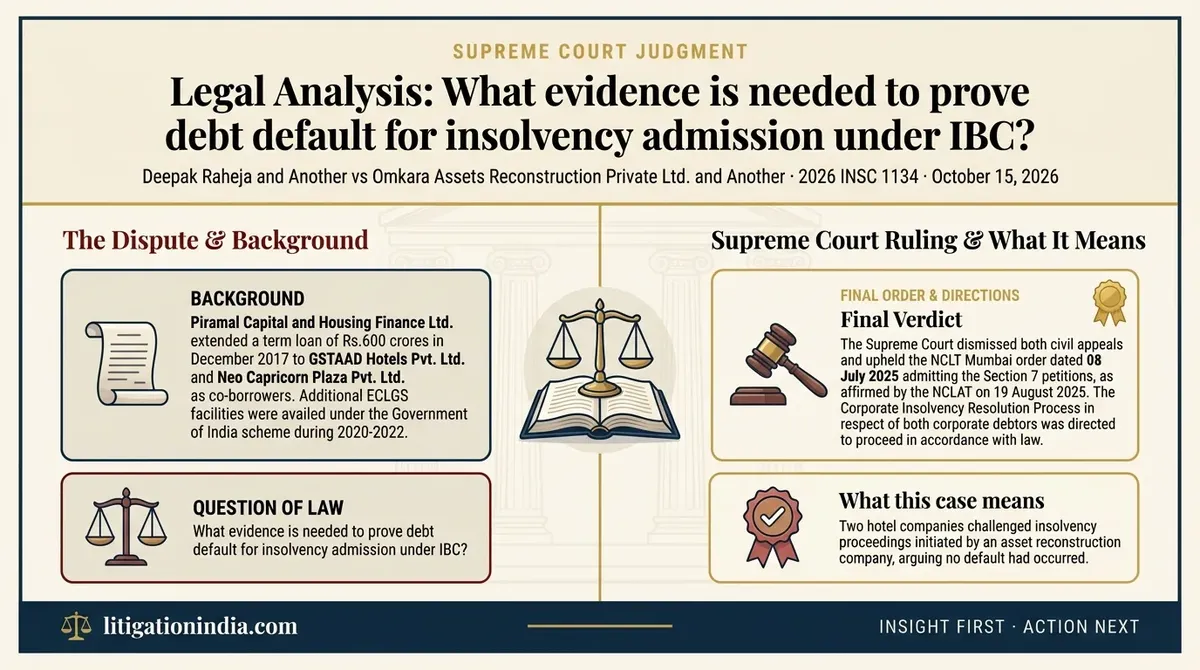
Supreme Court Upholds CIRP Admission Against Hotel Companies on Debt Default — infographic summary

What this case means

Two hotel companies challenged insolvency proceedings initiated by an asset reconstruction company, arguing no default had occurred. The Supreme Court dismissed both appeals, holding that the evidentiary standard for proving default under Section 7 of the IBC is a summary prima facie threshold, not a full reconciliation of accounts. The ruling clarifies the hierarchy of documentary evidence and the legal weight of Information Utility records in insolvency proceedings.

What the Supreme Court held

The Supreme Court dismissed both civil appeals and upheld the NCLT Mumbai order dated 08 July 2025 admitting the Section 7 petitions, as affirmed by the NCLAT on 19 August 2025. The Corporate Insolvency Resolution Process in respect of both corporate debtors was directed to proceed in accordance with law. No order as to costs was made in view of the death of the first appellant.

Case: Deepak Raheja and Another vs Omkara Assets Reconstruction Private Ltd. and Another (2026) Citation: 2026 INSC 1134

Want the full legal reasoning, citations and case documents?

Read the full judgment analysis
Deepak Raheja
Omkara Assets Reconstruction
Insolvency and Bankruptcy Code 2016
Section 7 IBC
default
CIRP admission
Information Utility
financial creditor
GSTAAD Hotels
Neo Capricorn Plaza
Sections 3(12), 4, 5(7), 7, 7(3)(a), 7(4), 7(5), 14, 18, 21, 62, 215, Insolvency and Bankruptcy Code, 2016
Section 7(5) as amended, Explanation I and Explanation II, Insolvency and Bankruptcy Code (Amendment) Act, 2026
Sections 31 and 115, Indian Evidence Act, 1872
Sections 25 and 121, Bharatiya Sakshya Adhiniyam, 2023

More in Insolvency and Bankruptcy Law / Corporate Insolvency Resolution Process