
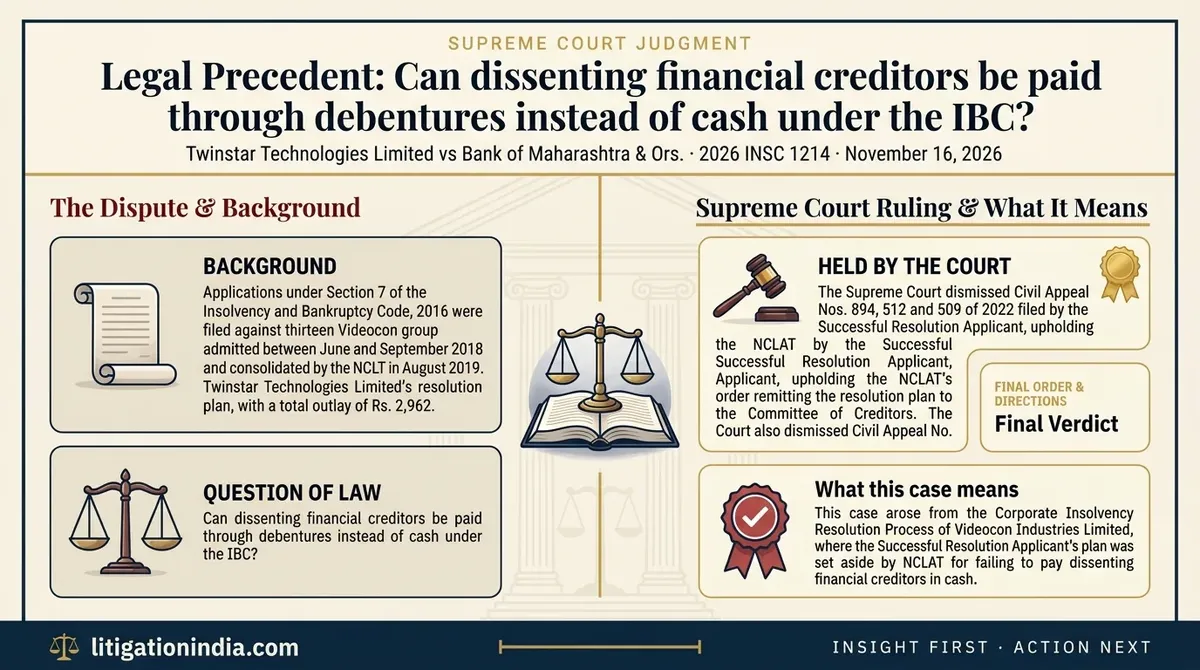
Full text of the judgment
Text extracted from Twinstar Technologies Limited vs Bank of Maharashtra & Ors.. For the authoritative version refer to the Supreme Court of India's official website.
2026 INSC 1214 1
IN THE SUPREME COURT OF INDIA CIVIL APPELLATE JURISDICTION CIVIL APPEAL NO. 894 OF 2022
TWINSTAR TECHNOLOGIES LIMITED …APPELLANT
BANK OF MAHARASHTRA & ORS. …RESPONDENTS
WITH CIVIL APPEAL NO. 512 OF 2022
CIVIL APPEAL NO. 509 OF 2022
CIVIL APPEAL NO. 1307 OF 2022
CIVIL APPEAL NOS. 8659–8661 OF 2026
CIVIL APPEAL NO. OF 2026 (@ DIARY NO. 41234 OF 2026)
CIVIL APPEAL NO. OF 2026 (@ DIARY NO. 41286 OF 2026)
CIVIL APPEAL NOS. 8718–8719 OF 2026
ALOK ARADHE, J. 1. This batch of appeals under Section 62 of the Insolvency and Bankruptcy Code, 2016 (‘the Code’) arises out of the Corporate Insolvency Resolution Process (‘CIRP’) of Videocon Industries Limited Digitally signed by KAPIL TANDON Date: 2026.11.16 17:10:11 IST Reason: Signature Not Verified
(‘VIL’) and twelve other companies of the Videocon group, as well as of VOVL Limited (‘VOVL’), a wholly owned subsidiary of VIL. 2. The appeals arise out of two separate judgments of the National Company Law Appellate Tribunal, Principal Bench, New Delhi (‘NCLAT’), and having regard to the issues involved, can be categorised into following two groups: (I) GROUP I – This group comprises three Civil Appeals, namely, Civil Appeal Nos. 894, 512 and 509 of 2022, which have been filed by Twinstar Technologies Limited, the Successful Resolution Applicant (‘SRA’). The aforesaid appeals emanate from the judgment dated 05.01.2022 passed in Company Appeal (AT) (Insolvency) Nos. 503, 505 and 529 of 2021 filed by three dissenting financial creditors, namely, Bank of Maharashtra, IFCI Ltd., and Small Industries Development Bank of India (‘SIDBI’) respectively. By the impugned judgment, the NCLAT set aside the approval of the resolution plan of the SRA in the consolidated CIRP of VIL and twelve group companies and remitted the matter to the Committee of Creditors (‘CoC’). (II) GROUP II – This group comprises the appeals concerning the foreign oil and gas assets of the Videocon group. Civil Appeal No. 1307 of 2022, Civil
Appeal Nos. 8659-8661 of 2026, 8718-8719 of 2026 and Civil Appeal @ Diary No.41234 of 2026 have been filed by Mr. Venugopal Dhoot, the erstwhile promoter of VIL (‘the Promoter’). Civil Appeal @ Diary No.41286 of 2026 has been filed by VIL Vendors Association. Civil Appeal No. 1307 of 2022 arises out of the judgment dated 05.01.2022, insofar as the NCLAT dismissed Company Appeal (AT) (Insolvency) No. 650 of 2021 filed by the Promoter, whereas the remaining appeals arise out of judgment dated 14.05.2026 in Company Appeal (AT) (Insolvency) Nos. 299, 467, 639 and 640 of 2020 and 1442 and 1623 of 2024, by which the NCLAT set aside the order dated 12.02.2020 of the National Company Law Tribunal, Mumbai Bench (‘NCLT’) directing inclusion of the foreign oil and gas assets of the Videocon group in the CIRP of VIL, and upheld the orders dated 26.06.2024 of the NCLT in the CIRP of VOVL. 2.1 The subject matter of present appeals pertains to the CIRP of VIL and its group companies and the CIRP of VOVL, which are intertwined, as each of them concerns the assets forming part of the CIRP of VIL. Therefore, the batch of appeals was heard analogously and is being decided by this judgment. 2.2 For the facility of reference, this judgment has been divided in Parts A and B which deal with Groups I and II appeals respectively.
PART A – GROUP I: APPEALS OF THE SRA ARISING OUT OF THE JUDGMENT DATED 05.01.2022
3. The appeals in this group raise questions of considerable importance in the working of the Code, namely, (i) the nature and limits of the jurisdiction of the NCLT and the NCLAT while dealing with a resolution plan, (ii) whether a resolution plan which provides for payment to dissenting financial creditors by way of non-convertible debentures satisfies the requirement contained in Section 30(2)(b) of the Code, and (iii) whether the CoC, having once approved a resolution plan under Section 30(4) of the Code, can revisit its decision while the approval is subject to challenge in a statutory appeal? FACTUAL BACKGROUND
4. The facts giving rise to the filing of these appeals, briefly stated, are that, the applications under Section 7 of the Code were filed by the State Bank of India (‘SBI’) and other creditors against thirteen companies of the Videocon group, including VIL. The said applications were admitted by the NCLT by various orders passed between 06.06.2018 and 25.09.2018. The NCLT, Mumbai, on 08.08.2019 directed consolidation of the CIRPs of the thirteen corporate debtors (‘the corporate debtors’). The Resolution Professional (‘RP’) invited expressions of interest on 11.10.2019. On 26.11.2019, the RP issued the Information Memorandum along with request for resolution plans.
The timeline for submission of resolution plans was extended on several occasions. 5. The RP received eleven resolution plans, which were opened in the 15th meeting of the CoC held on 02.09.2020. At that meeting, the CoC was informed that the fair value and the liquidation value of the corporate debtors, being the average of the estimates provided by two registered valuers, were Rs. 4,069.95 crores and Rs. 2,568.13 crores respectively. Two of the resolution plans, namely those submitted by the SRA and V Shape Investment Management Limited, were found to be compliant and were placed before the CoC. A proposal for withdrawal of the CIRP under Section 12A of the Code was also submitted by the Promoter on 31.08.2020. The said proposal was placed before the CoC for its consideration. 6. On 07.11.2020, the SRA submitted an amended and restated resolution plan with a total financial outlay of Rs. 2,962.02 crores. The resolution plan provided, inter alia, for (i) an upfront payment of Rs. 200 crores to the financial creditors; (ii) an upfront payment of Rs. 52 crores towards the admitted dues of workmen and employees; (iii) an upfront payment of Rs. 10 crores to the operational creditors; (iv) issuance of non-convertible debentures (‘NCDs’) of an aggregate face value of Rs. 2,700 crores, carrying an annual coupon of 6.65 per
cent, to the financial creditors, redeemable in five instalments, (v) the first instalment of Rs. 200 crores falling due 25 months after the closing date and the remaining four of Rs. 625 crores each falling due in the third to sixth years; (vi) 8 per cent equity in VIL to the financial creditors; and (vii) the cash balances of the corporate debtors to accrue to the financial creditors. Clause 3.5.1 of the resolution plan provided that dissenting financial creditors would not be paid less than the amount payable under Section 53 of the Code and would be paid in priority as per Regulation 38(1) of the Insolvency and Bankruptcy Board of India (Insolvency Resolution Process for Corporate Persons) Regulations, 2016 (‘CIRP Regulations’). Clause 3.5.7 of the resolution plan provided that “in all circumstances and in any event” payment to dissenting financial creditors would be made strictly as per Section 30(2)(b) of the Code and Regulation 38(1)(b) of CIRP Regulations. 7. In the 19th meeting of the CoC held on 11.11.2020, it was resolved that the two compliant plans and the proposal under Section 12A would be put to vote simultaneously. On 13.11.2020, SBI Capital Markets Limited (‘SBI Caps’), the process advisor to the CoC, circulated a distribution calculation according to which the dissenting financial creditors, if any, would receive Rs. 114.21 crores. Upon conclusion of the voting on 11.12.2020, the Plan of the SRA was
approved by 95.09 per cent of the voting share. Four financial creditors holding about 3.077 per cent voting share dissented, namely, Bank of Maharashtra (1.97 per cent), IFCI Limited (1.03 per cent), SIDBI (0.053 per cent) and ABG Shipyard Limited (0.024 per cent). The proposal under Section 12A submitted by the Promoter was rejected by 98.14 per cent of the voting share. On 12.12.2020, the RP issued a Letter of Intent to the SRA, which was accepted by it, and the SRA furnished a performance bank guarantee of Rs. 296.20 crores. 8. On 16.12.2020, the RP filed I.A. No. 196 of 2021 before the NCLT seeking approval of the resolution plan. In Form H appended thereto, the amount payable to the dissenting financial creditors was estimated at Rs. 105.23 crores. During the pendency of the said application, this Court on 24.03.2021 delivered its judgment in Jaypee Kensington Boulevard Apartments Welfare Association v. NBCC (India) Ltd.1, holding that the payment to a dissenting financial creditor contemplated by Section 30(2)(b) of the Code can only be a payment in terms of money. Relying upon the said decision, Bank of Maharashtra filed I.A. No. 982 of 2021 objecting to approval of the resolution plan on the grounds that it provided for payment to dissenting financial creditors in NCDs and that there was a
1 (2022) 1 SCC 401
discrepancy between the amount reflected in Form H and the figure circulated by SBI Caps. A statement was made on behalf of CoC through its counsel before NCLT that the dues of the dissenting financial creditors would be paid upfront in accordance with the judgment in Jaypee Kensington (supra) and Section 30(2) of the Code. ORDER OF THE NCLT
9. By an order dated 08.06.2021, the NCLT held as follows: (i) out of admitted claims of Rs. 64,838.63 crores, the Plan offered Rs. 2,962.02 crores, entailing a haircut of 95.85 per cent, (ii) the operational creditors would receive 0.72 per cent of their admitted claims, and (iii) by paying Rs. 262 crores the SRA would obtain possession of all the thirteen corporate debtors. The NCLT, having deference to the commercial wisdom of the CoC, approved the plan under Section 31(1) of the Code. The NCLT, however, requested the CoC and the SRA to increase the payout to operational creditors, particularly MSMEs. The NCLT directed that the dissenting financial creditors be paid their liquidation value in cash, upfront, before any payment is made to the assenting financial creditors. 10. The order of approval was challenged before the NCLAT by Bank of Maharashtra, IFCI Limited and SIDBI by way of appeals, namely,
Company Appeal (AT) (Ins.) Nos. 503, 505 and 529 of 2021. The order of approval was also challenged by the Promoter as well as by others, including Electrolux Home Products Inc., the registered proprietor of the ‘Kelvinator’ trademarks licensed to the corporate debtor, by way of Company Appeal (AT) (Ins.) No. 545 of 2021. The appeal of the Promoter was registered as Company Appeal (AT) (Ins.) No. 650 of 2021. 11. On 19.07.2021, the NCLAT, at the stage of issuance of notice, noted the manner of payment proposed under the Plan to the dissenting financial creditors, that is, deferment of the bulk of the amount in NCDs which was redeemable over a period of six years. Thereafter, considering the observations of the Adjudicating Authority and the “exceptional facts” of the matter, the NCLAT stayed the order of approval and directed status quo ante to be maintained. The SRA’s challenge to the said order was disposed of by this Court on 13.08.2021 with a request to the NCLAT to decide the appeals expeditiously. 12. By an affidavit dated 17.09.2021, filed on 18.09.2021, the CoC, through SBI on behalf of the assenting financial creditors constituting about 94.98 per cent of the voting share, informed the NCLAT that, in view of the observations of the Adjudicating Authority and the NCLAT,
and in the larger public interest, it wished to reconsider its approval of the Plan, and prayed that the matter be remitted to it for that purpose. JUDGMENT OF NCLAT 13. By the impugned judgment dated 05.01.2022, the NCLAT held, inter alia, that (i) the resolution plan did not comply with Section 30(2)(b) of the Code, inasmuch as payment to the dissenting financial creditors by way of NCDs redeemable after a long period did not qualify as “payment” in accordance of order of priority; (ii) the direction of the NCLT to pay the dissenting financial creditors in cash amounted to a modification of the resolution plan, which lay within the domain of the CoC and not of the Adjudicating Authority; (iii) the CoC, which has the power to approve a plan, has also the power to reconsider its decision and is not functus officio upon approval of the Plan; and (iv) prior approval of the Competition Commission of India (‘CCI’) under the proviso to Section 31(4) of the Code was not shown to have been obtained. 14. The NCLAT accordingly set aside the approval of the Plan by the CoC and by the Adjudicating Authority and remitted the matter to the CoC for completion of the CIRP in accordance with the Code. By the same judgment, the NCLAT dismissed the appeal of the Promoter, holding
that his grievances regarding the haircut and the non-inclusion of the foreign oil and gas assets related to the commercial wisdom of the CoC, and noting that his Section 12A proposal had been rejected by the CoC by 98.14 per cent of the voting share. 15. Pursuant to the impugned judgment, the CoC in its 25th meeting held on 12.01.2022 resolved by 97 per cent of the voting share to invite fresh expressions of interest, and a Form G was published on 18.01.2022. When the appeals were taken up on 14.02.2022, this Court issued notice and the CoC was asked not to proceed further. SUBMISSIONS ON BEHALF OF THE SRA 16. Mr. Guru Krishna Kumar, learned senior counsel for the SRA, submitted that NCLAT erroneously held that CoC had power to review its approval of the resolution plan, even post approval of such plan by the Adjudicating Authority. It was pointed out that no new facts were either averred or recorded by CoC to justify its request for review and the ground assigned, namely “larger Public Interest” was factually erroneous. It was contended that resolution plan is binding on CoC upon approval under Section 30(4) of the Code and the provisions of the Code are sui generis and principles of any other statute cannot be imported into the Code. It was urged that it was not open to CoC to exercise its plenary powers to issue fresh expressions of interest after
the Section 30(4) stage of the Code. In support of the aforesaid submissions, reliance has been placed on a decision of this Court in Ebix Singapore (P) Ltd. v. Committee of Creditors of Educomp Solutions Ltd.2 16.1 It was contended that there is no scope for any negotiations and discussions after the approval of the resolution plan by the CoC, as the same would be contrary to terms of the Code. It was urged that NCLT cannot do what the Code has consciously not empowered it to do, especially in the absence of any express provision regarding reinitiation of the CIRP. In support of the aforesaid submission, reference has been made to the decisions of this Court in Committee of Creditors of Amtek Auto Ltd. v. Dinkar T. Venkatasubramanian & Ors.3, Gujarat Urja Vikas Nigam Ltd. v. Amit Gupta & Ors.4 and a decision of NCLAT in Edelweiss Asset Reconstruction Company Ltd. v. Peter Beck and Peter Vermoegensdverwaltung Ltd & Anr.5 16.2 It was submitted that the resolution plan offers Rs.2962 crores which is more than liquidation value of respondent Nos.2 to 13, that is
2 (2022) 2 SCC 401 3 (2021) 4 SCC 457 4 (2021) 7 SCC 209 5 CA (AT) (Ins.) No.161 of 2021
Rs.2568.13 crores and there is nothing unprecedented about the haircut in view of approval of plans in other CIRP cases. It was pointed out that this Court has approved the resolution plan even when the same was below the liquidation value. Our attention was invited to a decision of this Court in Maharashtra Seamless Ltd. v. Padmanabhan Venkatesh & Ors.6 It was urged that neither NCLT nor NCLAT are vested with any residual equity jurisdiction to interfere with an otherwise lawful plan. It was contended that haircut being a commercial decision of CoC, cannot be gone into by NCLAT under Section 61(3) of the Code and upon approval of the resolution plan CoC becomes functus officio. In this connection reference was made to the decisions of this Court in K. Sashidhar v. Indian Overseas Bank & Ors.7, Committee of Creditors of Essar Steel India Ltd. v. Satish Kumar Gupta & Ors.8 and K.N. Rajakumar v. V. Nagarajan & Ors.9 16.3 It was contended that NCLAT erroneously held that the SRA failed to obtain approval of CCI prior to the vote of the CoC. It was pointed out that the approval of the CCI was granted on 08.12.2020, i.e., before the voting by the CoC concluded on 11.12.2020, and that the issue
6 (2020) 11 SCC 467 7 (2019) 12 SCC 150 8 (2020) 8 SCC 531 9 2021 SCC OnLine SC 732
was neither pleaded nor argued before the NCLAT. It was contended that the findings recorded by the NCLAT that resolution plan violates Section 30(2) of the Code and that the adjudicating authority modified the plan are factually and legally erroneous. SUBMISSIONS ON BEHALF OF BANK OF MAHARASHTRA (DISSENTING FINANCIAL CREDITOR)
17. Mr. N. Venkataraman, learned Additional Solicitor General, submitted that the resolution plan suffered from several contraventions inasmuch as it does not provide for either any priority of payment, or cash payment to dissenting financial creditors in view of a decision of this Court in Jaypee Kensington (supra). It was pointed out that payment of debts to the dissenting financial creditors was below the liquidation value contrary to Section 30(2)(b) of the Code and there was a discrepancy between Form H and the distribution sheet sent by SBI Caps and misinformation had been furnished to the CoC while approving the plan. It was urged that commercial terms or distribution scheme approved by the CoC are non-interferable, provided that the mandatory statutory safeguards under Section 30(2) of the Code are satisfied. In support of aforesaid submissions, reliance was placed on the decisions of this Court in Essar Steel (supra) and Jaypee Kensington (supra).
17.1 It was contended that prior approval of the CCI under Sections 5 and 6 of the Competition Act, 2002, in respect of the resolution plan, having not been obtained, the same violates the proviso to Section 31(4) of the Code and it is a major omission which cannot be cured at a later stage. In this connection, reference has been made to a decision of this Court in Independent Sugar Corporation Limited v. Girish Sriram Juneja & Ors.10 It was submitted that the judicially evolved principle of asset maximisation provides an additional legal ground for both, the dissenting creditors and the CoC to invoke appellate jurisdiction of NCLAT. It was pointed out that both the tribunals have concluded that resolution plan fails the test of maximisation of value. In this connection, our attention has been invited to findings contained in various paragraphs of the judgment of the NCLT and the NCLAT. Lastly, it was urged that CoC does not become functus officio upon approval of the resolution plan and continues to remain in existence until either finality is attached to the resolution plan or the same is implemented. In support of the aforesaid submissions, reliance has been placed on a decision of this Court in Kalyani Transco v. Bhushan Power and Steel Limited & Ors.11
10 (2025) 5 SCC 209 11 (2026) 6 SCC 431
SUBMISSIONS ON BEHALF OF THE COMMITTEE OF CREDITORS 18. Mr. Tushar Mehta, learned Solicitor General, submitted that after several rounds of discussion and extension of timelines to submit resolution plans, as on 31.08.2020, the RP had originally received eleven resolution plans for the corporate debtors. Out of the aforesaid eleven resolution plans, two plans were certified to be compliant by the RP and in the meeting of the CoC held on 11.11.2020, were put to vote. The resolution plan of the SRA was approved by 95.09% voting share. It was contended that CIRP had been conducted in a fair and transparent manner. It was pointed out that the NCLT and NCLAT had recorded findings regarding the low value of the resolution plan and the haircut suffered by the various classes of stakeholders including MSMEs and operational creditors. It was pointed out that the affidavit of the CoC dated 17.09.2021 seeking reconsideration of the resolution plan was filed before the NCLAT on 18.09.2021, i.e., after the interim order dated 19.07.2021 had been passed. 18.1 It was submitted that NCLAT has ample powers to remit the matter to CoC for reconsideration which is in larger public interest and preservation of public money. In support of the aforesaid submissions, reference has been made to the decisions of this Court in Jaypee Kensington (supra), Essar Steel (supra), and Rajputana Properties
(P) Ltd. v. Ultratech Cement Ltd. & Ors.12, and to a decision of NCLAT in Binani Industries Ltd. v. Bank of Baroda & Anr.13 It was contended that the power to approve a resolution plan carries with it all incidental powers including power to reconsider the same, even if, not expressly provided in the statute. Therefore, it was urged that if a resolution plan is approved once, it can always be reconsidered, as power to revoke the approval is inherent within the power of CoC to approve. In this connection, our attention has been invited to decisions in Sakiri Vasu v. State of Uttar Pradesh & Ors.14, K. Dhikpathy & Ors. v. Chairman, Chennai Port Trust & Anr.15, Duli Chand v. State of U.P. & Ors.16 and Kamleshkumar Ishwardas Patel v. Union of India & Ors.17 It was also pointed out that similar principles are envisaged even under the General Clauses Act, 1897. 18.2 It was also pointed out that CoC acts as a custodian of public trust during the resolution process and is required to apply highest standard, duty of care, follow due process, and has to be fair to all stakeholders and has to act in a transparent manner in discharge of its responsibilities. It was also argued that considering the role of CoC,
12 (2024) 243 Comp Cas 537 13 2018 SCC OnLine NCLAT 521 14 (2008) 2 SCC 409 15 2001 SCC OnLine Mad 154 16 2011 SCC OnLine All 1279 17 (1995) 4 SCC 51
the institution of CoC is a key to successful conduct and resolution of the companies under the Code. It was pointed out that CoC’s commercial wisdom is paramount. In support of the aforesaid submissions, reference has been made to the decisions of this Court in K. Sashidhar (supra), Essar Steel (supra), Kalpraj Dharamshi & Anr. v. Kotak Investment Advisors Limited & Anr.18, and also on the Report of Bankruptcy Law Reforms Committee, Volume-I:- Rationale and Design (November, 2015) and the Report of the Insolvency Law Committee, 2018. It was urged that CoC has the power to reconsider its own decision and decisions of this Court in Ebix (supra) and Amtek Auto Ltd. (supra) do not have any application to these appeals. It was further urged that the CoC remains in existence throughout the CIRP and that it is not an ‘authority’ exercising adjudicatory power to which the doctrine of functus officio could apply. It was pointed out that Ebix (supra) concerned a resolution applicant who sought to withdraw from its resolution plan, and no question arose therein as to whether the CoC could reconsider a resolution plan in public interest. Reliance has also been placed on paragraphs 93–94, 105 and 107 of the decision in Kalyani Transco (supra).
18 (2021) 10 SCC 401
SUBMISSIONS OF THE SRA BY WAY OF REJOINDER 19. Mr. Guru Krishna Kumar, learned senior counsel in his rejoinder submissions argued that NCLAT had no power to set aside the approvals and remit the matter for a fresh process. It was contended that the resolution plan fully complies with Section 30(2)(b) and Section 31(4) of the Code. It was further contended that CoC had no power to withdraw its approval once granted under Section 30(4) of the Code and order dated 19.07.2021 granting status quo ante did not confer power on CoC to reconsider the resolution plan which was otherwise binding. It was urged that the resolution plan exceeds the liquidation value and therefore, extent of haircut is irrelevant and cannot furnish a ground for interference with the resolution plan. It was submitted that any interference with the commercial decisions under the Code, must follow a calibrated approach which favours implementation of the Plan. It was argued that “public interest” cannot be a ground to revisit an approved plan, since public interest under the Code lies in timely revival and certainty of the process. Reference was made to the decision of this Court in Swiss Ribbons (P) Ltd. & Anr. v. Union of India & Ors.19 Reliance was placed on the decision of this Court in Bank of India & Ors. v. S.M. Kamal Pasha & Ors.20, delivered on 26.10.2026,
19 (2019) 4 SCC 17 20 2026 SCC OnLine SC 2242
wherein, after referring to Kalyani Transco (supra) and Ebix (supra), it has been held that the CoC is bound by its acceptance and subsequent approval of a resolution plan. In the alternative, it was submitted that if the matter is to be sent back, then, as held in Kalyani Transco (supra), only the approval of the SRA’s plan be revoked, and the CIRP be not reopened afresh. 20. Lastly, it was contended that without prejudice to any of the submissions, in case this Court is inclined to direct any reconsideration, it may be directed that the reconsideration be confined to the SRA’s existing plan and specific defect be identified within a short fixed time with status quo in the meantime in consonance with the decisions of this Court in Jaiprakash Associates Limited & Anr. v. IDBI Bank Limited & Anr.21 and Jaypee Kensington (supra). SUBMISSIONS ON BEHALF OF UNION OF INDIA (INTERVENOR)
21. Mr. Vikramjit Banerjee, learned Additional Solicitor General, for the Applicant in I.A. Nos. 167546 and 167555 of 2025, submitted that the applications raise an issue as to whether certain assets can be treated as assets of the corporate debtor. It was contended that the interest of
21 (2020) 3 SCC 328
the corporate debtor in the oil and gas blocks under the production sharing contracts could, at the most, be a right of exploration and extraction, and not a proprietary interest in the property. It was urged that the proprietary interest continues to vest in the Union. SUBMISSIONS ON BEHALF OF GAIL (INTERVENOR)
22. Mr. Shashank Garg, learned counsel, for Applicant in I.A. No. 120494 of 2025, an operational creditor, submitted that GAIL had filed its claim before the RP under the gas sale agreement dated 30.12.2008, which was not taken into consideration and did not form part of the resolution plan. An application filed by it before the NCLT under Section 60(5) of the Code was disposed of as infructuous since the resolution plan had been approved. It was pointed out that an appeal had been preferred by GAIL before the NCLAT, which succeeded since the NCLAT had already remitted the matter to the CoC. It was pointed out that GAIL filed an application before NCLT which was rejected by an order dated 18.03.2025, on the ground that the resolution plan had been approved in the year 2021, and that order is the subject matter of Company Appeal (AT) (Ins.) No. 908 of 2025 pending before the NCLAT. It was submitted that if the resolution plan is restored, GAIL would be left high and dry.
ISSUES FOR CONSIDERATION 23. We have heard learned counsel for the parties at length and have perused the record. The following issues arise for our consideration: (i) What is the nature and extent of the jurisdiction of the NCLT and the NCLAT in relation to a resolution plan approved by the CoC? (ii) Whether the NCLAT has the power to remit the resolution plan to CoC? (iii) Whether the resolution plan conformed to the provisions of the Code and the CIRP Regulations, namely: (a) Whether the resolution plan is in conformity with Section 30(2)(b) of the Code and Regulation 38(1)(b) of the CIRP Regulations and whether NCLT could cure the deficiency in the resolution plan by directing cash payment to the dissenting financial creditors? (b) Whether the approval of the CCI was obtained under Sections 5 and 6 of the Competition Act, 2002 as required by the proviso to Section 31(4) of the Code? (iv) What is the role of the CoC during CIRP under the Code? (a) Whether CoC had become functus officio on approval of the resolution plan?
(b) Whether CoC could revisit its decision? ANALYSIS IN RE: ISSUE (i) NATURE AND EXTENT OF THE JURISDICTION OF THE NCLT AND THE NCLAT IN RELATION TO A RESOLUTION PLAN APPROVED BY THE COC 24. Section 30 of the Code deals with submission of resolution plan. Section 30(2) of the Code mandates the RP to examine each resolution plan received by him to confirm that each resolution plan fulfils the requirement mentioned in clauses (a) to (f) of Section 30(2) of the Code. Section 30(3) of the Code requires the RP to present the resolution plan which conforms to the requirements contained in Section 30(2) to the CoC. Section 30(4) provides that CoC may approve the resolution plan by a vote of not less than 66% of voting share of financial creditors after considering its feasibility and viability, the manner of distribution proposed which may take into account the order of priority amongst the creditors as laid down in Section 53(1) including the priority and value of the security interest of the secured creditor and such other requirements as may be specified by the Board. Relevant extract of Section 30(2) to Section 30(4) of the Code is extracted below for the facility of reference: “(2) The resolution professional shall examine each resolution plan received by him to confirm that each resolution plan—
(a) provides for the payment of insolvency resolution process costs in a manner specified by the Board in priority to the payment of other debts of the corporate debtor; (b) provides for the payment of debts of operational creditors in such manner as may be specified by the Board which shall not be less than- (i) the amount to be paid to such creditors in the event of a liquidation of the corporate debtor under section 53; or (ii) the amount that would have been paid to such creditors, if the amount to be distributed under the resolution plan had been distributed in accordance with the order of priority in subsection (1) of section 53, whichever is higher, and provides for the payment of debts of financial creditors, who do not vote in favour of the resolution plan, in such manner as may be specified by the Board, which shall not be less than the amount to be paid to such creditors in accordance with sub-section (1) of section 53 in the event of a liquidation of the corporate debtor. Explanation 1.-For removal of doubts, it is hereby clarified that a distribution in accordance with the provisions of this clause shall be fair and equitable to such creditors. Explanation 2.-For the purpose of this clause, it is hereby declared that on and from the date of commencement of the Insolvency and Bankruptcy Code (Amendment) Act, 2019, the provisions of this clause shall also apply to the corporate insolvency resolution process of a corporate debtor- (i) where a resolution plan has not been approved or rejected by the Adjudicating Authority;
(ii) where an appeal has been preferred under section 61 or section 62 or such an appeal is not time barred under any provision of law for the time being in force; or (iii) where a legal proceeding has been initiated in any court against the decision of the Adjudicating Authority in respect of a resolution plan;] (c) provides for the management of the affairs of the Corporate debtor after approval of the resolution plan; (d) the implementation and supervision of the resolution plan; (e) does not contravene any of the provisions of the law for the time being in force; (f) conforms to such other requirements as may be specified by the Board. Explanation.- For the purposes of clause (e), if any approval of shareholders is required under the Companies Act, 2013 (18 of 2013) or any other law for the time being in force for the implementation of actions under the resolution plan, such approval shall be deemed to have been given and it shall not be a contravention of that Act or law. (3) The resolution professional shall present to the committee of creditors for its approval such resolution plans which confirm the conditions referred to in sub-section (2). (4) The committee of creditors may approve a resolution plan by a vote of not less than sixtysix per cent. of voting share of the financial creditors, after considering its feasibility and viability, the manner of distribution proposed, which may take into account the order of priority amongst creditors as laid down in subsection (1) of section 53, including the priority and value of the security interest of a secured
creditor and such other requirements as may be specified by the Board: xxx xxx xxx” 24.1 Section 31 deals with approval of resolution plan. Section 31(1) provides that if the adjudicating authority is satisfied that the resolution plan as approved by the CoC under Section 30(4) meets the requirement referred to in Section 30(2), it shall by order approve the resolution plan. Proviso to Section 31(1) requires that adjudicating authority shall before passing an order for approval of resolution plan under the sub-section, satisfy that the resolution plan has provisions for its effective implementation. Section 31(2) of the Code requires an adjudicating authority to reject the resolution plan if it is satisfied that the same does not conform to requirements of sub-section (1) of Section 31 of the Code. Section 31(1) and (2) are reproduced below for the facility of reference:- “31. (1) If the Adjudicating Authority is satisfied that the resolution plan as approved by the committee of creditors under sub-section (4) of section 30 meets the requirements as referred to in sub-section (2) of section 30, it shall by order approve the resolution plan which shall be binding on the corporate debtor and its employees, members, creditors, including the Central Government, any State Government or any local authority to whom a debt in respect of the payment of dues arising under any law for the time being in force, such as authorities to whom statutory dues are owed, guarantors and
other stakeholders involved in the resolution plan. Provided that the Adjudicating Authority shall, before passing an order for approval of resolution plan under this sub-section, satisfy that the resolution plan has provisions for its effective implementation. (2) Where the Adjudicating Authority is satisfied that the resolution plan does not conform to the requirements referred to in sub-section (1), it may, by an order, reject the resolution plan.”
24.2 Section 61 provides for an appeal to the NCLAT against an order of the adjudicating authority. Section 61(3) provides the grounds on which an appeal against an order approving a resolution plan under Section 31 may be filed. Section 61(3) which is relevant for the purposes of the controversy involved in the instant appeals, reads as under: “(3) An appeal against an order approving a resolution plan under section 31 may be filed on the following grounds, namely:— (i) the approved resolution plan is in contravention of the provisions of any law for the time being in force; (ii) there has been material irregularity in exercise of the powers by the resolution professional during the corporate insolvency resolution period; (iii) the debts owed to operational creditors of the corporate debtor have not been provided for in the resolution plan in the manner specified by the Board;
(iv) the insolvency resolution process costs have not been provided for repayment in priority to all other debts; or (v) the resolution plan does not comply with any other criteria specified by the Board.”
24.3 The statutory scheme contained in the Code suggests that it is a complete and self-contained Code. It entrusts the commercial decisions on the issue of revival of corporate debtor to CoC. The relevant statutory provisions referred to supra, namely Section 31 (1) & (2) and Section 61(3) suggest that the Code identifies the adjudicating authority and the NCLAT as adjudicatory bodies and not merely approving authorities. As held by this Court in K. Sashidhar (supra) and Essar Steel (supra), the adjudicating authority and the NCLAT can neither interfere on merits with the commercial decision of the CoC nor can rewrite or modify a resolution plan. The adjudicating authority while approving the resolution plan has to satisfy itself that the resolution plan is in consonance with the requirements mentioned in Section 30(2) of the Code. The NCLAT also can interfere with the resolution plan if the grounds mentioned in clauses (i) to (v) of Section 61(3) of the Code are made out. Thus, the Code itself, defines the nature and extent of jurisdiction of the
adjudicating authority and the NCLAT. Issue no. (i) is answered accordingly. IN RE: ISSUE (ii) POWER OF NCLAT TO REMIT THE RESOLUTION PLAN TO CoC
25. It is well-settled that an express grant of a statutory power carries with it, by necessary implication, every incidental and ancillary power required for its effective exercise.22 In the scheme of the Code, the power to remit a plan to CoC is not only permissible but is the only lawful course for the following reasons, (i) neither the adjudicating authority nor the NCLAT can modify a resolution plan and also cannot substitute their own commercial judgment for that of the CoC, and (ii) rejecting a plan under Section 31(2) of the Code may, by virtue of Section 33(1)(b), lead to the liquidation of a corporate debtor, which the Code treats as a measure of last resort. The appellate power conferred on the NCLAT by necessary implication includes the power to remit a plan. The aforesaid inference is further fortified by Rule 11 of the National Company Law Appellate Tribunal Rules, 2016, which preserves the inherent powers of the Appellate Tribunal to make such orders or to give such directions as may be necessary for meeting the ends of justice or to prevent the abuse of the process of Appellate Tribunal.
22 ITO v. M.K. Mohammed Kunhi, AIR 1969 SC 430
26. It is noteworthy that the power to remit a resolution plan to CoC has been recognised by this Court in Jaypee Kensington (supra), wherein it has been held that in case a resolution plan requires modification, the adjudicating authority which would include NCLAT by virtue of the scheme of the Code must remit the resolution plan to CoC to consider the modification, so as to afford an opportunity to resolution applicant to modify the plan and vote upon the same. The relevant extract of the aforesaid decision in Jaypee Kensington (supra) is extracted below for the facility of reference:- “170. As noticed and held in Point A (supra— see paras 101 to 109), the adjudicating authority has no jurisdiction to enter into the commercial aspects of the resolution plan and to interfere with the wisdom of the Committee of Creditors. The terms as provided in the resolution plan for discharging the obligations towards the dissenting financial creditors were clearly and directly pertaining to the financial model proposed by the resolution applicant and accepted by the requisite majority of the Committee of Creditors. The submissions made on behalf of the IRP in this regard are correct that if the adjudicating authority was of the view that the plan did not meet with any particular requirement, it could have only sent it back to the CoC to consider the proposed modifications, so as to afford an opportunity to the resolution applicant to modify the plan and to the CoC to reconsider and vote upon the same. xxx xxx xxx 172. The upshot of the discussion foregoing is that though the adjudicating authority has not
erred in disapproving the treatment of dissenting financial creditor like ICICI Bank in the resolution plan but, has erred in modifying the terms of the resolution plan and in not sending the matter back to the Committee of Creditors for reconsideration while extending an opportunity to the resolution applicant to make the necessary modifications.”
26.1 Similar view has been taken in Essar Steel (supra) wherein the power to remand the resolution plan to CoC has been affirmed. The relevant extract of the aforesaid decision reads as under:- “73. There is no doubt whatsoever that the ultimate discretion of what to pay and how much to pay each class or sub-class of creditors is with the Committee of Creditors, but, the decision of such Committee must reflect the fact that it has taken into account maximising the value of the assets of the corporate debtor and the fact that it has adequately balanced the interests of all stakeholders including operational creditors. This being the case, judicial review of the Adjudicating Authority that the resolution plan as approved by the Committee of Creditors has met the requirements referred to in Section 30(2) would include judicial review that is mentioned in Section 30(2)(e), as the provisions of the Code are also provisions of law for the time being in force. Thus, while the Adjudicating Authority cannot interfere on merits with the commercial decision taken by the Committee of Creditors, the limited judicial review available is to see that the Committee of Creditors has taken into account the fact that the corporate debtor needs to keep going as a going concern
during the insolvency resolution process; that it needs to maximise the value of its assets; and that the interests of all stakeholders including operational creditors has been taken care of. If the Adjudicating Authority finds, on a given set of facts, that the aforesaid parameters have not been kept in view, it may send a resolution plan back to the Committee of Creditors to re-submit such plan after satisfying the aforesaid parameters. The reasons given by the Committee of Creditors while approving a resolution plan may thus be looked at by the Adjudicating Authority only from this point of view, and once it is satisfied that the Committee of Creditors has paid attention to these key features, it must then pass the resolution plan, other things being equal.”
26.2 At this stage, we deem it appropriate to deal with the alternate submission made by SRA that its existing plan be remitted for consideration in the light of decision of this Court in Jaiprakash Associates (supra). We are unable to accept the aforesaid submission for the following reasons, (i) once the resolution plan is found noncompliant and its approval is set aside, the matter reverts to the CoC, which must then exercise its commercial wisdom afresh, (ii) it is not for the Adjudicating Authority, the NCLAT or this Court to dictate to the CoC, the commercial course it should adopt, including whether it should consider only a modified version of the existing Plan or invite fresh plans, (iii) to confine the CoC as suggested by the SRA would itself
be an intrusion into the domain of commercial wisdom which the Code reserves to the CoC, and (iv) the order in Jaiprakash Associates (supra) was passed in exercise of the powers under Article 142 of the Constitution in the peculiar facts of that case and was expressly directed not to be treated as a precedent. 26.3 It is noteworthy that the Code was amended by the Insolvency and Bankruptcy Code (Amendment) Act, 2026 (Act 6 of 2026). By the said amendment, a proviso has been inserted in Section 31(2) of the Code, which reads as under: “Provided that the Adjudicating Authority may, before rejecting the resolution plan, give notice to the committee of creditors to rectify any defects in the resolution plan.”
The amendment gives statutory expression to the principle laid down by this Court in Essar Steel (supra) and Jaypee Kensington (supra), namely, that where a resolution plan suffers from a defect, the appropriate course is to send it back to the CoC for rectification, rather than to reject it outright or modify it. Our conclusion in the present case rests on the law as it then stood. The amendment, however, confirms the legislative policy that the remedy for a defective resolution plan lies in remittance to the CoC, and the NCLAT’s order of remittance is in consonance with it.
26.4 For the foregoing reasons, in our opinion, the NCLAT has rightly remitted the matter to CoC. Accordingly, issue no. (ii) is answered in the affirmative. IN RE: ISSUE (iii)(a) COMPLIANCE OF SECTION 30(2)(b) OF THE CODE & REGULATION 38(1)(B) OF CIRP REGULATIONS AND NCLT’S CURING POWER
27. As stated supra, Section 30 deals with submission of resolution plan. Section 30(2) provides that RP shall examine each resolution plan received by him to confirm that each resolution plan conforms to the requirements mentioned in Clauses (a) to (f) of Section 30(2). Section 30(2)(b) provides for payment of debts of operational creditors in such manner as may be specified by the Board, and for payment of the debts of financial creditors who do not vote in favour of the resolution plan, in such manner as may be specified by the Board, which shall not be less than the amount to be paid to such creditors in accordance with Section 53(1) of the Code in the event of a liquidation of the corporate debtor. Section 30(2)(b) reads as under: - “(2) The resolution professional shall examine each resolution plan received by him to confirm that each resolution plan— xxx xxx xxx xxx xxx (b) provides for the payment of debts of operational creditors in such manner as may be
specified by the Board which shall not be less than- (i) the amount to be paid to such creditors in the event of a liquidation of the corporate debtor under section 53; or (ii) the amount that would have been paid to such creditors, if the amount to be distributed under the resolution plan had been distributed in accordance with the order of priority in subsection (1) of section 53, whichever is higher, and provides for the payment of debts of financial creditors, who do not vote in favour of the resolution plan, in such manner as may be specified by the Board, which shall not be less than the amount to be paid to such creditors in accordance with sub-section (1) of section 53 in the event of a liquidation of the corporate debtor. Explanation 1.-For removal of doubts, it is hereby clarified that a distribution in accordance with the provisions of this clause shall be fair and equitable to such creditors. Explanation 2.-For the purpose of this clause, it is hereby declared that on and from the date of commencement of the Insolvency and Bankruptcy Code (Amendment) Act, 2019, the provisions of this clause shall also apply to the corporate insolvency resolution process of a corporate debtor- (i) where a resolution plan has not been approved or rejected by the Adjudicating Authority; (ii) where an appeal has been preferred under section 61 or section 62 or such an appeal is not time barred under any provision of law for the time being in force; or (iii) where a legal proceeding has been initiated in any court against the decision of the
Adjudicating Authority in respect of a resolution plan;]” 27.1 Regulation 38 of CIRP Regulations provides for mandatory contents of the resolution plan. Regulation 38(1)(b) reads as under: - “(b) to the financial creditors, who have a right to vote under sub-section (2) of section 21 and did not vote in favour of the resolution plan, shall be paid in priority over financial creditors who voted in favour of the plan.”
27.2 A three-Judge bench of this Court in Jaypee Kensington (supra) had an occasion to deal with Section 30(2)(b) of the Code and held that for a proper and meaningful implementation of the approved resolution plan, the payment envisaged by the Second Part of Clause (b) of sub-section (2) of Section 30 can only be payment in terms of money, and that a financial creditor who chooses to quit the corporate debtor by dissenting cannot be forced to remain attached to it by way of provisions in the nature of equities or securities. The expression ‘payment’ refers only to payment of money and not to anything of its equivalent in the nature of barter. This Court further held that if the Adjudicating Authority was of the view that the plan did not meet any particular requirement, it could only have sent it back to the CoC to consider the proposed modifications, so as to afford an opportunity to the resolution applicant to modify the plan and to the CoC to reconsider and vote upon it, and that the
Adjudicating Authority, though justified in disapproving the treatment of the dissenting financial creditor, had erred in modifying the terms of the resolution plan instead of sending the same back to the CoC. 27.3 In the instant case, from perusal of para 10 of the order dated 19.07.2021 passed by NCLAT and the resolution plan itself, it is evident that against liquidation value of Rs.2568.13 crores the financial creditors as a class were to receive an upfront payment of Rs. 200 crores and NCDs of a face value of Rs. 2,700 crores, carrying a coupon of 6.65 per cent, redeemable in instalments commencing 25 months after the closing date and extending up to the sixth year. The dissenting financial creditors were not carved out of this structure by any express provision for payment in money. Their entitlement was to be worked out within the same instruments, with a priority which, according to Bank of Maharashtra, amounted to redemption a day before the assenting creditors. A plan which leaves the dissenting financial creditors to be discharged, in substance, through debentures redeemable over a period of six years does not provide for “payment” within the meaning of Section 30(2)(b) of the Code as explained by a three-Judge Bench of this Court in Jaypee Kensington (supra). 27.4 Clause 3.5.7 of the resolution plan, which states that payment to dissenting financial creditors shall in all events be made strictly as per
Section 30(2)(b), does not advance the case of the SRA. A general stipulation of compliance with the law cannot be a substitute for a specific provision in the plan as to how, when and in what form the dissenting creditors will be paid. Compliance with Section 30(2) of the Code is to be found in the terms of the plan, and not in an undertaking to comply. For the aforementioned reasons, the Resolution Plan contravenes Section 30(2)(b) of the Code. 27.5 Regulation 38(1)(b) of the CIRP Regulations secures the priority to the financial creditors who did not vote in favour of the resolution plan over the financial creditors who voted in favour of the plan. The resolution plan does not secure such a right in favour of dissenting financial creditors and the same is in violation of Regulation 38(1)(b) of the CIRP Regulations. 27.6 Thus, the resolution plan being in contravention of Section 30(2)(b) of the Code and Regulation 38(1)(b) of the CIRP Regulations, is in contravention of provisions of “any law for the time being in force” and thus a ground for interference with the resolution plan under Section 61(3) of the Code is made out. 27.7 The NCLT in its order dated 08.06.2021 directed the dissenting financial creditors to be paid their liquidation value in cash, upfront before any payment is made to the assenting creditors. The upfront cash of Rs.200
crores was to be paid to the financial creditors as a class and therefore, such a direction altered the payment structure of the Resolution Plan and as a necessary consequence order of disbursement of payment among the financial creditors. It was in substance modification of the resolution plan by the NCLT which is impermissible as the resolution plan can be approved and thereafter altered only by the CoC by the requisite voting share under Section 30(4) of the Code. Therefore, the deficiency in the resolution plan could not be cured by the NCLT in the light of the statement made by the counsel for CoC. Accordingly, issue no. (iii)(a) is answered. IN RE: ISSUE (iii)(b) APPROVAL OF CCI UNDER SECTION 31(4) OF THE CODE
28. This Court in Independent Sugar Corporation (supra) has held that where a resolution plan contains a provision for combination as referred to in Section 5 of the Competition Act, 2002, prior approval of CCI before the approval of the plan by the CoC is mandatory. The NCLAT, in paragraph 49 of the impugned judgment, has held that prior approval of the CCI under the proviso to Section 31(4) had not been obtained. However, the SRA, has placed on record by way of I.A. No. 15932 of 2022, a communication of the CCI dated 08.12.2020 from which it is evident that approval was obtained before the voting concluded on
11.12.2020 and requirement contained in proviso to Section 31(4) of the Code was complied with. Accordingly, issue no. (iii)(b) is answered in affirmative. IN RE: ISSUE (iv)(a) ROLE OF CoC DURING CIRP AND WHETHER CoC HAD BECOME FUNCTUS OFFICIO
29. The CoC is constituted under Section 21(1) of the Code and remains in existence throughout the CIRP. A majority of its members are public sector banks and financial institutions dealing with public money. The CoC, therefore, acts as custodian of public trust, discharges a statutory role and owes a duty of trust and care and its powers under the Code are commensurate with those responsibilities. The CoC is enjoined by the Code to choose the best resolution plan from the market and provide for any measure as part of such plan to ensure sustained life of the corporate debtor. The CoC is required to follow due process and be fair to all stakeholders and has to act in a transparent manner in discharge of its responsibilities. The objective of the Code is to respect the commercial wisdom of CoC.23 The appropriate disposition of a
23 Report of the Insolvency Law Committee (March 2018)
defaulting firm is a business decision and only the creditors should make it.24 29.1 The doctrine of functus officio applies to an authority which, having discharged its function by a final decision, stands divested of further jurisdiction in the matter. The CoC is not an adjudicatory authority. It is a body of creditors, comprising domain experts, entrusted by the Code with the commercial decision on the viability and feasibility of a resolution plan. Its decisions are founded on its commercial wisdom, which this Court has repeatedly held to be paramount. The CoC does not cease to exist upon approving a plan. A three-Judge bench of this Court in Kalyani Transco (supra), rejected the contention that the CoC becomes functus officio upon approval of the resolution plan and held that a resolution plan approved under Section 31 does not attain finality until the appeals under Sections 61 and 62 are decided. It was further held that, in view of the Explanation to Regulation 18(2) of the CIRP Regulations, the CoC continues to exist, until the plan is implemented or an order of liquidation is passed. It was also held that in case after approval of resolution plan the CoC is held to be functus officio, the same would leave creditors without remedy, where a plan
24 Report of the Bankruptcy Law Reforms Committee, Volume I: Rationale and Design (November 2015)
cannot be implemented or is set aside in appeal. Accordingly, issue no. (iv)(a) is answered in the negative. IN RE: ISSUE (iv)(b) CoC’s POWER TO REVISIT ITS DECISION
29.2 In the present case, the approval of the resolution plan never attained finality. Within a little over a month of its approval, the order of the NCLT was assailed in statutory appeals under Section 61(3), and on 19.07.2021, the NCLAT, citing the exceptional facts of the case, stayed the approval and directed maintenance of status quo ante. Such an order is unusual. Its effect was to restore the parties to the position existing before the order of approval and to keep the process open while the appeals were pending. It was in these circumstances, and after the interim order, that the CoC, by an overwhelming majority of about 95 per cent, sought remission of the resolution plan for its reconsideration. The submission that the interim order did not confer on the CoC a carte blanche to revisit its commercial wisdom misses the point. The source of the CoC’s power is not only the interim order, but also its continuing role under the Code. The interim order merely ensured that the process was not foreclosed while the legality of the Plan was under scrutiny in the statutory appellate mechanism.
29.3 The reliance placed by the SRA on Ebix (supra) and Amtek Auto (supra) is misplaced. In Ebix (supra), the question was whether a successful resolution applicant could withdraw or seek modification of a resolution plan after its approval by the CoC and while the application for approval was pending before the Adjudicating Authority. This Court held that the Code does not envisage such withdrawal, and that the binding effect of the plan inter se the CoC and the resolution applicant prevents either from reneging on its terms. Amtek Auto (supra) likewise concerned the resolution applicant’s attempt to walk out of an approved plan. Neither decision dealt with a situation where the approval of the plan by the Adjudicating Authority had been stayed and set aside in a statutory appeal on a ground under Section 61(3) of the Code, and the matter had reverted to the CoC. The binding character of a plan approved by the CoC presupposes a plan that is compliant with the Code. It cannot be invoked to insulate from reconsideration a plan which has been found to contravene Section 30(2)(b) of the Code. 29.4 Likewise, K.N. Rajakumar (supra) arose in the context of a withdrawal under Section 12A and is of no assistance to the SRA. Similarly, the reliance on Kalpraj Dharamshi (supra) is also misconceived, since that decision affirmed the primacy of the commercial wisdom of the CoC, which in the present case, has been exercised in favour of
reconsideration. Insofar as S.M. Kamal Pasha (supra) is concerned, it is noteworthy that, the CoC, on its own, sought to withdraw its approval of a plan which complied with the Code, solely because the financial position of the corporate debtor had improved. This Court termed that attempt “shortsighted opportunism” and not an exercise of commercial wisdom. Even so, it recognised that reconsideration may be directed to ensure compliance with Section 30(2) of the Code. In the present case, the resolution plan was found to contravene Section 30(2)(b) of the Code and its approval was set aside in a statutory appeal. The decision, therefore, does not assist the SRA. Therefore, the CoC was well within its right to revisit the decision. Thus, issue no. (iv)(b) is answered in the affirmative. PART B – GROUP II: CIVIL APPEALS CONCERNING THE FOREIGN OIL AND GAS ASSETS FACTUAL BACKDROP
30. The foreign oil and gas assets comprise participating interests in four oil and gas concessions in Brazil and in the Nunukan block in Indonesia. VIL holds the entire shareholding of VOVL and one per cent of the shares of Videocon Hydrocarbon Holdings Limited (‘VHHL’), a company incorporated in the Cayman Islands, the remaining ninetynine per cent of which is held by VOVL. VHHL wholly owns Videocon Energy Brasil Limited (‘VEBL’), a company incorporated in the British
Virgin Islands, and Videocon Indonesia Nunukan Inc. (‘VINI’). The Brazilian participating interests are held by IBV Brasil Petróleo Limitada (‘IBV’), a joint venture company incorporated in Brazil, whose quotas were held in equal proportion by VEBL and BPRL Ventures B.V. (‘BPRL’), an indirect wholly owned subsidiary of Bharat Petroleum Corporation Limited. The relationship between the quotaholders of IBV is governed by a Quotaholders’ Agreement dated 12.09.2008 (‘QHA’), which confers on the non-transferring quotaholder a right of first refusal (‘ROFR’). The Indonesian participating interest was held by VINI. 31. The CIRP of VIL commenced on 06.06.2018. On 08.08.2019, the NCLT ordered consolidation of the CIRPs of VIL and twelve domestic group companies. However, VOVL was not included. 32. On 03.07.2019, the Promoter filed M.A. No. 2385 of 2019 in the CIRP of VIL seeking a direction that the assets, rights and participating interests of VOVL, VHHL, VEBL and VINI be treated as assets of VIL. By an interim order dated 22.08.2019, SBI was restrained from selling or disposing of the foreign oil and gas assets. The NCLT vide an order dated 12.02.2020, allowed the application, holding that VIL and its subsidiaries were being treated as a single economic unit and that the assets were to be included in the CIRP of VIL. The said order was
challenged by SBI, Pertamina and BPRL Ventures Indonesia B.V. in Company Appeal (AT) (Ins.) Nos. 299, 467, 639 and 640 of 2020, and on 19.02.2020 the NCLAT stayed it while continuing the interim order dated 22.08.2019. M.A. No. 3944 of 2019 filed by the Promoter for consolidation of the CIRP of VOVL with that of VIL was dismissed on 09.02.2022 for non-prosecution. 33. The Promoter had also challenged the order of approval of the resolution plan dated 08.06.2021 in Company Appeal (AT) (Ins.) No. 650 of 2021, seeking a direction to issue a fresh Information Memorandum with the foreign oil and gas assets included. By the judgment dated 05.01.2022, the NCLAT dismissed the said appeal, holding that his grievances regarding the haircut and the non-inclusion of the foreign oil and gas assets related to the commercial wisdom of the CoC. That part of the judgment is the subject matter of Civil Appeal No. 1307 of 2022. 34. The NCLT on 08.11.2019, on an application under Section 9 of the Code, admitted VOVL into CIRP. In the CIRP of VOVL, offers were received from PRIO S.A. and Eneva S.A. for the Brazilian assets. A transfer of the quotas of VEBL in IBV triggered the ROFR of BPRL under the QHA. On 13.04.2023, a ROFR notice was issued to BPRL. BPRL exercised its ROFR on 26.05.2023 by matching the offers, and the CoC
of VOVL, in its 40th meeting held on 02.06.2023, approved the offer of BPRL by 99.96 per cent of the voting share. By orders dated 26.06.2024, the NCLT allowed I.A. No. 2787 of 2023 filed by the RP of VOVL for approval of the transaction, and dismissed I.A. No. 3896 of 2023 filed by the Promoter seeking its rejection. The Promoter challenged those orders in Company Appeal (AT) (Ins.) Nos. 1442 and 1623 of 2024, which the NCLAT, by an order dated 29.07.2024, directed to be heard along with the appeals against the order dated 12.02.2020. JUDGMENT OF THE NCLAT
35. By the impugned judgment dated 14.05.2026, the NCLAT allowed Company Appeal (AT) (Ins.) Nos. 299, 467, 639 and 640 of 2020 setting aside the order of the NCLT dated 12.02.2020 and dismissing Company Appeal (AT) (Ins.) Nos. 1442 and 1623 of 2024. It inter alia, held that the contentions of the Promoter had been dealt with and rejected in the judgment dated 05.01.2022 and that the NCLT had mixed up the issue of consolidation with that of inclusion of the assets. It was found that the Promoter had taken contradictory stands. It was observed that VOVL was never treated as part of a single economic unit with VIL and that the assets of subsidiaries, which have a distinct legal personality, cannot be included in the CIRP of VIL. It has been stated before us that
the ROFR transaction of BPRL stood concluded on 02.07.2026. In the aforesaid factual background, this group of appeals arises for our consideration. SUBMISSIONS ON BEHALF OF THE PROMOTER
36. Mr. K.K. Venugopal and Mr. Gopal Sankaranarayanan, learned senior counsel, submitted that VIL is the original acquirer of the foreign oil and gas assets, having entered into the MoU with Bharat Petroleum Corporation Limited, acquired the assets as purchaser under the share sale agreement and furnished the performance guarantees, and that the subsidiaries are mere special purpose vehicles holding the assets as bare trustees for VIL under the Beneficial Ownership Agreements of 2008, 2010 and 2015. It was urged that (i) the lenders acknowledged VIL’s ownership of the assets, and claims of Rs. 23,120.90 crores (about 40.2 per cent of the claims) relating to them were admitted in the CIRP of VIL while the assets were excluded, to the prejudice of the operational creditors of VIL, who have no recourse against VOVL; (ii) SBI transferred VIL’s shares in VOVL to SBICAP Trustee Company Limited on 13.03.2018 to keep the assets out of the CIRP, which is a fraud on the process;25 (iii) the NCLAT dismissed Company Appeal (AT) (Ins.) No. 650 of 2021 without dealing with his contentions, despite
25 S.P. Chengalvaraya Naidu (Dead) by LRs v. Jagannath (Dead) by LRs & Ors., (1994) 1 SCC 1
noticing the matching concept of liability and assets, and ought to have first decided the appeals against the order dated 12.02.2020; (iv) the NCLAT wrongly treated its judgment dated 05.01.2022 as concluding the issue, and is inconsistent in permitting the assets to be dealt with in the CIRP of VOVL, which also holds them only through subsidiaries; and (v) in view of Alpha Corp Development (P) Ltd. v. Greater Noida Industrial Development Authority & Ors.26, the corporate veil be lifted and the group be treated as a single economic unit. It was prayed that the CIRPs of VIL and VOVL be sent back together, with the assets included. SUBMISSIONS ON BEHALF OF VIL VENDORS ASSOCIATION
37. Mr. Maninder Singh, learned senior counsel for the VIL Vendors Association, an association of about 97 unpaid suppliers of VIL, mostly MSMEs, who were to receive 0.72 per cent of their admitted claims, supported the Promoter and submitted that (i) the NCLAT ignored the Beneficial Ownership Agreement dated 18.09.2008, the treatment of the assets as “Identified Assets” in the SBI’s sanction, VOVL’s own stand that it was an SPV of VIL and the minutes of the meetings of the lenders dated 16.03.2018 and 13.06.2018 to sequester the assets, (ii)
26 2026 SCC OnLine SC 806
the corporate veil be lifted27, (iii) VIL parted with its rights in the assets and gave the guarantee dated 30.03.2017 without consideration, and such transactions must be undone, (iv) Explanation (b) to Section 18 applies only where the subsidiary acquired the assets from its own sources, (v) the CoC was bound to maximise value28, the assets being valued at USD 7.02 billion, and (vi) the same lenders, holding 92.66 per cent of the CoC of VIL and 99.96 per cent of the CoC of VOVL, would recover twice on claims of Rs. 23,120.90 crores. It was prayed that the impugned judgment be set aside and the order dated 12.02.2020 be restored. Permission to file the appeal has been sought. SUBMISSIONS ON BEHALF OF THE CoC
38. Mr. Tushar Mehta, learned Solicitor General, submitted that (i) the Promoter himself, by letters dated 21.11.2016 and 17.01.2017, sought release of VIL as co-obligor “to protect the oil and gas assets of the group”, whereupon VIL became a corporate guarantor on 30.03.2017; (ii) his consolidation application (M.A. No. 1416 of 2018) did not include VOVL; (iii) in Writ Petition (Civil) No. 1138 of 2018, VOVL claimed the assets as its own; (iv) on 20.12.2018, he consented on behalf of VOVL to their monetisation; (v) M.A. No. 2385 of 2019 was filed more than a
27 Alpha Corp (supra) and Life Insurance Corporation of India v. Escorts Ltd. & Ors., (1986) 1 SCC 264 28 Essar Steel (supra)
year after the CIRP commenced, contrary to his earlier stand; (vi) M.A. Nos. 2620 and 3944 of 2019 were dismissed for non-prosecution and were never challenged, nor was the stay order dated 19.02.2020; (vii) his Section 12A proposal, considered though he was not an “applicant”, kept the offshore assets out and was rejected by 98.14 per cent without challenge; (viii) he made a volte face in Company Appeal (AT) (Ins.) No. 650 of 2021, and has not filed the affidavit directed by the NCLAT on 02.11.2022 as to whether he was a director of VOVL; (ix) the assets stand excluded by clause (b) of the Explanation to Section 18 and Section 36(4)(d) of the Code, and he is estopped from contending otherwise; (x) the allegations of fraud and collusion lack particulars; and (xi) the transaction with BPRL was approved by the CoC of VOVL in its commercial wisdom, and the repeated attempts to re-agitate the issue amount to an abuse of process. SUBMISSIONS ON BEHALF OF BPRL 39. Mr. N. Venkataraman, learned Additional Solicitor General, appearing for BPRL, submitted that BPRL, a third party, exercised its pre-existing ROFR under the QHA; that it invested about USD 1,092 million in the Brazilian assets pursuant to the approval of the Cabinet Committee on Economic Affairs dated 27.07.2022, and paid about USD 151 million between December 2018 and December 2025 to cure the defaults of
VEBL and prevent forfeiture; that the transaction concluded on 02.07.2026, before the appeals were first listed on 21.07.2026; and that VINI lost its Indonesian participating interest on account of defaults in 2019. SUBMISSIONS ON BEHALF OF PERTAMINA
40. Mr. Nakul Dewan, learned senior counsel for Pertamina, submitted that (i) VINI’s 23 per cent participating interest in the Nunukan block under the Joint Operating Agreement dated 04.07.2007 stood deemed transferred to Pertamina and BPRL Ventures Indonesia B.V. on 11.07.2019 upon VINI’s default, which was never challenged and was formally effected by the Republic of Indonesia on 08.07.2026, and hence no interest of VINI existed when the NCLT passed its order dated 12.02.2020, to which Pertamina was not a party; (ii) VINI is incorporated in the Cayman Islands, the Code does not apply to it, and assets outside India can be reached only through Sections 234 and 235 of the Code, which were never invoked29; (iii) the moratorium in the CIRP of VIL extended only to VIL’s shares in VOVL; (iv) Alpha Corp (supra) is distinguishable; and (v) Pertamina pressed all its grounds before the NCLAT, and the reference to the Brazilian assets in paragraph 3 of the impugned judgment is a typographical error.
29 Lalit Kumar Jain v. Union of India & Ors., (2021) 9 SCC 321
SUBMISSIONS ON BEHALF OF THE RP OF VIL
41. Mr. Niranjan Reddy, learned senior counsel for the RP, submitted that VIL’s shares in VOVL are its assets and have been so shown in the Information Memorandum, and that the order dated 12.02.2020 having been stayed by the NCLAT on 19.02.2020, the foreign oil and gas assets could not be included in the CIRP of VIL. SUBMISSIONS ON BEHALF OF THE SRA
42. Mr. Guru Krishna Kumar, learned senior counsel for the SRA, submitted that the Promoter raised no objection to the Plan before the NCLT; that his pleas on haircut and value relate to the non-justiciable commercial wisdom of the CoC; that the rejection of his Section 12A proposal, which itself excluded the foreign assets, has attained finality; that the assets, being held by subsidiaries, stand excluded by clause (b) of the Explanation to Section 18, as also held by the NCLAT on 14.05.2026; and that the Plan takes no part of these assets, each subsidiary being left to its own process under Clauses 3.1.3 and 3.2 of the Plan. SUBMISSIONS ON BEHALF OF THE CoC IN REPLY
43. Mr. Tushar Mehta, learned Solicitor General, in reply, submitted that unlike the cases relied upon by the SRA, where the CoC took a somersault on its own, the CoC in the present case sought
reconsideration only when prompted by judicial intervention, namely, the order of the NCLT dated 08.06.2021 and the interim order of the NCLAT dated 19.07.2021. REJOINDER ON BEHALF OF THE PROMOTER
44. Mr. Gopal Sankaranarayanan, learned senior counsel, in rejoinder, submitted that VOVL is an Indian company and the assets are held by VHHL. Reliance was placed on the admissions of SBI that VIL holds the oil and gas assets, contained in the minutes of the meetings dated 28.07.2012, 29.06.2015 and 28.06.2017, the Rupee Term Facility Agreement dated 08.08.2012, and SBI’s M.A. No. 1306 of 2018. It was urged that nothing was suppressed, the consistent stand of the Promoter being that VIL owns everything; that the writ petition, filed even before the proceedings under Section 7 of the Code, must be read in the context of the prayer made therein; and that by the minutes dated 13.06.2018 the lenders decided to sequester the assets, which is not the way a lender should behave. It was prayed that both the plans, in the CIRPs of VIL and VOVL, be sent back and the assets be included. ANALYSIS
45. The principal question which arises for consideration in this group is whether the foreign oil and gas assets of the Videocon group, which are
held through the subsidiaries of VIL, can be included in the CIRP of VIL. 46. A company may, for tax or regulatory reasons, divide itself into multitude of commonly owned subsidiaries. The Companies Act statutorily recognises subsidiary company as a separate legal entity. The holding company and the subsidiary company are considered as separate legal entities. The legal relationship between a holding and a subsidiary company is that they are distinct legal persons and a holding company does not own the assets of the subsidiary and in law the management of the business of the subsidiary also vests in its Board of Directors.30 47. Section 18 of the Code requires the interim resolution professional to take control and custody of the assets over which the corporate debtor has ownership rights. The Explanation to Section 18 reads as under: “Explanation.—For the purposes of this section, the term “assets” shall not include the following, namely:— (a) assets owned by a third party in possession of the corporate debtor held under trust or under contractual arrangements including bailment; (b) assets of any Indian or foreign subsidiary of the corporate debtor; and
30 Vodafone International Holdings B.V. v. Union of India & Anr., (2012) 6 SCC 613
(c) such other assets as may be notified by the Central Government in consultation with any financial sector regulator.” (emphasis supplied)
48. The same legislative policy is reflected in Section 36(4)(d) of the Code, which excludes the assets of any Indian or foreign subsidiary of the corporate debtor from the liquidation estate. These provisions recognise the settled principle that a holding company and its subsidiary, even a wholly owned one, are distinct legal persons and that the holding company does not own the assets of its subsidiary. 49. In the backdrop of aforesaid statutory provisions and the decision of this Court in Vodafone International Holdings B.V. (supra), we may advert to the facts of the case in hand. In December, 2005, VIL signed an MoU with BPCL to jointly acquire domestic and international oil and gas assets in Brazil and Indonesia. In pursuance of the aforesaid MoU, VIL and Bharat Petroleum Ventures BV which is a wholly owned subsidiary company of BPCL, formed a joint venture company in Brazil, namely, VB (Brasil) Petroleo Ltda (‘VB Brasil’). In July, 2009, VIL and BPRL entered into a Joint Study and Participation Agreement to jointly bid for an Indonesian Company, pursuant to which VINI was incorporated to hold the Indonesian assets. Thereafter, VIL transferred its entire quota in VB Brasil, later renamed IBV, to VEBL, its wholly owned subsidiary, which in turn came to be held through VHHL. VIL
also entered into Beneficial Ownership Agreements with its downstream subsidiary companies. The aforesaid facts clearly demonstrate that the Brazilian and Indonesian assets are held by the subsidiaries of the VIL and not VIL itself. VIL does not hold any interest directly in the Brazilian and Indonesian assets but through its subsidiaries, namely, VOVL and VHHL. As already noticed supra, holding and subsidiary companies are separate and distinct legal entities, and the holding company does not own the assets of the subsidiary company. Therefore, even though VOVL, namely subsidiary of VIL, may have interest in Brazilian and Indonesian assets, the same do not become the assets of VIL. A plain reading of clause (b) of Explanation to Section 18, also supports the conclusion that the said assets cannot be termed as assets belonging to VIL. 50. It is trite law that a party cannot be permitted to approbate and reprobate, or to blow hot and cold, by taking inconsistent stands to the prejudice of others; having accepted the benefit of, or acquiesced in, a particular course, he is estopped from repudiating it at a later stage.31 51. In the instant case, the Promoter cannot be permitted to agitate the issue of inclusion of foreign oil and gas assets in the CIRP for the
31 R.N. Gosain v. Yashpal Dhir, (1992) 4 SCC 683 and Cauvery Coffee Traders v. Hornor Resources (International) Co. Ltd., (2011) 10 SCC 420
following reasons, (i) VIL and VOVL had availed of the financial assistance as obligor/co-obligor, however, vide communication dated 21.11.2016, the VIL requested to be released from its obligation as a co-obligor, (ii) in the communication dated 17.01.2017, signed by the Promoter himself, he had requested the SBI to shift the facilities sanctioned to VIL and VOVL only to VOVL, (iii) the Promoter actively participated in the valuation and monetization process which was sought to be initiated by the secured lenders, (iv) the Section 12A proposal submitted by the Promoter also expressly kept the offshore assets out of the business plan, (v) the Promoter did not take any steps to get the order dated 19.02.2020 passed by the NCLAT staying the inclusion of foreign oil and gas assets, vacated, (vi) the Promoter neither filed any objection to the resolution plan nor challenged the rejection of his proposal, (vii) the application of the Promoter seeking to bring VOVL within the consolidated process, namely M.A. No. 3944 of 2019, was dismissed for non-prosecution on 09.02.2022, and that order has attained finality and (viii) Promoter had himself filed an application for consolidation of CIRP, which did not include any prayer for inclusion of foreign subsidiaries within the realm of CIRP in India. 52. The Promoter, having acquiesced in the consolidated CIRP, cannot be permitted now to take a plea that foreign oil and gas assets should be
included in the CIRP of VIL. The Promoter has acquiesced in the consolidated CIRP wherein foreign oil and gas assets were not included. He, himself, requested to keep the said assets out of the CIRP process and thus, cannot be permitted to approbate and reprobate. He is estopped from taking the plea of inclusion of foreign oil and gas assets in the CIRP of VIL by his conduct. 53. The reliance placed on the Beneficial Ownership Agreements is also of no assistance to the Promoter. The same are three intra-group agreements under which overseas subsidiaries of VIL agreed to hold the foreign oil and gas assets for the benefit of VIL. The aforesaid arrangement does not transfer the assets of subsidiaries to the holding company, namely, VIL. 54. The Promoter has relied on the admissions made by the SBI in relation to foreign oil and gas assets by referring to the meeting dated 28.07.2012 between VIL and Consortium of Lenders of VIL for rupee term loan, rupee term facility dated 08.08.2012, minutes of meetings dated 29.06.2015 and 28.06.2017 between VIL, Group Companies and Lenders’ Forum as well as admission made by the SBI in M.A. No. 1306 of 2018 seeking consolidation of insolvency of group companies. The same are of no assistance to the Promoter as correspondence/agreements between the parties cannot confer title to
a holding company in respect of assets of a subsidiary company in the absence of any document showing such a transfer. In any case, the correspondence/agreements cannot alter the legal position. 55. The reliance placed by the Promoter on a decision of this Court in Alpha Corp. (supra) is of no assistance to him as the principle that the Court may look at the substance of an arrangement rather than its form, cannot be invoked to override a statutory exclusion contained in the clause (b) of explanation to Section 18 of the Code. It is also pertinent to note that in Alpha Corp. (supra), the companies whose assets were sought to be included shared common directors with the parent company and had no assets other than the lands leased to them by the development authority for the very projects. The decision in LIC v. Escorts Ltd. (supra) also does not advance the case of the Promoter. The corporate veil is lifted to prevent fraud or the evasion of a statute, whereas here the statute itself, by Explanation (b) to Section 18, excludes the assets of a subsidiary, and the Explanation admits of no qualification as to the source from which the subsidiary acquired the assets. 56. Insofar as the grievance of the Promoter with regard to the extent of the haircut and the adequacy of liquidation value is concerned, suffice it to say that haircut and evaluation of the resolution plan are the matters
squarely within the commercial wisdom of CoC. The liquidation value was determined as the average of the estimates of two registered valuers and was placed before the CoC on 02.09.2020. The Promoter did not challenge the said valuation. The commercial wisdom of CoC as held by this Court in K. Sashidhar (supra) and Essar Steel (supra), is non-justiciable. Therefore, the aforesaid grievance of the Promoter cannot be entertained. 57. The Promoter is also aggrieved by the rejection of his proposal under Section 12A of the Code. Even though, the Promoter was not an “applicant” within the meaning of Section 12A of the Code, yet the CoC got the proposal evaluated by its advisors, gave promoters opportunity of presentation, and put the same to vote along with compliant resolution plans. The proposal of the Promoter was rejected by 98.14% of voting share which was never challenged. A decision of CoC on a proposal for withdrawal under Section 12A is a business decision resting on its commercial wisdom32 and no ground is made out to interfere with the same. 58. The allegations of fraud and collusion against SBI, the RP and the CoC are general and bereft of the particulars required in law. The invocation of the pledge over the shares of VOVL in March 2018 was
32 Vallal RCK v. Siva Industries and Holdings Ltd. & Ors., (2022) 9 SCC 803
an act of enforcement of security by the lenders of VOVL, and a challenge to a pre-insolvency transaction, if any, lies only in the manner provided under the Code before the Adjudicating Authority. The decision in S.P. Chengalvaraya Naidu (supra) has no application in the absence of any specific pleading describing particulars of fraud allegedly practised on the Adjudicating Authority. 59. Now, we may deal with the submission made by BPRL that the CIRP of VOVL should not be interfered with. In the CIRP of VOVL, what was approved was the transfer of the quotas of VEBL in IBV, which stood pledged to the secured financial creditors of VOVL, pursuant to the exercise by BPRL of its pre-existing contractual ROFR under the QHA. The transaction did not involve treating the assets of VOVL’s subsidiaries as forming part of the estate of VOVL. In any event, the challenge of the Promoter to the transaction rests entirely on the premise that the assets belong to VIL, which we have already rejected. The transaction was approved by the CoC of VOVL by 99.96 per cent of the voting share in its commercial wisdom, and by the NCLT. The Promoter has no locus to question it. The transaction has since been concluded, and BPRL, a third party, has acted upon it, including by funding the defaults of VEBL for several years to preserve the assets. No ground is made out to interfere with the CIRP of VOVL.
APPEAL OF THE VIL VENDORS ASSOCIATION
60. The grievance of the VIL Vendors Association is derivative. The operational creditors of VIL are entitled to recover their dues from the estate of VIL in accordance with the Code. Since the foreign oil and gas assets do not form part of that estate, their exclusion causes no legal injury to them. The minutes of the meetings of the lenders relied upon relate to the enforcement of the pledge over the shares of VOVL, which was a pre-insolvency transaction; a challenge to such a transaction, if any, lies only in the manner provided under the Code before the Adjudicating Authority. If VIL parted with its rights or furnished the guarantee without consideration, the remedy lies under Sections 43 to 51 and 66 of the Code before the Adjudicating Authority, and no such application has been filed. The inclusion of assets in the CIRP is a question of law under Section 18, and not of the commercial wisdom of the CoC. The valuation of assets which do not belong to VIL is, therefore, irrelevant. However, having regard to the nature of the issue, we grant permission to the VIL Vendors Association to pursue such remedies as may be available to it under law. CONSIDERATIONS WHICH OUGHT TO GUIDE NCLAT WHILE REMANDING AN APPROVED RESOLUTION PLAN
61. Before parting with the judgment, we would like to advert to the scope and ambit of power of NCLAT to remand an approved resolution plan to the CoC. 62. NCLAT, while exercising powers under Section 61(3) of the Code, may remand a non-compliant Resolution Plan back to the CoC to achieve the object and purpose of the Code. At the same time, we place guardrails on the power of remand, such that it is only used in the most appropriate situations. 63. One of the elementary rules of interpretation is that a statute must be construed as a whole, in line with the object and intention of the Legislature, so as to achieve the purpose of the Statute.33 No provision is to be read in isolation, as a watertight compartment.34 The provisions must instead be read together so as to advance the legal and policy goals that the statute as a whole seeks to achieve. Therefore, our inquiry flows in the following manner: the power of remand cannot be assessed by looking at the appellate jurisdiction of the NCLAT in
33Maxwell on The Interpretation of Statutes, Twelfth Edition: While applying the principles of Interpretation of Statute, the Courts find out the intention, purpose and the object of the legislation so as to ensure that the interpretation given makes the statute workable and the words are given their normal meaning. 34 Philips India Ltd. v. Labour Court, Madras, (1985) 3 SCC 103, paras 14-15; Punjab Beverages Pvt. Ltd., Chandigarh v. Suresh Chand And Anr 1978 SCR (3) 370, para 3
isolation, but only by asking how that power fits within the scheme of the Code as a whole. 64. Four sets of functionaries bear on the completion of the CIRP in the scheme of the Code : the RP to commence, conduct and conclude the process, the CoC to take commercial decisions, the Adjudicating Authority (NCLT) to examine whether decisions are in compliance under Section 31; and the Appellate Authority (NCLAT) under Sections 61 and 62, to correct errors in that examination. While the role of each functionary is earmarked and operates at a distinctive stage, they are not watertight compartments; rather, they operate in tandem within the same framework so as to realise the ultimate purpose of maximising the value of assets, and to promote enterprise. These functionaries weave themselves into each other to realise the objective purpose of the insolvency resolution. 65. The objectives of the Code are, first, to keep the corporate debtor a going concern; second, to provide an efficient recovery mechanism for all creditors; and third, to maximise the value of assets during insolvency in a time-bound manner.35 Underlying each of these is the object of preventing the liquidation of the corporate debtor, a measure the
35 Statement of Object and Reasons, Insolvency and Bankruptcy Code, 2016; The Report of the Bankruptcy Law Reforms Committee, Vol-I : Rationale and Design (November 2015) (paras 3.4.1 to 3.4.2)
Legislature has consciously treated as a last resort.36 These objectives supply the yardstick against which the exercise of every power under the Code, including the power of remand, must be measured. 66. It is against this yardstick that the necessity for the NCLAT to remand the approved resolution plan to the CoC must be examined. That such a power exists has already been recognised by this Court.37 What requires articulation is when the exercise of such power is necessary, and within what limits. 67. The necessity becomes apparent from the structure of the appellate remedy itself. An appeal against an order approving a resolution plan lies only on the grounds enumerated in Section 61(3), and the NCLAT, confined to those grounds, may either dismiss the appeal or allow it. If the appeal is allowed, the only consequence, absent a remand, is that the approval is set aside. Where the CIRP period has run its course, such setting aside would ordinarily push the corporate debtor towards liquidation, the very outcome the Legislature has sought to avoid. A binary choice between affirming a non-compliant plan and setting it aside altogether would thus place the Appellate Authority at odds with the objectives it is meant to serve.
36 Swiss Ribbons Pvt. Ltd. (supra) 37 Greater Noida Development Authority v. Prabhjit Singh Soni & Anr., 2024 INSC 102, para. 33 and Essar Steel (supra)
68. Remand resolves this dilemma and does so in a manner consistent with the allocation of roles among the actors under the Code. Where the defect calls for a modification to the commerciality of the plan itself, it would not be open to either the Adjudicating Authority or the Appellate Authority to undertake that modification, given that it is settled that the commercial wisdom of the CoC is paramount.38 The appropriate course is to remit the matter to the CoC, which alone is competent to reconsider the plan on its merits. The power of remand, therefore, operates as the connecting link between the three actors: it permits the appellate authority to check the legality without trespassing on the commerciality, which is the sole domain of the CoC, and keeps the Code functioning as a single organism, with each sub-unit serving its respective objective, rather than as watertight compartments. 69. The same feature that makes remand useful, however, also makes it necessary to define its limits. Remand returns the matter to the body best placed to assess the merits, whether by reason of its domain expertise or its closer engagement with the facts. But it carries a clear cost: prolonged litigation, erosion of certainty, increased financial burden on the parties, and, in the context of Code, depletion of asset
38 Essar Steel (supra)
value.39 Thereby, the very objectives of efficient recovery and timely maximisation of value that the Code seeks to secure may be negatively impacted. 70. The power of remand must, therefore, be exercised in a manner that secures its benefit by incurring the least potential costs. Since timeliness is itself an objective of the Code, the following considerations ought to guide the NCLAT when remanding an approved resolution plan to the CoC : a) The power of remand is to be exercised only in furtherance of the objectives of the Code, namely, keeping the corporate debtor a going concern, ensuring a fair and reasonable recovery for all classes of creditors, and maximising the value of the corporate debtor’s assets during the CIRP. A remand that advances none of these objectives is not justified merely because the power to order it exists. b) Remand must rest on a finding of legal non-compliance, whether under Section 30(2) or under any other law within
39Arvind Kumar Jaiswal (D) thr. Lr. v. Devendra Prasad Jaiswal Varun, 2023 SCC OnLine SC 146; TrustBridge, Natasha Agarwal & Bhavin Patel, Working Paper, “Return to sender: The Misuse Of Remand Orders By Appellate Tribunals” (September 26, 2025), <https://trustbridge.in/RePEc/papers/2025_Aggarwaletal_Remands.pdf>, p. 1. (Patel & Agarwal)
the meaning of Section 61(3)(i). This follows from the confined grounds on which an appeal against an approved resolution plan lies. c) Remand is to be exercised sparingly and with circumspection, and not in a manner that departs from any express procedure prescribed under the Code, consistent with the limitations laid down by this Court on the exercise of inherent and implied powers to do justice. d) Remand also serves a corrective function. Where the Adjudicating Authority, on encountering a curable defect in a resolution plan placed before it for approval under Section 31, proceeds to modify the plan in exercise of its own discretion instead of remitting it to the CoC, the NCLAT may remand the plan so as to restore the allocation of roles between the Adjudicating Authority and the CoC. e) Since a speedy and time-bound resolution is itself an objective of the Code, any order of remand must be accompanied by a strict direction to adhere to the timelines prescribed under the Code and the relevant regulations, so that the remedy does not itself become a source of the very delay that the Code seeks to avoid.
CONCLUSION PART-A
71. For the reasons assigned by us in Part-A of this judgment, we do not find any merit in Civil Appeal Nos. 894, 512 and 509 of 2022. In the result, the aforesaid appeals fail and are hereby dismissed. However, there shall be no order as to costs. INTERLOCUTORY APPLICATIONS
71.1 I.A. No. 120494 of 2025 has been filed by GAIL (India) Ltd., for intervention on the ground that in case resolution plan is approved, its claim shall stand extinguished. As we have already upheld the order passed by the NCLAT, needless to state that the claim of GAIL shall be dealt with by the RP in accordance with the Code and the CIRP Regulations. The NCLAT shall decide the Company Appeal (AT)(Ins.) No. 908 of 2025 in the light of this judgment. All contentions of GAIL are left open. The application is, accordingly, disposed of. 71.2 I.A. Nos. 167546 and 167555 of 2025 are applications seeking intervention by Union of India. The issue whether interest of the corporate debtor in oil and gas blocks under the production sharing contracts is only a right of exploration and extraction, would arise when a resolution plan dealing with such interest is placed for consideration. Needless to state that Union of India shall be at liberty to state all
contentions before the RP and the adjudicating authority. Accordingly, the interlocutory applications are disposed of. 71.3 The pending interlocutory applications in Civil Appeal Nos. 894, 512 and 509 of 2022 are disposed of. PART-B
72. In view of the reasons assigned by us in Part-B of this judgment, the Civil Appeal No. 1307 of 2022, Civil Appeal Nos. 8659–8661 of 2026, 8718–8719 of 2026 and Civil Appeal @ Diary No. 41234 of 2026 are also dismissed. Civil Appeal @ Diary No. 41286 of 2026 is dismissed, with liberty as aforesaid. Pending interlocutory application(s), if any, shall stand disposed of. There shall be no order as to costs.
………………………………………………J. [PAMIDIGHANTAM SRI NARASIMHA]
………………………………………………J. [ALOK ARADHE]
NEW DELHI; NOVEMBER 16, 2026.