Full text of the judgment
Text extracted from Tejaram vs State of Rajasthan. For the authoritative version refer to the Supreme Court of India's official website.
2026 INSC 1147
Criminal Appeal @ SLP (Crl.) No. 11709 of 2025 Page 1 of 17
IN THE SUPREME COURT OF INDIA CRIMINAL APPELLATE JURISDICTION
CRIMINAL APPEAL NO. OF 2026 (Arising out of SLP (Crl.) No. 11709 of 2025)
STATE OF RAJASTHAN
…RESPONDENT
J U D G M E N T
N.V. ANJARIA, J.
Leave granted. 2. By preferring this appeal by special leave, the appellant seeks to call in question judgment and order dated 26.03.2025 passed by the High Court of Rajasthan at Jodhpur1, whereby the High Court dismissed Criminal Revision Petition No. 1608 of 2024 of the appellant herein, challenging the order dated 12.09.2024 of learned Special
1 Hereinafter “High Court” Digitally signed by LOKESH ARORA Date: 2026.10.16 18:15:48 IST Reason: Signature Not Verified
Criminal Appeal @ SLP (Crl.) No. 11709 of 2025 Page 2 of 17
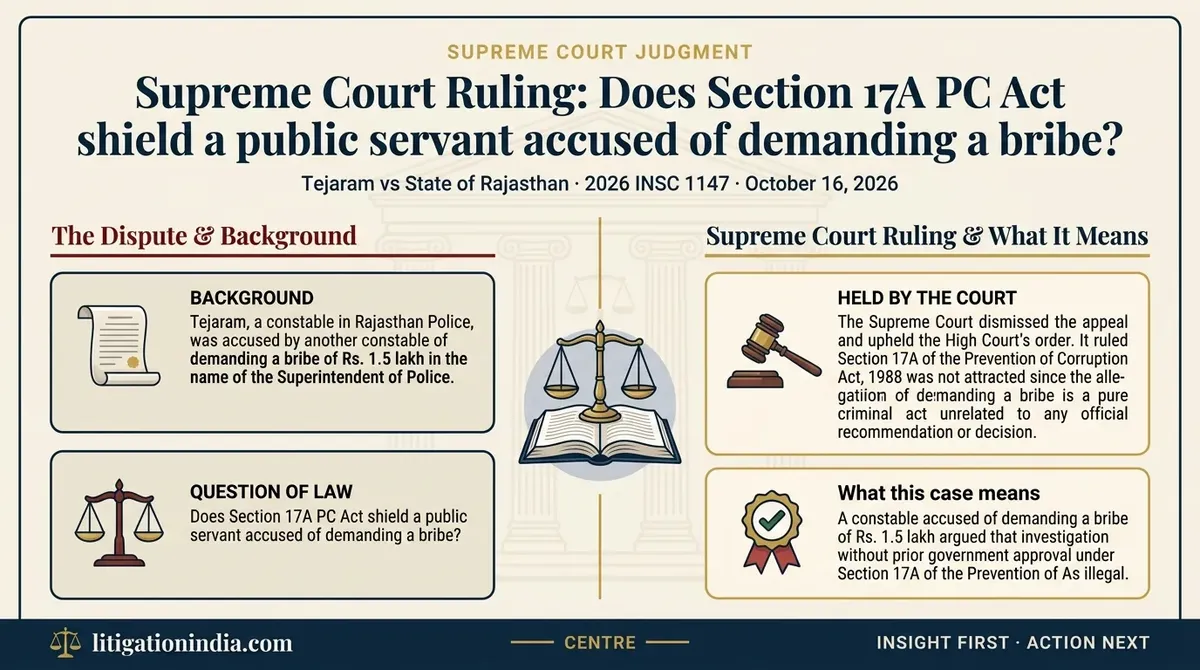
Judge, Anti-Corruption Bureau, Pali2 in Sessions Case No.2 of 2024 framing a charge against the appellant for the offence under Section 7 of the Prevention of Corruption Act, 19883, which order of Trial Court came to be upheld. 3. Sifted from unnecessary details, the pertinent facts are that the appellant was a constable posted at the office of Deputy Superintendent of Police, Sirohi, Rajasthan. It appears that the appellant levelled an allegation of graft on the complainant named Devendra Kumar who was also a constable posted at Police Station, Abu City, Sirohi, Rajasthan. The complainant was asked to visit Madurai along with another constable for official work relating to an investigation. The appellant alleged that the complainant had taken illegal gratification from the accused persons to allow them to escape. 3.1 It is the case of the appellant that, in retaliation the complainant sent a false e-mail dated 22.04.2021 to the Anti-Corruption Bureau and alleged that the appellant had demanded bribe of Rs.1.5 lakh on behalf of the
2 Hereinafter “Trial Court” 3 Hereinafter “PC Act”
Criminal Appeal @ SLP (Crl.) No. 11709 of 2025 Page 3 of 17
Superintendent of Police. First Information Report4 No. 174 of 2021 dated 04.06.2021 came to be registered against the appellant under Section 7A of the PC Act and under Section 120B of the Indian Penal Code, 18605. 3.2 Thereafter, the chargesheet came to be filed against the appellant under Section 7 of the PC Act. The case came to be committed to the Trial Court to be registered as Sessions Case No. 2 of 2024. By order dated 12.09.2024, the charge against the appellant was directed to be framed for the offence punishable under Section 7 of the PC Act as amended in 2018. 3.3 The aggrieved appellant challenged order dated 12.09.2024 passed by the Trial Court framing the charge as above, by filing Criminal Revision Petition before the High Court. The High Court dismissed the same leading the appellant to approach this Court. 4. The principal contention raised by learned Senior Counsel Mr. Abhimanyu Bhandari for the appellant to assail
4 Hereinafter “FIR” 5 Hereinafter “IPC”
Criminal Appeal @ SLP (Crl.) No. 11709 of 2025 Page 4 of 17
the impugned judgment and order of the High Court as well as against framing the charge by the Trial Court was that since the appellant was a public servant, the provision under Section 17A of the PC Act ought to have been complied with before initiating investigation. It was submitted that Section 17A of the PC Act was mandatory and created a bar against initiation of any enquiry or investigation against a public servant for the acts done in discharge of official functions without prior approval of the competent authority. 4.1 Learned Senior Counsel for the appellant submitted that the High Court erred in dismissing the Revision Petition by relying on the judgment in Nara Chandrababu Naidu vs. State of Andhra Pradesh6, while disregarding the position of law laid down in Yashwant Sinha and Others vs. Central Bureau of Investigation7. It was further submitted that prior approval under Section 17A of the PC Act was a mandatory and that the failure to obtain such approval cannot be cured at a subsequent stage. Learned Senior
6 (2020) 2 SCC 338 7 (2020) 2 SCC 338
Criminal Appeal @ SLP (Crl.) No. 11709 of 2025 Page 5 of 17
Counsel further submitted that the question whether Sections 17A and 19 of the PC Act are procedural or substantive remains pending consideration before this Court in B.S Yeddiyurappa vs. A. Alam Pasha and Others8. 4.2 On the other hand, learned Additional Advocate General for the State of Rajasthan Ms. Sansriti Pathak submitted that Section 17A does not provide for blanket immunity in respect of all actions taken by the public servants and that those actions and conducts which are criminal in nature or are unrelated to their official duties cannot be protected. Referring to essential ingredients necessary to be satisfied for applying Section 17A of the Act, learned Additional Advocate General for the respondent- State submitted that the case involved the allegation of demand of illegal gratification and the FIR was filed for such alleged criminal act, and that it was in no way part of the discharge of official functions by the appellant nor relatable to any recommendation or decision in discharge of his duty.
8 2025 SCC OnLine SC 836
Criminal Appeal @ SLP (Crl.) No. 11709 of 2025 Page 6 of 17
4.2.1 It was submitted that the appellant did not challenge the FIR which was filed in the year 2021. It was highlighted that on 08.12.2023, sanction for prosecution under Section 19 of the PC Act was granted and a chargesheet was subsequently filed on 19.01.2024, framing the charge under Section 7 of the PC Act. 4.2.2 It was next submitted that the reliance placed by the appellant on the decision of this Court in Yashwant Sinha (supra) was misplaced, inasmuch as it has no bearing on the facts of the present case when Section 17A is not attracted at all. It was submitted that the same way, Yeddyurappa (supra) would also not apply as none of the questions framed therein are relevant for the present matter. It was submitted that the issue regarding validity of Section 17A of the Act has been referred to larger bench by judgment and order dated 13.01.2026 passed by this Court in Centre for Public Interest Litigation vs. Union of India in W.P. (C) No. 1373 of 2018, but the said aspect has no relevance, as Section 17A of the PC Act is not attracted at all in the facts of the case.
Criminal Appeal @ SLP (Crl.) No. 11709 of 2025 Page 7 of 17
5. Recapitulating the facts, FIR No. 174 of 2021 was lodged on 04.06.2021 on the basis of the complaint dated 22.04.2021 made by the complainant Devendra Kumar, alleging an offence against the appellant under Section 7A of the PC Act, inter alia, that the appellant demanded bribe in the name of Superintendent of Police. The appellant was arrested on 01.09.2021. On 08.12.2023, sanction for prosecution under Section 19 of the PC Act was granted, and a chargesheet bearing No. 06 of 2024 dated 19.01.2024 came to be filed in respect of the aforesaid offence under the PC Act against the appellant. On 12.09.2024, the Trial Court framed a charge against the appellant. 5.1 Adverting to Section 17A of the PC Act at the outset, it reads as under, “17-A. Enquiry or Inquiry or investigation of offences relatable to recommendations made or decision taken by public servant in discharge of official functions or duties.- (1) No police officer shall conduct any enquiry or inquiry or investigation into any offence alleged to have been committed by a public servant under this Act, where the alleged offence is relatable to any recommendation made or decision taken by such public servant in discharge of his official functions or duties, without the previous approval-
Criminal Appeal @ SLP (Crl.) No. 11709 of 2025 Page 8 of 17
(a) in the case of a person who is or was employed, at the time when the offence was alleged to have been committed, in connection with the affairs of the Union, of that Government; (b) in the case of a person who is or was employed, at the time when the offence was alleged to have been committed, in connection with the affairs of a State, of that Government; (c) in the case of any other person, of the authority competent to remove him from his office, at the time when the offence was alleged to have been committed: Provided that no such approval shall be necessary for cases involving arrest of a person on the spot on the charge of accepting or attempting to accept any undue advantage for himself or for any other person: Provided further that the concerned authority shall convey its decision under this section within a period of three months, which may, for reasons to be recorded in writing by such authority, be extended by a further period of one month.”
5.1.1 A bare perusal of the aforesaid Section goes to show that it provides that no police officer shall conduct an enquiry or investigation into any offence which is alleged to have been committed by a public servant under the PC Act, where the alleged offence is relatable to any recommendation made or decision taken by such public servant, and further that the same has to be in discharge of official functions or official
Criminal Appeal @ SLP (Crl.) No. 11709 of 2025 Page 9 of 17
duties of such public servant, against whom enquiry or investigation is to be initiated. 5.1.2 If those conditions are satisfied, a previous approval of the competent authority as per sub-clauses (a), (b) and (c) would be necessary. The First Proviso of the section says that no such approval shall be necessary in respect of the cases involving arrest of a person on the spot on the charge of accepting or attempting to accept any undue advantage for himself or for any other person. As per the Second Proviso, the authority concerned shall convey its decision under this provision within stipulated time, which is extendable by recording reasons for such extension. 5.2 In Central Bureau of Investigation vs. Santosh Karnani and Another9, the appellant-Central Bureau of Investigation was aggrieved by the order of the High Court of Gujarat whereby the High Court allowed the anticipatory bail application of the respondent in connection with the FIR which was in respect of the offence under Section 7 of the PC Act.
9 (2023) SCC OnLine SC 427
Criminal Appeal @ SLP (Crl.) No. 11709 of 2025 Page 10 of 17
5.2.1 The contention that the prior approval of investigation, as per under Section 17A of the PC Act was not obtained and thus the proceedings initiated against the respondent were vitiated, was rejected stating that it had no legal basis, “Section 17A merely contemplates that police officers shall not conduct any enquiry, inquiry or investigation into any offence alleged to have been committed by a public servant where the alleged offence is relatable to any recommendation made or decision taken in discharge of official functions or duties, without the previous approval of the competent authority. The first proviso to the section states that such approval is not necessary in cases involving arrest of the person on the spot on the charges of accepting undue advantage.”
5.2.2 The accusation against the appellant in the aforementioned case did not involve any recommendation made or decision taken by him in his official capacity as a public servant. This Court observed, which observations equally apply to the facts of the present case. “As may be seen, the first proviso to Section 17A refers to cases wherein a public servant is charged with acceptance of an undue advantage or attempt thereof. A prior approval or sanction to investigate such an officer in a trap case is likely to defeat the very purpose of trap and the investigation, which is not the underlying intention of the legislature. The investigation against Respondent No. 1, being an accused of demanding a bribe, did not require any
Criminal Appeal @ SLP (Crl.) No. 11709 of 2025 Page 11 of 17
previous approval of the Central Government. That apart, the accusation against Respondent No. 1 does not revolve around any recommendations made or decisions taken by him in his quasijudicial or administrative capacity.”
(Para 34) 5.3 The decision in Santosh Karnani (supra) was quoted to be relied on in Surendra Dhariwal vs. The State of Rajasthan and Another Etc. which was Criminal Appeal Nos. 3717-3718 of 2025 decided on 25.08.2025. Again, it was a case wherein the FIR was registered for the offence punishable under Section 7 of the PC Act and Sections 384, 120-B and 201 of the IPC. 5.4 The judicial view on the above score is consistent and categorical. Yet in another and more recent decision of this Court in Anil Daima Etc. vs. State of Rajasthan and Others10, the petitioner before this Court was prosecuted for the offence punishable under Section 7 and Section 7A respectively of the PC Act. It was also a case for demand of illegal gratification as in the present case. 5.4.1 This Court dispelled the contention about the applicability of Section 17A of the Act, observing,
10 2026 SCC OnLine SC 807
Criminal Appeal @ SLP (Crl.) No. 11709 of 2025 Page 12 of 17
“The entire submission of the learned counsel is thoroughly misconceived. Section 17-A came to be enacted with a particular object. Section 17-A talks about enquiry or inquiry or investigation of offences relatable to recommendations made or decision taken by public servant in discharge of official functions or duties. Section 17-A by any stretch of imagination cannot be applied to cases of demand of illegal gratification.” (Para 7)
5.5 In Shankara Bhat vs. State of Kerala and Others11, the Kerala High Court observed that Section 197(1) of the Code of Criminal Procedure, 1973 and Section 17A of the PC Act though operate in two different fields and in distinct situations, they have, in common, the aspect of offence committed by the public servant while acting or purporting to act in discharge of his official duty. It was stated that the commission of crime by public servant which had no connection with his official duty, cannot be considered to be falling within the ambit of Section 17A of the PC Act. 5.5.1 It was stated that the offences like misappropriation, falsification of accounts, cheating, criminal breach of trust, receiving bribes, etc. are beyond
11 2021 SCC OnLine Ker 16357
Criminal Appeal @ SLP (Crl.) No. 11709 of 2025 Page 13 of 17
the scope of the provision. The same dictum of law was reiterated by the same High Court in M.R. Simon vs. State of Kerala12. 6. An unequivocal position of law emanates from the above decisions about the scope and extent of applicability of Section 17A of the PC Act which contemplates taking a prior approval before investigation or inquiry against a public servant. The language of the provision itself outlines and circumscribes the ambit of operation of the provision. The decisive phrase in the section is “discharge his official functions or duties”. Though the legislature has intended to protect the public servant from being prosecuted by engrafting Section 17A in the statute book, the protection envisaged could be extended only if the conditions contemplated in the Section are satisfied. The Section cannot be viewed to have an omnibus application. 6.1 In order that the provisions of Section 17A of the PC Act applies, there has to be a “decision” or “recommendation” by a public servant against whom an
12 2024 SCC OnLine Ker 7255
Criminal Appeal @ SLP (Crl.) No. 11709 of 2025 Page 14 of 17
enquiry or investigation is to be initiated. Such “decision” or “recommendation” shall be a “decision” taken or “recommendation” made by such public servant in discharge of his official functions or duties. In other words, the alleged offence against the public servant must be relatable to any recommendation made or decision taken by such public servant in discharge of his official duties. These primary and essential aspects are absent in the present case to attract Section 17A of the PC Act. The allegation is of demanding illegal gratification by the appellant, which is a pure criminal act unconnected to discharge of the official functions or duties. 6.2 Thus, from the plain language of the provision of Section 17A, it is evident that the provision is confined to be applied in the situations where there is a recommendation or a decision taken by a public servant in discharge of his official duties. The allegation against the appellant in the present case is that of a criminal act, namely that the appellant demanded illegal gratification of Rs.1.5 lakh. The conduct on the part of the appellant, by no stretch of imagination, can be treated as part of the discharge of his
Criminal Appeal @ SLP (Crl.) No. 11709 of 2025 Page 15 of 17
official functions. It was not in any way relatable to recommendation or a decision taken by the appellant in discharge of his official duties but was an act unrelated to his official duty. 6.3 In the aforesaid view, Section 17A of the PC Act is not applicable in the case of appellant herein. None of the ingredients provided for in the Section is satisfied to attract its operation. The act of demanding a bribe is a pure criminal act, not connected with official functions and not relatable to or having any linkage with recommendation or decision of the appellant in his capacity, as public servant. In the facts and circumstances of the case, therefore, the act of the appellant does not fall within the protective umbrella of Section 17A of the Act. It could not be said that the proceedings were vitiated for want of sanction. 7. Disposing of the submission of the learned counsel for the appellant that the issue regarding the validity of Section 17A of the PC Act is referred to a larger bench by this Court as per order dated 13.01.2026 passed in Centre for Public Interest Litigation (supra), it is to be stated that
Criminal Appeal @ SLP (Crl.) No. 11709 of 2025 Page 16 of 17
the reference has no connection with the issue involved in the present case since the present case could be decided without awaiting the reference, when Section 17A of the PC Act has no applicability at all. 8. In the impugned judgment and order, the High Court has noted that subsequent sanction for prosecution under Section 19 of the PC Act has been taken. A faint attempt was made on behalf of the appellant to contend that it was a belated sanction obtained. Evaluating the said aspect in the light of the operative facts in the present case, firstly as held above, Section 17A has no application. As far as Section 19 is concerned, sanction was taken as alleged before the cognizance was taken, it would amount to mere an irregularity. It cannot be said to be vitiating the entire criminal proceedings and the trial that would take place, on the count of said aspect as well. The trial would be conducted on its merits, where the respective parties would raise their rival contentions. 9. The High Court was justified in dismissing the Criminal Revision Petition of the appellant. The judgment
Criminal Appeal @ SLP (Crl.) No. 11709 of 2025 Page 17 of 17
and order of the High Court warrants no interference. It is upheld. 10. For the reasons recorded by the High Court and for those supplied additionally in this judgment by this Court, it is ruled that Section 17A of the PC Act would not be attracted in the facts of the case and that want of prior sanction thereunder by the competent authority, has in no manner vitiated the initiation of criminal proceedings against the appellant. 11. The appeal stands dismissed.
Any interlocutory application, if pending, shall not survive in view of the dismissal of the appeal.
..………………………...J.
[S.V.N BHATTI]
………………………….J. [N.V. ANJARIA] NEW DELHI; OCTOBER 16, 2026.