
All insights

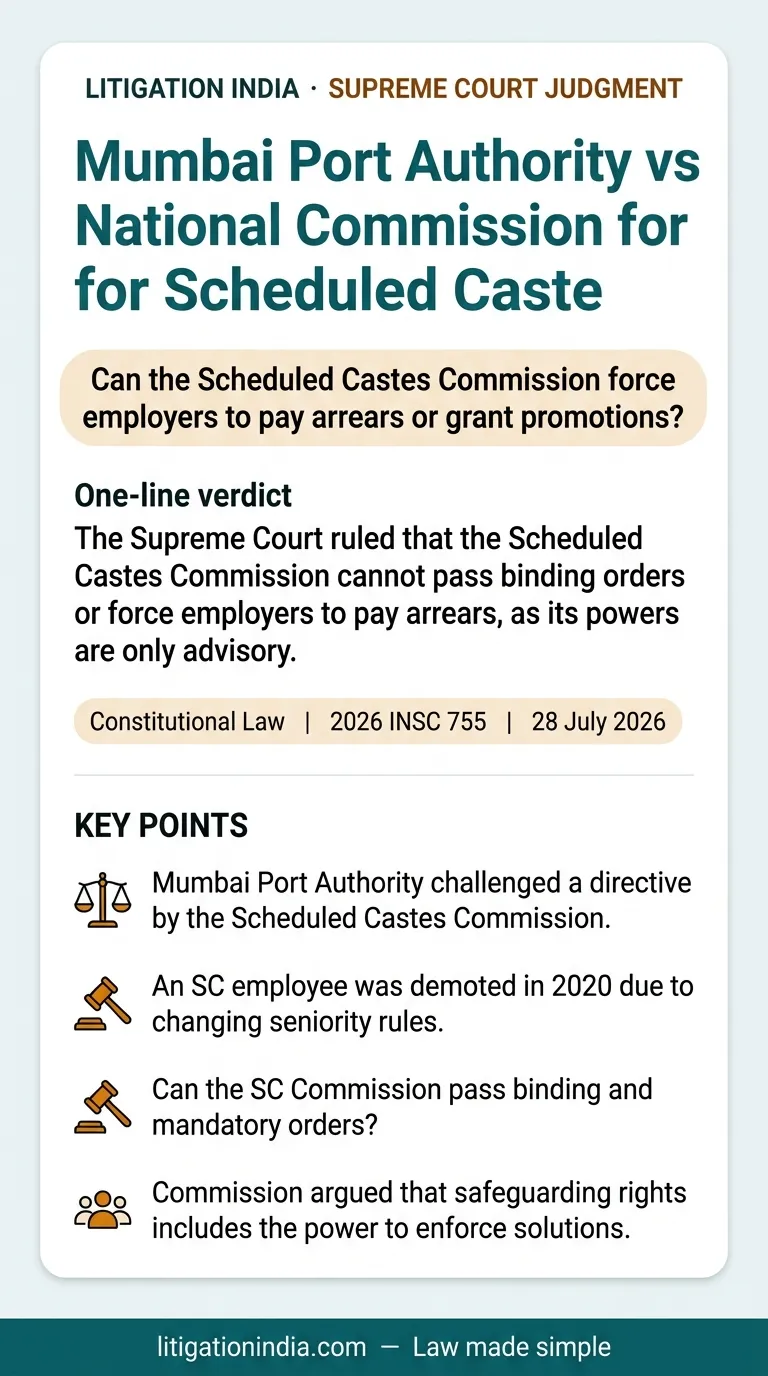
Can the Scheduled Castes Commission force employers to pay arrears or grant promotions?

Mumbai Port Authority vs National Commission for Scheduled Caste

The Supreme Court ruled that the Scheduled Castes Commission cannot pass binding orders or force employers to pay arrears, as its powers are only advisory.

Litigation India Editorial 9 August 2026 1 min read 2026 INSC 755

Story

Key points1 / 7

Case at a Glance

  • Mumbai Port Authority challenged a directive by the Scheduled Castes Commission.
  • The Commission had ordered the Port to pay arrears to an employee.
  • The Supreme Court examined the Commission's actual legal powers.
Mumbai Port Authority vs National Commission for Scheduled Caste · 2026 INSC 7552026-08-09T17:08:58.981178+00:00
Key points2 / 7

What Triggered the Dispute?

  • An SC employee was demoted in 2020 due to changing seniority rules.
  • She filed a complaint with the National Commission for Scheduled Castes.
  • The Commission ordered her promotion and arrears within 30 days.
Mumbai Port Authority vs National Commission for Scheduled Caste · 2026 INSC 7552026-08-09T17:08:58.981178+00:00
Key points3 / 7

The Main Legal Question

  • Can the SC Commission pass binding and mandatory orders?
  • Are the powers of the Commission directory or mandatory?
  • Can it act as an alternative court for service disputes?
Mumbai Port Authority vs National Commission for Scheduled Caste · 2026 INSC 7552026-08-09T17:08:58.981178+00:00
Key points4 / 7

What the Sides Argued

  • Commission argued that safeguarding rights includes the power to enforce solutions.
  • Employer argued that only courts of law can pass binding payment orders.
  • They argued the Commission is only an advisory body under Article 338.
Mumbai Port Authority vs National Commission for Scheduled Caste · 2026 INSC 7552026-08-09T17:08:58.981178+00:00
Key points5 / 7

What the Court Decided

  • The Supreme Court ruled that the Commission has limited powers.
  • It can collect evidence and investigate like a civil court.
  • However, it has no power to pass binding, adjudicatory judgments.
Mumbai Port Authority vs National Commission for Scheduled Caste · 2026 INSC 7552026-08-09T17:08:58.981178+00:00
Key points6 / 7

Recommendations vs Judgments

  • The Commission's role is to advise and make recommendations.
  • It can submit factual findings to the Government.
  • It cannot take over the functions of actual judicial courts.
Mumbai Port Authority vs National Commission for Scheduled Caste · 2026 INSC 7552026-08-09T17:08:58.981178+00:00
Key points7 / 7

Takeaway for the Public

  • Commissions are excellent for highlighting discrimination and investigating facts.
  • For final binding relief like promotion or back-pay, go to courts.
  • Do not rely on Commission orders as final court decrees.
Mumbai Port Authority vs National Commission for Scheduled Caste · 2026 INSC 7552026-08-09T17:08:58.981178+00:00
Mumbai Port Authority vs National Commission for Scheduled Caste — infographic summary

What this case means

The Supreme Court ruled that the Scheduled Castes Commission cannot pass binding orders or force employers to pay arrears, as its powers are only advisory.

What the Supreme Court held

The Supreme Court set aside the High Court's order and declared the Commission's directive to pay arrears invalid. The Court held that the Commission can only investigate and recommend actions, but cannot pass binding, mandatory orders like a regular court.

Case: Mumbai Port Authority vs National Commission for Scheduled Caste (2026) Citation: 2026 INSC 755

Want the full legal reasoning, citations and case documents?

Read the full judgment analysis
National Commission for Scheduled Castes
Article 338
Adjudicatory Powers
Service Matters
Recommmendatory Power
Constitutional Law
Supreme Court legal news
Supreme Court judgment today
latest Supreme Court news
More in Constitutional Law

Supreme Court Denies Backward Class Muslim Quota to Converts: Ruling in Sameer Ahamed Analyzed
Constitutional Law
15 Oct 2026

Supreme Court Denies Backward Class Muslim Quota to Converts: Ruling in Sameer Ahamed Analyzed

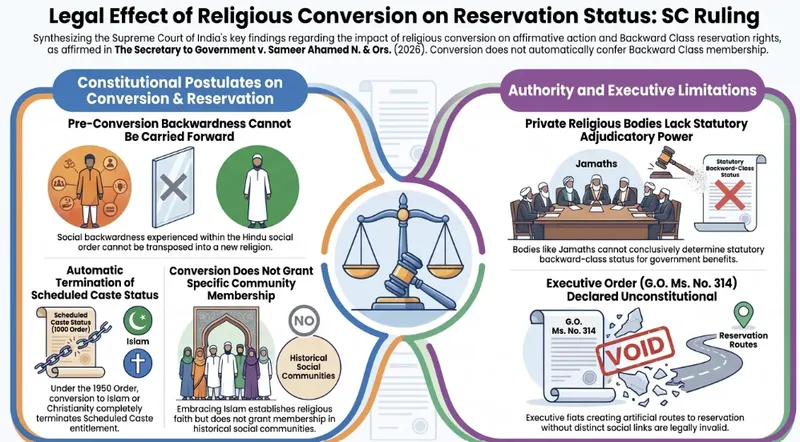
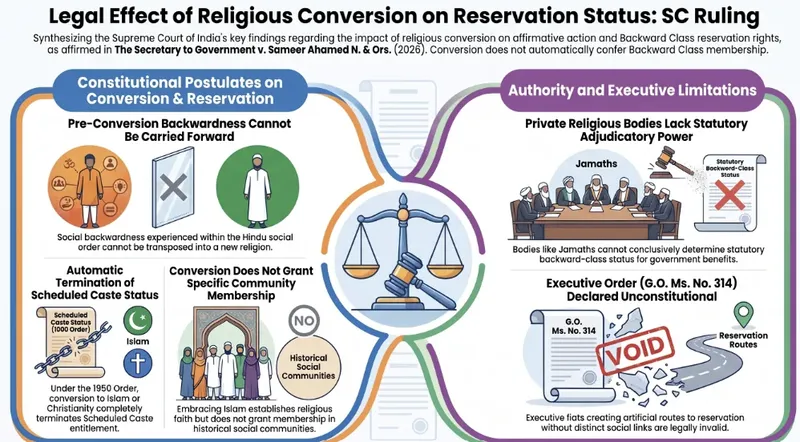
Excerpt (1-2 sentences, shown on cards)** The Supreme Court has ruled that a person converting from Hinduism to Islam cannot carry forward pre-conversion caste backwardness to claim Backward Class Muslim reservation or statutory membership in historical communities such as Labbai. Upholding the Madras High Court’s invalidation of Tamil Nadu’s G.O. (Ms.) No. 314, the Court articulated six binding constitutional postulates governing religious conversion, community identity, and affirmative action under Article 16(4).

Supreme Court Denies Backward Class Muslim Quota to Converts: Ruling in Sameer Ahamed Analyzed
Constitutional Law
15 Oct 2026

Supreme Court Denies Backward Class Muslim Quota to Converts: Ruling in Sameer Ahamed Analyzed

The Supreme Court has ruled that a person converting from Hinduism to Islam cannot carry forward pre-conversion caste backwardness to claim Backward Class Muslim reservation or statutory membership in historical communities such as Labbai. Upholding the Madras High Court’s invalidation of Tamil Nadu’s G.O. (Ms.) No. 314, the Court articulated six binding constitutional postulates governing religious conversion, community identity, and affirmative action under Article 16(4).