Introduction: The Intersection of Faith, Caste, and Affirmative Action
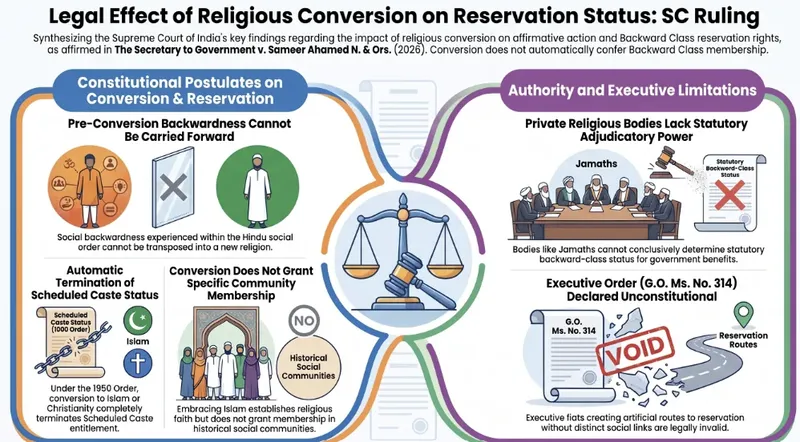
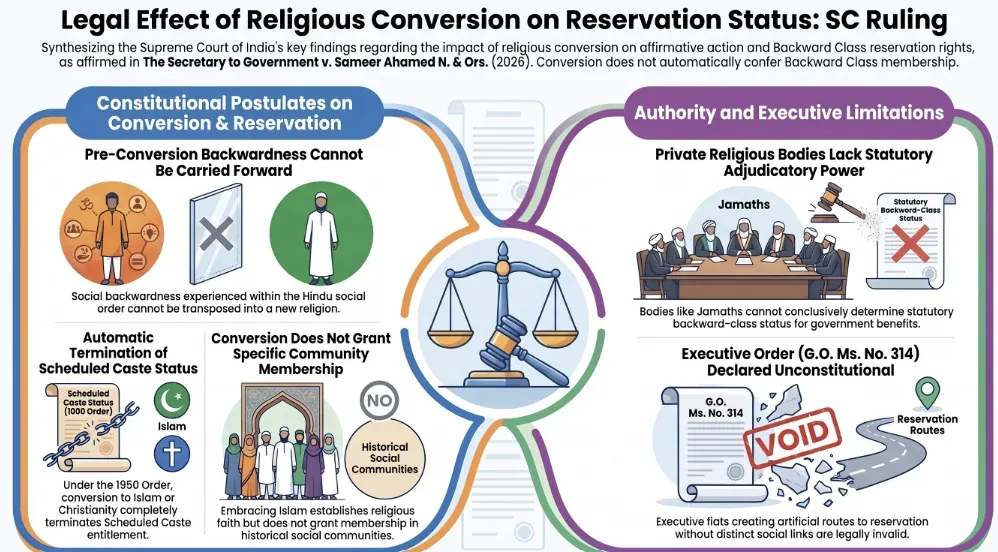
In a landmark verdict on the constitutional limits of affirmative action, the Supreme Court of India in _The Secretary to Government v. Sameer Ahamed N. and Others_ (2026 INSC 1129) held that conversion to Islam does not automatically entitle a person to the status or reservation benefits of a Backward Class Muslim (BCM). The Division Bench comprising Justice Prashant Kumar Mishra and Justice Shree Chandrashekhar affirmed the judgment of the Madras High Court, which quashed a Tamil Nadu Government Order designed to extend Backward Class Muslim benefits to proselytes.
The judgment addresses a foundational question under Part III of the Constitution: can social backwardness born out of the Hindu caste order be carried forward upon conversion into a non-Hindu religion, thereby enabling a convert to enter a distinct, historically recognized backward class community within the adopted faith?
Writing for the Bench, Justice Prashant Kumar Mishra held that religious conversion establishes religious affiliation but does not confer membership in a distinct socio-historical community. The Court rejected the notion that reservation is a transferable personal entitlement that migrates across different social and theological orders.
Factual Background: The Dispute in Thoothukudi
The dispute arose from an application submitted by Respondent No. 1, Sameer Ahamed N., born into a Hindu family on April 12, 1993, in Tuticorin District to Narayanan and Gomathiammal, and originally named Paramasivara. On September 11, 2015, the Sunnath Jamath, Kayathar, issued a certificate recording that he had embraced Islam and changed his name to Sameer Ahamed. His change of name was notified in the Tamil Nadu Government Gazette on November 2, 2016. Two days later, on November 4, 2016, he married Vahitha in accordance with Islamic customs.
Respondent No. 1 claimed to follow the faith of Labbai Muslims and subsequently applied online before the Kayathar Taluk Office, Thoothukudi District, for a Backward Class (Muslim) community certificate as "Muslim Labbai". On November 13, 2020, the revenue authority rejected his application on the explicit ground that he had "only converted to religion and not to the caste".
Aggrieved by this rejection, Respondent No. 1 filed a writ petition, W.P.(MD) No. 7127 of 2022, before the High Court of Judicature at Madras under Article 226 of the Constitution, seeking to quash the rejection and obtain a direction for the issuance of the "Muslim Labbai" certificate.
Executive Intervention: G.O. (Ms.) No. 314 and the High Court's Strike-Down
While the writ petition was pending before the High Court, the Tamil Nadu Backward Class Commission (TNBCC), by a letter dated February 6, 2024, recommended a mechanism to issue Backward Class Muslim certificates to converts from Backward Classes (BC), Most Backward Classes (MBC), Denotified Communities (DNC), and Scheduled Castes (SC) who had enjoyed reservation prior to conversion.
Acting upon this recommendation, the State Government issued G.O. (Ms.) No. 314 dated March 9, 2024. The executive order noted that:
- Under the Tamil Nadu Backward Class Muslims (Reservation of Seats in Educational Institutions including Private Educational Institutions and of Appointments or Posts in the Services under the State) Act, 2007 (Act 33 of 2007), a separate 3.5% reservation is earmarked for Backward Class Muslims.
- Seven distinct Muslim communities are recognized as Backward Classes under Section 3(a) of the Tamil Nadu Act 45 of 1994: Dekkani Muslims, Dudekula, Labbais (including Rowthar and Marakayar), Mapilla, Sheik, Syed, and Ansar.
- Proselytes to Islam from BC, MBC, and DNC categories who were already availing reservation could, upon conversion into any of the seven recognized Muslim communities, receive a Backward Class Muslim community certificate.
Relying on this G.O., Respondent No. 1 pressed his claim before the Madras High Court. However, the High Court formed a prima facie view that the executive order was constitutionally infirm, suo motu impleaded the State Government on June 11, 2026, and delivered its judgment on June 25, 2026. The High Court declared G.O. (Ms.) No. 314 unconstitutional, holding that a person who embraces Islam becomes a Muslim and cannot, merely by reason of conversion, claim membership in an identified Backward Class Muslim community.
Submissions Before the Supreme Court
The State of Tamil Nadu challenged the High Court's ruling before the Supreme Court. Appearing for the State, learned Senior Counsels Shri Mukul Rohatgi and Shri Sidharth Luthra advanced two primary contentions:
- Pleadings and Scope of Judicial Review: The High Court traveled beyond the pleadings because Respondent No. 1 never challenged the constitutional validity of G.O. (Ms.) No. 314; rather, he relied upon it. The State argued it was denied an adequate opportunity to defend a policy with state-wide implications.
- Preservation of Substantive Backwardness: On the merits, the State contended that the G.O. did not confer birth-based community membership (such as Labbai or Rowther) upon a convert, but merely preserved the backward class reservation status already held prior to conversion. Citing the Constitution Bench ruling in _Indra Sawhney v. Union of India_ (1992 Supp (3) SCC 217), the State submitted that social and educational backwardness under Articles 15(4) and 16(4) does not automatically disappear upon conversion to another religion. It was also argued that principles governing Scheduled Castes under Article 341 could not be mechanically applied to Other Backward Classes.
Procedural Objection Overruled
The Supreme Court rejected the State's preliminary objection regarding the scope of the High Court's inquiry. Citing _Union of India v. Manjurani Routray_ ((2023) 9 SCC 144), the Court observed that while courts should not decide unpleaded issues without notice, a constitutional court is not prohibited from examining an instrument whose validity is inseparable from the relief claimed. Because the State was specifically impleaded, filed counter-affidavits, and argued the validity of the G.O. through its Additional Advocate General, procedural fairness was satisfied.
Theological Egalitarianism vs. Social Reality in India
To determine the legal effect of conversion, the Supreme Court analyzed the distinction between religious doctrine and social practice.
Foundational Islamic Doctrine
The Court observed that foundational Islamic theology is rooted in human equality and rejects hierarchy based on birth, lineage, or descent. The Court referenced:
- The Holy Quran (Surah Al-Hujurat, Ayah 49:13):
> "O humanity! Indeed, We created you from a male and a female, and made you into peoples and tribes so that you may get to know one another. Surely the most noble of you in the sight of Allah is the most righteous among you. Allah is truly All-Knowing, All-Aware."
- The Prophet Muhammad’s Farewell Sermon (_Khutbat al-Hajjat_):
> "All mankind is from Adam and Eve. An Arab has no superiority over a non-Arab, nor does a non-Arab have any superiority over an Arab; a white person has no superiority over a black person, nor does a black person have any superiority over a white person, except by piety and good deeds. Learn that every Muslim is a brother to every Muslim and that the Muslims constitute one brotherhood."
The Bench noted that under Islamic theological tenets, distinctions of birth or descent do not determine moral worth or social status.
Sociological Stratification Among Indian Muslims
Notwithstanding theological egalitarianism, the Court examined sociological literature establishing that Muslim society in India has historically experienced social differentiation:
- Ghaus Ansari’s 1960 Study: Classified Indian Muslims into three broad social categories: Ashraf (the noble born), Ajlaf (backward occupational groups), and Arzal (most degraded groups).
- Imtiaz Ahmad’s Works: Documented that groups within Indian Muslim society, often described through terms like biradari and zat, frequently practiced endogamy, maintained traditional occupational links, and occupied hereditary social standings. Ahmad also explored "Ashrafisation", a process through which lower-placed groups sought social mobility by adopting Ashraf customs and titles.
The Court emphasized that while Muslim communities developed hereditary social stratification analogous to caste in certain contexts, these groups cannot be equated to a uniform, scriptural caste hierarchy identical to the classical Hindu caste system.
Constitutional Analysis: The Severance of Caste-Based Entitlement
Turning to Articles 14, 15(4), and 16(4) of the Constitution, the Supreme Court dismantled the State's theory of "preserving" pre-conversion backwardness.
1. The Core Meaning of Indra Sawhney
The Bench clarified that while _Indra Sawhney_ recognized that occupational groups, sects, and denominations among non-Hindus could constitute backward classes under Article 16(4), that decision dealt with groups historically evolving within those religious collectivities. It never sanctioned the cross-religious transfer of caste backwardness.
2. Disadvantage Cannot Be Detached from Its Originating Social Order
The Supreme Court explained that caste-based social backwardness under Article 16(4) is an organic product of the Hindu social order. When an individual converts to Islam or Christianity—faiths whose foundational structures do not recognize caste—the foundational basis of the antecedent disability ceases to operate. Even if material deprivations persist, they cannot carry forward antecedent social backwardness into the new religious fold.
3. The Scheduled Caste Constitutional Bar
The Court examined the constitutional framework governing Scheduled Castes under Article 341 and Paragraph 3 of the Constitution (Scheduled Castes) Order, 1950, which explicitly provides that no person professing a religion different from Hinduism, Sikhism, or Buddhism shall be deemed a member of a Scheduled Caste.
Reiterating its recent decision in _Chinthada Anand v. State of Andhra Pradesh_ (2026 SCC OnLine SC 466), the Bench emphasized that conversion to a religion outside those specified in Paragraph 3 results in the immediate and complete loss of Scheduled Caste status. The executive cannot circumvent this constitutional bar by transposing an erstwhile Scheduled Caste individual into a Backward Class Muslim category through an administrative order.
4. Communities vs. Theological Faith: The G. Michael Precedent
Relying on the Madras High Court’s ruling in _G. Michael v. S. Venkateswaran_ (1951 SCC OnLine Mad 312)—approved in _Kailash Sonkar v. Maya Devi_ ((1984) 2 SCC 91) and _C. Selvarani v. Special Secretary-cum-District Collector_ ((2024) 16 SCC 537)—the Court affirmed:
"...the general rule is conversion operates as an expulsion from the caste; in other words, a convert ceases to have any caste."
The seven notified Muslim communities under Tamil Nadu Act 45 of 1994 (such as Labbai, Rowther, and Marakkayar) are historically evolved social communities defined by common descent, traditional occupation, endogamy, and shared social history—not theological denominations. Consequently, an individual who converts to Islam becomes a Muslim, but does not, by that act alone, acquire membership in a distinct hereditary social community.
5. Article 14 and Lack of Intelligible Differentia
Citing _Ashoka Kumar Thakur v. Union of India_ ((2008) 6 SCC 1), the Bench pointed out that a "class" for affirmative action must share common defining characteristics. G.O. (Ms.) No. 314 arbitrarily assembled individuals from diverse Hindu backward classes and Scheduled Castes and deemed them members of pre-existing Muslim communities without establishing any intelligible differentia or rational nexus, rendering the order constitutionally unsustainable.
Scrutiny of Community Certificates: Rejection of Jamath Authority
A critical aspect of the ruling addresses the role of private religious bodies in determining statutory reservation status.
Before the High Court, the State suggested that the local Jamath would decide whether a convert is accepted into a particular Muslim sect, and revenue authorities should not question the Jamath’s certificate. The Supreme Court strongly disapproved of this stance, holding that determining statutory backward class status is an unalienable public function governed by secular law.
- _Kumari Madhuri Patil v. Addl. Commissioner, Tribal Development_ ((1994) 6 SCC 241): Reaffirmed the strict procedural safeguards and verification standards required for caste certificates through statutory Scrutiny Committees and vigilance inquiries.
- _Vishwa Lochan Madan v. Union of India_ ((2014) 7 SCC 707): Reaffirmed that non-statutory bodies like Dar-ul-Qaza or Jamaths have no legal authority to issue binding adjudications affecting secular legal rights.
The Bench held that while a Jamath may certify the fact of conversion to Islam, it cannot conclusively determine statutory community membership for affirmative action.
The Six Binding Postulates of the Supreme Court
In Paragraph 61, the Supreme Court crystallized its conclusions into six binding constitutional postulates:
- No Carry-Forward of Caste Backwardness: A person converting from the Hindu social order to a non-Hindu social order cannot claim affirmative action under Article 16(4) merely on the basis of pre-conversion social backwardness.
- Absolute Loss of Scheduled Caste Status: Under Paragraph 3 of the Constitution (Scheduled Castes) Order, 1950, conversion to a religion other than Hinduism, Sikhism, or Buddhism terminates Scheduled Caste status and extinguishes any affirmative action claim predicated upon that status.
- No Automatic Entry into Notified BC Communities: Conversion to a non-Hindu social order does not confer membership in a distinct notified Backward Class community, nor can pre-conversion status be transposed into a new community.
- Strict Standard for Reconversion: Where a convert reconverts to Hinduism, revival of affirmative action entitlements requires an independent, fact-specific inquiry by the competent authority to establish that the original caste identity has genuinely revived.
- Severance of Hindu Social Order Entitlements: Any statutory benefit under Article 16(4) predicated upon membership in a Hindu social order is severed upon conversion to Islam, Christianity, or any other non-Hindu faith.
- Community Certificates are Declaratory, Not Conferring: A community certificate merely declares an existing status and cannot create or confer rights; executive instructions cannot alter substantive statutory or constitutional requirements.
Conclusion and Future Implications
The Supreme Court dismissed the State's appeal, holding that G.O. (Ms.) No. 314 impermissibly attempted to create an artificial administrative conduit between pre-conversion backwardness and notified Muslim communities.
This judgment cements the principle that while affirmative action extends to socially and educationally backward classes across all faiths, eligibility must be grounded in an independent assessment of disadvantage within that community’s own social history, rather than a mechanical transposition of caste identity across religious boundaries.
Cover image (16:9 recommended)

Tags (comma separated) Supreme Court of India, Backward Class Muslims, Reservation, Religious Conversion, Article 16(4), Article 14, Muslim Labbai, G.O. Ms. No. 314, Tamil Nadu Backward Classes Commission, Constitutional Law
Author Litigation India Editorial
SEO
Meta title (28/60) SC on Conversion & BC Muslim Status | Litigation India Insights
Meta description (0/158) Supreme Court rules converts to Islam cannot carry forward Hindu caste backwardness to claim Backward Class Muslim reservation; quashes Tamil Nadu G.O. 314.
Would you like to examine how this ruling affects pending reconversion petitions or the procedural compliance requirements under the Kumari Madhuri Patil framework?