Updates
Constitutional Law
14 views

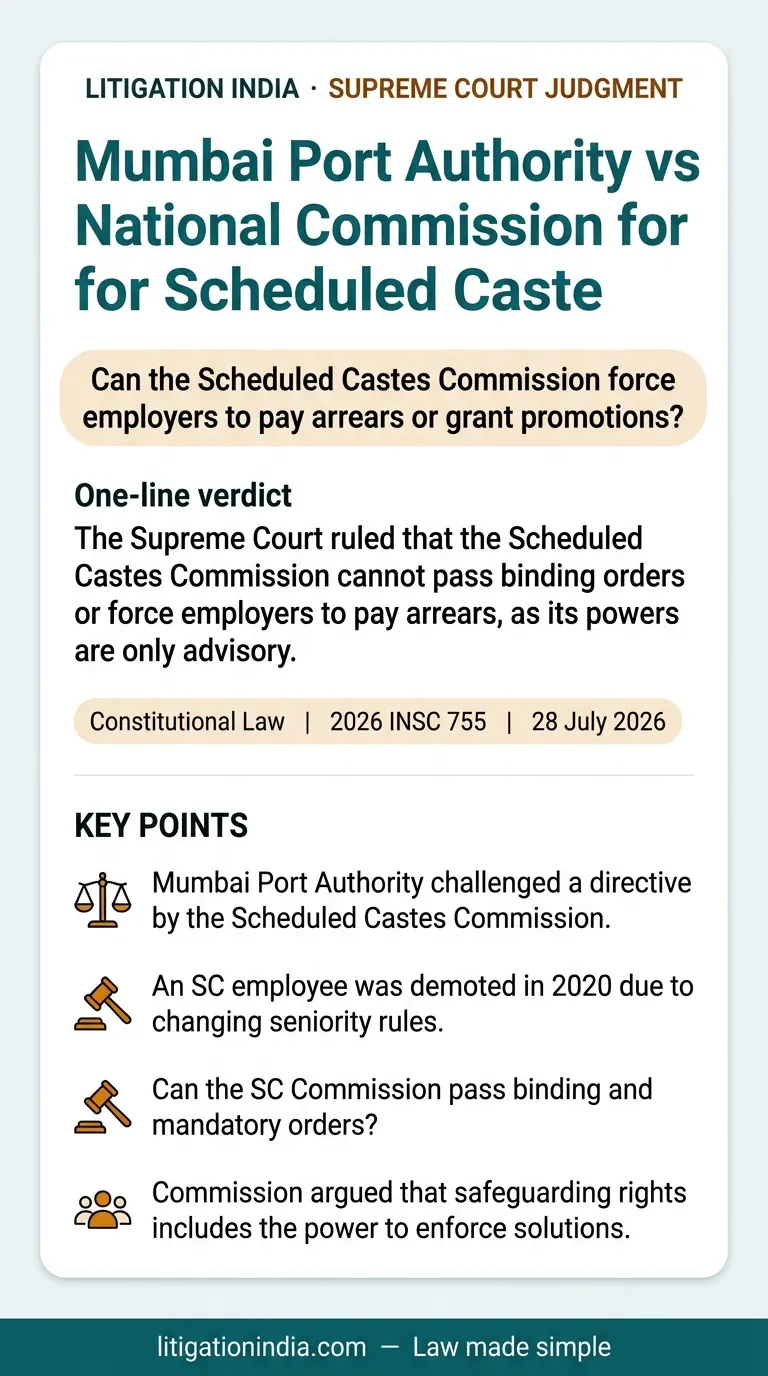
Mumbai Port Authority vs National Commission for Scheduled Caste

The big legal question

Can the Scheduled Castes Commission force employers to pay arrears or grant promotions?

“The Supreme Court ruled that the Scheduled Castes Commission cannot pass binding orders or force employers to pay arrears, as its powers are only advisory.”

Story Slides
1 / 7

Case at a Glance

  • Mumbai Port Authority challenged a directive by the Scheduled Castes Commission.
  • The Commission had ordered the Port to pay arrears to an employee.
  • The Supreme Court examined the Commission's actual legal powers.
Mumbai Port Authority vs National Commission for Scheduled Caste28 July 2026
2 / 7

What Triggered the Dispute?

  • An SC employee was demoted in 2020 due to changing seniority rules.
  • She filed a complaint with the National Commission for Scheduled Castes.
  • The Commission ordered her promotion and arrears within 30 days.
Mumbai Port Authority vs National Commission for Scheduled Caste28 July 2026
3 / 7

The Main Legal Question

  • Can the SC Commission pass binding and mandatory orders?
  • Are the powers of the Commission directory or mandatory?
  • Can it act as an alternative court for service disputes?
Mumbai Port Authority vs National Commission for Scheduled Caste28 July 2026
4 / 7

What the Sides Argued

  • Commission argued that safeguarding rights includes the power to enforce solutions.
  • Employer argued that only courts of law can pass binding payment orders.
  • They argued the Commission is only an advisory body under Article 338.
Mumbai Port Authority vs National Commission for Scheduled Caste28 July 2026
5 / 7

What the Court Decided

  • The Supreme Court ruled that the Commission has limited powers.
  • It can collect evidence and investigate like a civil court.
  • However, it has no power to pass binding, adjudicatory judgments.
Mumbai Port Authority vs National Commission for Scheduled Caste28 July 2026
6 / 7

Recommendations vs Judgments

  • The Commission's role is to advise and make recommendations.
  • It can submit factual findings to the Government.
  • It cannot take over the functions of actual judicial courts.
Mumbai Port Authority vs National Commission for Scheduled Caste28 July 2026
7 / 7

Takeaway for the Public

  • Commissions are excellent for highlighting discrimination and investigating facts.
  • For final binding relief like promotion or back-pay, go to courts.
  • Do not rely on Commission orders as final court decrees.
Mumbai Port Authority vs National Commission for Scheduled Caste28 July 2026

At a glance (infographic)

Mumbai Port Authority vs National Commission for Scheduled Caste — infographic summary
Download infographic

In short

The Supreme Court of India clarified the exact powers of the National Commission for Scheduled Castes (NCSC) under Article 338 of the Constitution. The case started when an employee of the Mumbai Port Authority, belonging to a Scheduled Caste, was demoted to a lower grade following changes in promotion rules. She complained to the NCSC, which then ordered the Port Authority to restore her promotion and pay her back-salary (arrears) within 30 days. The Port Authority challenged this order, arguing that the NCSC lacks the power to issue such binding mandates. While the High Court rejected their challenge, the Supreme Court reversed the decision. The Supreme Court explained that although the NCSC is a vital body created to safeguard the rights of Scheduled Castes, its powers are limited. It possesses the powers of a civil court to investigate and collect evidence, such as summoning people or requisitioning documents. However, it does not have the power to act as a judge, decide disputes, or pass legally binding orders. Its role is strictly recommendatory and advisory. Therefore, its order directing the payment of arrears was declared invalid and unconstitutional.

Background

An employee belonging to a Scheduled Caste was demoted to a lower post in 2020 after court rulings changed the promotion and seniority rules. She complained to the National Commission for Scheduled Castes, which ordered her employer to restore her promotion and pay her arrears.

The Decision

The Supreme Court set aside the High Court's order and declared the Commission's directive to pay arrears invalid. The Court held that the Commission can only investigate and recommend actions, but cannot pass binding, mandatory orders like a regular court.

Why it matters for you

This judgment clarifies that special commissions (like SC/ST/OBC commissions) are advisory bodies, not alternative courts. Litigants seeking legally binding relief like back-wages must approach actual courts or tribunals, rather than relying solely on commission orders.

AI-assisted summary, reviewed by our editors.

Litigation India

A public-service initiative to make justice understandable for every Indian.

contact@litigationindia.com

+91 9956486585

New Delhi, India

Quick Links

Our Mission

To make every important Supreme Court of India judgment understandable to ordinary citizens in simple English and Hindi, and to connect litigants and junior lawyers with experienced Supreme Court advocates — so that no one suffers injustice merely for lack of correct guidance.

Disclaimer: Summaries are for general public understanding only and are not legal advice. Always consult a qualified lawyer for your specific case.

© 2026 Litigation India. All rights reserved.