All insights

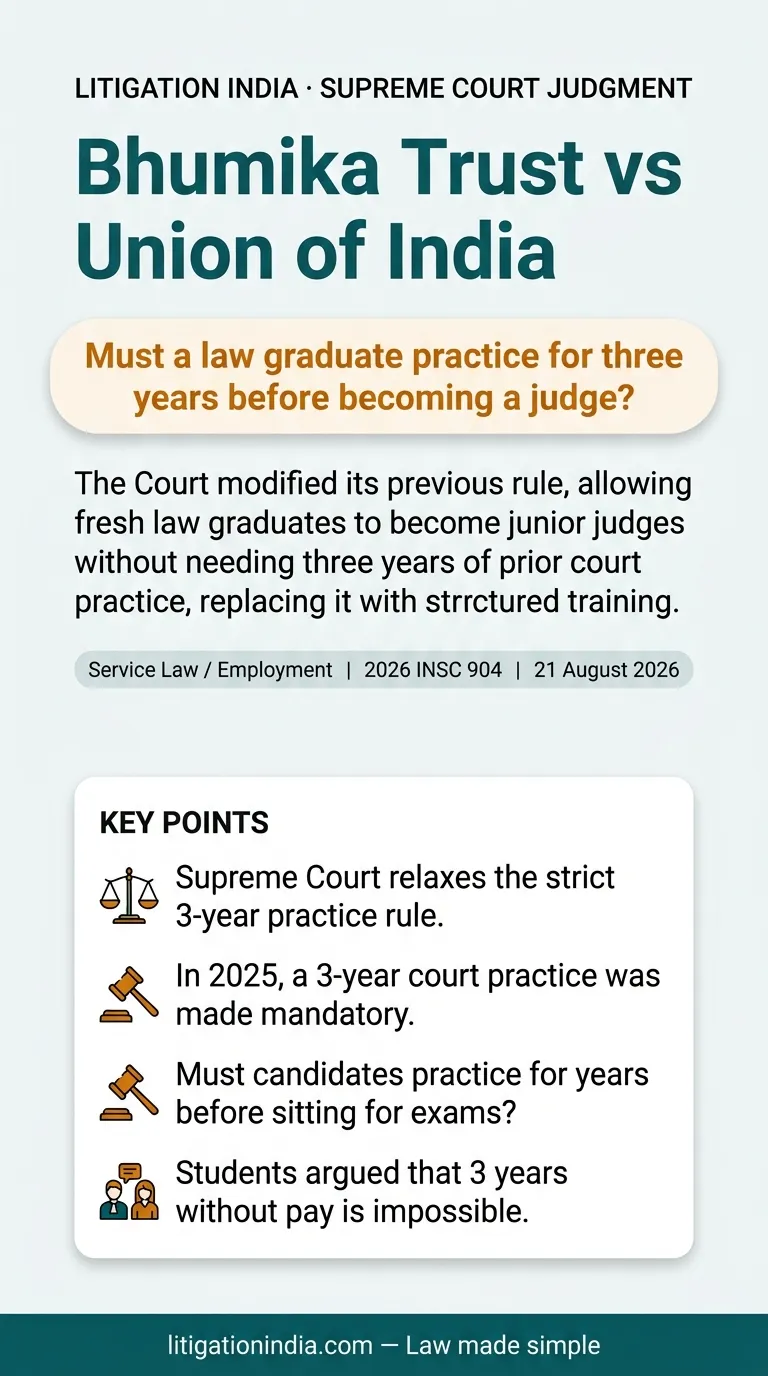
Must a law graduate practice for three years before becoming a judge?

Bhumika Trust vs Union of India

The Court modified its previous rule, allowing fresh law graduates to become junior judges without needing three years of prior court practice, replacing it with structured training.

Litigation India Editorial 21 August 2026 1 min read 2026 INSC 904

Story

Key points1 / 7

Becoming a Judge Made Simpler

  • Supreme Court relaxes the strict 3-year practice rule.
  • Fresh law graduates can now become junior judges.
  • New rules balance practice with intensive training.
Bhumika Trust vs Union of India · 2026 INSC 9042026-08-21T07:45:38.339246+00:00
Key points2 / 7

The Sudden Strict Rule

  • In 2025, a 3-year court practice was made mandatory.
  • Fresh law graduates were suddenly barred from exams.
  • Poor, female, and disabled candidates faced huge financial hardships.
Bhumika Trust vs Union of India · 2026 INSC 9042026-08-21T07:45:38.339246+00:00
Key points3 / 7

The Big Question

  • Must candidates practice for years before sitting for exams?
  • Can academy training substitute for actual court practice?
  • How to make the entry process fair for everyone?
Bhumika Trust vs Union of India · 2026 INSC 9042026-08-21T07:45:38.339246+00:00
Key points4 / 7

Arguments in Court

  • Students argued that 3 years without pay is impossible.
  • High Courts argued that direct college recruits lack court decorum.
  • Disabled groups demanded equal opportunity without barriers.
Bhumika Trust vs Union of India · 2026 INSC 9042026-08-21T07:45:38.339246+00:00
Key points5 / 7

The Smart Middle Path

  • Up to March 2027: Fresh graduates can apply directly.
  • Selected candidates will undergo one year academy training.
  • They will also serve as law clerks for one year.
Bhumika Trust vs Union of India · 2026 INSC 9042026-08-21T07:45:38.339246+00:00
Key points6 / 7

Future Rules Explained

  • From April 2027: Only 1 year of court practice needed.
  • Practice must be verified with active court presence.
  • The post-selection training of two years remains mandatory.
Bhumika Trust vs Union of India · 2026 INSC 9042026-08-21T07:45:38.339246+00:00
Key points7 / 7

Benefit to Common People

  • Ensures future judges are highly skilled and trained.
  • Protects career opportunities for poor and marginalised students.
  • Maintains high quality in the Indian justice system.
Bhumika Trust vs Union of India · 2026 INSC 9042026-08-21T07:45:38.339246+00:00
Bhumika Trust vs Union of India — infographic summary

What this case means

The Court modified its previous rule, allowing fresh law graduates to become junior judges without needing three years of prior court practice, replacing it with structured training.

What the Supreme Court held

The Court modified the rules: for exams up to March 2027, fresh graduates can apply directly but must undergo a two-year trainee and clerkship program after selection. After March 2027, only one year of actual practice is required before applying.

Case: Bhumika Trust vs Union of India (2026) Citation: 2026 INSC 904

Want the full legal reasoning, citations and case documents?

Read the full judgment analysis
Civil Judge Recruitment
Three Years Practice
Judicial Training
Trainee Judicial Officers
Law Clerkship
Service Law / Employment
Supreme Court legal news
Supreme Court judgment today
latest Supreme Court news
More in Service Law / Employment

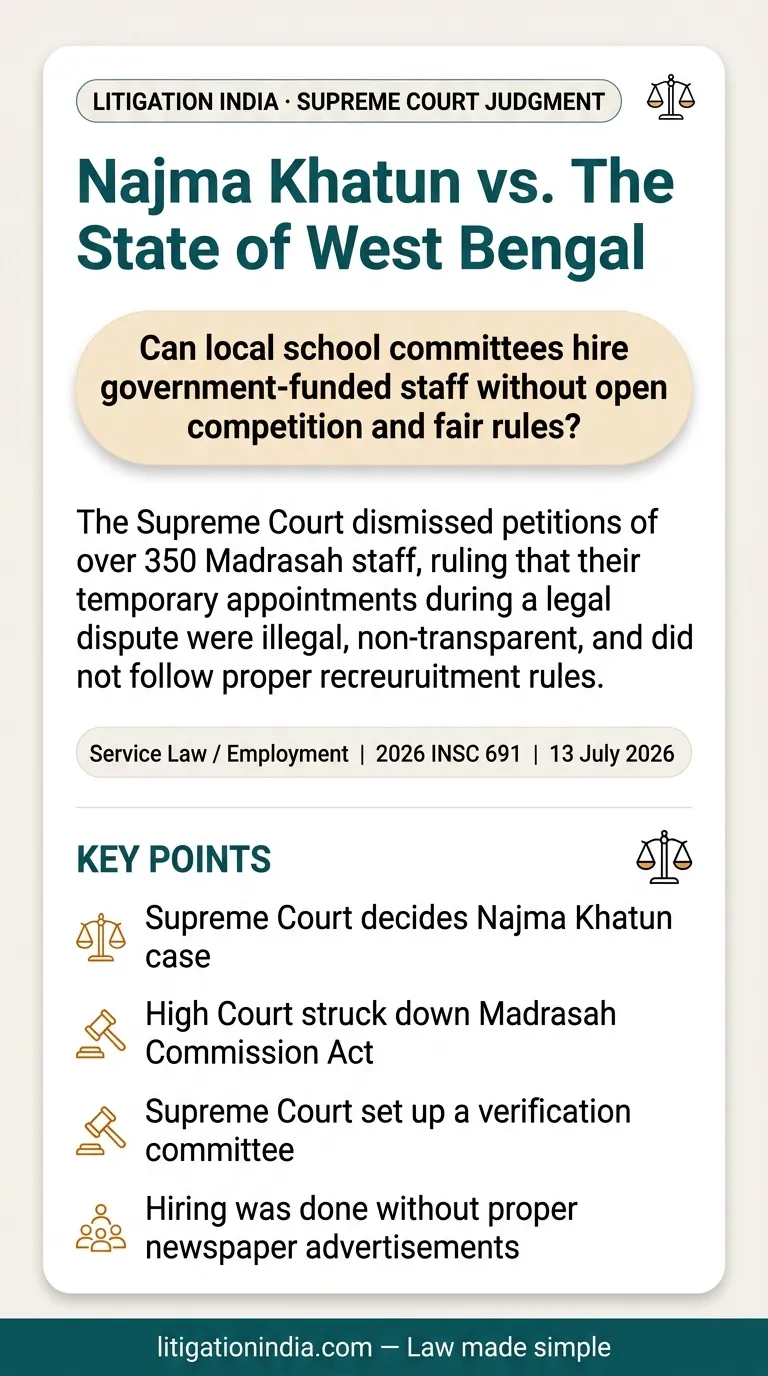
Najma Khatun vs. The State of West Bengal
Service Law / Employment
28 Aug 2026

Najma Khatun vs. The State of West Bengal

The Supreme Court dismissed petitions of over 350 Madrasah staff, ruling that their temporary appointments during a legal dispute were illegal, non-transparent, and did not follow proper recruitment r