
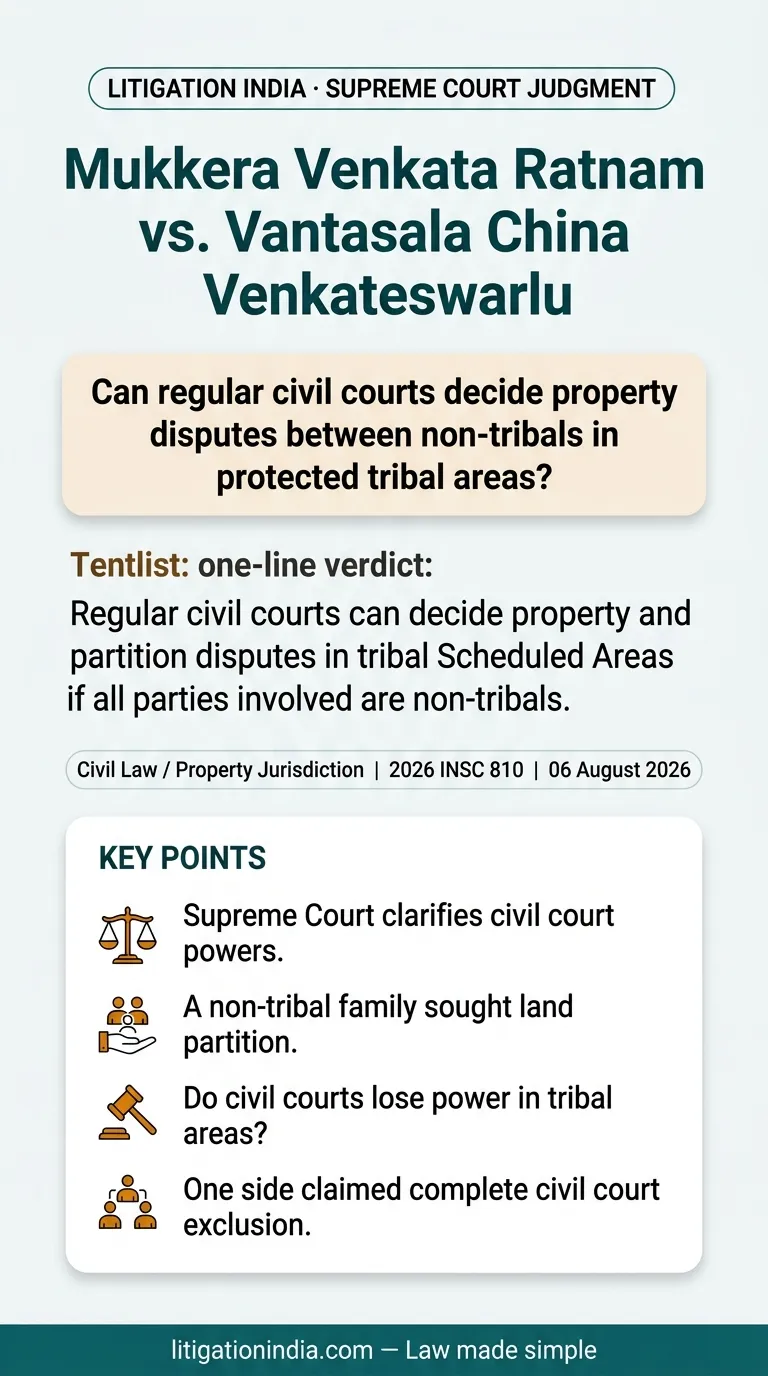
Can regular civil courts decide property disputes between non-tribals in protected tribal areas?
Mukkera Venkata Ratnam vs. Vantasala China Venkateswarlu
Case: Mukkera Venkata Ratnam vs. Vantasala China VenkateswarluCitation: 2026 INSC 810Decided on: 06 August 2026
“Regular civil courts can decide property and partition disputes in tribal Scheduled Areas if all parties involved are non-tribals.”
Case Quick Facts
- Case Title
- Mukkera Venkata Ratnam vs. Vantasala China Venkateswarlu
- Neutral Citation
- 2026 INSC 810
- Bench
- Justice Sanjay Karol, Justice Nongmeikapam Kotiswar Singh
- Date of Judgment
- 06 August 2026
- Area of Law
- Civil Law / Property Jurisdiction
Outcome: Regular civil courts can decide property and partition disputes in tribal Scheduled Areas if all parties involved are non-tribals.
Story Slides
In short
This case resolves whether regular civil courts can handle property disputes located in tribal 'Scheduled Areas' when both parties are non-tribal. The dispute began when a non-tribal family filed a lawsuit in a civil court for partitioning their family land located in a Scheduled Area. The trial court dismissed the suit on facts, but the first appeal court ruled in favor of the family. However, the High Court overturned this, holding that civil courts have zero jurisdiction in Scheduled Areas, even for non-tribals. It relied on a previous ruling which suggested civil court powers are completely void in these regions. The Supreme Court corrected this view. It explained that special rules and 'Agency Courts' are meant only to protect simple tribal populations from being exploited by outsiders. Applying these special procedures to disputes strictly between non-tribals has no logical connection to that goal. Therefore, the Supreme Court ruled that regular civil courts do have the power to decide civil and property matters in Scheduled Areas, provided all parties involved are non-tribals and no tribal interest is affected. However, if even one tribal person is involved, special Agency Courts will still handle the matter. The Supreme Court restored the case to the High Court for a decision on its merits.
Need clarity on a similar legal issue?
Request free pro bono guidance from a Supreme Court Advocate.
Background
A non-tribal family filed a civil lawsuit to divide their ancestral property. However, because the land was located within a protected tribal Scheduled Area, a dispute arose over whether regular civil courts had any authority to hear the case.
The Decision
The Supreme Court ruled that regular civil courts retain their power to decide property and civil disputes in Scheduled Areas if both parties are non-tribals. It set aside the High Court's order and sent the case back to be decided on its merits.
Why it matters for you
This judgment clarifies that laws meant to protect vulnerable tribal communities should not be blindly applied to disputes between non-tribal residents. It ensures that non-tribal families living in these regions can easily resolve private civil matters in regular courts without unnecessary procedural hurdles.
Frequently Asked Questions
AI-assisted summary, reviewed and verified by our editorial team.
Need help with your case?
Facing a property, eviction, or landlord-tenant dispute? Consult our property lawyers for a free initial review.
Related Supreme Court services