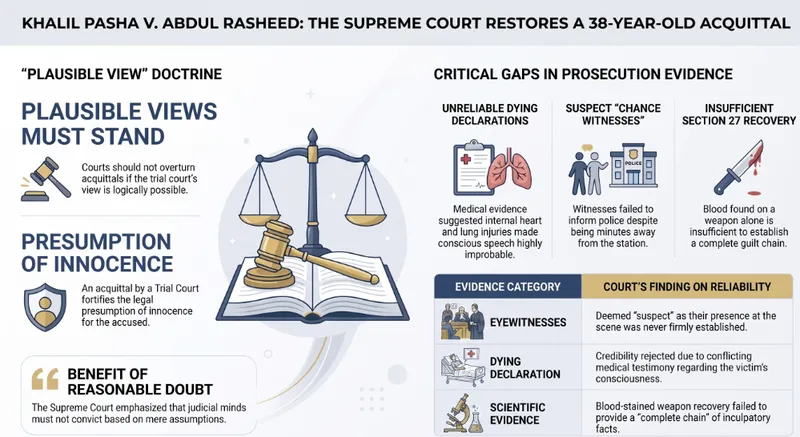
Headline question (English): Can an appellate court overturn a trial court's order of acquittal and remit the case for fresh consideration based on unreliable chance witnesses and an isolated, uncorroborated recovery under Section 27 of the Evidence Act?
********
In short
The Supreme Court of India set aside a Bombay High Court order that had remitted a 1988 murder case back to the Sessions Court for fresh consideration . Re-appreciating the prosecution's evidence, the Supreme Court found it highly suspect and insufficient for conviction . The alleged motive was factual contradicted , the eye-witnesses were categorized as unreliable chance witnesses who exhibited highly unnatural conduct , and the medical evidence directly conflicted regarding the deceased's capacity to make a conscious dying declaration . Additionally, the recovery of a weapon with human blood under Section 27 of the Evidence Act was ruled insufficient to sustain a conviction in isolation . Reaffirming that an acquittal strengthens the presumption of innocence, the Court restored the Trial Court's judgment of acquittal and ordered the immediate release of the accused
“One-line (English): The Supreme Court restored the acquittal of the accused, ruling that a trial court's plausible acquittal cannot be overturned on the basis of unreliable chance witnesses and contradictory medical evidence regarding the deceased's dying declaration.”
Story Slides
Background
The Decision
Why it matters for you
Frequently Asked Questions
Photos