
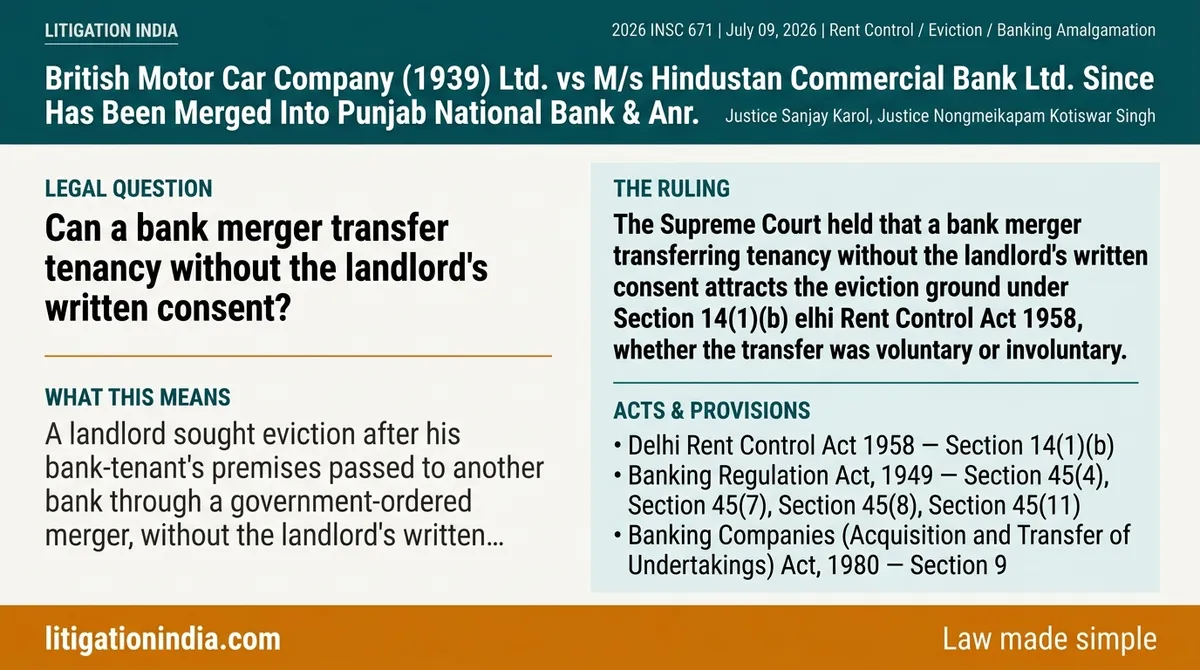
Can a bank merger transfer tenancy without the landlord's written consent?
Bank Merger Without Landlord Consent Triggers Eviction Under Rent Control Law
Case: British Motor Car Company (1939) Ltd. vs M/s Hindustan Commercial Bank Ltd. Since Has Been Merged Into Punjab National Bank & Anr.Citation: 2026 INSC 671Decided on: July 09, 2026
What this case means
A landlord sought eviction after his bank-tenant's premises passed to another bank through a government-ordered merger, without the landlord's written consent. The Supreme Court held that the eviction ground under Section 14(1)(b) of the Delhi Rent Control Act is attracted regardless of whether the transfer was voluntary or involuntary. This ruling clarifies that landlords' consent rights cannot be bypassed even by statutory bank amalgamation schemes.
“The Supreme Court held that a bank merger transferring tenancy without the landlord's written consent attracts the eviction ground under Section 14(1)(b) of the Delhi Rent Control Act 1958, whether the transfer was voluntary or involuntary.”
Case Quick Facts
- Case Title
- British Motor Car Company (1939) Ltd. vs M/s Hindustan Commercial Bank Ltd. Since Has Been Merged Into Punjab National Bank & Anr.
- Neutral Citation
- 2026 INSC 671
- Bench
- Justice Sanjay Karol, Justice Nongmeikapam Kotiswar Singh
- Date of Judgment
- July 09, 2026
Outcome: The Supreme Court held that a bank merger transferring tenancy without the landlord's written consent attracts the eviction ground under Section 14(1)(b) of the Delhi Rent Control Act 1958, whether the transfer was voluntary or involuntary.
Story Slides
In short
British Motor Car Company (1939) Ltd., the landlord, had leased commercial premises at Pratap Building, Connaught Circus, New Delhi to Hindustan Commercial Bank (HCB) in 1947 at Rs. 585 per month. In December 1986, the Government of India, pursuant to a scheme prepared by the Reserve Bank of India under Section 45 of the Banking Regulation Act, 1949, amalgamated HCB with Punjab National Bank (PNB). As a result, all rights and liabilities of HCB, including the tenancy, vested in PNB. The landlord filed an eviction petition under Section 14(1)(b) of the Delhi Rent Control Act 1958, alleging that the tenant had parted with possession without the landlord's written consent. The Additional Rent Controller dismissed the petition, holding the amalgamation scheme was binding on the landlord. The Additional Rent Control Tribunal reversed this, granting eviction. The High Court of Delhi, relying on a case arising under the Banking Companies (Acquisition and Transfer of Undertakings) Act, 1980, set aside the eviction decree, holding the transfer was involuntary and not covered by Section 14(1)(b). The Supreme Court allowed the landlord's appeal. It held that Section 14(1)(b) of the DRC Act does not distinguish between voluntary and involuntary transfers of tenancy rights. The scheme under Section 45 of the BR Act is administrative, not legislative, and cannot override the DRC Act. Once possession and tenancy rights pass to a new entity without the landlord's written consent, eviction grounds are made out. The Court restored the eviction decree but gave the respondents time until January 31, 2027 to vacate, subject to payment of rent and filing an undertaking within four weeks.
Need clarity on a similar legal issue?
Request free pro bono guidance from a Supreme Court Advocate.
Background
In 1947, the appellant landlord leased commercial space in Pratap Building, Connaught Circus, New Delhi to Hindustan Commercial Bank at Rs. 585 per month. In December 1986, the Government of India amalgamated HCB with Punjab National Bank pursuant to a scheme framed by the Reserve Bank of India under Section 45 of the Banking Regulation Act, 1949, causing all rights and liabilities of HCB, including the tenancy, to vest in PNB. The landlord then filed an eviction petition in 1987 alleging that the original tenant had parted with possession of the premises without the landlord's written consent, making the new occupant PNB liable to eviction under Section 14(1)(b) of the Delhi Rent Control Act 1958.
The Decision
The Supreme Court allowed the appellant landlord's appeal and set aside the High Court's judgment dated 12.03.2012 which had set aside the eviction decree. The Court restored the eviction decree passed by the Additional Rent Control Tribunal on 21.05.2001 under Section 14(1)(b) of the Delhi Rent Control Act 1958. However, given the respondents' long possession, the Court granted time until 31st January 2027 to deliver peaceful and vacant possession, subject to filing an undertaking within four weeks and continued payment of rent.
Why it matters for you
This ruling firmly establishes that a landlord's right to written consent before any change of tenant cannot be overridden even by a government-ordered statutory bank merger. It settles that Section 14(1)(b) of the Delhi Rent Control Act applies equally to involuntary transfers of tenancy arising from banking amalgamation schemes under the Banking Regulation Act, 1949. Ordinary property owners can take comfort that their consent rights remain enforceable even against powerful institutional changes beyond their control.
Relevant Legal Provisions
Key Acts and sections cited or relied upon in this judgment
“This provision allows eviction of a tenant who sub-lets, assigns or otherwise parts with possession of premises without the landlord's written consent; the Court held it applies regardless of whether the transfer of tenancy rights was voluntary or involuntary, including transfers resulting from a statutory bank amalgamation scheme.”
“Section 45 empowers the RBI to frame and the Central Government to sanction amalgamation schemes for banking companies; the Court held that the scheme-framing process under Section 45 is administrative and not legislative in nature, and therefore cannot override Section 14(1)(b) of the Delhi Rent Control Act 1958.”
“The Court distinguished schemes framed under Section 9 of this Act, which are legislative in nature because Parliament can modify or reject them, from schemes under Section 45 of the Banking Regulation Act, 1949, which are merely placed before Parliament without further approval, to clarify why the High Court's reliance on a case arising under this Act was misplaced.”
“Article 227 was invoked by the respondents to file a revision petition before the High Court challenging the eviction decree; Article 31-A(1)(c) was cited by the Additional Rent Controller at first instance as a basis for holding the amalgamation scheme binding on the landlord, a reasoning ultimately rejected by the Supreme Court.”
Frequently Asked Questions
AI-assisted summary, reviewed and verified by our editorial team.
In the Court's words
“The applicability of the section depends upon occurrence of a factual situation, namely, sub-letting or assignment or otherwise parting with possession of the whole or any part of the premises by the tenant. Whether it is a voluntary act of the tenant or otherwise and also the reasons for doing so are wholly irrelevant and can have no bearing.”
“Once the possession of the tenanted premises, together with the accompanying rights, passes to an entity other than the original tenant without the written consent of the landlord, and the tenant losing its identity and control of possession of the tenanted premises, Section 14(1)(b) of the DRC Act stands automatically attracted.”
“The amalgamation scheme framed by the Reserve Bank of India, in exercise of power under Section 45(4) of the BR Act, cannot be accorded the status of a statutory enactment so as to override the operation of Section 14(1)(b) of the DRC Act.”
“Parting with the possession of the premises without consent of the landlord was sufficient for eviction of the tenant without getting into the question of subletting or assignment.”
Need help with your case?
Facing a property, eviction, or landlord-tenant dispute? Consult our property lawyers for a free initial review.
Related Supreme Court services