
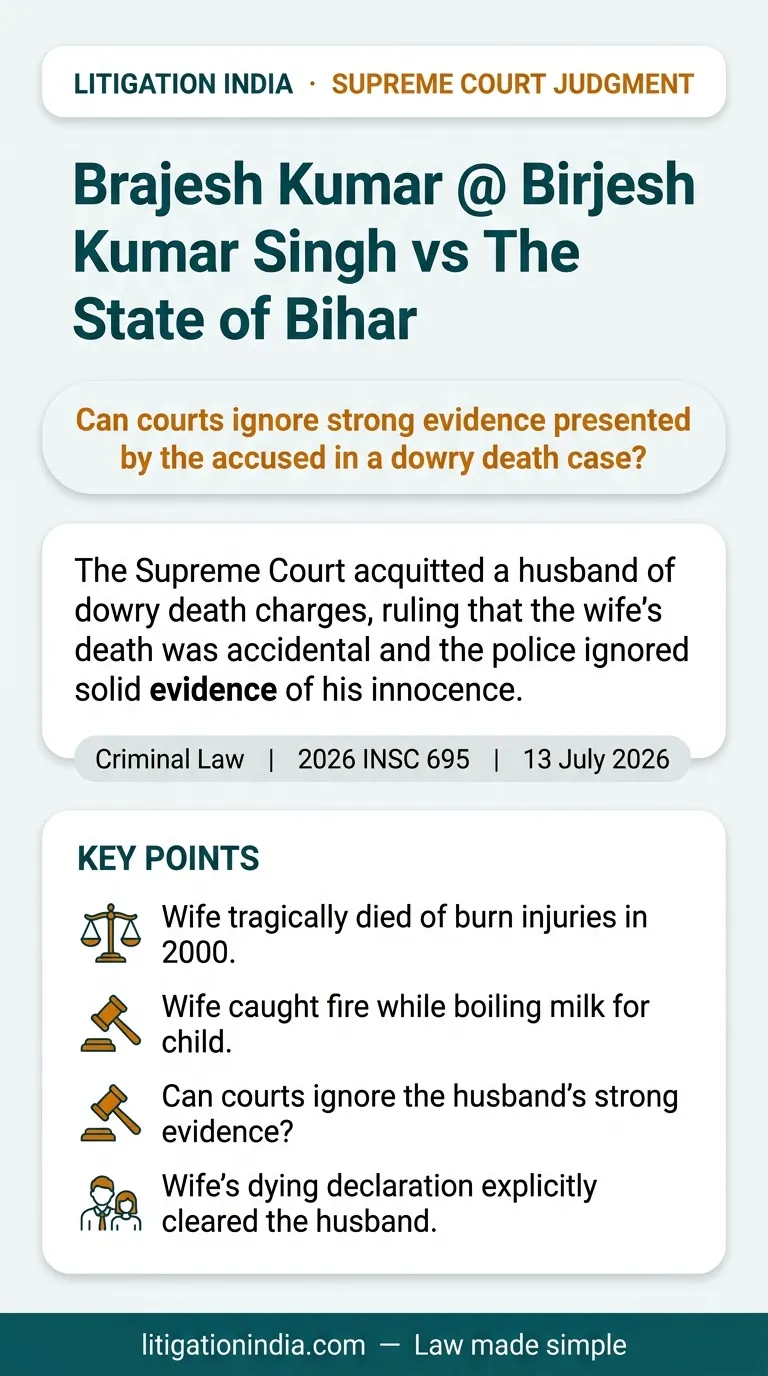
Can courts ignore strong evidence presented by the accused in a dowry death case?
Brajesh Kumar @ Birjesh Kumar Singh vs The State of Bihar
Case: Brajesh Kumar @ Birjesh Kumar Singh vs The State of BiharCitation: 2026 INSC 695Decided on: 13 July 2026
“The Supreme Court acquitted a husband of dowry death charges, ruling that the wife's death was accidental and the police ignored solid evidence of his innocence.”
Case Quick Facts
- Case Title
- Brajesh Kumar @ Birjesh Kumar Singh vs The State of Bihar
- Neutral Citation
- 2026 INSC 695
- Bench
- Justice Sanjay Kumar, Justice K. Vinod Chandran
- Date of Judgment
- 13 July 2026
- Area of Law
- Criminal Law
Outcome: The Supreme Court acquitted a husband of dowry death charges, ruling that the wife's death was accidental and the police ignored solid evidence of his innocence.
Story Slides
In short
The Supreme Court cleared a husband who was convicted of marital cruelty and dowry death following his wife's tragic death from burn injuries in 2000. Originally, seventeen family members were accused, but only the husband was convicted by the trial court, while others were acquitted. The High Court had later sent the case back to the trial court due to a minor procedural issue. Instead of delaying the 25-year-old case further, the Supreme Court decided it on its merits. The Court found massive flaws in the prosecution's case. No postmortem was conducted, and the police failed to collect vital medical documents. Crucially, the wife had given a dying declaration to an Executive Magistrate stating that her clothes caught fire accidentally while boiling milk, and that her husband had tried to save her (even burning his own hand, supported by medical records). The husband also produced documents showing joint bank investments and insurance policies in his wife's name, disproving any financial greed or dowry harassment. The Supreme Court emphasized that trial courts must not treat defence evidence with suspicion or distrust. Since the prosecution could not prove its case beyond reasonable doubt and the husband presented a highly probable story of his innocence, he was entitled to the benefit of the doubt and was fully acquitted.
Need clarity on a similar legal issue?
Request free pro bono guidance from a Supreme Court Advocate.
Background
In April 2000, a woman suffered severe burns at her home and died in a hospital. Her father filed a delayed police complaint alleging she was harassed and killed for a Rs 50,000 dowry, leading to a long trial where only the husband was convicted.
The Decision
The Supreme Court set aside the husband's conviction and acquitted him. The Court ruled that the prosecution failed to prove any dowry demands, while the husband proved the fire was an accident and that he actively tried to save his wife's life.
Why it matters for you
This judgment clarifies that courts must treat the evidence produced by the accused with the same fairness as prosecution evidence. It also rules that a reliable statement of the victim declaring an accident cannot be ignored to secure a conviction.
Frequently Asked Questions
AI-assisted summary, reviewed and verified by our editorial team.
Need help with your case?
Facing a similar legal challenge in the Supreme Court or High Court? Connect with our pro bono volunteer advocates today.
Request Free CallbackRelated Questions of Law
- Can a murder conviction stand on unreliable eyewitnesses and incomplete circumstantial evidence?
- Can a person be convicted of murder if the police investigation is highly careless
- Can helpers escape a murder conviction if they did not fire the fatal shot?
- Do normal family fights mean a husband forced his wife to commit suicide?
- Can courts convict someone based on electronic evidence that lacks a legal certificate?