
Can courts use new laws to change sentences for older crimes?
Balesh Kumar Kuraiti vs. State of Chhattisgarh
Case: Balesh Kumar Kuraiti vs. State of ChhattisgarhCitation: 2026 INSC 850Decided on: 12 August 2026
“The Supreme Court restored the life imprisonment sentence of a man who sexually assaulted a three-year-old girl, ruling that courts cannot apply newer, harsher laws retrospectively to reduce or modify sentences.”
Case Quick Facts
- Case Title
- Balesh Kumar Kuraiti vs. State of Chhattisgarh
- Neutral Citation
- 2026 INSC 850
- Bench
- Justice Aravind Kumar, Justice Vipul M. Pancholi
- Date of Judgment
- 12 August 2026
- Area of Law
- Criminal Law
Outcome: The Supreme Court restored the life imprisonment sentence of a man who sexually assaulted a three-year-old girl, ruling that courts cannot apply newer, harsher laws retrospectively to reduce or modify sentences.
Story Slides
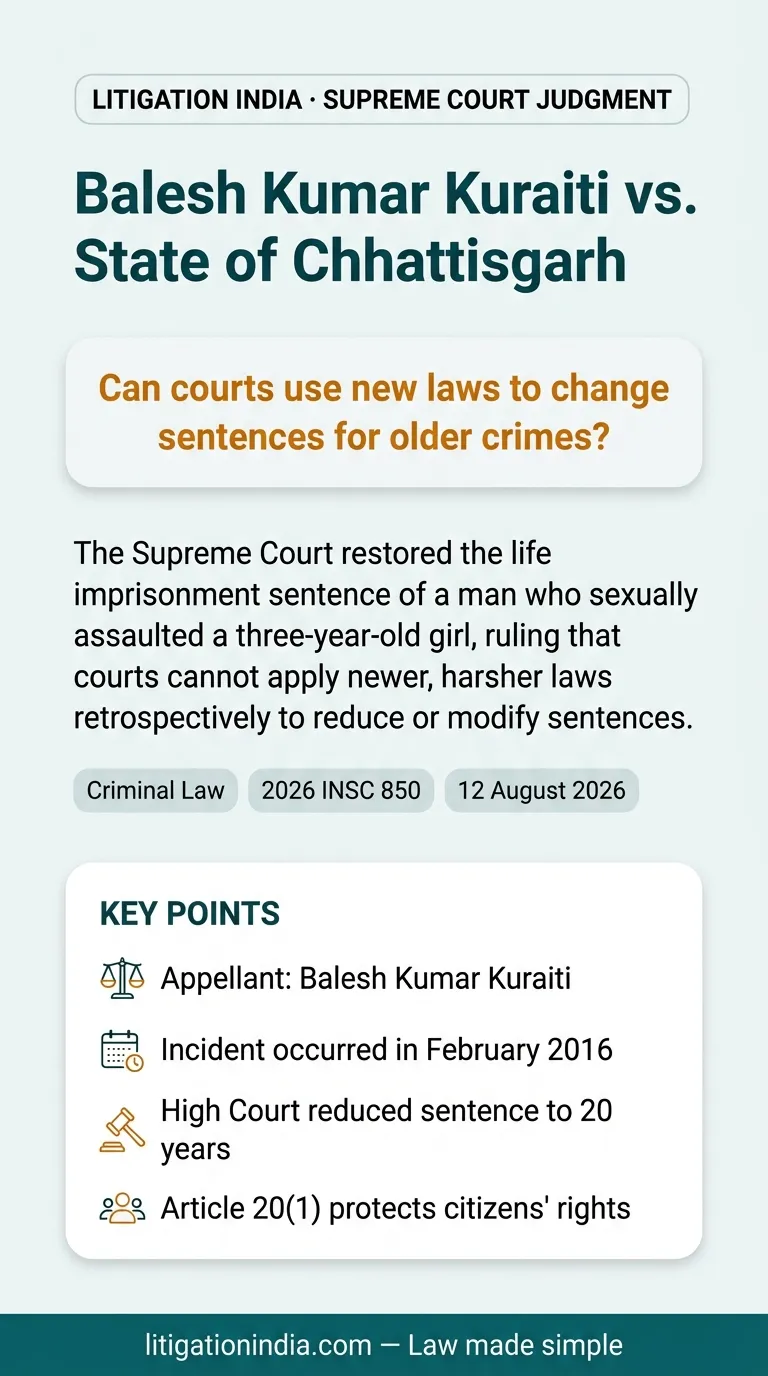
In short
This case involves the horrific sexual assault of a three-year-old girl in 2016 by the appellant, Balesh Kumar Kuraiti. The Trial Court convicted him under Section 376(2)(i) of the Indian Penal Code and Section 6 of the Protection of Children from Sexual Offences (POCSO) Act, sentencing him to life imprisonment. However, the Chhattisgarh High Court modified this sentence to 20 years of rigorous imprisonment, mistakenly applying the 2019 POCSO Amendment Act which had increased the minimum sentence for offences committed after 2019. The Supreme Court set aside the High Court’s order and restored the life imprisonment sentence. It clarified that under Article 20(1) of the Indian Constitution, criminal laws and harsher punishments cannot be applied retrospectively. A person can only be punished based on the law active at the time the crime was committed. Since the crime occurred in 2016, the pre-amendment POCSO Act applied, which allowed for life imprisonment. The Court criticized the High Court for reducing the sentence without valid reasons, especially given the extreme gravity of the crime against a vulnerable toddler. The Supreme Court emphasized that protecting children from barbaric acts is paramount and directed authorities to make the legal system less intimidating for child victims.
Need clarity on a similar legal issue?
Request free pro bono guidance from a Supreme Court Advocate.
Background
In February 2016, a three-year-old girl was brutally sexually assaulted by the appellant, who was a guest at her family's relative's house. Forensic reports and medical examinations confirmed the horrific injuries and assault.
The Decision
The Supreme Court set aside the High Court's decision and restored the Trial Court's sentence of life imprisonment, ruling that the 2019 POCSO amendment could not be applied to a 2016 crime.
Why it matters for you
This judgment reinforces that courts must strictly follow the constitutional rule against applying criminal laws retrospectively. It also highlights the judiciary's commitment to ensuring maximum punishment for heinous crimes against young children.
Frequently Asked Questions
AI-assisted summary, reviewed and verified by our editorial team.
Need help with your case?
Facing a similar legal challenge in the Supreme Court or High Court? Connect with our pro bono volunteer advocates today.
Related Supreme Court services
Related Questions of Law
- Can a murder conviction stand on unreliable eyewitnesses and incomplete circumstantial evidence?
- Can a person be convicted of murder if the police investigation is highly careless
- Can helpers escape a murder conviction if they did not fire the fatal shot?
- Do normal family fights mean a husband forced his wife to commit suicide?
- Can courts convict someone based on electronic evidence that lacks a legal certificate?