Updates
Criminal Law / Quashing of FIR
Verified 24 views

Supreme Court Quashes FIR Against GPA Holder in Civil Property Dispute

Sudha Rakesh vs The State of Karnataka & Anr.

The big legal question

Can a GPA holder face criminal charges when landowners were already exonerated?

What this case means

A GPA holder was named in a cheating FIR after land she sold on behalf of landowners was claimed by a prospective buyer who had failed to act within the agreed time. The Supreme Court quashed the FIR, holding that a purely civil property dispute had been given a criminal colour. The Court emphasised that since the FIR was already quashed against the landowners, there was no basis to treat the GPA holder differently.

“The Supreme Court quashed the FIR against the GPA holder, holding that a civil property dispute was wrongly given a criminal colour and that judicial consistency required the same relief as was given to the landowners.”

Share:

Story Slides

Case at a glance1 / 6

Supreme Court of India

Civil Dispute Dressed as Crime: FIR Quashed Against GPA Holder

Sudha Rakesh v. State of Karnataka & Anr. | 2026 INSC 1086

Court: Supreme Court of India | Date: October 05, 2026Bench: Justice Satish Chandra Sharma and Justice Nongmeikapam Kotiswar SinghArea of law: Criminal Law — Quashing of FIR, Civil vs Criminal LiabilityFIR under Sections 420, 423, 120-B read with Section 34 IPC quashed
Sudha Rakesh vs The State of Karnataka & Anr. · 2026 INSC 1086October 05, 2026
The legal question2 / 6

Can a GPA Holder Face Criminal Charges When Landowners Were Already Exonerated?

Core legal issue before the Supreme Court

  • Appellant: Petitioner was only a GPA holder and confirming party; dispute is purely civil; landowners were exonerated.
  • Appellant: Coordinate bench ought to have followed earlier judgment quashing the FIR against landowners.
  • Respondent: Petitioner was the principal actor, received the amounts, signed the 2012 agreement as PoA holder.
  • Respondent: There is a triable issue whether consideration was transmitted to landowners; High Court rightly distinguished the case.
Sudha Rakesh vs The State of Karnataka & Anr. · 2026 INSC 1086October 05, 2026
Statutory comparison3 / 6

High Court's Grounds vs Supreme Court's Analysis

Why the High Court's distinction was held erroneous

Ground Used by High CourtSupreme Court's Ruling
Amounts were received by petitionerConsideration was received collectively; physical receipt alone does not elevate culpability
Petitioner signed 2012 agreement as PoA holderExecuted on behalf of landowners; no allegation of acting outside GPA authority
Land sold at lesser valuePurely speculative; equally applicable to landowners; not an incriminating circumstance
Triable issue on transmission of consideration to landownersLandowners raised no misappropriation allegation; High Court traversed beyond scope of allegations
Sudha Rakesh vs The State of Karnataka & Anr. · 2026 INSC 1086October 05, 2026
The Court's reasoning4 / 6

How the Court Reached Its Decision Step by Step

The Court's legal reasoning in sequence

  1. 1Step 1: Prospective buyers failed to act on the 2012 agreement within 7 months or even before limitation expired.
  2. 2Step 2: Landowners and petitioner lawfully sold to a third party in 2016; FIR lodged only after civil suit was filed.
  3. 3Step 3: FIR already quashed against landowners — petitioner's role was no more aggravated than theirs.
  4. 4Step 4: Ingredient of cheating (Section 420 IPC) absent; Section 423 IPC mis-invoked — no false statement in any document.
  5. 5Step 5: Judicial consistency required the FIR to be quashed against the petitioner as well.
Sudha Rakesh vs The State of Karnataka & Anr. · 2026 INSC 1086October 05, 2026
The verdict5 / 6

The Verdict: FIR Quashed, Civil Dispute Restored to Civil Court

  • The Fact: Prospective buyers did not complete the purchase within agreed time; land was legally sold to another party after expiry of limitation.
  • The Law: Cheating under Section 420 IPC requires deception inducing delivery; Section 423 IPC requires a false statement in a transfer document — neither ingredient was present.
  • The Result: SLP allowed; High Court order of 19.09.2022 set aside; FIR No. 121/2016 and all consequential proceedings quashed.
FIR No. 121/2016, PS Kadugodi, along with all consequential proceedings, stands quashed.
Sudha Rakesh vs The State of Karnataka & Anr. · 2026 INSC 1086October 05, 2026
Why it matters6 / 6

What This Means for Ordinary People

Practical significance of the judgment

  • Filing a criminal complaint just because a civil property deal went wrong can be challenged as an abuse of process.
  • A person acting as a GPA holder within the scope of authority cannot face harsher criminal liability than the property owners themselves.
  • Courts must ensure consistency: if one accused is exonerated, a similarly placed co-accused cannot be prosecuted for the same act.
  • Prospective buyers who fail to honour agreements within the stipulated time cannot later use criminal law to pressurise sellers.
A civil dispute cannot be given a criminal colour to pressurise the other side — courts will quash such FIRs.
Sudha Rakesh vs The State of Karnataka & Anr. · 2026 INSC 1086October 05, 2026

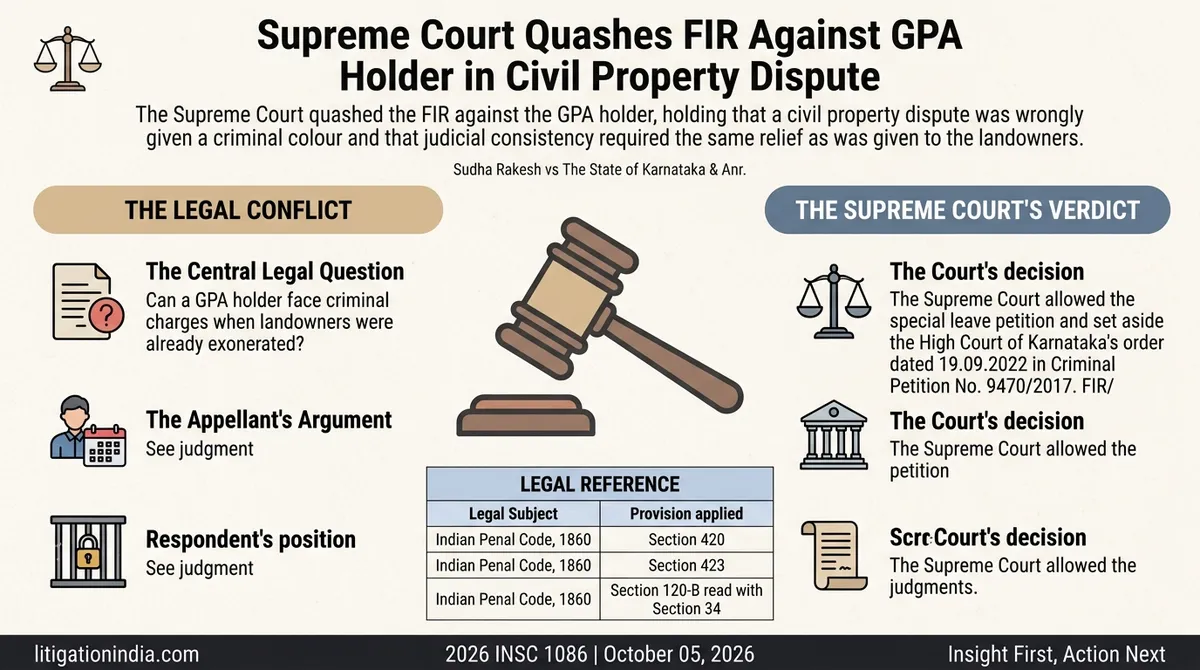
At a glance (infographic)

Sudha Rakesh vs The State of Karnataka & Anr. — infographic summary
Download infographic

In short

The case arose from a land transaction in Karnataka. One Ganesh owned a piece of land which, after his intestate death, was inherited by his wife and legal heirs. The landowners executed an agreement for sale and a General Power of Attorney in favour of the petitioner, Sudha Rakesh, on 05.10.2012. The petitioner, acting as GPA holder, then entered into another agreement dated 19.11.2012 with the prospective buyers — Respondent No. 2 and one Kalpana Sure — for the sale of the same land. The prospective buyers were required to pay the balance consideration and come forward for execution of the sale deed within 7 months. They failed to do so. After waiting beyond even the limitation period for specific performance, the petitioner and landowners sold the land to Gaffar Baig by a sale deed dated 11.02.2016. The prospective buyers then filed a civil suit for specific performance and also lodged an FIR on 13.05.2016 under Sections 420, 423, and 120-B read with Section 34 of the IPC. The Magistrate took cognizance on 28.09.2017. The landowners obtained quashing of the FIR from the Karnataka High Court in 2017. However, the petitioner's quashing petition was dismissed in 2022. The High Court distinguished the petitioner on the grounds that she received the amounts, signed the 2012 agreement, was a confirming party to the 2016 sale deed, and that there was a triable issue about transmission of consideration to landowners. The Supreme Court found the High Court's reasoning erroneous. It held that the petitioner's role was not more aggravated than the landowners — the sale deed was executed by the landowners, the consideration was collectively received, and no allegation of misappropriation was made by the landowners. The Court also held that the foundational ingredient of cheating was missing, and Section 423 IPC was mis-invoked. The FIR was quashed.

Background

Landowners who inherited property from Ganesh executed a sale agreement and GPA in favour of the petitioner in 2012. The petitioner, as GPA holder, agreed to sell the land to prospective buyers who failed to complete the purchase within 7 months or thereafter. The petitioner and landowners then sold the land to a third party in 2016, after which the prospective buyers filed both a civil suit for specific performance and a criminal FIR alleging cheating and criminal conspiracy.

The Decision

The Supreme Court allowed the special leave petition and set aside the High Court of Karnataka's order dated 19.09.2022 in Criminal Petition No. 9470/2017. FIR/Crime No. 121/2016 at PS Kadugodi and all consequential proceedings were quashed. The Court held that the petitioner's culpability could not be stretched beyond that of the landowners, who had already obtained quashing of the same FIR.

Why it matters for you

This judgment reinforces the principle that courts must guard against misuse of criminal law to pressurise parties in civil property disputes. It establishes that a GPA holder acting within the scope of authority cannot face harsher criminal treatment than the principals themselves. It also reaffirms that judicial consistency requires co-ordinate benches to follow earlier decisions on the same FIR.

Relevant Legal Provisions

Key Acts and sections cited or relied upon in this judgment

“Section 420 deals with cheating and dishonestly inducing delivery of property; the Court held that the foundational ingredient of cheating — a deceptive act inducing delivery of property — was missing because the money was paid under the 2012 agreement without any deception at that time.”
“Section 423 requires a false statement as to consideration in an instrument of transfer; the Court held it was mis-invoked as there was no false statement in the agreement dated 19.11.2012 or in the sale deed.”
“Section 120-B deals with criminal conspiracy and Section 34 with common intention; both were invoked in the FIR but the Court found no basis to sustain these charges against the petitioner given that her role was not more aggravated than that of the landowners.”

Full text of the judgment

Text extracted from Sudha Rakesh vs The State of Karnataka & Anr.. For the authoritative version refer to the Supreme Court of India's official website.

2026 INSC 1086 SLP (Criminal) No. 12638 of 2022 Page 1 of 9

REPORTABLE IN THE SUPREME COURT OF INDIA EXTRA-ORDINARY CRIMINAL JURISDICTION SPECIAL LEAVE PETITION (CRL.) NO. 12638 OF 2022

SUDHA RAKESH

...PETITIONER VERSUS THE STATE OF KARNATAKA & ANR. ...RESPONDENT(S)

J U D G M E N T

SATISH CHANDRA SHARMA, J.

1. The tendency of litigants to colourize civil disputes into criminal offences is an open secret in the present times. The courts have tried to put their foot down to prevent the litigants from obliterating the fine distinction between the two. We have done so to prevent the abuse of criminal process. The instant case presents a similar opportunity. Digitally signed by RAHUL KUMAR Date: 2026.10.05 18:15:16 IST Reason: Signature Not Verified

SLP (Criminal) No. 12638 of 2022 Page 2 of 9

2. The facts lie within a narrow compass. One Ganesh was the owner of a piece of land bearing survey no. 115, admeasuring 4 acres 19 guntas, located in Channasandra Village, Karnataka. He died intestate and after demise, the said land was inherited by his wife and other legal heirs (“landowners”). The landowners entered into an agreement for sale dated 05.10.2012 purporting to sell the subject land in favour of the petitioner herein. They also executed a General Power of Attorney (“GPA”) dated 05.10.2012 in favour of the petitioner. Thereafter, the landowners, acting through their GPA holder/petitioner, entered into another agreement dated 19.11.2012 with respondent no. 2 and one Kalpana Sure (“prospective buyers”) for sale of the subject land. 3. As per this agreement, the prospective buyers were required to pay the balance sale consideration and come forward for execution of sale deed within 7 months from the date of agreement. They never turned up. The petitioner and landowners waited even beyond the period of 7 months and till the expiry of the limitation period for seeking specific performance. The prospective buyers took no action whatsoever and eventually, the petitioner and landowners sold the subject land by executing a sale deed dated 11.02.2016 in favour of one Gaffar Baig (“ultimate buyer”).

SLP (Criminal) No. 12638 of 2022 Page 3 of 9

4. Immediately thereafter, the prospective buyers instituted a civil suit for specific performance of the agreement for sale executed on 19.11.2012. Subsequently, they also lodged a criminal complaint on 13.05.2016, which was registered as FIR No. 121/2016 under Sections 420, 423, 120-B read with Section 34 of Indian Penal Code, 1860 (“IPC”). The petitioner was named as an accused in the said FIR along with the landowners. After the filing of final report, the Magistrate took cognizance of the offences on 28.09.2017. 5. Against the said FIR and order of cognizance, the landowners preferred a quashing petition before the High Court of Karnataka. Vide order dated 22.11.2017 passed in Criminal Petition No. 9095/2016, the High Court quashed the FIR qua the landowners. 6. Thereafter, the petitioner also filed a quashing petition before the High Court. However, his petition was dismissed on merits vide order dated 19.09.2022 passed in Criminal Petition No. 9470/2017 (“impugned order”). 7. Taking exception to the impugned order, the petitioner submits that he was similarly placed with the landowners and the coordinate bench ought to have followed the earlier judgment, whereby the case against the landowners was quashed. He submits that the dispute is purely civil in nature and there is no

SLP (Criminal) No. 12638 of 2022 Page 4 of 9

element of criminality to sustain the FIR in question. He further submits that he was merely a GPA holder on behalf of the landowners and the sale deed was executed by the landowners, with the petitioner only being a confirming party. Therefore, there is no reason to deprive the petitioner from similar consideration. 8. Per contra, Respondent no. 2 submits that the High Court has rightly distinguished the petitioner’s case from the landowners. It is submitted that the petitioner was not merely a confirming party, but a principal actor. To buttress, it is submitted that the amounts were received by the petitioner herself. It is further submitted that the sale deed dated 11.02.2016 was executed on the basis of material concealment of the preexisting agreement dated 19.11.2012 in favour of the respondent. 9. The State has also filed its objections against the prayer sought in the present petition. The submissions of the State are on similar lines and are not reproduced for brevity. 10. We have heard learned counsel for the parties and have carefully gone through the record including the written submissions. 11. The admitted position indicates that the agreement for sale dated 19.11.2012 was supposed to be acted upon within 7 months

SLP (Criminal) No. 12638 of 2022 Page 5 of 9

of its execution. It is not denied that the same was not acted upon within the stipulated time and even thereafter, till the execution of sale deed on 11.02.2016. After the sale deed, respondent no. 2 woke up and instituted the suit for specific performance of the agreement dated 19.11.2012. We consciously refrain from expressing any observation regarding the merits of the said suit or the elements of readiness and willingness. The same ought to be adjudicated by the concerned civil court. 12. What is relevant for our consideration is that after the institution of civil suit, respondent no. 2 also lodged an FIR for the commission of offences mentioned above. While quashing the said FIR qua the landowners in Crl. Petition No. 9095/2016, the High Court observed thus: “4…. Therefore, when the complainant has already approached the civil court and in view of the long delay in moving for getting the sale deed executed, in my opinion, it is purely a civil transaction between the parties which has been given a criminal colour by the complainant (respondent herein) for such type for proceedings, when the factual aspects clearly disclose there is not even a tinge of criminal attitude on the part of the petitioners.”

13. Evidently, the petitioner’s petition for quashing of the same FIR was listed before a different bench. While denying similar relief to the petitioner, the coordinate bench distinguished

SLP (Criminal) No. 12638 of 2022 Page 6 of 9

the petitioner’s case from that of the landowners by observing that – the amounts were received by the petitioner; agreement dated 19.11.2012 was signed by the petitioner as PoA holder; petitioner was confirming party to the sale deed; land was sold at a lesser value to the ultimate buyer; and existence of triable issue whether the consideration received by the petitioner was eventually transmitted to the landowners or not. 14. On a consideration of the distinguishing features noted in the impugned judgment, we are of the clear view that the High Court has fallen into error, and a grave one. The FIR alleges the commission of offence by the landowners as well as the petitioner. The allegation is based on the execution of sale deed, and the sale deed was executed by the landowners themselves. The petitioner was only a confirming party. If no criminality could be attributed to the landowners by virtue of the execution of sale deed, it cannot be sustained against the petitioner as well. For, there is nothing to attribute any aggravated role to the petitioner. The consideration was also received collectively by the landowners and petitioner. Merely because it was physically received by the petitioner on behalf of all of them, it does not place him at a different pedestal. The agreement dated 19.11.2012 was, no doubt, executed by the petitioner only, however, it was executed on behalf of the landowners and there is no allegation that the petitioner executed the same in violation

SLP (Criminal) No. 12638 of 2022 Page 7 of 9

of the authority conferred upon him by the landowners or by keeping them in the dark. 15. The fact that the property was eventually sold at a lesser price should not have weighed with the High Court. It is purely a speculative line of reasoning and cannot be treated as an incriminating circumstance. Moreover, even if it is incriminating, the same ought to have incriminated the landowners as well. For, the property was sold by all the accused persons and not by the petitioner alone. If the said fact has not weighed against the landowners, it could not have been of any consequence against the petitioner. 16. The High Court further erred in posing to itself a hypothetical question i.e. whether the sale consideration was transmitted by the petitioner to the landowners or not. The High Court observed that it is a triable question, without regard to the fact that the said question does not even fall within the ambit of the allegations. The landowners have not raised any allegation against the petitioner regarding misappropriation of sale consideration meant for them. In order to distinguish the petitioner’s case, the High Court has traversed beyond the scope of the allegations. 17. Notably, the offence of cheating requires a deceptive act which leads to inducement for delivery of property/money. Even

SLP (Criminal) No. 12638 of 2022 Page 8 of 9

on bare perusal of the allegations, it becomes clear that the property (that is the amount transferred by respondent no. 2 at the time of agreement for sale dated 19.11.2012) was not transferred on the basis of any deception. At that time, the property could have legitimately been transferred in favour of respondent no. 2 and there was no deception. The subsequent sale took place in 2016, almost 4 years after the alleged delivery of money by respondent no. 2. Thus, the foundational ingredient of cheating is missing. Section 423 IPC is also mis-invoked in the FIR. It requires a false statement as to consideration in an instrument of transfer. There is no such false statement in the agreement dated 19.11.2012 or in the sale deed. Even if there is any false averment in the sale deed, it ought to have created a right in favour of the ultimate buyer Mr. Gaffar Baig and not respondent no. 2 herein. It is a classic case of casting the shadow of criminality on a pure civil dispute. 18. In view of the above, we are of the considered opinion that the FIR was rightly quashed by the High Court against the landowners and there was absolutely no reason for the coordinate bench to deprive the petitioner from the same relief. His culpability could not have been stretched beyond that of the landowners. The High Court, in the peculiar facts of the case, ought to have adhered to the principle of judicial consistency and propriety.

SLP (Criminal) No. 12638 of 2022 Page 9 of 9

19. Accordingly, the instant petition is allowed. The impugned judgment dated 19.09.2022 passed by the High Court of Karnataka in Criminal Petition No. 9470/2017 is set aside. Consequently, the proceedings in FIR/Crime No. 121/2016 PS Kadugodi, along with all consequential proceedings, stand quashed. 20. The petition stands disposed of along with pending application(s), if any.

....................................................................... J. [SATISH CHANDRA SHARMA]

..........................................................................J. [NONGMEIKAPAM KOTISWAR SINGH]

NEW DELHI October 05, 2026.

AI-assisted summary, reviewed and verified by our editorial team.

In the Court's words

“The tendency of litigants to colourize civil disputes into criminal offences is an open secret in the present times.”
“If no criminality could be attributed to the landowners by virtue of the execution of sale deed, it cannot be sustained against the petitioner as well. For, there is nothing to attribute any aggravated role to the petitioner.”
“The High Court further erred in posing to itself a hypothetical question i.e. whether the sale consideration was transmitted by the petitioner to the landowners or not.”
“It is a classic case of casting the shadow of criminality on a pure civil dispute.”

Need help with your case?

Facing a similar legal challenge in the Supreme Court or High Court? Connect with our pro bono volunteer advocates today.

Request Free Callback
Litigation India

Insight First, Action Next. A public-service initiative to make justice understandable for every Indian.

contact@litigationindia.com

+91 9956486585

New Delhi, India

Quick Links

Our Mission

To empower ordinary citizens, litigants, and junior advocates across India by translating complex Supreme Court of India judgments into editor-verified, plain-language summaries in both English and Hindi. We aim to bridge the gap between judicial proceedings and everyday citizens by delivering verified legal insights and offering free, pro bono guidance from experienced Supreme Court advocates—ensuring no individual suffers injustice merely for lack of correct guidance.

Legal Disclaimer: The information provided on this website is for general informational purposes only and does not constitute legal advice. Accessing this website or receiving any guidance does not create an attorney-client relationship. A formal attorney-client relationship is established only upon signing a formal engagement agreement with a lawyer. Litigation India is an informational platform — it does not provide legal representation, legal services, or legal advice.

Disclaimer: These summaries are provided for general public understanding only and do not constitute legal advice. Please consult a qualified advocate before acting on any information relating to your specific matter.

© 2026 Litigation India. All rights reserved.