Updates
Criminal Law / Quashing of FIR
21 views

Supreme Court Quashes FIR in Consensual Relationship Gone Sour Case

Sachin Gupta vs The State of Chhattisgarh and Anr.

The big legal question

Can an FIR be quashed when rape allegation masks a consensual relationship?

What this case means

The Supreme Court quashed an FIR and charge sheet alleging rape and assault against the appellant, finding the relationship was consensual and the complaint was filed to coerce the appellant into marriage. Applying a four-step test from precedent, the Court held no purpose would be served by trial. The judgment clarifies when High Courts must exercise quashing powers under Section 482 CrPC.

“The Supreme Court quashed the FIR and charge sheet finding the relationship was consensual and the complaint was filed solely to coerce marriage.”

Share:

Story Slides

Case at a glance1 / 6

Supreme Court of India

FIR Quashed: Rape Allegation Filed to Coerce Marriage

Sachin Gupta vs State of Chhattisgarh & Anr. | 2026 INSC 1082

Court: Supreme Court of India | Date: October 01, 2026Bench: Justice J. B. Pardiwala and Justice K. Vinod ChandranArea of law: Criminal Law — Quashing of FIR under Section 482 CrPCFIR alleged rape and refusal to marry; charge sheet filed in Ambikapur court
Sachin Gupta vs The State of Chhattisgarh and Anr. · 2026 INSC 1082October 01, 2026
The legal question2 / 6

Should the FIR be quashed when the complainant admits filing it to coerce marriage?

Core legal issue before the Supreme Court

  • Appellant: Relationship was consensual; FIR is a counter-blast to his prior complaints and extortion demands.
  • Appellant: Rape allegation delayed over 1.5 years; hotel incident unreported; no medical proof of abortions.
  • Respondent State: High Court rightly refused to quash; FIR raises serious allegations requiring trial.
  • Second Respondent: Did not appear before the Supreme Court despite notice.
Sachin Gupta vs The State of Chhattisgarh and Anr. · 2026 INSC 1082October 01, 2026
The Court's reasoning3 / 6

Four-Step Quashing Test Applied by the Court

From Pradeep Kumar Kesarwani v. State of UP (2025 SCC OnLine SC 1947)

  1. 1Step 1: Appellant's material (payments made, two prior complaints) is of sterling quality — YES.
  2. 2Step 2: Material rules out the charges — rape allegation delayed 1.5 years; promise to marry was not the inducement for sex.
  3. 3Step 3: Material unrebutted — hotel incident never reported; no medical corroboration of abortions.
  4. 4Step 4: Trial would serve no purpose — complaint explicitly filed to coerce marriage, not to seek justice.
  5. 5Conclusion: All four steps answered YES; High Court should have quashed under Section 482 CrPC.
Sachin Gupta vs The State of Chhattisgarh and Anr. · 2026 INSC 1082October 01, 2026
Key points4 / 6

Key Distinction: Promise to Marry as Inducement vs. Post-Rape Promise

A critical legal distinction drawn by the Court

  • Rape by false promise: accused promises marriage before sex to obtain consent — this is a recognised offence.
  • Present case: second respondent alleged rape first; promise to marry came after, to prevent reporting.
  • No allegation that promise of marriage was proffered to entice her into a sexual relationship.
  • This distinction meant the FIR lacked the foundational element of rape by false promise.
The allegation of rape is delayed by more than one and a half years — a significant factor against credibility.
Sachin Gupta vs The State of Chhattisgarh and Anr. · 2026 INSC 1082October 01, 2026
The verdict5 / 6

Supreme Court's Final Decision

Appeal allowed; FIR and charge sheet quashed

  • The Fact: Consensual relationship soured; FIR filed explicitly to coerce appellant into marriage.
  • The Law: Section 482 CrPC empowers High Court to quash; all four steps of the quashing test were satisfied.
  • The Result: High Court order set aside; charge sheet No. 5 of 2026 and FIR quashed; no proceedings to continue against any accused.
No criminal proceedings shall be continued against the appellant or any other accused in the above FIR.
Sachin Gupta vs The State of Chhattisgarh and Anr. · 2026 INSC 1082October 01, 2026
Why it matters6 / 6

What This Judgment Means for Ordinary People

Practical significance

  • Courts will scrutinise whether a rape complaint is genuinely seeking justice or is filed to coerce someone.
  • A long delay in reporting rape and absence of corroborating evidence weigh heavily against the complainant.
  • When a complainant's own words reveal a coercive motive, courts must exercise quashing powers under Section 482 CrPC.
  • This ruling protects individuals from prolonged criminal trials founded on non-bona-fide complaints.
A complaint filed to coerce marriage, not to seek justice, cannot be allowed to become a tool of harassment.
Sachin Gupta vs The State of Chhattisgarh and Anr. · 2026 INSC 1082October 01, 2026

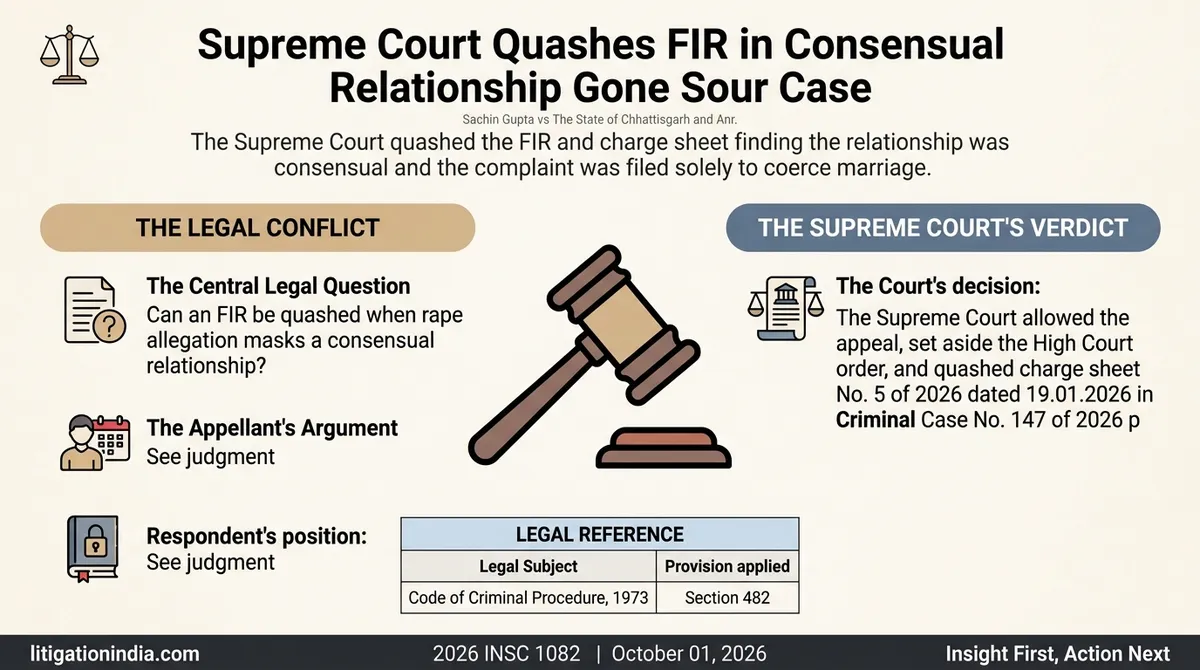
At a glance (infographic)

Sachin Gupta vs The State of Chhattisgarh and Anr. — infographic summary
Download infographic

In short

The appellant, Sachin Gupta, challenged the Chhattisgarh High Court's refusal to quash FIR No. 326 of 2025 registered at Police Station Manipur, Surguja on 05.12.2025. The FIR alleged sexual assault by the appellant and refusal to marry. The second respondent, an employee of a bank where the appellant was a customer, alleged that on 05.05.2024, the appellant took her in a car, intoxicated her, raped her, and later promised to marry her to prevent her from reporting the incident. The relationship continued, and the second respondent claimed to have undergone two abortions. A separate incident in a hotel room on 29.10.2025 was alleged, including threats to make intimate videos viral. The appellant contended the relationship was consensual, that the second respondent had extorted money from him, and that two prior complaints registered by him were the reason for this counter-FIR. The Supreme Court applied the four-step test laid down in Pradeep Kumar Kesarwani v. State of Uttar Pradesh and Anr. (2025 SCC OnLine SC 1947). The Court found that: the rape allegation was delayed by more than one and a half years; the second respondent never raised a claim that a promise to marry was used to induce sexual consent; the hotel assault was never reported; the medical record did not support the claimed abortions; and the complaint was explicitly filed to coerce the appellant into marriage. Concluding that all four steps of the quashing test were satisfied and that a trial would serve no purpose, the Supreme Court set aside the High Court order, quashed charge sheet No. 5 of 2026 dated 19.01.2026 and the FIR, and directed that no criminal proceedings shall continue against the appellant or any other accused. Proceedings in respect of the complaints filed by the appellant were also directed to not be proceeded with.

Background

The second respondent, a bank employee, filed FIR No. 326 of 2025 alleging that the appellant raped her on 05.05.2024 and, to prevent her from reporting, promised to marry her. The relationship continued for over a year, during which she claims to have undergone two abortions. She filed the complaint after the appellant allegedly attacked her in a hotel room on 29.10.2025 and threatened her, stating she wanted the appellant punished if he refused to marry her.

The Decision

The Supreme Court allowed the appeal, set aside the High Court order, and quashed charge sheet No. 5 of 2026 dated 19.01.2026 in Criminal Case No. 147 of 2026 pending before the Chief Judicial Magistrate, Ambikapur. The Court directed that no criminal proceedings shall continue against the appellant or any other accused in the FIR, and also directed that proceedings on the appellant's own complaints need not be proceeded with.

Why it matters for you

This judgment reinforces that courts must carefully scrutinise rape allegations filed explicitly to coerce a person into marriage rather than to seek genuine justice. It confirms that when a complainant's own statement reveals the motive is to pressurise and not to redress a crime, the High Court must exercise its quashing powers under Section 482 CrPC. Ordinary citizens are protected from being subjected to a prolonged trial where the complaint is not bona fide.

Relevant Legal Provisions

Key Acts and sections cited or relied upon in this judgment

“Section 482 grants inherent powers to the High Court to quash criminal proceedings; the Supreme Court held the High Court ought to have exercised this power to quash the FIR and charge sheet given the consensual nature of the relationship and the complainant's admitted motive to coerce marriage.”

Full text of the judgment

Text extracted from Sachin Gupta vs The State of Chhattisgarh and Anr.. For the authoritative version refer to the Supreme Court of India's official website.

2026 INSC 1082 1 REPORTABLE IN THE SUPREME COURT OF INDIA CRIMINAL APPELLATE JURISDICTION Criminal Appeal No.4721of 2026 (@Special Leave Petition (Crl.) No(s).4615 of 2026) SACHIN GUPTA ……APPELLANT VERSUS THE STATE OF CHHATTISGARH AND ANR. ……RESPONDENTS O R D E R Leave granted. 2. The appellant is aggrieved by the impugned order, refusing to quash FIR No.326 of 2025 registered at Police Station Manipur, Surguja on 05.12.2025 on the First Information Statement of the second respondent at Police Station Manipur, Surguja. The allegation was of sexual assault by the 1st accused, who is the appellant herein and further allegation of refusal to marry levelled against him. The other persons arrayed are accused of assaulting and threatening her from lodging a complaint with respect to an incident that occurred on 29.10.2025. 3. We heard Mr. K. Parameshwar, learned Senior Counsel appearing for the appellant and Mr. Siddhartha Sinha, learned AoR appearing for the Digitally signed by VISHAL ANAND Date: 2026.10.05 16:47:38 IST Reason: Signature Not Verified

2 respondent State. Though notice was issued to the 2nd respondent, none appeared. 4. In considering the application for quashing a criminal complaint in general, this Court had laid down certain propositions in Pradeep Kumar Kesarwani v. State of Uttar Pradesh and Anr.1. The facts of the said case indicate a similar circumstance where rape was alleged against one person, which was identical to this case. It was stated that no complaint was made on a rape carried out, since there was, later, a promise to marry by the perpetrator. Paragraph 20 of the said decision is extracted herein: - 20. The following steps should ordinarily determine the veracity of a prayer for quashing, raised by an accused by invoking the power vested in the High Court under Section 482 of the Cr.P.C.:- (i)Step one, whether the material relied upon by the accused is sound, reasonable, and indubitable, i.e., the materials is of sterling and impeccable quality? (ii) Step two, whether the material relied upon by the accused, would rule out the assertions contained in the charges levelled against the accused, i.e., the material is sufficient to reject and overrule the factual assertions contained in the complaint, i.e., the material is such, as would persuade a reasonable person to dismiss and condemn the factual basis of the accusations as false. 1 2025 SCC OnLine SC 1947

3 (iii) Step three, whether the material relied upon by the accused, has not been refuted by the prosecution/complainant; and/or the material is such, that it cannot be justifiably refuted by the prosecution/complainant? (iv) Step four, whether proceeding with the trial would result in an abuse of process of the court, and would not serve the ends of justice? If the answer to all the steps is in the affirmative, judicial conscience of the High Court should persuade it to quash such criminal – proceedings, in exercise of power vested in it under Section 482 of the Cr.P.C. Such exercise of power, besides doing justice to the accused, would save precious court time, which would otherwise be wasted in holding such a trial (as well as, proceedings arising therefrom) specially when, it is clear that the same would not conclude in the conviction of the accused. [(See: Rajiv Thapar & Ors. v. Madan Lal Kapoor (Criminal Appeal No. 174 of 2013)] 5. In the present case, the appellant admits that he got acquainted with the 2nd respondent, who was an employee of a bank; where he used to be a frequent customer. It is also his case that taking advantage of the relationship between a bank official and a customer, the 2nd respondent obtained his mobile number and was in the habit of pestering him to invest in the various schemes floated by the bank.

4 He had been consistently refusing it, upon which the 2nd respondent raised allegations against him and extorted money, which he initially paid and later refused to succumb to. He is also stated to have registered two complaints Annexure P1 dated 07.11.2025, and Annexure P2 dated 02.12.2025. The present FIR registered on 05.12.2025 is a counter blast to the inquiries initiated by the police on his complaints. 6. Going through the averments, it is very clear that there was a consensual relationship between the parties. Both the parties have admitted that they became acquainted from the bank, where the 2nd respondent was an employee. The allegation of the 2nd respondent is that on 05.05.2024, the appellant took her in a car, got her intoxicated and committed rape on her. On regaining consciousness, the appellant implored with her not to report the incident and agreed to marry her. Admittedly, the relationship continued for long and the 2nd respondent claims to have been impregnated twice in October 2024 and February 2025, which were also aborted. 7. Then it is alleged that on 29.10.2025, she was attacked by the appellant and his cousin in a hotel

5 room and they forced her out of the room and in front of the hotel staff, she was assaulted and there were threats levelled of videos of their intimate relationship being made viral. The further allegation is that on the next day when she was proceeding to register a complaint, the appellant along with the other accused threatened her with her life and she was forced to go back to her house without registering a complaint. She says that subsequently, the appellant’s father has been threatening her continuously in which circumstances, especially since she wants to marry the appellant, she is filing this complaint since if he does not marry her, she wants punitive action to be taken against the appellant for the sexual exploitation and assault. 8. Looking at the extract from the above decision, insofar as step one is concerned, the material relied upon by the appellant clearly indicates money having been paid by the appellant to the 2nd respondent; which the former claims, was in pursuance of the extortion made by the 2nd respondent. Two complaints were also lodged by the appellant before the jurisdictional police station.

6 On step two, we have to specifically notice that admittedly there was a courtship and even according to the 2nd respondent she was raped against her will and then the desire to marry was put forth. No allegation of a promise to marry, proffered to entice the 2nd respondent into a sexual relationship, was raised. The specific allegation is that the petitioner was raped and, to desist her from reporting the same, the desire to marry was expressed, which was voluntarily and willingly accepted. The allegation of rape, hence, is delayed by more than one and a half years. 9. The assault in a hotel room was never reported to the police, either by the hotel staff or by the 2nd respondent. The allegation that she was threatened by the relatives of the appellant also was not reported. The complaint was filed specifically to coerce the appellant into marrying the complainant, failing which she wanted punitive action taken for the sexual assault and the exploitation. We also notice that the 2nd respondent though she asserts that twice her pregnancy was aborted, there is nothing indicated in the medical report to that end.

7 10. On Step four, we are of the definite opinion that no purpose would be served in carrying out a trial. 11. On a conspectus of the entire facts and circumstances, we are of the opinion that the High Court ought to have invoked its powers under Section 482 of the Code of Criminal Procedure, 1973 to quash the complaint. The High Court having not done so, we set aside the impugned order and quash charge sheet No.5 of 2026, dated 19.01.2026 in Criminal Case No.147 of 2026 pending in the Court of Chief Judicial Magistrate, Ambikapur, District Sarguja as revealed from Exhibits P9 and P10. No criminal proceedings shall be continued in the above case, either against the appellant or any other accused in the above FIR; since the foundation of the allegations is on the criminal culpability of the accused having raped the complainant on the promise of marriage. The allegations of hurt, having been caused, and criminal intimidation as alleged against the other accused also fail to impress us. 12. We are also of the opinion that since the FIR against the appellant has been quashed, further proceedings in respect of Annexure P1 and Annexure

8 P2 also need not be proceeded with. 13. We pass these consequential directions only since we are convinced that there had been a consensual relationship between the parties which went sour and then each started accusing the other.

14. The appeal stands allowed. 15. Pending application(s), if any, shall stand rejected. ……………………………………………J. (J. B. PARDIWALA) …………………………………………J. (K. VINOD CHANDRAN) NEW DELHI; OCTOBER 01, 2026.

AI-assisted summary, reviewed and verified by our editorial team.

In the Court's words

“We are of the definite opinion that no purpose would be served in carrying out a trial.”
“The complaint was filed specifically to coerce the appellant into marrying the complainant, failing which she wanted punitive action taken for the sexual assault and the exploitation.”
“We are convinced that there had been a consensual relationship between the parties which went sour and then each started accusing the other.”
“No allegation of a promise to marry, proffered to entice the 2nd respondent into a sexual relationship, was raised.”

Need help with your case?

Facing a similar legal challenge in the Supreme Court or High Court? Connect with our pro bono volunteer advocates today.

Related Supreme Court services

Request Free Callback
Litigation India

Insight First, Action Next. A public-service initiative to make justice understandable for every Indian.

contact@litigationindia.com

+91 9956486585

New Delhi, India

Quick Links

Our Mission

To empower ordinary citizens, litigants, and junior advocates across India by translating complex Supreme Court of India judgments into editor-verified, plain-language summaries in both English and Hindi. We aim to bridge the gap between judicial proceedings and everyday citizens by delivering verified legal insights and offering free, pro bono guidance from experienced Supreme Court advocates—ensuring no individual suffers injustice merely for lack of correct guidance.

Legal Disclaimer: The information provided on this website is for general informational purposes only and does not constitute legal advice. Accessing this website or receiving any guidance does not create an attorney-client relationship. A formal attorney-client relationship is established only upon signing a formal engagement agreement with a lawyer. Litigation India is an informational platform — it does not provide legal representation, legal services, or legal advice.

Disclaimer: These summaries are provided for general public understanding only and do not constitute legal advice. Please consult a qualified advocate before acting on any information relating to your specific matter.

© 2026 Litigation India. All rights reserved.