
Full text of the judgment
Text extracted from Sonal Talpada vs Veerbhan Singh. For the authoritative version refer to the Supreme Court of India's official website.
2026 INSC 620 C.A. @ SLP (C) No.10422/2025 Page 1 of 26 REPORTABLE
IN THE SUPREME COURT OF INDIA CIVIL APPELLATE JURISDICTION
CIVIL APPEAL NO. OF 2026 (ARISING OUT OF SLP (C) NO.10422 OF 2025)
SONAL TALPADA … APPELLANT(S)
VEERBHAN SINGH … RESPONDENT(S)
J U D G M E N T
AUGUSTINE GEORGE MASIH, J.
1. Leave granted.
2. The instant Appeal assails the judgment and order dated 02.01.2025 (hereinafter referred to as “Impugned Judgment”) passed by the High Court of Rajasthan at Jaipur (hereinafter referred to as “High Court”), whereby the D.B. Civil Miscellaneous Appeal No. 5127 of 2019 filed by the Respondent-husband (Divorce Petitioner) herein stands allowed by setting aside the judgment and decree dated Digitally signed by SOURAV PAL Date: 2026.06.03 10:10:22 IST Reason: Signature Not Verified
C.A. @ SLP (C) No.10422/2025 Page 2 of 26 21.08.2019 passed by the Family Court at Bharatpur, Rajasthan (hereinafter referred to as “Family Court”), vide which petition seeking divorce from the Appellant-wife filed by the Respondent-husband was dismissed.
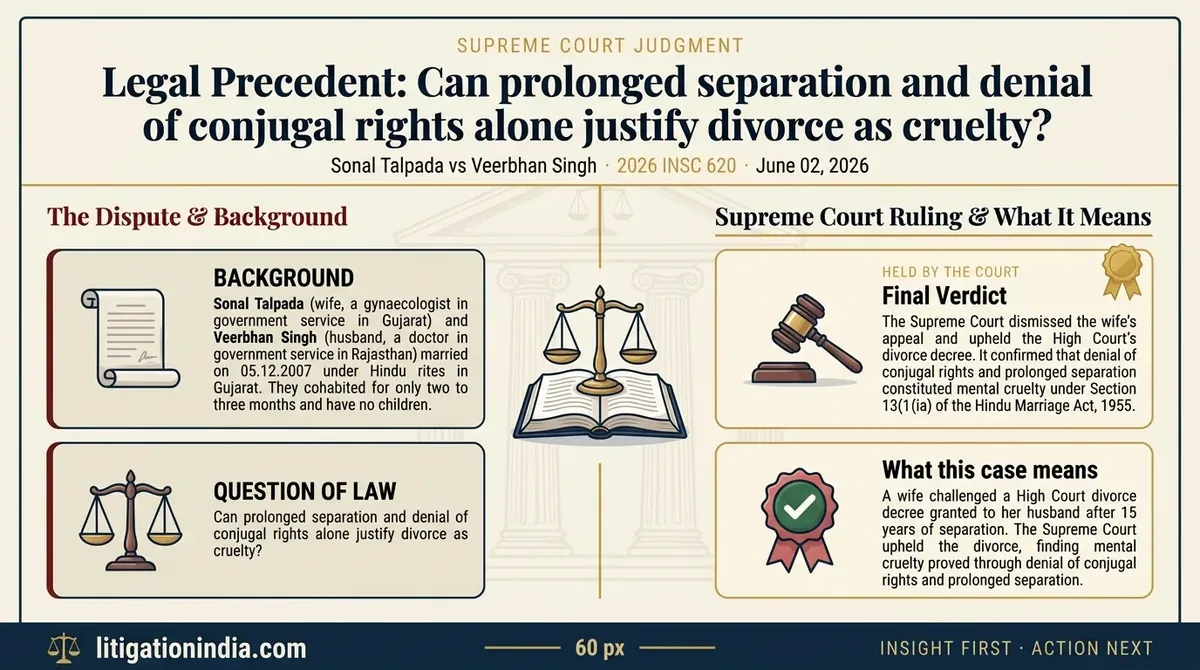
3. Brief facts are that the marriage of the Appellant-wife and the Respondent-husband took place on 05.12.2007 as per the Hindu rites in Nadiyad Khera, Gujarat. No child was born out of their wedlock. At the time of marriage, Appellant-wife was working as a Gynaecologist in a government hospital in Nadiyad Khera, Gujarat and Respondent-husband, also a doctor, in State service in Rajasthan.
4. It appears that there were sociocultural differences between the parties and according to the Respondent-husband, cruelty was meted out to him. Appellant-wife lived with him for hardly two to three months in their matrimonial home at Bharatpur, Rajasthan during their matrimonial period of two years. Leading to the Respondent-husband filing a divorce petition in
C.A. @ SLP (C) No.10422/2025 Page 3 of 26 the year 2009 before the Family Court. The said petition was filed under Section 13(1) (ia) of the Hindu Marriage Act, 1955 (hereinafter referred to as “HMA”). The Family Court on 21.08.2018 dismissed the said divorce petition holding therein that the Respondent-husband has failed to prove the cruelty committed by the Appellant-wife against him.
5. Feeling aggrieved and dissatisfied with the judgment and order passed by the Family Court dismissing the divorce petition, the Respondent-husband preferred an appeal before the High Court. By the impugned judgment and order, the High Court allowed the said appeal. Hence, the Appellant-wife is before this Court by way of the present appeal.
6. The learned counsel appearing for the Appellant-wife submits that she has never abandoned the Respondent-husband and was always ready and willing to lead a matrimonial life with him. Respondent-husband cannot be allowed to take advantage of his own wrong. It
C.A. @ SLP (C) No.10422/2025 Page 4 of 26 was further contended that Respondenthusband did not allow Appellant-wife to perform her conjugal duties.
7. The learned counsel further submits that the grounds for desertion and irretrievable breakdown of marriage were not pleaded in the Divorce Petition. In fact, it was Respondenthusband who deserted the Appellant-wife. Appellant-wife had left her government service in Gujarat and started living in Bharatpur to save her matrimonial life. Father of the Respondent-husband had allowed the Appellant-wife to work in Gujarat till construction of Nursing home in Bharatpur. However, construction of said nursing home never commenced and therefore, Appellant-wife continued working in Gujarat. Respondenthusband has failed to produce any evidence to establish that Appellant-wife has committed any cruelty against him. Therefore, present appeal be allowed and decree of Divorce granted by the High Court vide the impugned judgment in favour of Respondent-husband be set aside.
C.A. @ SLP (C) No.10422/2025 Page 5 of 26
8. Learned counsel for Appellant-wife has heavily relied upon decisions of this Court in Darshan Gupta v. Radhika Gupta1, Vishnu Dutt Sharma v. Manju Sharma2 and Samar Ghosh v. Jaya Ghosh3.
9. The present appeal is vehemently opposed by the learned counsel of the Respondenthusband. The learned counsel submits that the Appellant-wife has never made any efforts to save her matrimonial life. The parties are living separately for more than 15 years and have cohabited for merely 2-3 months in the span of 18 years. The Appellant-wife has denied establishment of sexual relations to Respondent-husband on several occasions. Therefore, the Appellant-wife has committed cruelty and has deserted the Respondenthusband.
10. Learned counsel for the Respondent-husband
1 (2013) 9 SCC 1 2 (2009) 6 SCC 379 3 (2007) 4 SCC 511
C.A. @ SLP (C) No.10422/2025 Page 6 of 26 further submits that the Appellant-wife has failed to build any mutual trust, companionship and shared experiences with the Respondenthusband which led to irretrievable breakdown of marriage. The parties have different lifestyle and personal preferences. To overcome such differences is beyond the control of both the parties. There is no chance of reconciliation. Parties were engaged in matrimonial litigation from last many years. It is denied that Appellant-wife has left her job in Gujarat. He asserts that it is a fit case to dissolve the marriage between the Appellant-wife and the Respondent-husband on the ground of irretrievable breakdown of marriage. Therefore, the present appeal deserves to be dismissed.
11. The learned counsel for the Respondenthusband has relied upon decisions of this Court in Naveen Kohli v. Neelu Kohli4, Vikas Kanaujia v. Sarita5, Amutha v. A.R. Subramanian6, Shilpa Sailesh v. Varun
4 (2006) 4 SCC 558 5 (2025) 3 SCC 748 6 2024 SCC OnLine SC 3822 : 2024 INSC 1033
C.A. @ SLP (C) No.10422/2025 Page 7 of 26 Sreenivasan7 and Savitri Pandey v. Prem Chandra Pandey8.
12. We have heard the learned counsel for the respective parties at length and with their assistance have gone through the relevant pleadings and evidence lead by the parties before the Courts below. It is pertinent to mention, that the Appellant-wife has, right from the stage of trial till this Court, rigidly maintained her stand that she does not want to dissolve the marriage and wants to continue her matrimonial life with the Respondent-husband. No other civil or criminal proceedings were instituted by either party against each other.
13. The parties have been living separately for about fifteen (15) years and there is no child from the wedlock. Despite repeated efforts by Courts, there has been no reconciliation between the parties. At the stage of admission of appeal, this Court had referred the parties to mediation vide order dated 23.05.2025. However, mediation
7 (2023) 14 SCC 231 8 (2002) 2 SCC 73
C.A. @ SLP (C) No.10422/2025 Page 8 of 26 was unsuccessful which is evident from the Mediation report dated 27.11.2025. No efforts have been made since then, by either of the parties, to reconcile their matrimonial differences.
14. At the outset, it is required to be noted that the High Court granted the divorce in favour of Respondent-husband on the following grounds: a) Appellant-wife had insulted the Respondent-husband before a shopkeeper while on their visit to Taj Mahal; b) Cruelty was committed by the Appellantwife against the Respondent-husband as she denied sexual relations on several occasions; c) Desertion due to long absence from matrimonial home; and d) Parties were living separately since 15 years.
15. Adverting to findings recorded by the High Court, this Court is called to adjudicate upon whether the Respondent-husband was subjected to ‘cruelty’ within the meaning of law, and whether the marital bond between the parties has ruptured to such an extent that the marriage has broken down irretrievably,
C.A. @ SLP (C) No.10422/2025 Page 9 of 26 rendering any reconciliation impossible.
16. Though with respect to ‘cruelty’ no uniform standard can ever be laid down for guidance, yet this Court in Samar Ghosh (supra) deemed it appropriate to enumerate some instances of human behaviour which may be relevant in dealing with the cases of ‘mental cruelty’:
“Para 101………(xii) Unilateral decision of refusal to have intercourse for considerable period without there being any physical incapacity or valid reason may amount to mental cruelty. (xiii) Unilateral decision of either husband or wife after marriage not to have child from the marriage may amount to cruelty. (xiv) Where there has been a long period of continuous separation, it may fairly be concluded that the matrimonial bond is beyond repair. The marriage becomes a fiction though supported by a legal tie. By refusing to sever that tie, the law in such cases, does not serve the sanctity of marriage; on the contrary, it shows scant regard for the feelings and emotions of the parties. In such like situations, it may lead to mental cruelty.” (emphasis supplied)
17. Reverting to facts of the present case, with regards to contention that the Appellant-wife had insulted the Respondent-husband before the shopkeeper, the Family Court has correctly assessed that the Respondent-husband himself
C.A. @ SLP (C) No.10422/2025 Page 10 of 26 admitted that Taj Mahal was closed on that day so, there was no requirement of hiring a drunk guide. There is nothing wrong in wife asking for a Teddy bear.
18. However, on the question of cruelty from the evidence of the Respondent-husband it also, comes out that even during that short period of cohabitation the Appellate-wife used to sleep early in night, lock her room from inside and never open the door on knocking. The Respondent-husband used to sleep in other separate room. The Appellant-wife has not denied the fact that they used to sleep in different rooms. The acceptance of the ground of cruelty for grant of divorce is, thus, correct.
19. As held in the case of Samar Ghosh (supra) and other catena of judgments by this Court, denial of conjugal rights including persistent refusal of sexual intercourse without a reasonable cause constitutes mental cruelty and is a valid ground for divorce under Section 13(1)(ia) of the HMA. The courts in India have repeatedly established
C.A. @ SLP (C) No.10422/2025 Page 11 of 26 that withholding sexual intimacy inflicts severe emotional distress and undermines the bedrock of marriage. Therefore, the conclusion of the High Court is sustained. The decree of divorce as granted by allowing the appeal of the Respondent-husband is upheld.
20. As regarding the ground of desertion, the Family Court has pointed out that the father of Respondent-husband had admitted during his cross-examination that he had asked father of Appellant-wife that she can continue to work in Nadiyad Khera, Gujarat till a nursing home was constructed in Bharatpur, Rajasthan. Merely because father-in-law had said so would not in itself means a licence for not joining and fulfilling the matrimonial obligations which arise upon the parties having entered into the relationship of husband and wife. Seeing when the things were not moving with regards to the construction of the nursing home, steps need to have been taken by the parties to cohabitate. Nothing has come on record indicating any effort on the part of the Appellant-wife or even
C.A. @ SLP (C) No.10422/2025 Page 12 of 26 the Respondent-husband in this direction.
21. While the statutory ground of desertion may not have been pleaded but matrimonial disputes are seldom confined to isolated legal labels. The Court is also required to examine the overall conduct of the parties and the manner in which they have discharged their matrimonial obligations. It is from this broader perspective issue of cruelty deserves further consideration.
22. Marriage, in its legal and constitutional dimension, can never be reduced to a mere contractual intersection of individual rights, nor can it be viewed strictly through the narrow lens of a petition for conjugal rights. It is a deeply personal and social partnership built on mutual respect, shared expectations and equal responsibility. When two parties enter into matrimony, they weave a tapestry of interdependence that demands a continuous balancing of interests. Conjugal rights do not exist in a vacuum; they are the structural counterparts to conjugal duties. To demand the
C.A. @ SLP (C) No.10422/2025 Page 13 of 26 fulfilment of the former while wilfully abandoning the sanctity of the latter is to undermine the very essence of the institution. Matrimony, therefore, is not a one-sided right to be enforced, but a shared covenant of emotional support, fidelity, responsibility and care, where the rights of one are always tied to the duties they owe to the other. Persistent withdrawal from the foundational aspects of marriage may have legal consequences while evaluating allegations of mental cruelty.
23. From the conduct of parties, it is clear that even during the short period of cohabitation they failed to perform their conjugal responsibilities. The parties have strongly held views with regard to the approach towards matrimonial life and they have refused to accommodate each other for a long period of time. As held in the case of Nayan Bhowmick v. Aparna Chakraborty9, this Court is of the view that in matrimonial matters involving two individuals, it is not for the society or for the Court to sit in judgment
9 2025 SCC OnLine SC 2798 : 2025 INSC 1436
C.A. @ SLP (C) No.10422/2025 Page 14 of 26 over which spouse’s approach is correct or not. It is their strongly held views and their refusal to accommodate each other that amounts to cruelty to one another.
24. This Court in multitude of cases, has held that in situations where parties have been living separately for a considerable time without any hope for reconciliation amounts to cruelty to both the parties.
25. In the light of the above, it can be said that the High Court has rightly assessed that where parties have been living separately for several years and at this stage asking them to live together after a prolonged duration would amount to cruelty to both the parties and divorce can be granted on this ground as provided under section 13 (1)(ia) of HMA. It may be added here that desertion as a ground requires an initial period as mentioned under the statute but if such desertion continues for a long period of time without any effort on the part of the parties to restore cohabitation would itself be a ground to be considered by the Appellate
C.A. @ SLP (C) No.10422/2025 Page 15 of 26 Court. This we say in the light of the fact that human relations are dynamic and once the initial mandate under the statute stands satisfied, continuation thereof during the litigation would aggravate the said agony which could be confirmational in substantiating the basis and pleaded ground for divorce. The same can be taken into consideration for formation of an opinion to accept the prayer by the Appellate Court. Appeal is the continuation of a suit and therefore, the Appellate Court would be entitled and justified to consider the conduct of the parties during the pendency of litigation. The same can also be looked into to support or reject an opinion on the ground in question.
26. An Appellate Court, while carefully ensuring that a party does not profit from their own manifest wrong or unilateral desertion, may legitimately treat a prolonged period of separation as an indicator of mental cruelty within the meaning of Section 13(1)(ia) of the HMA. The Appellate Court is not precluded from examining whether continuous separation over
C.A. @ SLP (C) No.10422/2025 Page 16 of 26 a substantial period, coupled with absence of any genuine effort at reconciliation, complete cessation of cohabitation and emotional alienation has resulted in mental cruelty. Subsequent events occurring during pendency of proceedings may legitimately be taken into consideration while undertaking such assessment. In such circumstances, the confirmation of a decree of divorce by an Appellate Court is not an invocation of extraordinary constitutional jurisdiction under Article 142 of the Constitution of India, but a lawful and realistic application of the statutory ground of cruelty to the facts of the case.
27. A significant aspect of this case is the prolonged physical separation spanning more than a decade and a half. While the statutory ground of 'desertion' under Section 13(1)(ib) of the HMA has not been formally pleaded by the Respondent-husband however, the element of desertion can be viewed neutrally through an objective lens where spouses choose independent professional and geographical
C.A. @ SLP (C) No.10422/2025 Page 17 of 26 paths and remain completely estranged without any reciprocal effort to bridge the distance.
28. In such circumstances, desertion ceases to be merely a matter of individual malice or unilateral fault rather it assumes the character of a shared, de facto abandonment of the matrimonial covenant. The parties have objectively deserted the matrimonial framework itself. The intentional maintenance of distinct lifestyles, separate domiciles, and the total cessation of marital interaction over fifteen years establishes a de facto abandonment of the marital covenant by both sides.
29. In any event, this Court in exercise of power to do “complete justice” under Article 142(1) of the Constitution of India has the discretion to dissolve the marriage on the ground of irretrievable breakdown.
30. In present case, it is not disputed that since more than last 15 years both the Appellant-wife and the Respondent-husband are residing separately. It also appears that all efforts to
C.A. @ SLP (C) No.10422/2025 Page 18 of 26 continue the marriage have failed and there is no possibility of re-union because of the strained relations between the parties. Thus, it is apparent that marriage between the Appellant-wife and the Respondent-husband has also, broken down irretrievably.
31. In the case of Vikas Kanaujia (supra), where the husband and wife lived together for total 43 days and period for separation was more than 22 years, this Court held that:
“17. The husband and wife have lived together on their own will for hardly 23 days since marriage. They further lived together for 20 more days from 15.06.2005 to 05.07.2015 as Sessions Court passed order for conciliation. Thus, in total the parties have not lived together for more than 43 days. The Respondent left her matrimonial house within the first month of marriage. The period of separation has been more than 22 years. The possibility of parties living together is further reduced as parties are in their early 50s now and have built independent lives. Further, the parties have fought multiple legal battles against each other since 2002 itself with six cases filed against each other, including criminal cases. The Respondent had filed a criminal case against the Appellant and his family members where they were arrested although subsequently discharged and acquitted. 18. Although the respondent claims that she is
C.A. @ SLP (C) No.10422/2025 Page 19 of 26 willing to live with the Appellant believing in the sanctity of marriage, her actions are not in consonance with her claim. In this long period of 22 years, there was no one to stop her from living together with the Appellant. The mediation and conciliation proceedings have failed. The Appellant on the other hand states that the claim of willingness to live together is falsely projected claim before the Court of law only to mislead the Court, delay the proceedings and harass the appellant. 19. Thus, the effective cumulation of actions of both the parties in past 22 years since marriage has resulted in demolition of their matrimonial bond beyond repair. The marriage has ceased to exist both in substance and in reality. The relation has even taken a sour taste as the families of parties have also developed rivalries. The act of Respondent to lodge a missing complaint against Appellant after the delivery of impugned order is also indicative of the bitter relation between the parties. Considering the long separation period of 22 years, lack of existence of marriage between the parties and the sour relations developed due to continuous legal battles, we deem this case to be fit for exercise of extraordinary powers conferred under Article 142 of the Constitution. 20. In Rajib Kumar Roy vs Sushmita Saha, this Court exercised the power conferred under Article 142 of the Constitution of India by dissolving the marriage between parties who were living separately for 12 years. Paragraph Nos. 8, 9 and 10 of the judgement are reproduced hereunder: ‘8. Continued bitterness, dead emotions and long separation, in the given facts and circumstances of a case, can be construed as a case of ‘irretrievable breakdown of marriage’, which is also a facet of ‘cruelty’.
C.A. @ SLP (C) No.10422/2025 Page 20 of 26 In Rakesh Raman v. Kavita, 2023 SCC OnLine SC 497, this is precisely what was held, that though in a given case cruelty as a fault, may not be attributable to one party alone and hence despite irretrievable breakdown of marriage keeping the parties together amounts to cruelty on both sides. Which is precisely the case at hand. 9.Whatever may be the justification for the two living separately, with so much of time gone by, any marital love or affection, which may have been between the parties, seems to have dried up. This is a classic case of irretrievable breakdown of marriage. In view of the Constitution Bench Judgment of this court in Shilpa Sailesh v. Varun Sreenivasan, 2023 SCC OnLine SC 544 which has held that in such cases where there is irretrievable breakdown of marriage then dissolution of marriage is the only solution and this Court can grant a decree of divorce in exercise of its power under Article 142 of the Constitution of India. 10.We therefore declare the marriage to have broken down irretrievably and therefore in exercise of our jurisdiction under Article 142 of the Constitution of India we are of the considered opinion that this being a case of irretrievable breakdown of marriage must now be dissolved by grant of decree of divorce.’ ” (emphasis supplied)
32. In the case of Shilpa Shailesh (supra), while considering the cases of Darshan Gupta (supra) and Vishnu Dutt Sharma (supra) as relied upon by the Appellant-wife, the
C.A. @ SLP (C) No.10422/2025 Page 21 of 26 Constitution Bench clarified that this Court, in exercise of power under Article 142(1) of the Constitution of India, has the discretion to dissolve the marriage on the ground of its irretrievable breakdown. This discretionary power is to be exercised to do ‘complete justice’ to the parties, wherein this Court is satisfied that the facts established show that the marriage has completely failed and there is no possibility that the parties will cohabit together, and continuation of the formal legal relationship is unjustified. The Court, as a court of equity, is required to also balance the circumstances and the background in which the party opposing the dissolution is placed. Further, it was held that:
“62. Having said so, we wish to clearly state that grant of divorce on the ground of irretrievable breakdown of marriage by this Court is not a matter of right, but a discretion which is to be exercised with great care and caution, keeping in mind several factors ensuring that “complete justice” is done to both parties. It is obvious that this Court should be fully convinced and satisfied that the marriage is totally unworkable, emotionally dead and beyond salvation and, therefore, dissolution of marriage is the right solution and the only way forward. 63. That the marriage has irretrievably broken
C.A. @ SLP (C) No.10422/2025 Page 22 of 26 down is to be factually determined and firmly established. For this, several factors are to be considered such as the period of time the parties had cohabited after marriage; when the parties had last cohabited; the nature of allegations made by the parties against each other and their family members; the orders passed in the legal proceedings from time to time, cumulative impact on the personal relationship; whether, and how many attempts were made to settle the disputes by intervention of the court or through mediation, and when the last attempt was made, etc. The period of separation should be sufficiently long, and anything above six years or more will be a relevant factor. But these facts have to be evaluated keeping in view the economic and social status of the parties, including their educational qualifications, whether the parties have any children, their age, educational qualification, and whether the other spouse and children are dependent, in which event how and in what manner the party seeking divorce intends to take care and provide for the spouse or the children. Question of custody and welfare of minor children, provision for fair and adequate alimony for the wife, and economic rights of the children and other pending matters, if any, are relevant considerations. We would not like to codify the factors so as to curtail exercise of jurisdiction under Article 142(1) of the Constitution of India, which is situation specific. Some of the factors mentioned can be taken as illustrative, and worthy of consideration.” (emphasis supplied)
33. In the similar set of facts and circumstances of the case, this Court in the case of R. Srinivas
C.A. @ SLP (C) No.10422/2025 Page 23 of 26 Kumar v. R. Shametha10 had directed to dissolve the marriage on the ground of irretrievable breakdown of marriage as parties were living separately for more than 22 years, in exercise of powers under Article 142 of the Constitution of India.
34. This Court, in a series of judgments, has exercised its inherent powers under Article 142 of the Constitution of India for dissolution of a marriage where the Court finds that the marriage is totally unworkable, emotionally dead, beyond salvage and has broken down irretrievably, even if the facts of the case do not provide a ground in law on which the divorce could be granted. In the present case, admittedly, the Appellant-wife and the Respondent-husband have been living separately for more than 15 years, all efforts to reconcile them have failed and therefore, it will not be possible for the parties to live together. Therefore, we are of the considered opinion that this is a fit case to exercise the powers under
10 (2019) 9 SCC 409
C.A. @ SLP (C) No.10422/2025 Page 24 of 26 Article 142 of the Constitution of India and to dissolve the marriage between the parties.
35. This Court is conscious of the view that approach of the Courts should be to preserve the sanctity of marriage and the Court should be reluctant to dissolve the marriage at the mere asking of one of the parties. But, in the present case, the parties have lived separately for far too long a period of time and there is no sanctity left in the marriage. Although plea had been taken that the Appellant-wife had left her job in Gujarat and started residing in Bharatpur, Rajasthan but no evidence has come on record to substantiate the same. Rather the evidence on record is to the contrary and it is not disputed that she still continues with her job in Gujarat. There appears to be no intention on her part to join company of the husband as actions speak more than the dry words. Grant of divorce in the present proceedings would not have a devastating effect on any third party, as there are no children from the wedlock. Both the wife and husband are doctors and are in government
C.A. @ SLP (C) No.10422/2025 Page 25 of 26 service in State of Gujarat and Rajasthan respectively, therefore, financially well off and independent.
36. This Court is also of the view that prolonged pendency of matrimonial litigation only leads to perpetuity of marriage on paper. It is in the best interest of parties and the society if ties are severed between parties in cases where litigation has been pending for a considerably long period of time. Prolongation of a matrimonial relationship would further lead not only to escalation of frustration in a dead relationship, which has already decayed and is decomposing day by day creating foul sociological, psychological and mental hollowness in life resulting in denial of a free and independent environment to flourish which each human strives in body and soul. Consequently, this Court is of the opinion that such matrimonial litigation pending in Court needs to be put to end by granting effective release to the parties from a stale and frozen relationship.
C.A. @ SLP (C) No.10422/2025 Page 26 of 26 37. In the light of what has been stated above, in our considered view, this would be a fit case where the relationship of marriage should come to an end for which exercise of powers under Article 142 of the Constitution of India would be essential to do complete justice. Accordingly, the marriage between the Appellant-wife and the Respondent-husband deserves to be dissolved in exercise of powers under Article 142 of the Constitution of India.
38. As a consequence of the above, the present appeal stands dismissed.
39. There shall be no order as to cost.
40. Pending application(s), if any, also stand disposed of.
.……..………..……………………..J. [ SANJAY KAROL ]
.……..………..……………………..J. [ AUGUSTINE GEORGE MASIH ] NEW DELHI; JUNE 02, 2026.