Police cannot arrest you automatically and courts must decide bail applications quickly
Satender Kumar Antil vs CBI
What this case means
This case was about thousands of innocent people locked in jails because of delayed bail and unnecessary arrests. The Supreme Court decided that the police cannot arrest people mechanically and courts must decide bail applications within two weeks. This matters to ordinary people because it protects their freedom, prevents unfair jail time, and ensures that bail is the rule while jail is the exception.
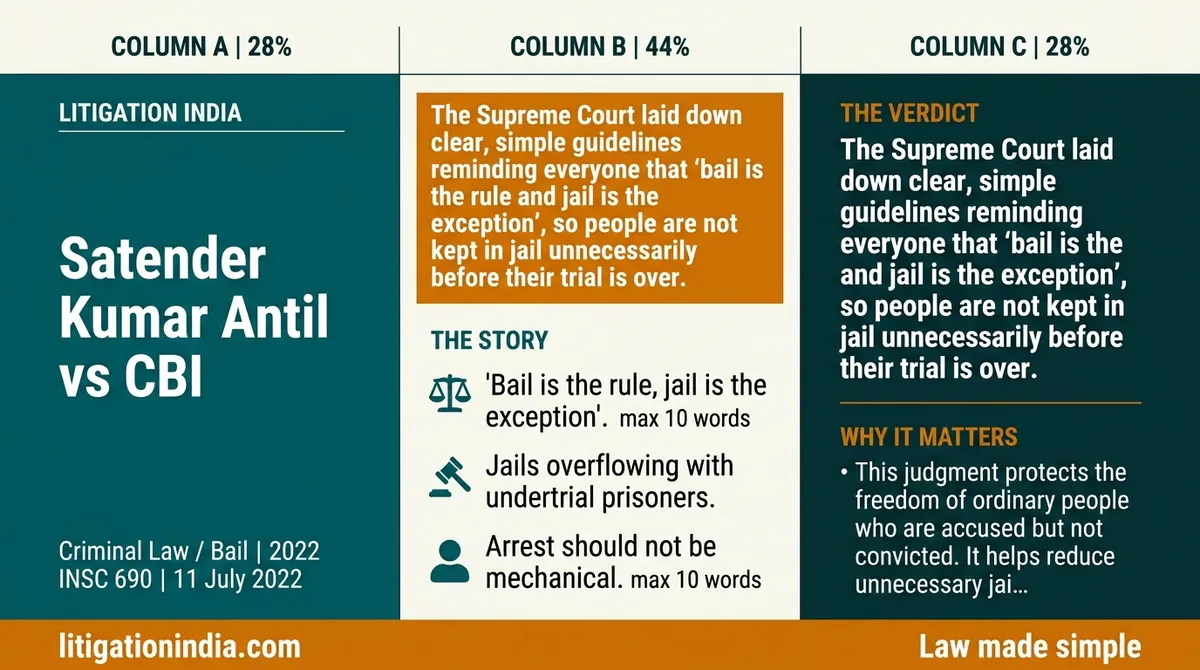
“The Supreme Court laid down clear, simple guidelines reminding everyone that 'bail is the rule and jail is the exception', so people are not kept in jail unnecessarily before their trial is over.”
Story Slides
In short
Indian jails are overcrowded, and a very large number of people inside are 'undertrials' — people who have only been accused, not yet found guilty. Many of them stay locked up for long periods simply because they cannot get bail quickly. In this case, the Supreme Court was troubled by this situation and issued practical guidelines to fix it. The Court reminded all courts and police that personal liberty is a precious fundamental right, and that arrest should not be automatic just because the law allows it. If an accused person has cooperated with the investigation and was not arrested during it, they usually should not be arrested the moment a chargesheet is filed. The Court divided offences into categories and gave simple directions on how bail should be handled in each, to make the process faster and fairer. It also urged the government to consider a separate, simple 'Bail Act' so ordinary people understand their rights. The core message is humane and clear: jail before conviction should be the exception, not the routine, and no one should lose their freedom unnecessarily while their case is still going on.
Background
The Supreme Court noticed that prisons were overflowing with undertrial prisoners who were stuck in jail mainly because bail was slow or denied. It took up the issue to give clear, uniform guidelines on arrest and bail.
The Decision
The Court issued category-wise guidelines for granting bail, stressed that arrest must not be mechanical, and directed faster decisions on bail applications. It also recommended that the government consider enacting a dedicated Bail Act.
Why it matters for you
This judgment protects the freedom of ordinary people who are accused but not convicted. It helps reduce unnecessary jail time, supports the principle 'innocent until proven guilty', and pushes the system to be faster and more humane.
Relevant Legal Provisions
Key Acts and sections cited or relied upon in this judgment
“This article guarantees that no person can be deprived of their life or personal liberty except according to the procedure established by law. The Supreme Court relied heavily on this to rule that liberty is the default state, and sending someone to jail before they are proven guilty must be a rare exception.”
“These sections state that the police do not need to arrest a person for offenses punishable with less than seven years of jail and should instead send a notice asking them to join the investigation. The Court emphasized that police must strictly follow these rules, and any officer who arrests someone without following them must face disciplinary action.”
“This section deals with producing an accused person before the court once the police investigation is complete. The Court clarified that when the police file a chargesheet, the court does not need to automatically send the accused to jail if they have cooperated during the investigation.”
“This section provides that an undertrial prisoner who has spent half of the maximum jail term for their alleged crime must be released on bail. The Court directed all trial courts to actively identify such prisoners and grant them bail without delay to reduce overcrowding in jails.”
AI-assisted summary, reviewed and verified by our editorial team.
Need help with your case?
Facing a similar legal challenge in the Supreme Court or High Court? Connect with our pro bono volunteer advocates today.
Related Supreme Court services