Gopi @ Sahaya Puruna vs. The State
The big legal question
Can a court increase your punishment when only you appeal against your conviction?
“The Supreme Court ruled that a High Court cannot increase an accused person's sentence in their own appeal if the state didn't ask for it, and multiple life sentences must run together, not one after another.”
Story Slides
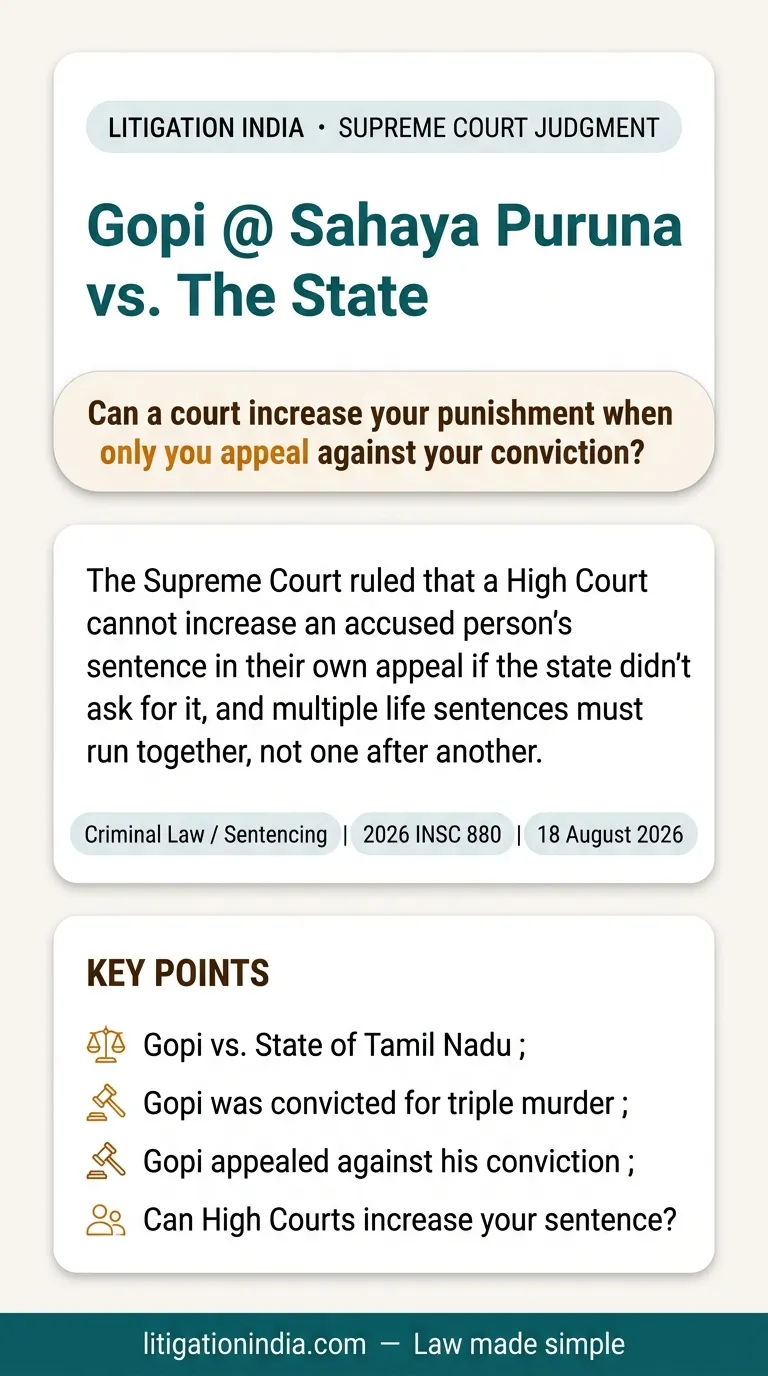
In short
In this case, a man named Gopi was convicted of murder and other crimes by the trial court. He was given multiple life imprisonments and some fixed-term jail sentences, with a direction that he must serve them one after another (consecutively). Gopi challenged this decision before the High Court. While hearing his appeal, the High Court not only kept his conviction but actually increased his punishment to imprisonment for the 'remainder of his natural life' (meaning he could never be released). It also agreed that his sentences should run one after another. The Supreme Court stepped in to correct two major mistakes. First, it held that if a convict appeals against their sentence, the High Court cannot make their situation worse by increasing the punishment on its own. The sentence can only be increased if the government or the victim files an appeal asking for a tougher penalty. Second, the Supreme Court explained that life imprisonment means staying in jail for the rest of one's natural life. Since a person only has one life, it is impossible to serve multiple life sentences or other jail terms one after another. Therefore, all his sentences must run at the same time (concurrently). The Supreme Court reduced his sentence back to normal life imprisonment and ordered all punishments to run together.
Background
The appellant, Gopi, was convicted for his involvement in a robbery where three people were brutally killed. The trial court handed down multiple life sentences and fixed jail terms, ordering him to serve them one after another.
The Decision
The Supreme Court set aside the High Court's order that increased Gopi's punishment to life without release. It also ordered that all of Gopi's life and fixed-term sentences must run together at the same time, rather than one after another.
Why it matters for you
This judgment protects convicts from having their sentences unfairly increased simply because they chose to appeal. It also clarifies that multiple life sentences must run together because a person cannot serve more than one lifetime in prison.
AI-assisted summary, reviewed and verified by our editorial team.
Need help with your case?
Facing a similar legal challenge in the Supreme Court or High Court? Connect with our pro bono volunteer advocates today.
Request Free Callback