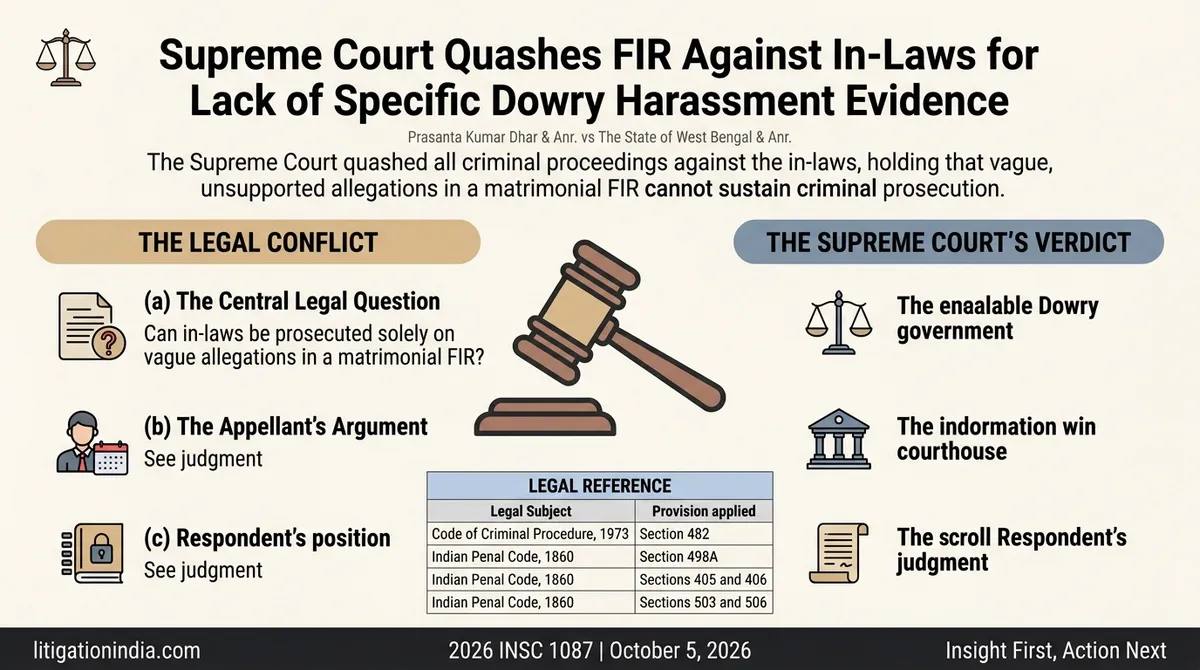
Full text of the judgment
Text extracted from Prasanta Kumar Dhar & Anr. vs The State of West Bengal & Anr.. For the authoritative version refer to the Supreme Court of India's official website.
2026 INSC 1087 Page 1 of 16
IN THE SUPREME COURT OF INDIA CRIMINAL APPELLATE JURISDICTION
CRIMINAL APPEAL
No. OF 2026 (@ SPECIAL LEAVE PETITION (CRL.) NO. 16908 OF 2024)
PRASANTA KUMAR DHAR & ANR.
…APPELLANTS
THE STATE OF WEST BENGAL & ANR. …RESPONDENTS
J U D G M E N T
NONGMEIKAPAM KOTISWAR SINGH, J. Leave granted. 2. The present appeal arises out of the judgment and final order dated 12.11.2024 passed by the High Court of Calcutta, Jalpaiguri Circuit, in C.R.R No. 280 of 2024 whereby the High Digitally signed by RAHUL KUMAR Date: 2026.10.05 18:16:00 IST Reason: Signature Not Verified
Page 2 of 16
Court partly allowed the petition filed by the Appellants herein under Section 482 of the Code of Criminal Procedure, 1973 (hereinafter referred to as “Cr.P.C.”), thus partially quashing FIR No. 152/2023 dated 21.11.2023 registered at Police Station Siliguri Women, District Darjeeling, West Bengal under Sections 498A, 406, 506 and 323 of the Indian Penal Code, 1860 (hereinafter referred to as “IPC”) and Sections 3 and 4 of the Dowry Prohibition Act, 1961 (hereinafter referred to as “DP Act”) qua only Section 323 IPC, but declining to quash the proceedings with respect to the other sections. 3. The Appellants herein are the father-in-law and motherin-law of Respondent No. 2 (hereinafter referred to as “the complainant”). The complainant married the Appellants’ son on 01.02.2021 as per Hindu rites and customs in Darjeeling. The complainant and her husband initially resided in a separate town. However, after the husband was transferred to Siliguri, the complainant began to reside with the Appellants. A child was born out of the wedlock on 17.07.2023.
Page 3 of 16
4. It appears that certain matrimonial disputes arose between the complainant and her husband and the Appellants pertaining to harassment and demand of dowry, because of which the complainant eventually left the matrimonial home. Thereafter, on 21.11.2023, the complainant submitted a complaint on the basis of which FIR No. 152/2023 was registered under Sections 498A, 406, 506 and 323 of the IPC and Sections 3 and 4 of the DP Act at Police Station Siliguri Women, Siliguri, West Bengal against the husband, and the two Appellants herein. 5. In the complaint, it was alleged that soon after the marriage, the complainant was subjected to verbal taunts and demands for dowry including a four-wheeler. It was further alleged that after the complainant became pregnant, the Appellants did not support her nutritionally or with her regular doctors’ visits and that upon the birth of a girl child, she was taunted and not welcomed back to the matrimonial home properly. It was also alleged that on 11.11.2023, the first Appellant and the husband went to the complainant’s parental home and compelled her to sign a document purporting to
Page 4 of 16
declare that she had received all her streedhan and valuable articles after she left the matrimonial house. 6. During the investigation, the parents of the complainant were examined. On completion of the investigation, Chargesheet No. 175/2023 came to be filed on 21.12.2023, charging the Appellants and the husband of the complainant under Sections 498A, 406, 506 and 323 of the IPC and Sections 3 and 4 of the DP Act. The matter is currently pending before the trial court at the stage of framing of charges. 7. On 07.08.2024, the Appellants filed a petition under Section 482 Cr.P.C. seeking quashing of the chargesheet. 8. The High Court, by the impugned order, partly allowed the petition and quashed the charge under Section 323 IPC but held that all the other charges against the Appellants would have to be examined in the trial. 9. Aggrieved by the said order of the High Court, the present Appellants have approached this Court. 10. We have heard the learned counsels appearing for the Appellants, as well as the Respondent-State, and the complainant at length.
Page 5 of 16
11. The learned counsel for the Appellants submits that the High Court erred in confining the quashing solely to the charge under Section 323 IPC, while declining to grant the same relief qua the charges under the other sections. It is contended that the dispute is primarily a matrimonial dispute between the complainant and her husband, and that the Appellants herein have simply been roped into said matrimonial dispute because of their relationship as the in-laws. Further, it is also argued that the allegations made by the complainant are false and that there is no material to show that there was any harassment or cruelty inflicted by the Appellants on the complainant, and that they rarely resided in the same household as the husband had a job in a different town. On the specific allegation that the declaration with the signature of the complainant was obtained by use of force, it is argued that there is no evidence of injuries to persons or damage to the property of the complainant and her parents produced in the FIR or in the chargesheet. The delay of ten days between the incident of 11.11.2023 where the complainant was allegedly forced to sign the document and the FIR being registered on 21.11.2023 is also argued to be indicative of the fact that the allegations made therein are false.
Page 6 of 16
12. Per contra, the learned counsel for the Respondent-State contends that the complaint categorically describes the demand for dowry and the infliction of cruelty and harassment on the complainant. The questions as to whether the allegations are false and whether there is sufficient evidence or not are to be decided in the trial, and are not to be adjudicated in a petition under Section 482 Cr.P.C. 13. The learned counsel for the complainant submits that this Court cannot enter into examining the correctness and veracity of the materials and evidence as that squarely lies in the domain of the trial court. Further, it was contended that the allegations on face-value disclose the commission of cognizable offences and any further veracity must be decided in the trial. It is also argued that cruelty under Section 498A IPC extends to mental cruelty and harassment, for which medical evidence is unlikely to exist. The lack of medical evidence alone cannot mean that the allegations are false. 14. We have considered the submissions advanced by the parties and carefully perused the materials on record. 15. As we proceed to examine this issue, it is apposite to recollect the well-settled principles relating to quashing of FIRs
Page 7 of 16
under Section 482 Cr.P.C. as laid down in the case of State of Harayana v. Bhajan Lal, 1992 Supp (1) SCC 335: “102. In the backdrop of the interpretation of the various relevant provisions of the Code under Chapter XIV and of the principles of law enunciated by this Court in a series of decisions relating to the exercise of the extraordinary power under Article 226 or the inherent powers under Section 482 of the Code which we have extracted and reproduced above, we give the following categories of cases by way of illustration wherein such power could be exercised either to prevent abuse of the process of any court or otherwise to secure the ends of justice, though it may not be possible to lay down any precise, clearly defined and sufficiently channelised and inflexible guidelines or rigid formulae and to give an exhaustive list of myriad kinds of cases wherein such power should be exercised: (1) Where the allegations made in the first information report or the complaint, even if they are taken at their face value and accepted in their entirety do not prima facie constitute any offence or make out a case against the accused. (2) Where the allegations in the first information report and other materials, if any, accompanying the FIR do not disclose a cognizable offence, justifying an investigation by police officers under Section 156(1) of the Code except under an order of a Magistrate within the purview of Section 155(2) of the Code. (3) Where the uncontroverted allegations made in the FIR or complaint and the evidence collected in support of the same do not disclose the commission of any offence and make out a case against the accused. (4) Where, the allegations in the FIR do not constitute a cognizable offence but constitute only a non-cognizable offence, no investigation is permitted by a police officer without an order of a Magistrate as contemplated under Section 155(2) of the Code. (5) Where the allegations made in the FIR or complaint are so absurd and inherently improbable on the basis of which no prudent person can ever reach a just conclusion that there is sufficient ground for proceeding against the accused. (6) Where there is an express legal bar engrafted in any of the provisions of the Code or the concerned Act (under which a criminal proceeding is instituted) to the institution
Page 8 of 16
and continuance of the proceedings and/or where there is a specific provision in the Code or the concerned Act, providing efficacious redress for the grievance of the aggrieved party. (7) Where a criminal proceeding is manifestly attended with mala fide and/or where the proceeding is maliciously instituted with an ulterior motive for wreaking vengeance on the accused and with a view to spite him due to private and personal grudge.”
16. Though the aforesaid broad principles laid down in Bhajan Lal would be the guidelines, this Court has to also keep in mind the peculiar nature of a criminal case which arises essentially out of a domestic dispute. In this regard, one may also refer to the decision of this Court in Arti Mehta v. State of Madhya Pradesh, 2026 SCC OnLine SC 933, which specifically pertains to proceedings out of the Protection of Women from Domestic Violence Act, 1961. “14. ….However, mere filing of the charge-sheet or pendency of proceedings under the DV Act would not by itself preclude this Court from interfering with the criminal proceedings, if upon examination of the FIR, the DV complaint and the material collected during investigation, it is found that no prima facie case is made out against the present appellants and that continuation of the proceedings would amount to abuse of the process of law.
43. However, while safeguarding the rights and dignity of victims of domestic violence remains of paramount importance, courts are simultaneously required to ensure that the rigours of criminal law are not indiscriminately extended to every member of the family without a clear factual foundation. In prosecutions arising out of matrimonial disputes, the allegations against each accused must be specific, distinct and supported by
Page 9 of 16
prima facie material indicating active involvement in the alleged acts of cruelty, harassment or unlawful demand of dowry. …
44. It must therefore be emphasised that each case arising out of matrimonial discord or allegations of domestic violence must necessarily turn on its own peculiar facts and the nature of allegations levelled against the accused concerned. The observations made herein should not be construed to mean that relatives of the husband can never be prosecuted under the relevant penal provisions. Where the material on record discloses specific overt acts, active participation, or direct involvement in perpetrating cruelty, harassment or domestic violence, such relatives would undoubtedly be liable to face prosecution in accordance with the law. What the Court is required to carefully examine is whether the allegations are genuine, specific and supported by foundational facts, or whether they are merely a consequence of matrimonial acrimony resulting in sweeping and omnibus implication of all family members. In the absence of such specific allegations and prima facie material, continuation of criminal proceedings against such relatives would amount to abuse of the process of law. …”
17. Therefore, in view of the peculiarities of criminal cases arising out of domestic disputes, this Court has highlighted the need for a nuanced approach and to be circumspect when applying stringent criminal principles to domestic disputes. In that context, this Court has made the following observations in Geddam Jhansi v. State of Telangana, 2025 SCC OnLine SC 263: “31. Invoking criminal process is a serious matter with penal consequences involving coercive measures, which can be permitted only when specific act(s) which constitute offences punishable under the penal code or any other penal statute are alleged or attributed to the
Page 10 of 16
accused and a prima facie case is made out. It applies with equal force when criminal laws are invoked in domestic disputes. Criminalising domestic disputes without specific allegations and credible materials to support the same may have disastrous consequences for the institution of family, which is built on the premise of love, affection, cordiality and mutual trust. Institution of family constitutes the core of human society. Domestic relationships, such as those between family members, are guided by deeply ingrained social values and cultural expectations. These relationships are often viewed as sacred, demanding a higher level of respect, commitment, and emotional investment compared to other social or professional associations. For the aforesaid reason, preservation of family relationship has always been emphasised upon. Thus, when family relationships are sought to be brought within the ambit of criminal proceedings rupturing the family bond, courts should be circumspect and judicious, and should allow invocation of criminal process only when there are specific allegations with supporting materials which clearly constitute criminal offences.”
18. The chargesheet filed mentions the offences under Sections 498A, 406, 506, 323 IPC and Sections 3 and 4 of the DP Act. The charge under Section 323 IPC was quashed by the High Court and the remaining charges survived. We, therefore, must examine each section to see if prima facie materials exist corresponding to each of the offences. 19. Cruelty under Section 498A IPC would consist of either: (a) Any wilful conduct that i. is likely to drive a woman to commit suicide, or
ii. cause grave injury or danger to her life, limb, or health (whether mental or physical); or
Page 11 of 16
(b) Harassment i. to coerce her or any persons related to her to meet any unlawful demand for property or valuable security, or
ii. harassment on account of failure to meet such demand.
20. A perusal of the records, however, shows that neither the complaint nor the investigation carried out by the police reveals any material that indicates that the Appellants herein had caused grave injury to her life, limb or mental or physical health, nor do they reveal any independent material that the Appellants harassed her for any property or valuable security. 21. As regards the offences under Sections 3 and 4 of the DP Act, the complainant has alleged that the Appellants and the complainant’s husband had demanded and accordingly were paid Rs. 5 lakhs at the time of the marriage. Further, demands for a four-wheeler were made by them, in fulfilment of which, furniture was allegedly given to them. The specifics of the same, any other witnesses privy to the demands for dowry, and any material outside of the allegations of the complainant did not surface during the investigation. The allegations do not disclose the particulars of the demands of dowry made by the Appellants,
Page 12 of 16
the occasions, the presence of any independent witnesses, or the manner such that such specific overt acts constituting cruelty under Section 498A IPC were committed. 22. Section 406 IPC provides the punishment for criminal breach of trust, which is understood under Section 405 IPC as: “405. Criminal breach of trust.—Whoever, being in any manner entrusted with property, or with any dominion over property, dishonestly misappropriates or converts to his own use that property, or dishonestly uses or disposes of that property in violation of any direction of law prescribing the mode in which such trust is to be discharged, or of any legal contract, express or implied, which he has made touching the discharge of such trust, or wilfully suffers any other person so to do, commits “criminal breach of trust.”
23. The investigation has not revealed specifics of the property entrusted to the Appellants and whether at all such property has been misappropriated or converted to their own use. Only vague and omnibus allegations have been made against the Appellants without any specificity whatsoever. From a bare reading of the allegations unsupported by any material evidence, the charge under Section 406 IPC cannot be sustained against the Appellants. 24. With respect to the offence under Section 506 IPC, we must also examine whether any of the ingredients of criminal
Page 13 of 16
intimidation have been made out. Section 503 IPC defines criminal intimidation as follows: “503. Criminal intimidation.—Whoever threatens another with any injury to his person, reputation or property, or to the person or reputation of any one in whom that person is interested, with intent to cause alarm to that person, or to cause that person to do any act which he is not legally bound to do, or to omit to do any act which that person is legally entitled to do, as the means of avoiding the execution of such threat, commits criminal intimidation.
Explanation.—A threat to injure the reputation of any deceased person in whom the person threatened is interested, is within this section.”
25. We find that the allegations made and investigation carried out do not reveal details as to any threats made by the Appellants to the complainant, her family, their property or their reputation. It is pertinent to note that the complainant states that her signing of the document stating that she has received all of her streedhan and valuables back was made under duress and coercion and intimidation of the first Appellant and her husband. However, the only material to demonstrate any coercive or intimidating behaviour of the first Appellant is her own complaint and the statements of her parents recorded under Section 161 Cr.P.C. There is no other evidence/material on record to implicate the first Appellant as regards the allegations of coercion or intimidation at the complainant’s parental house.
Page 14 of 16
26. Finding reliance on Bhajan Lal (supra), Arti Mehta (supra) and Geddam Jhansi (supra), we are of the view that the allegations levelled against the present Appellants are not specific, cogent and credible. They do not attribute an overt or specific act to either Appellant. Neither the complaint nor the investigation reveals any independent material that shows that the Appellants as the in-laws of the complainant committed any of the offences mentioned in the FIR or the chargesheet. The allegations against the Appellants for the demands for dowry, of criminal intimidation and cruelty find no supporting material in the FIR or the chargesheet submitted after the investigation. The oral allegations are devoid of any supporting material or witnesses, which renders the allegations of the complainant against the Appellants without any legal basis to continue the legal proceedings against the Appellants. 27. Specific allegations of cruelty, harassment and dowry demands have been made against the husband of the complainant, who was neither a party to the proceedings before the High Court, nor here. Hence, we are not dealing with the allegations against the husband.
Page 15 of 16
28. We, therefore, find that the complaint and investigation, as they currently stand, do not disclose sufficient material to warrant subjecting the Appellants herein to the rigours of a criminal trial. Since the allegations against the present Appellants are general and not substantiated by any investigative material in the chargesheet, the High Court ought to have quashed the entire proceedings against the present Appellants. The impugned order, to the extent that it declined to quash the remaining sections, cannot be sustained. 29. Accordingly, the impugned judgment and order dated 12.11.2024 passed by the High Court is set aside to the extent that it refused to quash the criminal proceedings against the Appellants qua Sections 498A, 406, 506 IPC and Sections 3 and 4 of the DP Act. Consequently, all proceedings out of F.I.R. No. 152/2023 registered at Police Station Siliguri Women, District Darjeeling are hereby quashed insofar as the present appellants are concerned. 30. As a result, the present criminal appeal is allowed in the above terms. 31. We consider it necessary to clarify that the observations made hereinabove are confined to the question of the
Page 16 of 16
maintainability of the criminal proceedings against the present Appellants and must not be construed as an expression of an opinion on the merits of the case against the husband, or any other civil proceeding/remedy the complainant may pursue against her husband and the Appellants. 32. Pending application(s), if any, stand(s) disposed of.
..……………….………………………………J.
(NONGMEIKAPAM KOTISWAR SINGH)
……………………………J.
(N.V. ANJARIA)
NEW DELHI; OCTOBER 5, 2026.