
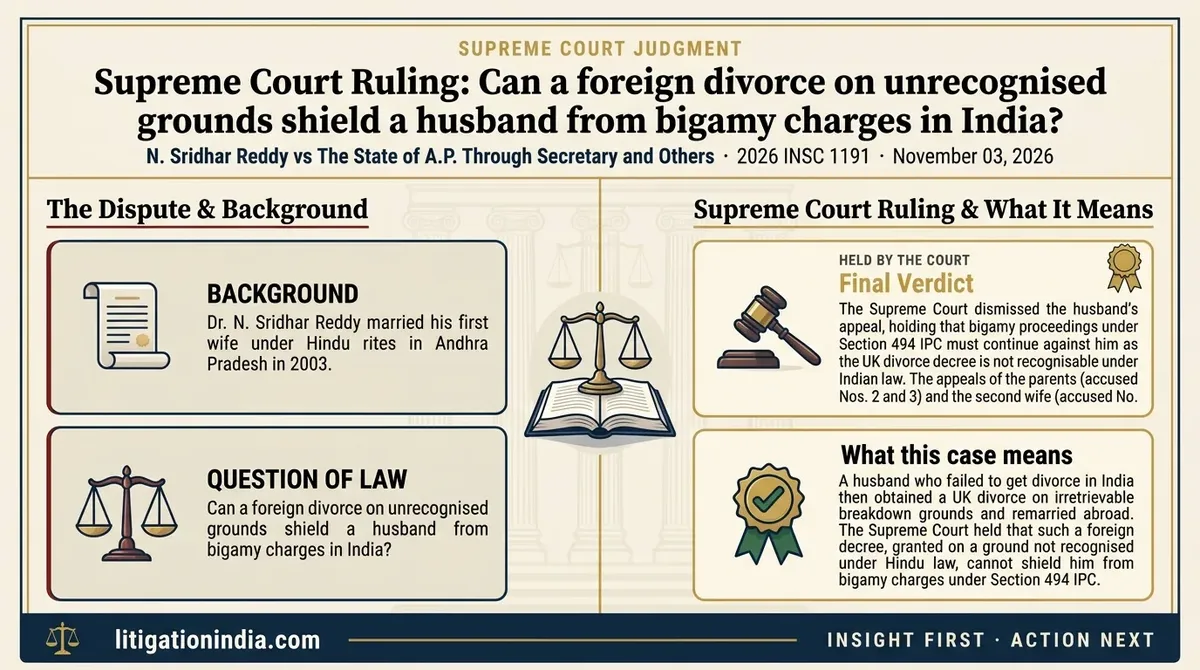
Full text of the judgment
Text extracted from N. Sridhar Reddy vs The State of A.P. Through Secretary and Others. For the authoritative version refer to the Supreme Court of India's official website.
2026 INSC 1191 S.L.P. (CRL.) NO.7708/2019 ETC.
Page 1 of 18
IN THE SUPREME COURT OF INDIA CRIMINAL APPELLATE JURISDICTION
CRIMINAL APPEAL NO. 5187 OF 2026 (ARISING OUT OF S.L.P. (CRIMINAL) NO.7708/2019)
N. SRIDHAR REDDY
…APPELLANT(S) VERSUS
THE STATE OF A.P. THROUGH SECRETARY AND OTHERS
…RESPONDENT(S)
CRIMINAL APPEAL NO. 5188 OF 2026 (ARISING OUT OF S.L.P. (CRIMINAL) NO.7793 OF 2019)
CRIMINAL APPEAL NO. 5189 OF 2026 (ARISING OUT OF S.L.P. (CRIMINAL) NO.7812 OF 2019) J U D G M E N T
PRASHANT KUMAR MISHRA, J.
1. The case before us brings into sharp focus the limits of matrimonial forum shopping, wherein the husband after failing to get his first marriage dissolved under the Indian jurisdiction, approaches the foreign court, procures a divorce decree under the foreign jurisdiction and thereafter solemnizes a second marriage. Can the sanctity of matrimonial status be allowed to yield to such forum non conveniens? 2. Leave granted. Digitally signed by NISHA KHULBEY Date: 2026.11.03 16:51:24 IST Reason: Signature Not Verified
S.L.P. (CRL.) NO.7708/2019 ETC.
Page 2 of 18
3. The lead Criminal Appeal1 is preferred by Dr. N. Sridhar Reddy2, who is the husband of N. Geetha Prasanthi, respondent No.2 (first wife). As far as the other two Criminal Appeals3 are concerned, they are preferred by Geetha Inturi4, the second wife of Dr. N. Sridhar Reddy and Nallapareddy Krishna Reddy5 and Nallapareddy Vasantha Kumari6, the parents of Dr. N. Sridhar Reddy, respectively. These Appeals impugn the common order dated 08.07.2019 passed by the High Court of Andhra Pradesh whereby the High Court has dismissed the petitions filed by the present appellants under Section 482 of the Code of Criminal Procedure, 19737 seeking quashing of C.C. No. 571/2018 pending on the file of I Additional Junior Civil Judge, Sattenapalli, Guntur District, Andhra Pradesh. A. FACTUAL MATRIX 4. The facts giving rise to the present Appeals are as follows: i. Accused no.1 married respondent No.2 (N. Geetha Prasanthi) on 18.04.2003 at Sattenapalli, Andhra Pradesh, according to Hindu rites and customs. ii. After the marriage, they resided in Hyderabad where accused No.1/husband was doing post-graduation from Osmania Medical College.
1 Arising out of S.L.P. (Crl.) No. 7708/2019 2 Hereinafter referred to as ‘accused No.1/husband’ 3 Arising out of S.L.P. (Crl.) Nos. 7793/2019 and 7812/2019 4 Hereinafter referred to as ‘accused No.4/second wife’ 5 Hereinafter referred to as ‘accused No.2’ 6 Hereinafter referred to as ‘accused No.3’ 7 For short, ‘Cr.PC’
S.L.P. (CRL.) NO.7708/2019 ETC.
Page 3 of 18
iii. On 04.02.2005, accused No.1/husband went to United Kingdom to pursue his career as a doctor. On 07.05.2006, respondent No.2/first wife, joined accused No.1/husband in the United Kingdom. iv. In August 2007, respondent No.2/first wife returned to her parental home at Sattenapalli, Andhra Pradesh, for delivery and their son was born on 04.11.2007. It is case of accused No.1/husband that despite repeated requests, respondent no.2/first wife did not return to United Kingdom. v. As the matrimonial relationship of the parties deteriorated, accused No.1/husband instituted a divorce and custody proceedings before the competent Court at Narasaraopet, Guntur District, Andhra Pradesh, which were dismissed. Against the dismissal of the divorce proceedings, accused No.1/husband preferred an appeal before the High Court, but subsequently, he withdrew the same. Thus, the original Hindu marriage continue to subsist. vi. Accused No.1/husband was granted citizenship of the United Kingdom (by naturalization) after 8 years of continuous residence in the United Kingdom on 01.02.2013. vii. Thereafter, on 16.08.2013, accused No.1/husband instituted divorce proceedings against respondent No.2/first wife before the Cambridge County Court in England. Respondent No.2/first wife
S.L.P. (CRL.) NO.7708/2019 ETC.
Page 4 of 18
filed objections concerning jurisdiction and competence of the foreign court in granting divorce. viii. On 27.11.2013, the Cambridge County Court passed an order in favour of accused No.1/husband and ordered that a decree nisi be issued. Ultimately on 29.01.2014, the divorce decree issued by the Cambridge County Court was made absolute wherein the marriage was dissolved on the ground of irretrievable breakdown of marriage. ix. On 03.03.2014, accused No.1/husband married Geetha Inturi, accused no.4/second wife, in Norfolk, United Kingdom. x. Almost after two years, i.e., on 01.02.2016, respondent No.2/first wife lodged a complaint with the Sattenapalli Town Police Station, Guntur District, under Sections 494, 120B read with Section 34 of the Indian Penal Code, 18608, which is the subject matter of these Appeals. xi. A chargesheet came to be filed against accused No.1/husband and his parents as accused Nos.2 and 3 respectively, but the name of accused no.4/second wife was deleted from the chargesheet. It was, however, at the cognizance stage that the learned Magistrate decided to take cognizance against accused no.4/second wife as well. Aggrieved by the same, the appellants filed petitions under Section 482 of the Cr.PC praying for quashing of the criminal proceedings instituted against them.
8 For short, ‘IPC’
S.L.P. (CRL.) NO.7708/2019 ETC.
Page 5 of 18
xii. The High Court vide its common impugned order dismissed the quashing petitions. Qua accused no.1/husband and accused no.4/second wife, it was noted that the High Court at the stage of Section 482 of the Cr.PC, could not conclusively decide the validity of the divorce decree granted by the foreign court. Further, the actual date of the second marriage could be determined after the trial concludes. Thus, the High Court held that the material available on record was not of such a sterling or impeccable quality that would justify quashing under Section 482 of the Cr.PC. xiii. Qua accused nos.2 and 3 (parents of accused no.1/husband), the High Court observed that at the threshold, the allegations against them could not be disregarded and that their role in the second marriage of accused No.1/husband could only be determined at the stage of trial. B. SUBMISSIONS OF THE PARTIES 5. The learned senior counsel appearing for accused No.1/husband submitted that he became a British citizen on 01.02.2013 and got married to accused no.4/second wife in United Kingdom on 03.03.2014. Thus, it is argued that at the time of the alleged offence, accused No.1/husband was a British citizen. Relying on Section 4 of the IPC, it was argued that IPC has no application to the acts of foreign citizens that have occurred abroad. 6. It was submitted that the divorce decree granted by the Cambridge County Court is a valid decree and the earlier marriage was not subsisting at
S.L.P. (CRL.) NO.7708/2019 ETC.
Page 6 of 18
the time the second marriage was solemnized. Further, respondent No.2/first wife specifically conceded to the jurisdiction of the UK Court and took the argument of forum non conveniens. It was also submitted on behalf of accused No.1/husband that once the divorce decree has been passed after hearing the respondent No.2/first wife and unless the same is set aside by a competent civil court in India, the said decree is presumed to be valid as per Section 14 of Civil Procedure Code, 19089. 7. It was also argued that there has been a substantial delay in filing the FIR. The decree of divorce granted by the UK Court is dated 27.11.2013 and 29.01.2014 and the second marriage between accused No.1/husband and accused No.4/second wife took place on 03.03.2014. However, the complaint by respondent No. 2/first wife was only filed on 01.02.2016. It is asserted that the said complaint has only been filed to harass accused No.1/husband. 8. Accused Nos.2 and 3, the parents of accused No.1/husband, have submitted in their rejoinder affidavit that they were not complicit with accused No.1/husband in commission of the offence of bigamy. Further, there has been no overt act attributed to them in the chargesheet, without which they cannot be made liable for conspiring with accused No.1/husband for the commission of bigamy. 9. Accused No.4/second wife, in her rejoinder affidavit, has claimed that she was not aware about the first marriage of accused No.1/husband. Further,
9 For short, ‘CPC’
S.L.P. (CRL.) NO.7708/2019 ETC.
Page 7 of 18
she relies upon the foreign decree of divorce to contend that at the time of her marriage with accused No.1/husband, he was already divorced. 10. Per Contra, it was argued on behalf of the respondent No.2/first wife that since the marriage between accused No.1/husband and respondent No.2/first wife, was solemnized in India, the dissolution of it could only take place in accordance with the provisions of Hindu Matrimonial Laws. 11. It was also submitted on behalf of respondent No.2/first wife that she did not voluntarily or unconditionally submit to the jurisdiction of the Cambridge County Court rather submitted her objections to the jurisdiction of the Cambridge County Court. 12. Further, respondent No.2/first wife also disputes the validity of the decree of divorce granted by the Cambridge County Court so far as it was founded on the ground of irretrievable breakdown of marriage which is not a statutory ground for the dissolution of marriage under the Hindu Marriage Act, 1955, thus violating the conditions laid down under Section 13 of the CPC. Reliance is accordingly placed on Y. Narasimha Rao and Others v. Y. Venkata Lakshmi and Another10. 13. Further, respondent No.2/first wife also places reliance on the decision of this Court in Satya v. Teja Singh 11 to contend that a foreign decree obtained from a Court lacking jurisdiction or wherein the jurisdiction is obtained by misrepresenting the facts cannot bind the Indian Courts.
10 (1991) 3 SCC 451 11 (1975) 1 SCC 120
S.L.P. (CRL.) NO.7708/2019 ETC.
Page 8 of 18
14. The rival submissions now fall for our consideration.
C. ANALYSIS AND FINDINGS 15. Keeping in view the facts and the submissions of the parties, the issue that arises to be determined by us is twofold – firstly, whether the decree of divorce granted by the foreign court on the ground of irretrievable breakdown of marriage is entitled to recognition in India under Section 13 of the CPC, and if not, whether accused No.1/husband can shield behind such decree to escape liability under Section 494 of the IPC and secondly, whether exercise of inherent jurisdiction under Section 482 of the Cr.PC could have been exercised against any of the appellants.
FOR ACCUSED NO.1/HUSBAND: FOREIGN DECREE CANNOT SHIELD THE SUBSEQUENT MARRIAGE
16. The statutory framework governing the recognition of the foreign judgments is laid down under Sections 13 and 14 of the CPC. These provisions largely are an extension of the principle of res judicata, wherein a judgment delivered by a foreign court of competent jurisdiction can be enforced by an Indian Court and will ultimately operate as res judicata between the parties, provided except in the cases as mentioned in Section 13 of the CPC. The larger policy behind these provisions is to further the principle of comity of nations subject to the general principles of justice, equity and good conscience.
S.L.P. (CRL.) NO.7708/2019 ETC.
Page 9 of 18
17. Before we proceed, it is appropriate to have a look at Sections 13 and 14 of the CPC which read as under: “13. When foreign judgment not conclusive.—A foreign judgment shall be conclusive as to any matter thereby directly adjudicated upon between the same parties or between parties under whom they or any of them claim litigating under the same title except— (a) where it has not been pronounced by a Court of competent jurisdiction; (b) where it has not been given on the merits of the case; (c) where it appears on the face of the proceedings to be founded on an incorrect view of international law or a refusal to recognise the law of India in cases in which such law is applicable; (d) where the proceedings in which the judgment was obtained are opposed to natural justice; (e) where it has been obtained by fraud; (f) where it sustains a claim founded on a breach of any law in force in India.
14. Presumption as to foreign judgments.—The Court shall presume upon the production of any document purporting to be a certified copy of a foreign judgment, that such judgment was pronounced by a Court of competent jurisdiction, unless the contrary appears on the record; but such presumption may be displaced by proving want of jurisdiction.” (emphasis supplied)
18. Section 14 of the CPC makes the foreign judgment as conclusive once it has passed the threshold of Section 13 and other requisites such as principles of natural justice, equity and good conscience. Once these requirements are fulfilled, the executing court cannot enquire into the validity, legality or otherwise of the foreign judgment. 19. Similar principles apply when the Courts are dealing with private international law, more particularly recognition of foreign matrimonial decrees. Thus, a foreign matrimonial decree itself would not assume recognition unless
S.L.P. (CRL.) NO.7708/2019 ETC.
Page 10 of 18
the same is tested on the anvil of Section 13 of the CPC, law governing marriage and jurisdictional principles recognized by that particular country. 20. This Court in the case of Y. Narasimha Rao (supra) interpreted Section 13 of the CPC and laid down the conditions under which a foreign decree of divorce would be recognised in India. It was held as follows: “20. From the aforesaid discussion the following rule can be deduced for recognising a foreign matrimonial judgment in this country. The jurisdiction assumed by the foreign court as well as the grounds on which the relief is granted must be in accordance with the matrimonial law under which the parties are married. The exceptions to this rule may be as follows: (i) where the matrimonial action is filed in the forum where the respondent is domiciled or habitually and permanently resides and the relief is granted on a ground available in the matrimonial law under which the parties are married; (ii) where the respondent voluntarily and effectively submits to the jurisdiction of the forum as discussed above and contests the claim which is based on a ground available under the matrimonial law under which the parties are married; (iii) where the respondent consents to the grant of the relief although the jurisdiction of the forum is not in accordance with the provisions of the matrimonial law of the parties.
21. The aforesaid rule with its stated exceptions has the merit of being just and equitable. It does no injustice to any of the parties. The parties do and ought to know their rights and obligations when they marry under a particular law. They cannot be heard to make a grievance about it later or allowed to bypass it by subterfuges as in the present case. The rule also has an advantage of rescuing the institution of marriage from the uncertain maze of the rules of the Private International Law of the different countries with regard to jurisdiction and merits based variously on domicile, nationality, residence — permanent or temporary or ad hoc, forum, proper law etc. and ensuring certainty in the most vital field of national life and conformity with public policy. The rule further takes account of the needs of modern life and makes due allowance to accommodate them. Above all, it gives protection to women, the most vulnerable section of our society, whatever the strata to which they may belong. In particular it frees them from the bondage of the tyrannical and servile rule that wife's domicile follows that of her husband and that it is the husband's domiciliary law which determines the jurisdiction and judges the merits of the case.” (emphasis supplied) 21. Further, this Court in the case of Satya (supra) laid down that principles governing the validity of the foreign decrees cannot be divorced from the law
S.L.P. (CRL.) NO.7708/2019 ETC.
Page 11 of 18
governing the matrimonial status of the parties. Any divergence from the law governing the parties would ultimately result in an anomalous situation which the Court regarded as a “limping marriage”. This Court observed thus: “9. We cannot therefore adopt mechanically the Rules of Private International law evolved by other countries. These principles vary greatly and are moulded by the distinctive social, political and economic conditions obtaining in these countries. Questions relating to the personal status of a party depend in England and North America upon the law of his domicile, but in France, Italy, Spain and most of the other European countries upon the law of his nationality. Principles governing matters within the divorce jurisdiction are so conflicting in the different countries that not unoften a man and a woman are husband and wife in one jurisdiction but treated as divorced in another jurisdiction. We have before us the problem of such a limping marriage. *** 18. In determining whether a divorce decree will be recognised in another jurisdiction as a matter of comity, public policy and good morals may be considered. No country is bound by comity to give effect in its courts to divorce laws of another country which are repugnant to its own laws and public policy. Thus, where a “mailorder divorce” granted by a Mexican court was not based on jurisdictional finding of domicile, the decree was held to have no extraterritorial effect in New Jersey [State v. Najjar, 2 NJ 208]. American courts generally abhor the collusive Mexican mail-order divorces and refuse to recognise them [Langner v. Langner, 39 NYS 2d 918] . Mail-order divorces are obtained by correspondence by a spouse not domiciled in Mexico. Latey, in his well known book on divorce says that “The facilities afforded by the Mexican courts to grant divorce to all and sundry whatsoever their nationality or domicile have become even more notorious than those in Reno, Nevada” [ Latey : The Law and practice in Divorce and Matrimonial Causes, 15th Edn., (1973) p. 461]. Recognition is denied to such decrees as a matter of public policy.” (emphasis supplied)
22. In the case before us, accused No.1/husband initially approached the Court of the learned Civil Judge, Guntur, Andhra Pradesh seeking dissolution of marriage with respondent No.2/first wife and having failed to obtain the required relief, he preferred an appeal before the High Court, but chose to withdraw it later. Instead of contesting his appeal here in India, accused No.1/husband chose to file for divorce proceedings before a foreign court after
S.L.P. (CRL.) NO.7708/2019 ETC.
Page 12 of 18
allegedly obtaining the citizenship of United Kingdom in the interregnum. The foreign court thereafter made the decree of divorce final on 29.01.2014, on the ground of irretrievable breakdown of marriage; a ground not statutorily recognized under the Hindu Laws under which the accused no.1/husband and respondent No.2/first wife, were married. Such a decree cannot automatically be accorded recognition in India. In our view, the foreign divorce decree was passed in contravention of the existing matrimonial law in India and on a ground that is not even recognized statutorily. This not only violates the legal threshold of Section 13 of the CPC, which every foreign decree has to pass through, but also the observations made by this Court in Y. Narasimha Rao (supra) as to the conditions required to be fulfilled by a foreign decree to be enforceable in India. 23. Here we would also like to advert to a recent judgment of this Court in Kishorekumar Mohan Kale v. Kashmira Kale12 wherein this Court was called to examine a decree of divorce granted by a foreign court on the ground of irretrievable breakdown of marriage wherein the marriage was solemnized under the Indian law. This court while refusing the recognition to such decree held as follows: “9. In the present case, the US Court granted a decree of divorce on the ground of irretrievable breakdown of marriage. This ground is not recognized under the HMA, which is the matrimonial law applicable to the parties. Further, while the appellant-husband was duly served, he only filed a written statement by post expressly contesting the jurisdiction of the US Court, and did not participate in those proceedings any further. It cannot therefore be said that he voluntarily or effectively submitted to the jurisdiction of the foreign forum, or that he was afforded a meaningful opportunity
12 2026 SCC OnLine SC 448
S.L.P. (CRL.) NO.7708/2019 ETC.
Page 13 of 18
to contest the matter. The foreign decree accordingly does not satisfy the conditions laid down in Y. Narasimha Rao (supra), and the principles of natural justice cannot be said to have been complied with.
10. In light of the foregoing, we find that the foreign decree is not conclusive and cannot be sustained as a valid decree of divorce between the parties. Consequently, the question of which Court, whether the Family Court, Pune or the Circuit Court for the County of Oakland, had jurisdiction to entertain the divorce proceedings, need not be conclusively decided in the present proceedings. We do, however, find it necessary to bring a quietus to this matter. The parties have been separated since 2008, nearly eighteen years now, and it is manifest that no matrimonial bond subsists between them. In such circumstances, this Court finds it appropriate to exercise its jurisdiction under Article 142 of the Constitution of India, and to grant the parties a decree of divorce on the ground of irretrievable breakdown of marriage.” (emphasis supplied) These observations may hold importance for us to decide that if the foreign decree does not satisfy the requirements of Section 13 of the CPC, whether accused No.1/husband while relying on such a decree contend that his first marriage stood dissolved in the eyes of matrimonial laws of India and, thus, escape the rigours of Section 494 of the IPC, in our view, this cannot be permitted. 24. Further, on the contention raised on behalf of accused No.1/husband that respondent No.2/first wife had, in fact, submitted to the jurisdiction of the foreign court and, hence, the foreign decree would be applicable to her, the proceedings before the foreign court prime facie do not support this conclusion. Proceedings before the foreign court would indicate that respondent No.2/first wife did raise an objection to the jurisdiction of the foreign court. Therefore, her participation cannot, at this stage, be equated with an unconditional
S.L.P. (CRL.) NO.7708/2019 ETC.
Page 14 of 18
submission to the jurisdiction of the foreign court and make the foreign decree binding on her. 25. Now coming to the argument of accused No.1/husband that since he was a British citizen when the second marriage with accused No.4/second wife was solemnized and since the second marriage took place outside India, keeping in view the mandate of Section 4 of the IPC, he cannot be held liable. We cannot accept this submission in the manner canvassed as accused No.1/husband was married to respondent No.2/first wife in India under the Hindu rites, rituals and customs, thus, even if the second marriage took place outside India, the allegations under Section 494 of the IPC cannot be said to be diluted since enquiry for the offence of bigamy cannot be confined to the place of second marriage but must necessarily take into account the subsisting matrimonial relationship. Even otherwise, legal consequences flowing from the subsisting marriage cannot be defeated by a subsequent change in the nationality of accused No.1/husband. 26. Further, the submission on behalf of accused No.1/husband that criminal proceedings qua him are liable to be interdicted on the ground of delay in lodging of the FIR cannot be accepted at this stage considering that bigamy is a continuing offence. Thus, on every occasion the disobedience or noncompliance occurs, the offence is committed. 27. We also clarify that the aforesaid conclusions are only confined to the limited scrutiny permissible at the present stage. Nothing contained in this judgment shall be construed as a final expression on the merits of the case.
S.L.P. (CRL.) NO.7708/2019 ETC.
Page 15 of 18
FOR ACCUSED NOS.2 AND 3 — PARENTS OF ACCUSED NO.1/HUSBAND: CRIMINAL LIABILITY CANNOT MERELY FLOW FROM RELATIONSHIP
28. Now coming to the Appeal preferred by accused Nos.2 and 3, the parents of accused No.1/husband. It has been alleged that accused Nos.2 and 3 conspired with accused No.1/husband for commission of the bigamy. The bare perusal of the allegations against accused Nos.2 and 3 do not point to any overt act on their part to conspire with accused No.1/husband for commission of bigamy. In the chargesheet, it is recorded that accused Nos.2 and 3 made criminal conspiracy against respondent No.2/first wife for execution of certain properties in favour of accused No.1/husband and thereby encouraging second marriage of accused No.1/husband with accused No.4/second wife. This, in our opinion, cannot be held as sufficient material to hold allegations against accused Nos.2 and 3. There is no material to show the existence of any agreement between the parties for commission of the offence of bigamy. 29. Additionally, even if accused Nos.2 and 3 were aware about the existence of second marriage, that itself cannot make them liable for conspiracy to commit bigamy. Here, we would like to advert to the findings of this Court in the case of Sivaraman Nair and Others v. State of Kerala and Another13 while referring to the judgment of this Court in S. Nitheen and Others v. State of Kerala and Another14 held that in the absence of evidence showing active
13 2026 INSC 412 14 (2024) 8 SCC 706
S.L.P. (CRL.) NO.7708/2019 ETC.
Page 16 of 18
participation, facilitation, or overt acts in the second marriage cannot make the in-laws liable. This Court observed thus: “26. Coming to the allegations under Section 494 of the IPC, it has been held in S. Nitheen (supra) [S. Nitheen and Others v. State of Kerala and Another, (2024) 8 SCC 706] that in order to bring home the said charge, the complainant is required to prima facie prove the overt act or omission of the accused persons in the second marriage ceremony. The prosecution has failed to provide any cogent evidence to establish such overt act or intention on part of the accused-appellants.
27. The High Court relied upon the statement of a witness to infer knowledge on the part of the accused-appellants. However, such inferential knowledge, without more, is insufficient to satisfy the threshold established in S. Nitheen (supra), which requires evidence of an overt act or omission. While it has been alleged that the accused-appellants were aware of the second marriage, mere knowledge that an act is being or has been committed by another person does not, by itself, establish the requisite common intention. Even proceeding on the basis that the accused-appellants were aware of the second marriage, there is no allegation, let alone any material, to suggest that they actively participated in, facilitated, or encouraged the solemnisation of that marriage.” (emphasis supplied)
FOR ACCUSED NO.4/SECOND WIFE : MATRIMONIAL STATUS AND CRIMINAL LIABILITY MUST BE EXAMINED SEPARATELY
30. Coming to the Appeal preferred by accused No.4/second wife, respondent No.2/first wife has stated in her complaint that she travelled to United Kingdom in 2013 and made enquiry in Electoral Directory of Cambridge County Council, Mandela House, Cambridge CB2 1BY, United Kingdom, wherein she obtained the information that accused nos.1 and 4 were living as husband and wife secretly since 2012, when respondent No.2/first wife confronted about the same with accused No.4/second wife, she stated that she was only a companion of accused No.1, living under the same roof.
S.L.P. (CRL.) NO.7708/2019 ETC.
Page 17 of 18
31. In the chargesheet, however, the investigating agencies did not find sufficient material against accused No.4/second wife and, thereafter, closed the case against her and deleted her name from the chargesheet. However, vide order dated 22.12.2018, the learned I Additional Junior Civil Judge, Sattenapalli, rejected the closure of the case against accused No.4/second wife and, in fact, decided to take cognizance against her without assigning any reason. 32. At this stage, this Court is not required to take a meticulous examination of the allegations levelled against accused No.4/second wife. The question, however, is that whether the material on record establishes a prime facie case of conspiring her with accused No.1/husband to enter into a second marriage despite knowing the existence of accused No.1’s first marriage. In the present case, apart from accused No.4’s alleged cohabitation or marriage with accused No.1, no other overt act demonstrates that she participated in the alleged commission of the offence knowingly or even had the conscious knowledge that the first marriage of accused No.1 was still subsisting. In our view, criminal liability must be established qua each accused separately and, thus, continuance of the criminal proceedings against accused No.4 would result in an abuse of the process of law. D. CONCLUSION 33. In view of the above discussions, we hold as follows: i. The criminal proceedings against accused No.1/husband for the offence under Section 494 of the IPC is sustained. Accordingly,
S.L.P. (CRL.) NO.7708/2019 ETC.
Page 18 of 18
Criminal Appeal arising out of S.L.P. (Criminal) No.7708 of 2019 stands dismissed; and ii. Criminal proceedings qua accused Nos.2 and 3, the parents of accused No.1/husband and in-laws of respondent No.2/first wife, and accused No.4/second wife, are quashed. Accordingly, Criminal Appeals arising out of S.L.P. (Criminal) Nos.7812 of 2019 and 7793 of 2019 are allowed.
…..………………………………………J. (PRASHANT KUMAR MISHRA)
…..………………………………………J. (SHREE CHANDRASHEKHAR)
NEW DELHI; NOVEMBER 03, 2026.