
Full text of the judgment
Text extracted from JC-377745M Ex Sub Maj & Hony Lt Devi Singh vs Union of India & Ors.. For the authoritative version refer to the Supreme Court of India's official website.
2026 INSC 1256
Page 1 of 20
REPORTABLE IN THE SUPREME COURT OF INDIA (CIVIL APPELLATE JURISDICTION)
CIVIL APPEAL NO. OF 2026 (@ DIARY NO. 33439 OF 2023)
JC-377745M EX SUB MAJ & HONY LT DEVI SINGH
…….APPELLANT(S)
UNION OF INDIA & ORS. …….RESPONDENT(S)
J U D G M E N T
NONGMEIKAPAM KOTISWAR SINGH, J. Leave to appeal granted. 2. The present appeal is directed against the final judgment and order dated 10 May 2023 passed by the Armed Forces Tribunal, Regional Bench, Lucknow, in O.A. No. 1066 of 2022, as well as the subsequent order dated 19 July 2023, whereby the Tribunal declined to grant leave to appeal to this Court. Digitally signed by RAHUL KUMAR Date: 2026.11.20 17:29:43 IST Reason: Signature Not Verified
Page 2 of 20 By the impugned judgment dated 10 May 2023, the Tribunal dismissed the claim of the appellant seeking the grant of pension under War Injury Element, principally on the ground that the requisite final Battle Casualty Certificate had not been issued by the competent authority, namely, the Adjutant General’s Branch/MP-5. The Tribunal accepted that the appellant’s disability was attributable to military service. It nevertheless rejected his claim for War Injury Element principally because the casualty had not received final approval from the Adjutant General’s Branch/MP-5 and the appellant’s name was not reflected in the relevant digital database. In doing so, the Tribunal did not determine the cumulative evidentiary effect of Part II Order No. BC-59, the Attributability Certificate issued by Signals Records, the Release Medical Board proceedings and the Commandant-endorsed Severity Certificate. The correctness of that approach arises for consideration in this appeal. FACTS
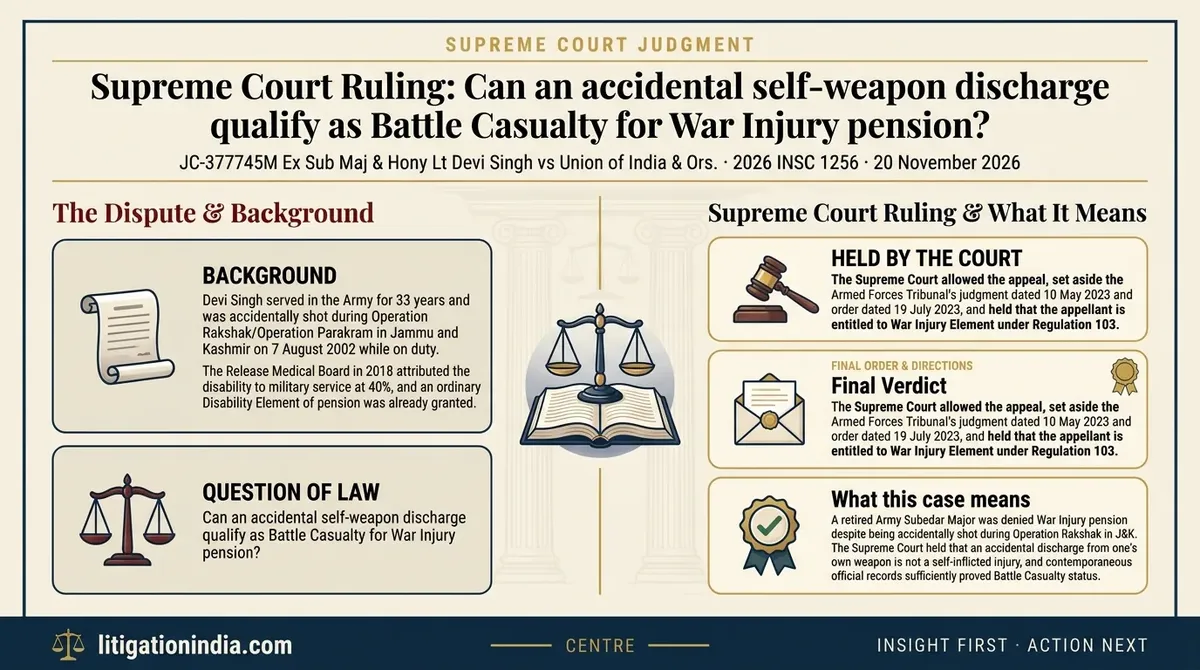
3. The appellant joined the Army on 24 June 1985 and retired on 31 March 2019 as Subedar Major and Honorary Lieutenant after
Page 3 of 20 33 years of service. On 7 August 2002, while serving with 31 Sub Area Signal Company in Jammu and Kashmir during Operation Rakshak/Operation Parakram, his loaded weapon accidentally discharged a bullet while he was on duty. The bullet passed through the left thigh and damaged the femoral vein. He was evacuated to 92 Base Hospital, where debridement and repair of the vein were performed. 4. The occurrence and the disability are not in dispute. The Release Medical Board proceedings dated 23 September 2018 found the injury attributable and connected with military service, assessed the disablement at 40% for life, and placed the appellant in permanent low medical category A2(P). The Union has already granted an ordinary Disability Element of pension at 40%, rounded to 50%, from 1 April 2019. However, the appellant seeks enhanced pension under the War Injury Element. Hence, the surviving issue is whether the same injury is to be recognised as a Battle Casualty/War Injury for the higher pensionary treatment under Regulation 103 of the Pension Regulations for the Army. The Release Medical Board proceedings dated 23 September 2018 referring to Part II Order No. BC-59 dated 16 December 2002, recorded the case as one of “battle casualty”.
Page 4 of 20 5. The contemporaneous Part II Order No. BC-59 dated 16 December 2002 bears the heading ‘BATTLE CASUALTY WOUND OP RAKSHAK OP PARAKRAM’. The document identifies the appellant, Northern Command, the unit area and the date and nature of the injury. Its precise material entry is reproduced and applied in paragraph 11 below. Thereafter, the Education Scholarship Entitlement Cards issued by the Chief Record Officer described the appellant as permanently disabled on 7 August 2002 during Operation Rakshak. On 5 February 2015, Brigadier K. Vinod Kumar, Officer-in- Charge, Signals Records, issued an Attributability Certificate which declared the injury attributable to military service and expressly certified it as a Battle Casualty with reference to BC-59 order dated 16 December 2002. The respondents neither withdrew that certificate nor alleged that it was obtained by misrepresentation. The Severity Certificate records the injury as “grievous” under Parameter No. 2 of Army Order 1/2003/MP. It was signed by the medical specialist and the Medical Board, countersigned by the Commanding Officer/Commandant and approved at Command
Page 5 of 20 level by the Major General (Medical). No medical or command authority has produced a contrary assessment. 6. The order of original Court of Inquiry, situation report and unit file could not subsequently be produced. According to the respondents, the relevant unit records had been submerged and destroyed in the 2014 floods while remaining in official custody. MP-5’s communication dated 21 August 2020 noted that the appellant’s name was absent from the digital database and sought reconstruction of the case and it expressly permitted the initial and detailed reports to be prepared from the documents presently available where originals were not held. The Army itself thus treated the absence of the original file as a matter for reconstruction, which they were unable to do. SUBMISSIONS 7. Learned counsel for the appellant submitted that the claim rests upon a consistent chain of official Army records. It was contended that these official findings could not be displaced merely because the appellant’s name was absent from a later digital database or because the primary unit records were destroyed in the 2014 floods. In the absence of any contrary material, due
Page 6 of 20 weight ought to be given to the field/ command records and medical authorities, who were best placed to ascertain the operational circumstances and ground reality. Per contra, the learned Additional Solicitor General appearing for the respondents submitted that MP-5 was the designated authority competent to accord final Battle Casualty status and that the Attributability Certificate issued by Signals Records with reference to Part II Order No. BC-59 could not substitute MP-5’s approval. Further, in the absence of a report of the Court of Inquiry, casualty reports and other primary records, it could not be established that the accidental discharge occurred while the appellant was actually carrying out operations against the enemy or militants. The mere fact that he was on duty in an operational area, according to the respondents, was insufficient to bring the injury within the special category of war injury. ANALYSIS 8. The appeal raises the following three questions: (i) What are the conditions governing entitlement to War Injury Element under Regulations 82 and 103 and Army Order 1/2003/MP;
Page 7 of 20 (ii) Whether an accidental gunshot injury caused by the discharge of the appellant’s own weapon is excluded as a selfinflicted injury or may qualify as a Battle Casualty when the prescribed operational nexus is established; and (iii) Whether the surviving Army records establish Parameter No. 1, Parameter No. 2 and Category ‘E’ notwithstanding the non-availability of the original records, the absence of a later digital entry and the objection regarding final approval by MP- 5. 9. The governing pensionary framework, Regulation 103 of the Pension Regulations for the Army, Part I, 2008 provides as follows: “WAR INJURY ELEMENT ON SUBSEQUENT RETIREMENT 103. (a) Where Service personnel is retained in service despite war injury/disability sustained under the circumstances mentioned in category 'E' of Regulation 82 of these Regulations and does not opt for lump sum compensation in lieu of war injury, he shall be entitled to the payment of war injury element on a monthly basis at the rates prescribed under Regulation 102 above on subsequent retirement/discharge or on completion of the terms of engagement in addition to retiring pension/service pension as admissible under normal rules. (b) For disabilities less than 100% but not less than 20%, the above rate shall be proportionately reduced. No war injury element shall be payable for disabilities less than 20%. The provision contained in Regulation 94(c) or Regulation 98(c) above shall not be applicable for computing war injury element.” (Emphasis supplied)
Page 8 of 20 10. Regulation 103 does not treat every disability attributable to military service as a war injury. It incorporates a further substantive requirement that the disability must have been sustained under the circumstances specified in Category 'E' of Regulation 82. Hence, for this purpose, the Category ‘E’ of the Regulation 82 is reproduced hereunder: “Category E Death or disability arising as a result of:- (a) Enemy action in international war. (b) Action during deployment with a peacekeeping mission abroad. (c) Border skirmishes. (d) During laying or clearance of mines including enemy mines as also minesweeping operation. (e) On account of accidental explosions of mines while laying operationally oriented mine-field or lifting or negotiating minefield laid by enemy or own forces in operational areas near international borders or the line of control. (f) War like situations, including cases which are attributable to/aggravated by:- (i) Extremist acts, exploding mines etc. while on way to an operational area. (ii) Battle inoculation training exercises or demonstration with live ammunition. (iii) Kidnapping by extremists while on operational duty. (g) An act of violence/attack by extremists, anti-social elements, etc. (h) Action against extremists, antisocial elements, etc. Death/disability while employed in the aid of civil power in quelling agitation, riots or revolt by demonstrators will be covered under this category. (i) Operations specially notified by the Govt. from time to time. (Emphasis supplied)
Page 9 of 20 11. Clause (h) directly governs the present case. The contemporaneous Part II Order No. BC-59 dated 16 December 2002 does not merely record the place of posting at Jammu and Kashmir. It places this particular casualty under an operationspecific heading and records the manner in which the injury occurred. Its material portion reads: “BATTLE CASUALTY WOUND OP RAKSHAK OP PARAKRAM Injured due to GSW LT Groin. Ligation of bleed vein (Femoral) and wound debridement done. Battle accident. (Sustained bullet injury due accidental discharge of his wpn while on duty unit area on 07 Aug 2002).” (Emphasis supplied)
The heading connects the identified gunshot wound with Operation Rakshak/Operation Parakram, whereas the narration records that the discharge was accidental and occurred while the appellant was on duty in the unit area. Read with the undisputed posting in Jammu and Kashmir engaged in the military operations namely Operation Rakshak/Operation Parakram, the Entitlement Cards recording permanent disability during the said operation and the Battle Casualty Certificate issued with express reference to BC-59, the entries establishes an operational connection with Operation Rakshak/ Parakram conducted by the Army and not merely presence in a geographically sensitive area. Operation
Page 10 of 20 Rakshak/ Parakram was directed against militants and extremists who are supported by enemies of the country. The disability therefore falls within the first limb of clause (h), namely, action against extremists or anti-social elements. 12. The next and narrow question is whether the injury must nevertheless be excluded merely because the bullet was discharged from the appellant’s own weapon. Army Order 1/2003/MP distinguishes physical casualties from battle casualties in the following terms: “3. Physical Casualties. Physical Casualties are those, which occur in non-operational areas or in operational areas where there is no fighting. Casualties of this type consist of the following categories:- (a) Died or Killed. (b) Seriously or dangerously ill. (c) Wounded or injured (including self-inflicted). (d) Missing. 4. Battle Casualties. Battle Casualties are those casualties sustained in action against enemy forces or whilst repelling enemy air attacks. Casualties of this type consist of the following categories:- (a) Killed in action. (b) Died of wounds or injuries (other than selfinflicted). (c) Wounded or injured (other than self-inflicted). (d) Missing.” (Emphasis supplied)
13. The distinction pertinent to note here is that the exclusion is of a self-inflicted injury, not of every injury in which a
Page 11 of 20 serviceman’s own weapon happens to be the source of the bullet. The words ‘his wpn’ in BC-59 record identify the weapon from which the bullet emerged. They do not establish that the appellant consciously fired the weapon at himself, intended to cause the wound to himself, or committed any act for the purpose of avoiding duty. Weapon ownership and intention are distinct facts, the former cannot, without evidence of intention, prove the latter. 14. A service weapon may discharge without an intention to cause bodily injury to himself, for example while holding a weapon, an impact or fall, snagging of the trigger, inadvertent pressure on the trigger, or a mechanical defect can also cause the discharge of a bullet from one’s own weapon. These nature of incidents are clearly distinguishable from the idea of self-inflicted injury which has certain element of knowledge or intention so as to disqualify from getting enhanced pensionary benefit. These possibilities are not findings as to how the present weapon discharged, however they demonstrate why the source of the bullet cannot, by itself, determine whether the wound was self-inflicted. That classification must rest upon the evidence concerning the occurrence and the contemporaneous findings of the competent authorities.
Page 12 of 20 15. Here, the earliest surviving contemporaneous official record expressly describes the discharge as ‘accidental’. No Court of Inquiry finding, disciplinary order, medical opinion or command decision describes the injury as deliberately self-inflicted, as an attempt to avoid duty, or as arising from an intentional act of the appellant. On the contrary, the Army’s Signal’s Record dated 5 February 2015 subsequently certified the same injury as a Battle Casualty by reference to Part II Order No. BC-59 dated 16 December 2002. In the absence of contrary contemporaneous material, an officially recorded accident cannot be converted into a self-inflicted injury merely because the weapon belonged to the appellant. 16. This conclusion is reinforced by paragraph 69 of Army Order 1/2003/MP, which expressly recognises an accidentally sustained gunshot wound as capable of being classified as a wounded Battle Casualty, provided the operational and severity requirements are satisfied, as otherwise the self-inflicted injury would have been also mentioned therein to take out from the scope of “battle casualty”. The material part reads: “69. Cause and Nature of Injury. The classification of wounded battle casualty will be guided by the parameters of cause/circumstances and the severity of injury
Page 13 of 20 sustained. Only when both these parameters are met, the casualty would be classified as a Battle Casualty. (a) Parameter No. 1 - The cause or the circumstances under which the injury has occurred. These are:- … (ii) Gun Shot Wound/Splinter injuries sustained accidentally/due to firing by own troops while carrying out operations against enemy/militants. … (b) Parameter No. 2 - The injury should at least be of grievous nature.” (Emphasis supplied)
17. Paragraph 69 of the Army Order 1/2003/MP prescribes two cumulative requirements: First, the cause and operational circumstances must satisfy Parameter No. 1. Clause (a)(ii) of Parameter No. 1 contemplates two situations: a gunshot or splinter injury ‘sustained accidentally’, or such an injury caused by firing by own troops. In either situation, the injury must have been sustained while carrying out operations against the enemy or militants. The present case rests on the first limb, “sustained accidentally”. The heading of Part II Order No. BC- 59, its narration that the appellant sustained the injury through the accidental discharge of his weapon while on duty, the Entitlement Cards and the Brigadier’s Battle Casualty Certificate collectively connect this particular injury with his duty under
Page 14 of 20 Operation Rakshak against militants. Parameter No. 1 is therefore satisfied. It is also pertinent to note the fact that the higher authority, Brigadier through his attributability certificate dated 05.02.2015 also endorsed the classification of the injury received by appellant as battle causality indicates the believability of the report from the field through the unit report of Part II Order No. BC-59. Second, Parameter No. 2 requires the injury to be at least grievous. That requirement is independently established by the Severity Certificate, which expressly classifies the injury as “grievous” and bears the signatures of the medical authorities, the countersignature of the Commanding Officer/Commandant and approval at Command level by the Major General (Medical). Since both the operational-cause requirement and the grievous-injury requirement are fulfilled, the appellant satisfies the cumulative test prescribed in Paragraph 69 of the Army Order 1/2003/MP for classification as a wounded Battle Casualty. 18. In Union of India v. Saroj Devi, 2024 SCC OnLine SC 3591, the Commanding Officer had initially classified the death as a Battle Casualty, but the classification was subsequently changed
Page 15 of 20 to a Physical Casualty. This Court upheld the Tribunal’s decision treating the death as a Battle Casualty because the Commanding Officer’s certificate recorded the actual operational circumstances; those facts had not been disputed by the Union; and the certified circumstances satisfied Appendix ‘A’ to Army Order 1/2003 and Category ‘E(f)’ of Regulation 82. The relevant portions of paragraphs 5 and 8 to 11 are reproduced below: “5. We must deal with the factual aspects. In paragraph 4.3 of the original application filed by the respondent, the following are the averments made: ‘4.3 That while the husband of the applicant was posted in J&K and was part of Area Domination Patrol which was launched from Manjit Main to Rangwar Post for domination of Rangwar Gap in the proximity of LC and along the AIOS in extreme climatic condition on 23/01/2013 from 0100 Hrs to 0330 Hrs. The husband of the applicant complained of breathlessness and was taken to Rangwar Post where he was given First Aid. The condition of the husband of the applicant deteriorated and was required for immediate evacuation, but due to the inclement weather, air evacuation could not be done and husband of the applicant was taken on foot to Chowkibal where he was declared dead. The Commanding Officer of the Unit has issued a Battle Casualty Certificate on 23/01/2013 whereby the death of the husband of the applicant has been treated as Battle Casualty.’ In the reply filed to the original application, the appellants did not dispute the correctness of the averments made in paragraph 4.3. The appellants could not have disputed the said facts as they were also mentioned in the certificate issued by the Commanding Officer. 8. It is brought on record that initially, the Commanding Officer had categorised the death as a ‘battle casualty’, and later on, it was changed to a ‘physical casualty’. To the
Page 16 of 20 counter filed by the respondent, a copy of Army Order 1 of 2003 has been annexed as Annexure R-6. The circumstances for the classification of physical/battle casualties have been incorporated in Appendix ‘A’. In Appendix ‘A’, category 1 is of battle casualties. Clause (g) thereto reads thus: ‘(g) Casualties occurring while operating on the International Border or Line of Control due to natural calamities and illness caused by climatic conditions.’ 9. Coming to the facts of the case, it is not disputed that on the date of the death, the deceased was posted with his battalion in Jammu and Kashmir as part of Operation Rakshak. He was part of an Area Domination Patrol for domination of the Rangwar gap in the proximity of LC. He was doing duty from 1.00 a.m. to 3.30 a.m. The certificate issued by the Commanding Officer records the following facts: (a) The deceased was working in extreme climatic conditions on the date of his death; (b) He was part of Operation Rakshak, and he was also part of the routine Area Domination Patrol close to LC. There were extreme climatic conditions at that place; and (c) When the deceased became breathless, his condition was such that he needed immediate evacuation. However, immediate evacuation by air could not be done due to bad weather conditions. Ultimately, he was taken on foot, and when the team carried him to Chowkibal’s MI room, he was declared dead. 10. Thus, the death can be attributed to illness caused by extreme climatic conditions. Hence, as per clause 1(g) of Appendix ‘A’ of the Army Order 1 of 2003, the case will fall in ‘Battle Casualties’. The reason is that the deceased was operating near LC in extreme climatic conditions. He was part of Operation Rakshak and was on duty near LC. The casualty caused by illness due to climatic conditions is covered by clause 1(g). In this case, the respondent’s husband was a victim of illness caused by extreme climatic conditions. Therefore, the case of the deceased will fall in the category of ‘Battle Casualties’.
Page 17 of 20 11. Clause (f) of category E is attracted when death arises as a result of war-like situations. The definition of death as a result of war-like situations is an inclusive definition, and the case cannot remain confined to sub-clauses (i) to (iii) of category E(f). In this case, the death has occurred as a result of a war-like situation prevailing near LC. Therefore, we concur with the view taken by the Tribunal that clause (f) of category E was applicable.” (Emphasis supplied) 19. The principle emerging from Saroj Devi (supra) is that an official contemporaneous certificate recording the circumstances of a casualty especially made at the time of injury must be accorded due evidentiary weight when it concerns matters within the institutional knowledge of the issuing authority and is not contradicted by any contemporaneous record. A Commanding Officer responsible for the unit is ordinarily better placed to know the place of deployment, the nature of the duty and the operational circumstances in which the casualty occurred. Such a certificate does not, by itself, create a pensionary entitlement. Its function is evidentiary, but the legal entitlement arises only when the facts thereby established satisfy the governing Army Order and pension regulations. Similarly in the present case, the contemporaneous Part II Order No. BC-59 is published by the appellant’s unit who are actually well-versed with the facts and reality of the field. Such
Page 18 of 20 order is also consistent with the entitlement records and the Release Medical Board proceedings. There is nothing contrary shown by the respondents disproving the certificates refer by the appellant. 20. The respondents rely upon two circumstances. First, the appellant’s name is not found in a later digital database, and second, that the original Court of Inquiry and connected unit records are no longer available. Neither circumstance disproves the appellant’s claim. The original records were destroyed in the 2014 floods while they remained in official custody, and their loss cannot be attributed to the appellant. MP-5 itself recognised their nonavailability and permitted the case to be reconstructed from the surviving official documents. Those documents include Part II Order No. BC-59 published by the appellant’s unit, the Brigadier’s Battle Casualty Certificate issued with reference to BC-59, the Release Medical Board proceedings and the Commandantendorsed Severity Certificate. MP-5 has passed no reasoned order holding any of these documents to be unauthorised, incorrect or invalid, nor has any competent authority classified the injury as self-inflicted. The absence of the appellant’s name from a subsequently created digital database is merely the absence of
Page 19 of 20 further corroboration, but it is not affirmative evidence capable of disproving the contemporaneous and signed official records that have survived. The appellant, therefore cannot be made to suffer for no fault on his part. 21. We accordingly hold that the contemporaneous Army record connects the injury with Operation Rakshak and brings it directly within clause (h) of Category ‘E’; that the accidental discharge from the appellant’s own weapon was not shown to be a deliberate or officially classified self-inflicted injury; and that Parameters Nos. 1 and 2 of paragraph 69 were satisfied. The appellant is therefore entitled to War Injury Element under Regulation 103. 22. The appeal is accordingly allowed. 23. The judgment dated 10 May 2023 in O.A. No. 1066 of 2022 and the order dated 19 July 2023 in M.A. No. 1034 of 2023 passed by the Armed Forces Tribunal, Regional Bench, Lucknow, are consequently set aside. 24. It is accordingly directed that the respondents shall sanction and pay War Injury Element of the pension to the appellant with effect from the date of retirement, computed in accordance with Regulation 103 and the applicable pensionary
Page 20 of 20 orders. The Disability Element already paid for the same disability and period shall be adjusted to avoid duplication. The revised Pension Payment Order and net arrears shall be issued and paid within three months from the date of this judgment. 25. Pending applications, if any, stand disposed of.
……………………………………J. (SATISH CHANDRA SHARMA)
………….……………………………………J. (NONGMEIKAPAM KOTISWAR SINGH) NEW DELHI; NOVEMBER 20, 2026.