
Full text of the judgment
Text extracted from Union of India & Ors. vs Narender Kumar. For the authoritative version refer to the Supreme Court of India's official website.
2026 INSC 1166 1
IN THE SUPREME COURT OF INDIA CIVIL APPELLATE JURISDICTION
CIVIL APPEAL NO. OF 2026 @ SPECIAL LEAVE PETITION (C) NO. OF 2026 @SPECIAL LEAVE PETITION (C) DIARY NO. 27220 OF 2026
UNION OF INDIA & ORS.
...APPELLANT (S)
NARENDER KUMAR
…RESPONDENT(S)
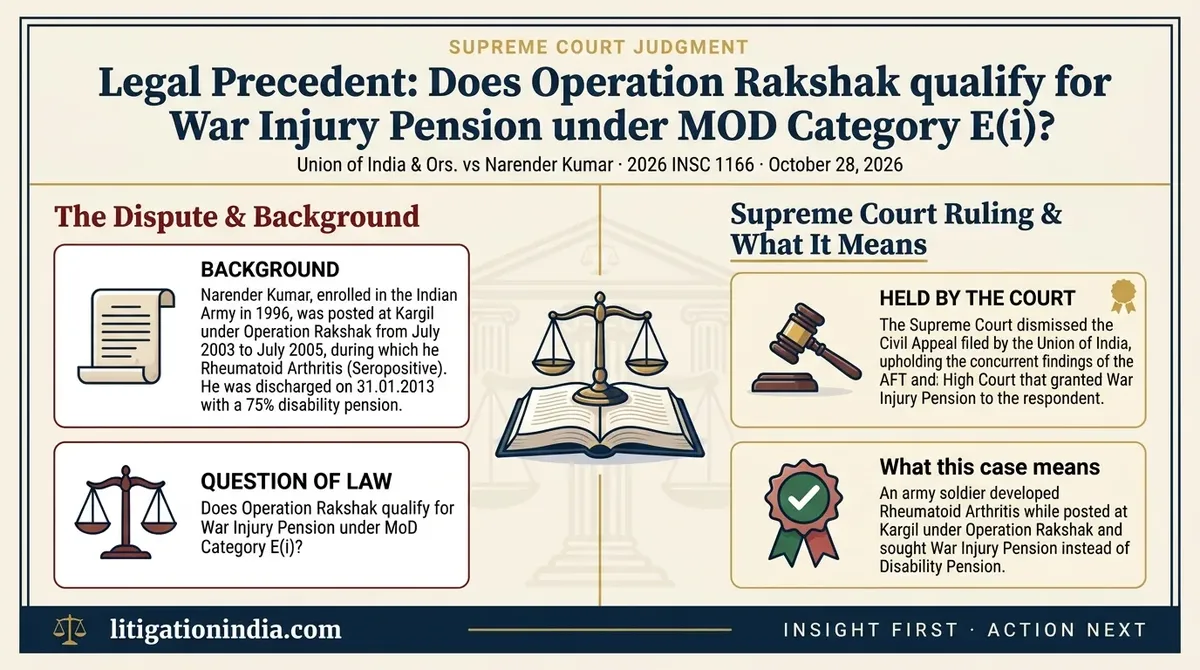
J U D G M E N T 1. Delay condoned. Leave granted. 2. In this Civil Appeal, Union of India through Ministry of Defence (MoD), challenges the concurrent findings of the Armed Forces Tribunal (AFT)1 and the High Court2 granting War Injury Pension to the respondent in place of Disability Pension already granted to him for the ailment ‘Rheumatoid Arthritis’ which developed owing to his posting at Kargil as part of Operation Rakshak.
1 In OA No. 221 of 2019, dated 08.04.2024. 2 In CWP No. 23117 of 2025, dated 11.08.2025. Digitally signed by Jayant Kumar Arora Date: 2026.10.28 16:36:51 IST Reason: Signature Not Verified
3. Facts, to the extent that they are relevant for disposal of this appeal, are that the respondent was enrolled in the Indian Army on 30.12.1996. While being posted at Kargil w.e.f. 13.07.2003 to 06.07.2005, he was diagnosed with ‘Rheumatoid Arthritis (Seropositive)’. Thereafter, he was also diagnosed with ‘PIVD L4/5, L5/S1’ and ‘PIVD C5/C6 (Operated)’ while being posted at West Bengal. The respondent applied for discharge and while discharging him from service on 31.01.2013, the Release Medical Board conceded to all the three disabilities of the respondent as aggravated by military service @70% for life rounded off to 75% for life. Having rendered more than 16 years of service, the respondent was granted Disability Pension consisting of Service Element and Disability Element. 4. Discharged in 2013, and having continued to regularly receive pensionary benefits with Service Element as well as Disability Element, it is after about 6 years that the respondent approached the AFT seeking grant of War Injury Pension under Part II, Category E(i), Para 4.1 of MoD Policy Letter (“Category E(i), Para 4.1 of MoD Policy Letter”) dated 31.01.2001, instead of Disability pension for Rheumatoid Arthritis (Seropositive), on the ground that this disablement is a direct consequence of his posting at Kargil between 2003 to 2005. 5. The Ministry of Defence (MoD), opposed the original application on various grounds, principally on the ground that the respondent was
not entitled to War Injury Pension as his disability was not covered under Category E(i), Para 4.1 of MoD Policy Letter dated 31.01.2001. It was also argued that while rounding off benefit was not admissible with effect from 01.02.2013, respondent could claim the benefit of rounding off benefits @75% disability with effect from 01.01.2016. 6. By its order dated 08.04.2024, the AFT allowed the original application holding that; (a) Rheumatoid Arthritis (Seropositive) has originated in January, 2005 when the respondent served at Kargil (J&K) 14F RAJ RIF, (b) the entire J&K area is an operational area and therefore the stand of MoD that the disability was not caused due to enemy action in an international war, peace keeping mission, violence/attack by terrorist, border skirmishes etc. has no substance, and that (c) the respondent made out a clear case for grant of War Injury Element under Category E(i), Para 4.1 of MoD Policy Letter dated 31.01.2001. 7. Ministry of Defence’s challenge to the decision of AFT was dismissed by the High Court on the ground that the opinion of the Release Medical Board proves that Rheumatoid Arthritis (Seropositive) originated when the respondent was actually posted at Kargil between 2003 to 2005.
8. Learned Additional Solicitor General Ms. Archana Pathak Dave, emphatically argued that respondent’s belated claim for the War Injury Pension does not fall under Category E(i), Para 4.1 of MoD Policy Letter. This is the short point for consideration and the answer to the question depends upon what the MoD Policy Letter dated 31.01.2001 states. 9. As usual, there is uncertainty about which Rules, Regulations, Instructions and Policies of Ministry of Defence (MoD) are applicable. We continue to wonder why this uncertainty about applicable rules continues. It is high time that the MoD issues a comprehensive and clearly identifiable subordinate legislation governing the services. This is necessary for fairness in action and also for good governance. 10. To start with, we may indicate that Para 4.1 of Part II of the MoD Policy Letter dated 31.01.2001 is now also a part of the Pension Regulations for Army, 2008. Chapter-IV of the Pension Regulations deals with “Casualty Pensionary Awards when cause of Invalidment from Service or Death is either Attributable to or Aggravated by Military Service”. Regulation 82 of these Pension Regulations provides for declaration of pensionary benefits on death and disability which is attributable to or aggravated by Military Service under different circumstances. The said Regulation formulates five categories, being
categories ‘A’ to ‘E’, of which Category ‘E’ deals with pensionary benefit in cases of death and disability arising out of nine circumstances which are in the nature of an actual war or a war-like situation. These are more or less in consonance with the MoD Policy Letter dated 31.01.2001. However, learned ASG as well as the counsel for the respondent have continued to refer and rely on the MoD Policy Letter dated 31.01.2001, hence, we will also adopt the same method to examine the legality of the claim of War Injury Pension, i.e. by referring to the MoD Policy Letter. 11. Part II of the Policy Letter deals with “Pensionary Benefits on Death/Disability in Attributable/Aggravated Cases”. Under this Part, there are five categories. Category ‘A’ deals with death and disability due to natural causes neither attributable to nor aggravated by military service. Category ‘B’ deals with cases where disease is attributable to or aggravated by service conditions entitled to a disability pension. Category ‘C’ deals with cases where death or disability occurs due to accidents in the performance of duties, for which disability pension is admissible. Category ‘D’ deals with cases where death or disability occurs due to acts of violence, attack by terrorists, antisocial elements, etc., whether on duty or not. Category ‘E’, with which we are concerned, deals with death or disability arising out of nine
circumstances. To examine this issue in detail, it is necessary to reproduce Category ‘E’ as well as its sub-categories for ready reference:- “Category E: Death or disability arising as a result of – (a) enemy action in international war. (b) action during deployment with a peace keeping mission abroad. (c) border skirmishes. (d) during laying or clearance of mines including enemy mines as also minesweeping operations. (e) On account of accidental explosions of mines while laying operationally oriented mine-field or lifting or negotiating mine-field laid by the enemy or own forces in operational areas near international borders or the line of control. (f) war like situations, including cases which are attributable to/aggravated by:- (i) extremist acts, exploding mines etc., while on way to an operational area (ii) battle inoculation training exercises or demonstration with live ammunition. (iii) kit mapping by extremists while on operational duty. (iv) Flying operations in normal or (illegible) of war plans and implementation of operations. (v) (illegible) (g) An Act of violence by extremists, anti social elements etc while on operational duty. (h) Action against extremists, antisocial elements etc death/disability while employed in the aid of civil power in quelling agitation riots or revolt by demonstrators will be covered under this category. (i) Operations specially notified by the Govt. from time to time.”
12. The contentious issue is about the scope and ambit of subcategory E(i) relating to “Operations specially notified by the Government from time to time”. While it has been the consistent stand
of the respondent that posting at Kargil is based on operations specially notified by the Government i.e. ‘Operation Rakshak’ and that the disability occurred during posting at Kargil, MoD insists that ‘Operation Rakshak’ is not a specially notified operation under Para 4.1, Category E(i) and therefore, respondent’s Rheumatoid Arthritis (Seropositive) cannot qualify as War Injury Pension. 13. Reiterating the same stand, Ld. ASG submitted before us that if such an interpretation is adopted, it will have the serious consequence of ‘rendering other clauses in Category E otiose’ and also that every army personnel posted in Jammu and Kashmir under Operation Rakshak, would be entitled to War Injury Pension. It is the stand of MoD that Category E(i) would cover only those operations, specially notified by Government, such as Operation Sindoor or Operation Snow Leopard etc., and not ongoing operations like Operation Rakshak (covering entire J & K) or Operation Rhino (covering entire Assam). Learned ASG also relied on Army Order 01 of 2003, Para 44 to support the contention that in case of Battle Casualty, reports will not be initiated in ongoing operations like Operation Rakshak or Operation Rhino etc. 14. On the other hand, learned counsel for the respondent insisted that this Court should adopt the same reasoning as that of the AFT and the High Court as Operation Rakshak at Kargil is an integral part of the
“Operations specially notified by the Government from time to time” under Category E(i) of the MoD Policy dated 31.01.2001. He also submitted that many High Courts have taken a clear stand that War Injury Pension is admissible for disabilities attributable to or arising out of posting at such notified areas. Referring to the very same, Army Order 1 of 2003, relied on by the ASG, it is submitted that Battle Casualties are defined under Clauses 4 and 5 and the circumstances for classification of Physical/Battle Casualties are mentioned in Appendix ‘A’. He drew our attention to Clause (g) of Appendix ‘A’, to show that Battle Casualties include casualties occurring while operating on the International Border or Line of Control due to natural calamities and illness caused by climatic conditions. On this basis, it is submitted that respondent’s disability is directly attributable to the climatic conditions at the Line of Control at Kargil. 15. Having considered the matter in detail, we are of the opinion that there is a distinction between each of the five categories contemplated in Category E(i), Para 4.1 of MoD Policy Letter dated 31.01.2001. Of the five categories, Category E is distinct and stands alone as it is directly relatable to death or disability arising out of (a) enemy action in international war, (b) action during deployment with a peacekeeping mission abroad, (c) border skirmishes, (d) laying and clearing of mines and minesweeping operations, (e) accidental explosions of mines etc.,
(f) war-like situations due to extremist acts, battle inoculation, kit mapping by extremists while on operational duty, flying operations, (g) acts of violence by extremists, (h) action against extremists, antisocial elements while agitation and riots, and finally (i) operations specially notified by the Government from time to time. The sub-categories ‘a’ to ‘h’ clearly indicate egregious situations where the circumstances are akin to war or extreme violence. These are instances where it can clearly be expected that the army personnel posted in the area will be faced with life-threatening situations. Moreover, instances under Category E may not be exhaustive. 16. Sub-Category E(i) is intended to give flexibility to our defence administration as it is natural that all war-like situations cannot comprehensively commence and conclude within the specified eight Sub-Categories (a) to (h). Government has reserved to itself the discretion to notify an additional sub-category (i) under Category E from time to time, depending on the situation that may arise to initiate an Operation for accomplishing a particular purpose. Going by the plain language of the Policy, once a notification is issued for a specific operation, Category E(i) is invoked, unless there is something indicative either in the Policy or in the notification so issued. Except for the oral statement of the Ld. ASG that Operation Rakshak is not intended to be covered under Category E(i), there is no other
interpretative aid for us to exclude Operation Rakshak from the scope of Category E(i). 17. There is no doubt about the fact that the power and jurisdiction to prescribe applicability of a policy to the concerned personnel or the conditions for its applicability are completely within the province of the Defence Administration. However, the policy formulations must clearly articulate their scope, ambit and their application. If an issue relating to applicability of a policy arises for consideration, the primary burden lies on the policymaker to demonstrate the circumstances in which the benefit would accrue or not accrue. Normally, the policymaker’s prescription will not be interfered with, unless the court finds that its approach is beyond the range of reasonable meaning that can be given to the plain language of the policy. If the policymaker interprets its own policy against the plain language or in a manner that could be discriminatory, arbitrary, irrational or goes against the very purpose and object of the policy, the Courts will disregard the interpretation offered by the policymaker. 18. While interpreting the plain language of the policy, Courts will simply declare, What a policy says, it is and not what is in the imagination of the policymaker. 19. We have already indicated that Category E(i), Para 4.1 of MoD Policy Letter is intended to provide necessary discretion to include
certain operations within the fold of the pensionary benefits arising out of death or disability in certain war-like situations. Moreover, Subcategory E(i) is enabling in nature. In other words, once operations specially notified by the Government are issued as Sub-category (i) does not indicate which of the operations specially notified by Government fall outside the scope of Sub-category E(i), the policy will apply and it must. When the language of the Policy is unrestrictive, it is not the burden of the Court to limit its application through an interpretative process, particularly when the policy relates to grant of pensionary benefits. A liberal interpretation is compelling, and this Court has adopted such an approach while interpreting such policies. 20. Attempting to restrict the applicability of pensionary benefit under Category E(i), the learned ASG relied on para 44 of the Army Order 01 of 2003 to submit that Battle Casualty reports will not be initiated in ongoing operations like Operation Rakshak or Operation Rhino, thereby wanting us to conclude that these are not operations falling under Category E(i). At the first place, Army Order 1 of 2003 is intended to deal with circumstances for classification of Physical and Battle Casualties. This Army Order is relied on by the learned counsel for the respondent to indicate that Battle Casualties are defined under Clauses 4 and 5 and the circumstances for classification of Physical/Battle Casualties are mentioned in Appendix ‘A’ of the said
Order. Under Clause (g) of Appendix ‘A’, Battle Casualties are defined to include casualties occurring while operating on the International Border or Line of Control due to natural calamities like illness caused by climatic conditions. On this basis, it is submitted that the respondent’s disability is directly attributable to the climatic conditions at the Line of Control at Kargil. We are of the opinion that it is unnecessary to refer to and/or rely on Army Order 1 of 2003, as the same causes more confusion than it clarifies. Moreover, MoD Policy Letter dated 31.01.2001 is clear as when there is no distinction between notifications issued under Category E(i), the benefit of the said Policy Letter cannot be denied. 21. For the reasons stated above, we see no reason to take a different view from that of AFT or the High Court. At the same time, we hasten to add that while notifying operations as contemplated under Category E(i), the Government must declare in clear terms whether the pensionary benefits contemplated under Para 4.1, Category E(i) of the MoD Policy letter dated 31.01.2001 would be applicable to such notification or not. 22. In view of the above, Civil Appeal arising out of SLP (C) Diary No. 27220 of 2026 against the judgment and order passed by the High Court in CWP No. 23117 of 2025 dated 11.08.2025 is hereby dismissed.
23. Pending application(s), if any, stand disposed of.
………………………………....J. [PAMIDIGHANTAM SRI NARASIMHA]
………………………………....J. [ALOK ARADHE] NEW DELHI; OCTOBER 28, 2026.