
Clear proof of adultery can stop temporary maintenance immediately without waiting for final trial
The Supreme Court ruled that a husband's claim of his wife's adultery can be evaluated at the initial stage to decide if she is entitled to interim maintenance, rather than postponing the decision entirely to the final trial.
Case: Himanshu Chordia vs State of Rajasthan & Anr.Citation: 2026 INSC 778Decided on: 31 July 2026
What this case means
This case is about a husband who refused to pay temporary maintenance, proving with photos that his wife was having an affair. The Supreme Court decided that courts can stop temporary maintenance early if there is clear, undeniable proof of an affair, instead of waiting for years for a final trial. This protects spouses from paying maintenance when there is immediate proof of unfaithfulness.
“The Supreme Court ruled that a husband's claim of his wife's adultery can be evaluated at the initial stage to decide if she is entitled to interim maintenance, rather than postponing the decision entirely to the final trial.”
Story Slides
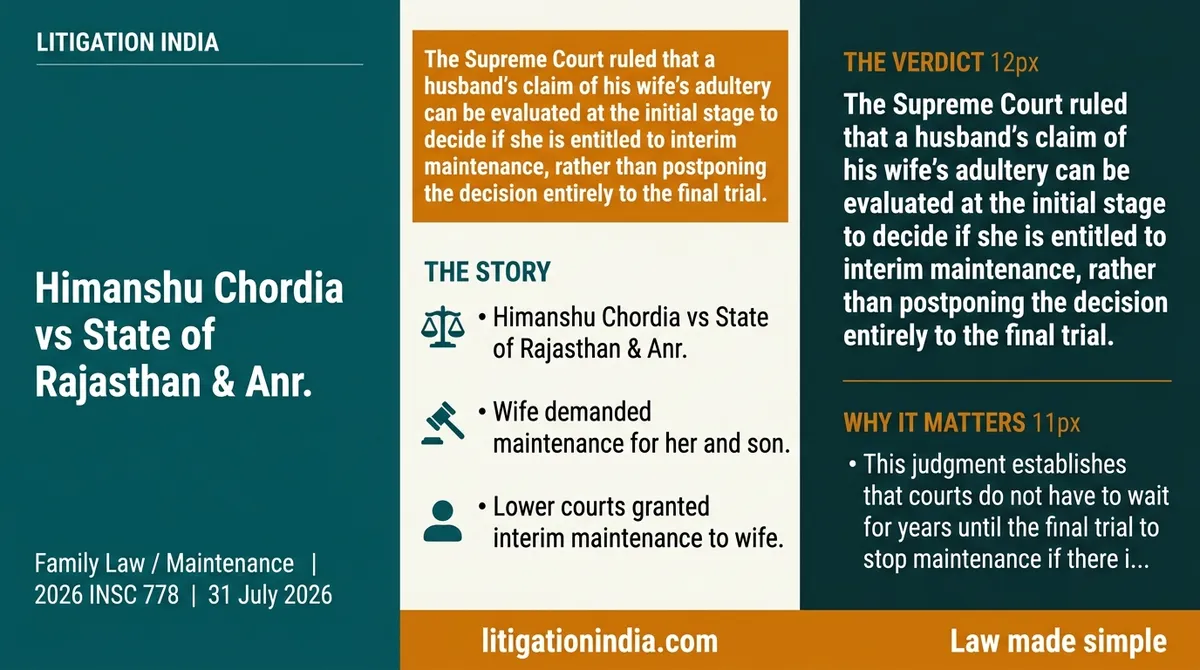
In short
This case arose from a dispute where a wife sought maintenance from her husband under Section 125 of the Criminal Procedure Code. The husband opposed this by filing an application under Section 125(4), alleging that his wife was living in adultery with another man. He submitted photos and videos, likely collected by private investigators, as proof. The Trial Court and High Court rejected the husband's plea to stop interim maintenance, ruling that the allegation of adultery could only be decided during the final trial after evaluating all evidence. The Supreme Court set aside these orders. It clarified that while the law aims to prevent a separated spouse from starving, a wife living in adultery is not entitled to maintenance. The Court held that if a husband can provide clear, undeniable, and immediate proof of adultery at the very beginning, the court can stop or deny interim maintenance right away. It is incorrect to postpone this decision entirely to the final trial. However, if the proof requires a detailed trial to be verified, interim maintenance must continue in the meantime. The Court sent the case back to the Trial Court to evaluate the husband's evidence. Crucially, the Court also flagged concerns over unregulated private detectives violating privacy rights and urged the Government and the Law Commission of India to frame laws to regulate them.
Need clarity on a similar legal issue?
Request free pro bono guidance from a Supreme Court Advocate.
Background
A husband and wife separated after disputes, and the wife filed for financial support (maintenance) for herself and their child. The husband refused to pay, claiming his wife was having an affair, and presented photos and videos as proof of her adultery.
The Decision
The Supreme Court allowed the husband's appeal and sent the case back to the local court. It ordered the local court to look at the husband's evidence at the early stage itself to see if it immediately proves the affair, rather than waiting for the final end of the case.
Why it matters for you
This judgment establishes that courts do not have to wait for years until the final trial to stop maintenance if there is clear, undeniable proof of a spouse's unfaithfulness. It also highlights the urgent need to regulate private detectives who gather electronic evidence by violating people's privacy.
Relevant Legal Provisions
Key Acts and sections cited or relied upon in this judgment
“This provision allows a wife, children, or parents who cannot support themselves to ask a court to order their husband or father to pay them a monthly allowance. In this case, the wife used this section to demand financial support for herself and her child after they separated. The Supreme Court had to balance this basic right of support against the husband's claims that she did not qualify for it.”
“This law states that a wife cannot receive any maintenance from her husband if she is living in adultery, refuses to live with him without a good reason, or if they are living separately by mutual agreement. The Supreme Court applied this section to rule that if a husband can immediately show clear and undisputed proof of his wife's adultery, the court should stop or deny her interim maintenance right away rather than waiting for the trial to end.”
“This provision allows a court to order a husband to pay temporary monthly support, called interim maintenance, while the main court case is still going on so that the wife does not starve. In this case, the lower courts had ordered the husband to pay this temporary support despite his evidence. The Supreme Court clarified that even this temporary support can be stopped early if the husband presents immediate, undeniable proof of adultery.”
AI-assisted summary, reviewed and verified by our editorial team.
Need help with your case?
Facing a similar legal challenge in the Supreme Court or High Court? Connect with our pro bono volunteer advocates today.
Related Supreme Court services