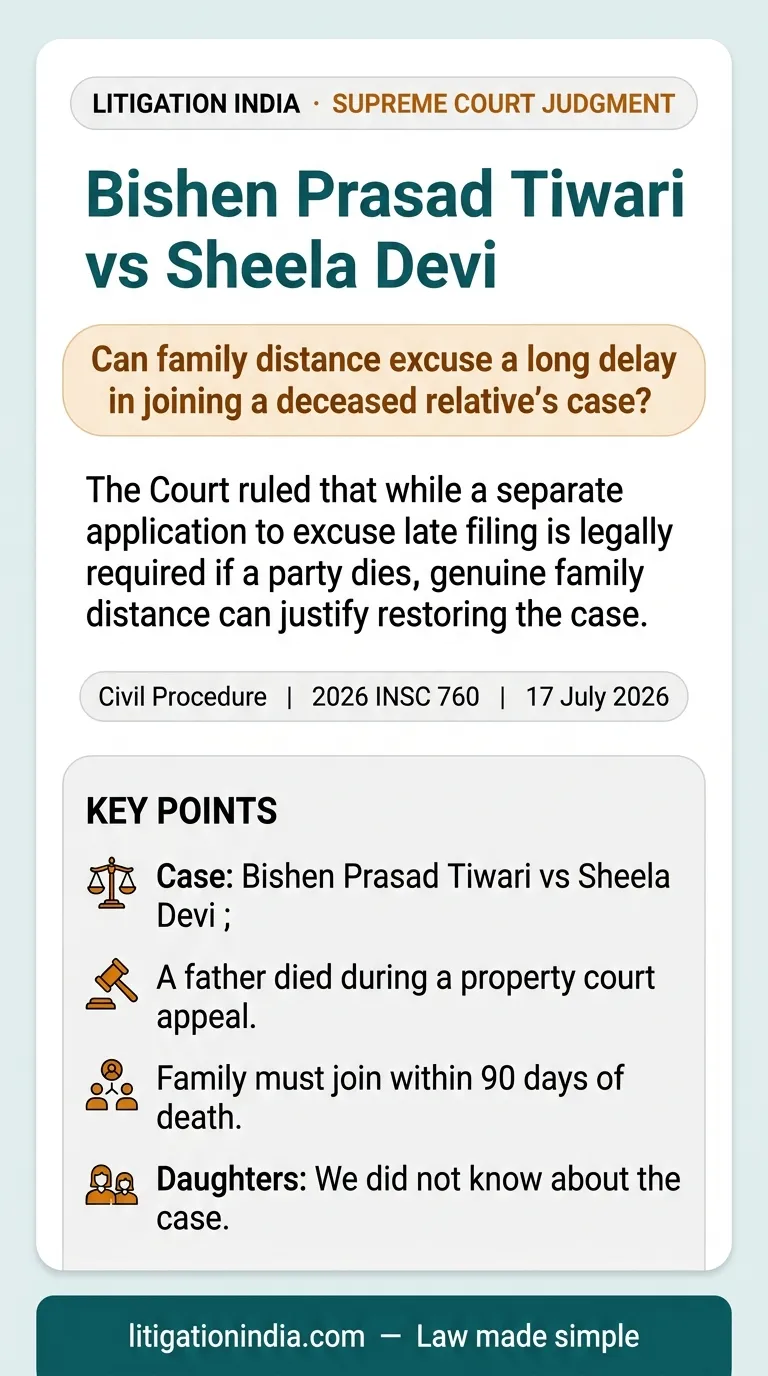
Bishen Prasad Tiwari vs Sheela Devi
The big legal question
Can family distance excuse a long delay in joining a deceased relative's case?
“The Court ruled that while a separate application to excuse late filing is legally required if a party dies, genuine family distance can justify restoring the case.”
Story Slides
In short
When a person fighting a court case dies, their family members (legal heirs) must apply to join the case within 90 days. If they fail to do so, the case closes automatically. To restart the case after a long delay, the law requires them to file a separate application explaining the delay with a genuine reason. In this case, a father died during a property appeal, and his daughters applied to join the case after a huge delay of 501 days. However, they did not file a separate application to excuse this delay, and their lawyer simply claimed he was 'too busy.' The lower court rejected their request, but the High Court allowed them to join, saying courts should not be too strict with technical rules. The Supreme Court corrected this legal view. It ruled that legal rules cannot be ignored casually, and a separate application to excuse the delay is mandatory under the law. However, looking at the actual facts, the Court found that the daughters had a strained relationship with their father and genuinely did not know about the case until they received a government notice. Since they acted immediately after finding out, the Court allowed them to join the case on humanitarian grounds, subject to paying a penalty of Rs 25,000 to the other side.
Background
A father passed away while a property dispute appeal was ongoing in court. His daughters, who had a strained relationship with him, only found out about the case much later when they received a notice from the local Tehsildar, resulting in a delay of 501 days in joining the lawsuit.
The Decision
The Supreme Court held that while filing a formal, separate application to excuse delays is a mandatory legal rule, the daughters' lack of knowledge due to family issues was a genuine reason. The Court allowed them to join the case but ordered them to pay Rs 25,000 as a penalty to the other side.
Why it matters for you
This judgment clarifies that court timelines and procedures must be respected and cannot be bypassed casually. However, it also shows that if family members genuinely did not know about a deceased relative's lawsuit due to personal distance, the courts will protect their rights.
AI-assisted summary, reviewed and verified by our editorial team.
Need help with your case?
Facing a similar legal challenge in the Supreme Court or High Court? Connect with our pro bono volunteer advocates today.
Related Supreme Court services