
All insights

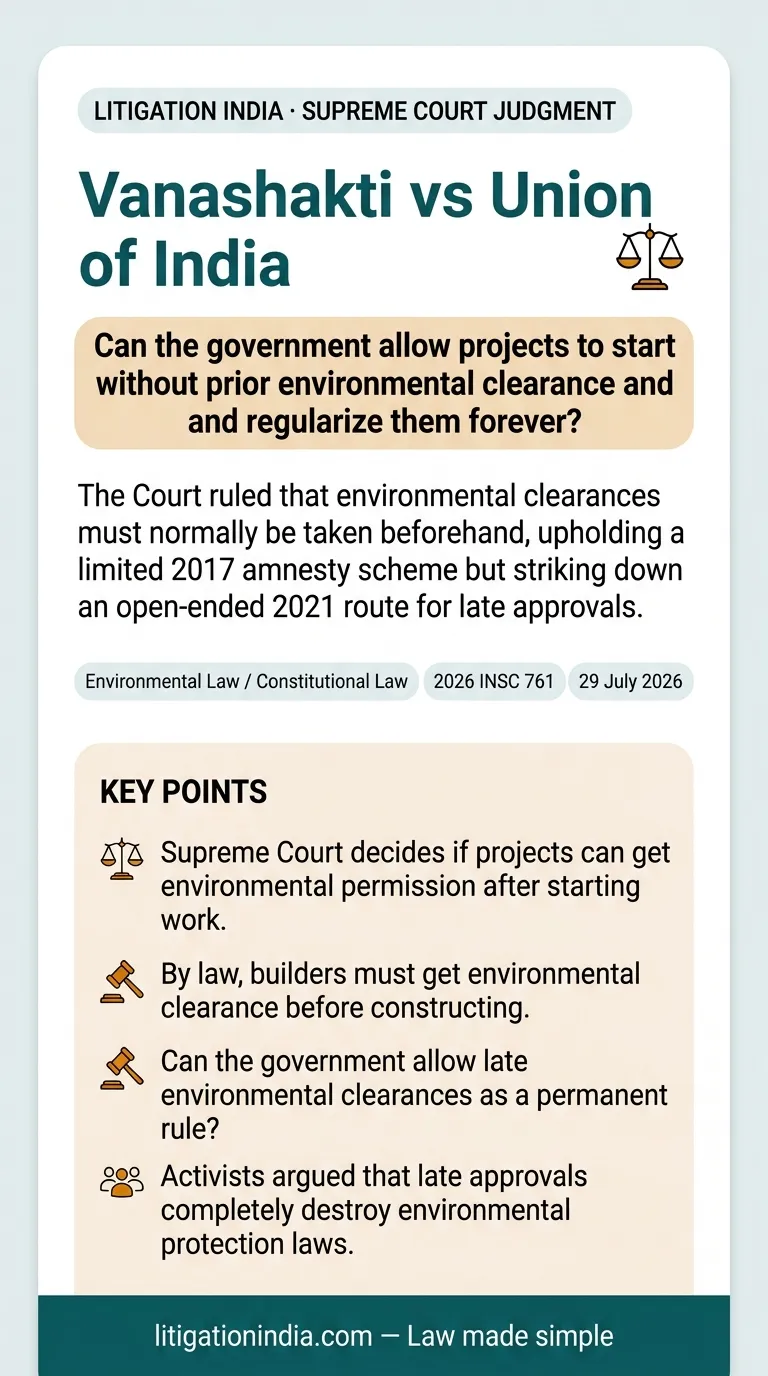
Can the government allow projects to start without prior environmental clearance and regularize them forever?

Vanashakti vs Union of India

The Court ruled that environmental clearances must normally be taken beforehand, upholding a limited 2017 amnesty scheme but striking down an open-ended 2021 route for late approvals.

Litigation India Editorial 9 August 2026 1 min read 2026 INSC 761

Story

Key points1 / 7

Environmental Clearances: Before or After?

  • Supreme Court decides if projects can get environmental permission after starting work.
  • Balances the right to a clean environment against the country's development needs.
Vanashakti vs Union of India · 2026 INSC 7612026-08-09T17:03:41.235872+00:00
Key points2 / 7

What Happened?

  • By law, builders must get environmental clearance before constructing.
  • Many industries and government projects started work without any prior clearance.
  • The government created pathways in 2017 and 2021 to approve these violations.
Vanashakti vs Union of India · 2026 INSC 7612026-08-09T17:03:41.235872+00:00
Key points3 / 7

The Core Legal Question

  • Can the government allow late environmental clearances as a permanent rule?
  • Does this encourage violators to pollute first and pay fines later?
Vanashakti vs Union of India · 2026 INSC 7612026-08-09T17:03:41.235872+00:00
Key points4 / 7

What Both Sides Argued

  • Activists argued that late approvals completely destroy environmental protection laws.
  • The government argued that stopping finished projects would cause massive public and economic loss.
Vanashakti vs Union of India · 2026 INSC 7612026-08-09T17:03:41.235872+00:00
Key points5 / 7

What the Court Decided

  • Getting environmental permission beforehand remains strictly compulsory.
  • The limited 2017 amnesty was allowed as a one-time correction.
  • The open-ended 2021 late-clearance route is completely illegal and struck down.
Vanashakti vs Union of India · 2026 INSC 7612026-08-09T17:03:41.235872+00:00
Key points6 / 7

Protection for Key Public Projects

  • Existing permissions and pending applications remain valid to protect public interest.
  • Major welfare projects like AIIMS hospitals and airports will not be demolished.
  • No fresh late applications under these old schemes will be accepted.
Vanashakti vs Union of India · 2026 INSC 7612026-08-09T17:03:41.235872+00:00
Key points7 / 7

Key Takeaways for Litigants

  • 'Build first, pay penalty later' is no longer a valid business strategy.
  • Citizens can expect stricter enforcement of environmental rules in their localities.
  • Public utility projects are protected from demolition but must follow laws in future.
Vanashakti vs Union of India · 2026 INSC 7612026-08-09T17:03:41.235872+00:00
Vanashakti vs Union of India — infographic summary

What this case means

The Court ruled that environmental clearances must normally be taken beforehand, upholding a limited 2017 amnesty scheme but striking down an open-ended 2021 route for late approvals.

What the Supreme Court held

The Supreme Court held that prior permission is compulsory and cannot be bypassed routinely. It upheld the limited 2017 amnesty scheme but struck down the permanent 2021 late-clearance loophole. However, to protect ongoing public welfare projects like hospitals and airports, it saved already granted permissions and pending applications.

Case: Vanashakti vs Union of India (2026) Citation: 2026 INSC 761

Want the full legal reasoning, citations and case documents?

Read the full judgment analysis
Environmental Clearance
Nature Protection
Government Approvals
Amnesty Scheme
Environmental Law / Constitutional Law
Supreme Court legal news
Supreme Court judgment today
latest Supreme Court news