
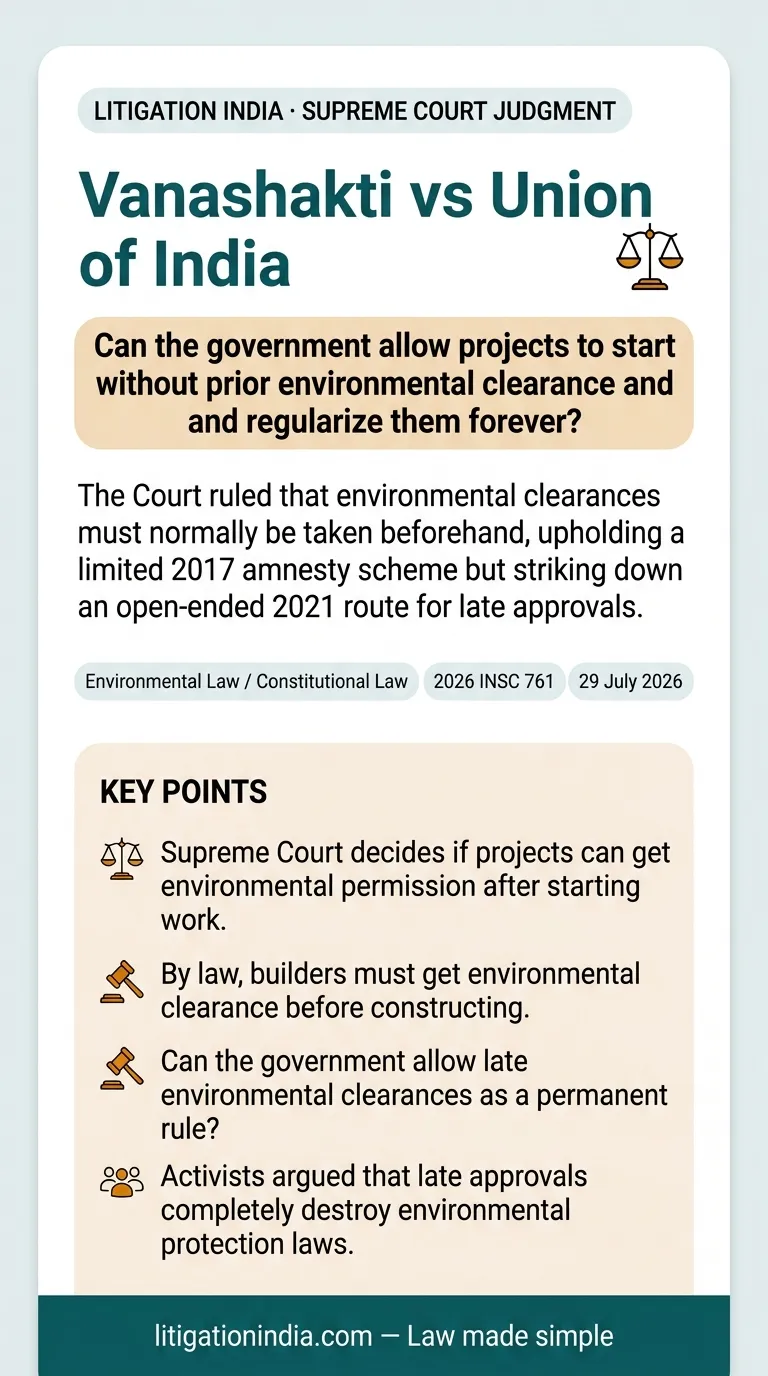
Can the government allow projects to start without prior environmental clearance and regularize them forever?
Vanashakti vs Union of India
Case: Vanashakti vs Union of IndiaCitation: 2026 INSC 761Decided on: 29 July 2026
“The Court ruled that environmental clearances must normally be taken beforehand, upholding a limited 2017 amnesty scheme but striking down an open-ended 2021 route for late approvals.”
Story Slides
In short
The Supreme Court of India decided an important environmental issue: can industries start construction without an Environmental Clearance (EC) and get it approved later? Under the law, getting an EC before starting a project is mandatory to protect nature. However, the government issued two rules to help violators. First, a 2017 Notification allowed a one-time, six-month window for violators to pay fines and get cleared. Second, a 2021 Office Memorandum created a permanent, open-ended way for any violator to get late clearance. The Court ruled that the 2017 rule was valid because it was a strict, one-time measure to bring old violators into compliance. However, it declared the 2021 rule illegal. The Court explained that a permanent, late-clearance route defeats the 'look before you leap' rule of protecting nature. It would encourage builders to 'pollute first and pay later.' Crucially, to protect public interest, the Court made its decision prospective. This means that major public welfare projects (like AIIMS hospitals, airports, and water channels) that already received clearances or have pending applications under these rules will not be demolished. However, the government cannot issue such late-clearance loopholes through simple administrative letters in the future.
Need clarity on a similar legal issue?
Request free pro bono guidance from a Supreme Court Advocate.
Background
Under environmental rules, factories and builders must get permission before starting work. Many builders violated this and started projects without permission. The government then made rules in 2017 and 2021 allowing these violators to pay fines and get approved after starting work, which environmental groups challenged in court.
The Decision
The Supreme Court held that prior permission is compulsory and cannot be bypassed routinely. It upheld the limited 2017 amnesty scheme but struck down the permanent 2021 late-clearance loophole. However, to protect ongoing public welfare projects like hospitals and airports, it saved already granted permissions and pending applications.
Why it matters for you
This judgment strikes a balance between protecting nature and continuing essential public development. It stops businesses from routinely ignoring environmental laws with the excuse of 'build first, pay penalty later,' while protecting hospitals and roads that citizens desperately need.
AI-assisted summary, reviewed and verified by our editorial team.
Need help with your case?
Facing a similar legal challenge in the Supreme Court or High Court? Connect with our pro bono volunteer advocates today.
Related Supreme Court services