
All insights

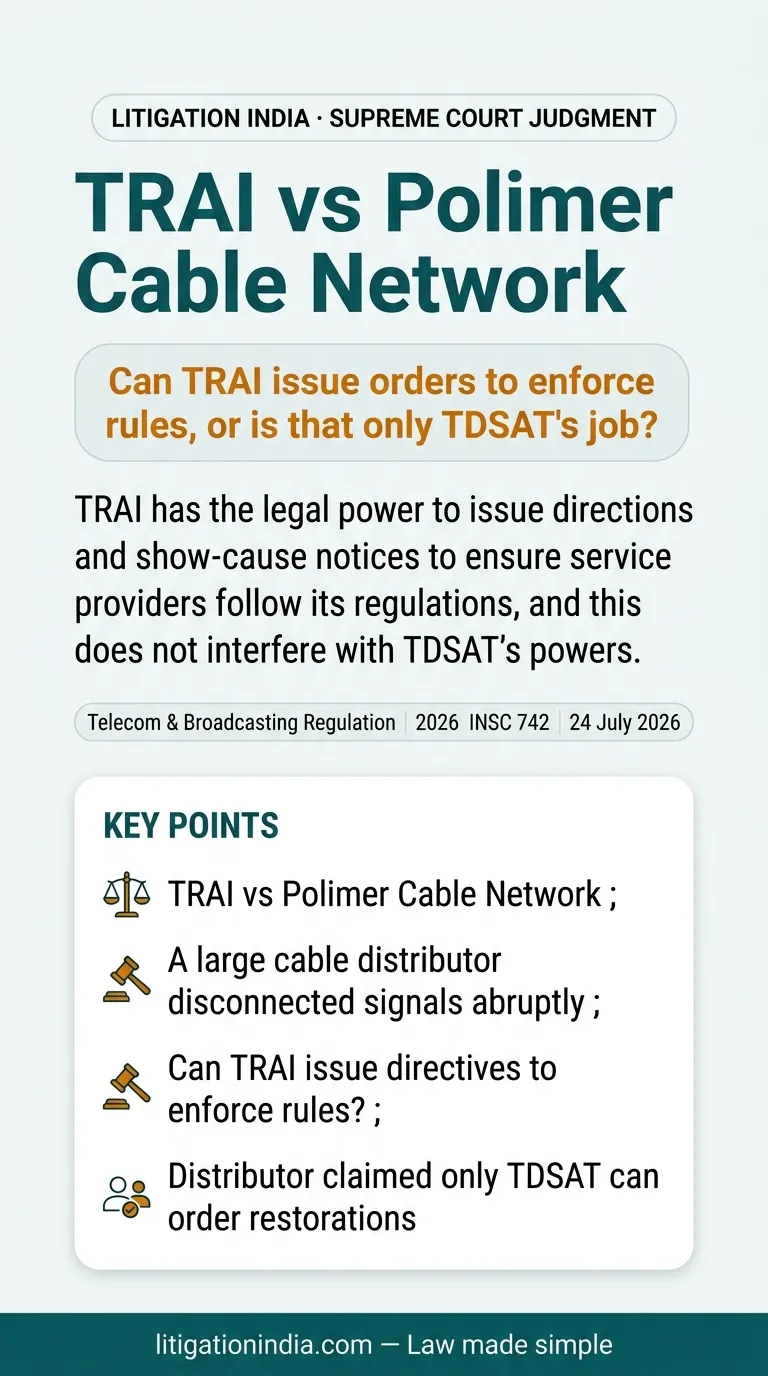
Can TRAI issue orders to enforce rules, or is that only TDSAT's job?

TRAI vs Polimer Cable Network

TRAI has the legal power to issue directions and show-cause notices to ensure service providers follow its regulations, and this does not interfere with TDSAT's powers.

Litigation India Editorial 8 August 2026 1 min read 2026 INSC 742

Story

Key points1 / 7

The Cable Signal Dispute

  • TRAI vs Polimer Cable Network
  • Decided on 24 July 2026
  • Focuses on regulatory powers of TRAI
  • Saves TRAI's power to enforce rules
TRAI vs Polimer Cable Network · 2026 INSC 7422026-08-08T14:24:40.293089+00:00
Key points2 / 7

Sudden Blackout of TV Signals

  • A large cable distributor disconnected signals abruptly
  • Local cable operators complained of rule violation
  • TRAI investigated the matter through police
  • The investigation confirmed illegal signal cut-off
TRAI vs Polimer Cable Network · 2026 INSC 7422026-08-08T14:24:40.293089+00:00
Key points3 / 7

The Legal Question

  • Can TRAI issue directives to enforce rules?
  • Or is enforcing rules also TDSAT's job?
  • Does direct compliance order mean resolving disputes?
  • Where does the regulator's boundary end?
TRAI vs Polimer Cable Network · 2026 INSC 7422026-08-08T14:24:40.293089+00:00
Key points4 / 7

The Clash of Roles

  • Distributor claimed only TDSAT can order restorations
  • They argued TRAI cannot act like a court
  • TRAI argued it was simply enforcing its rules
  • TRAI asserted it did not decide private contracts
TRAI vs Polimer Cable Network · 2026 INSC 7422026-08-08T14:24:40.293089+00:00
Key points5 / 7

Court Backs the Regulator

  • TRAI can order companies to follow rules
  • Directing compliance is administrative, not judicial
  • Show-cause notices are preparatory, not final judgments
  • TRAI cannot award damages or decide guilt
TRAI vs Polimer Cable Network · 2026 INSC 7422026-08-08T14:24:40.293089+00:00
Key points6 / 7

Why It Matters

  • Ensures swift action against unfair service cuts
  • Keeps regulators powerful enough to protect public
  • Saves consumers from endless tribunal fights
  • Maintains clear boundaries between regulator and court
TRAI vs Polimer Cable Network · 2026 INSC 7422026-08-08T14:24:40.293089+00:00
Key points7 / 7

Key Takeaways

  • Service providers must follow regulator's guidelines
  • Regulators can issue warnings for violations
  • Direct compliance orders are legal and binding
  • Private commercial claims still go to courts
TRAI vs Polimer Cable Network · 2026 INSC 7422026-08-08T14:24:40.293089+00:00
TRAI vs Polimer Cable Network — infographic summary

What this case means

TRAI has the legal power to issue directions and show-cause notices to ensure service providers follow its regulations, and this does not interfere with TDSAT's powers.

What the Supreme Court held

The Supreme Court ruled in favor of TRAI, holding that directing a company to comply with rules is a regulatory duty, not a court-like dispute resolution. The Court clarified that while TRAI cannot award damages or decide guilt, it has the absolute right to enforce compliance and file complaints against defaulters.

Case: TRAI vs Polimer Cable Network (2026) Citation: 2026 INSC 742

Want the full legal reasoning, citations and case documents?

Read the full judgment analysis
TRAI
TDSAT
Cable TV
Regulatory Powers
Show Cause Notice
Dispute Resolution
Telecom & Broadcasting Regulation
Supreme Court legal news
Supreme Court judgment today
latest Supreme Court news