TRAI vs Polimer Cable Network
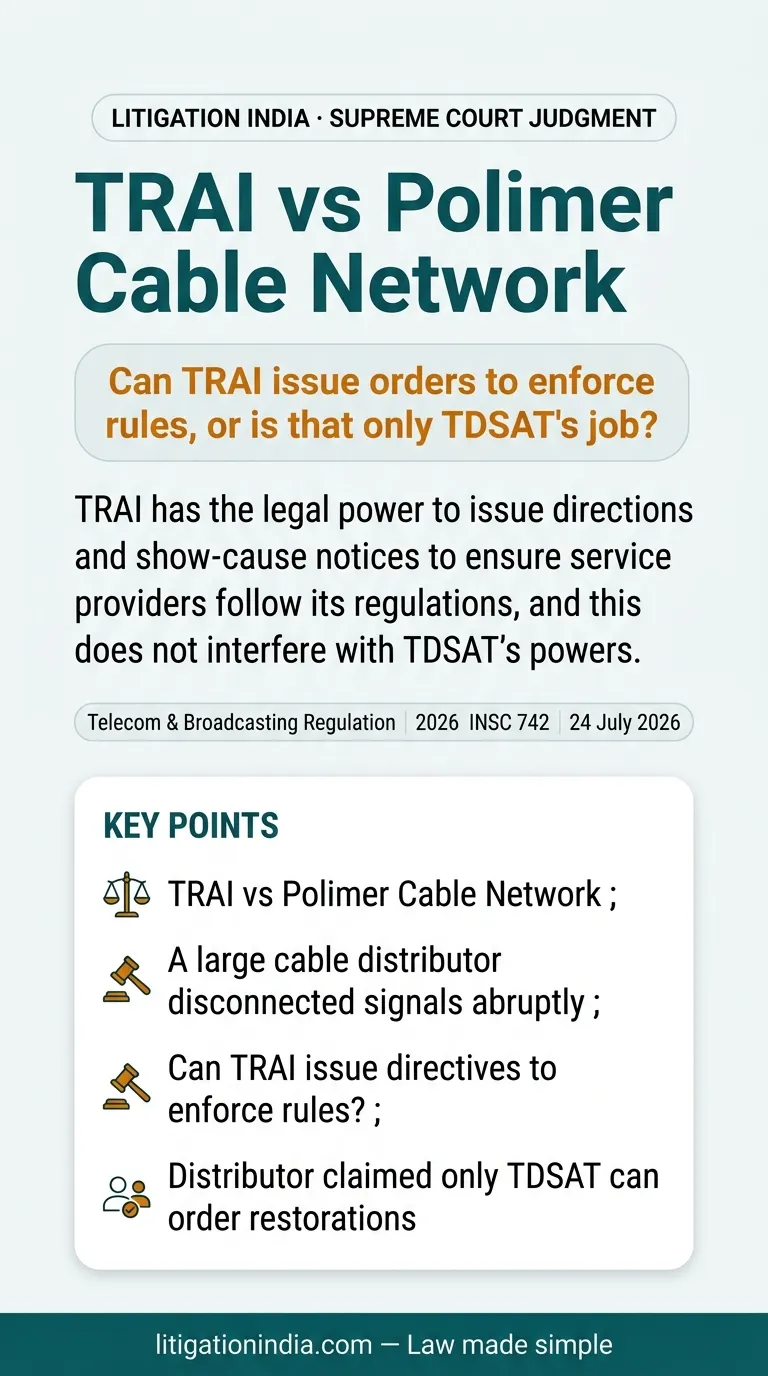
The big legal question
Can TRAI issue orders to enforce rules, or is that only TDSAT's job?
“TRAI has the legal power to issue directions and show-cause notices to ensure service providers follow its regulations, and this does not interfere with TDSAT's powers.”
Story Slides
In short
This case clarifies the separation of powers between the Telecom Regulatory Authority of India (TRAI), which is the sector regulator, and the Telecom Disputes Settlement and Appellate Tribunal (TDSAT), which is the specialized court. A major dispute arose when local cable operators complained that Polimer Cable Network, a Multi-System Operator (MSO), disconnected their TV signals abruptly without the mandatory three-week notice required by TRAI rules. Following directions from the Madras High Court, TRAI investigated the matter through the Police Commissioner and found the MSO in violation of regulations. Consequently, TRAI issued directions to restore signals and followed up with a show-cause notice asking why a criminal complaint should not be filed against the MSO. The MSO appealed to TDSAT, which ruled that TRAI had no power to issue such directions because the dispute was contractual, and only TDSAT had the jurisdiction to resolve it. The Supreme Court reversed TDSAT's decision. It held that when TRAI asks an entity to comply with its statutory regulations, it is executing its regulatory and administrative duties, not acting as a court or adjudicating a private dispute. While TRAI cannot award damages or decide criminal guilt—which are tasks for TDSAT and the courts—it has full authority to issue compliance directives and file complaints for rule violations.
Background
Local cable operators complained to TRAI that a larger cable distributor disconnected their TV signals without proper notice, violating safety regulations. After a police inquiry confirmed the violation, TRAI ordered the distributor to restore the signals and later issued a show-cause notice, which the distributor challenged as being outside TRAI's powers.
The Decision
The Supreme Court ruled in favor of TRAI, holding that directing a company to comply with rules is a regulatory duty, not a court-like dispute resolution. The Court clarified that while TRAI cannot award damages or decide guilt, it has the absolute right to enforce compliance and file complaints against defaulters.
Why it matters for you
This judgment ensures that public regulatory bodies remain powerful enough to enforce their guidelines and protect consumers immediately, rather than forcing every simple rule-violation case into long, expensive court battles.
AI-assisted summary, reviewed and verified by our editorial team.
Need help with your case?
Facing a similar legal challenge in the Supreme Court or High Court? Connect with our pro bono volunteer advocates today.
Related Supreme Court services