Introduction: A Decennial Institutional Audit of the Juvenile Justice Act, 2015
On October 10, 2026, the Juvenile Justice Committee of the Supreme Court of India, in association with UNICEF India, convened Day 1 of the two-day National Annual Stakeholders Consultation titled "Ten Years of the Juvenile Justice (Care and Protection of Children) Act, 2015: Progress, Challenges and Priorities for the Next Decade". Held at the Auditorium, C-Block, Administrative Buildings Complex of the Supreme Court of India in New Delhi, the conference brought together Supreme Court and High Court Judges, Directors of State Judicial Academies, Secretaries of Women and Child Development departments, Members of Juvenile Justice Boards (JJBs) and Child Welfare Committees (CWCs), child-protection specialists, legal academics, and civil society representatives.
The national consultation served as an evidence-based institutional audit to evaluate the first decade of the Act's implementation and establish operational priorities for the upcoming decade.
Keynote Perspectives: Restorative Justice over Retributive Penal Processes
CJI Surya Kant: "A Circumstance, Not an Identity"
Inaugurating the national consultation, the Hon’ble Chief Justice of India, Mr. Justice Surya Kant, framed the core philosophy of juvenile justice by emphasizing that a decade represents more than half of a child's formative years. His Lordship observed that the statutory phrase "child in conflict with law" describes a circumstance, not an identity.
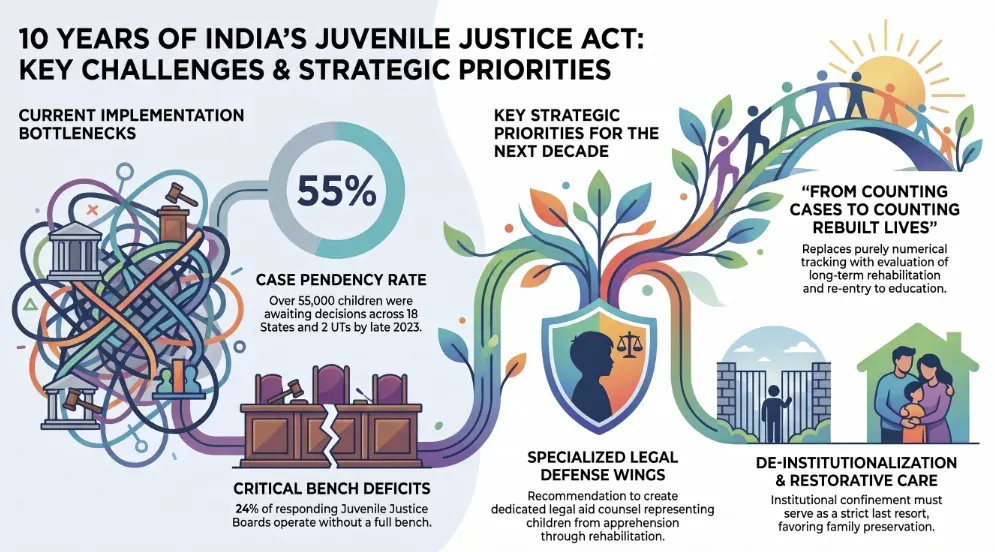
“For ten years we have counted cases; for the next ten, let us count lives rebuilt.”
— Hon’ble Mr. Justice Surya Kant, Chief Justice of India
Grounded in the constitutional mandates of Articles 15(3) and 39 of the Constitution of India, alongside the United Nations Convention on the Rights of the Child, the Chief Justice stressed that the legal response under the Act must remain restorative rather than retributive, treating institutional confinement as a strict measure of last resort.
To operationalize child-friendly safeguards, the Chief Justice highlighted critical structural deficiencies and outlined immediate systemic reforms:
- Dedicated Child Defence Cadre: Observing that numerous JJBs still operate without legal aid clinics under NALSA’s Child-Friendly Legal Services Scheme, 2024, the CJI urged Legal Services Institutions to establish a specialized cadre or wing of defence counsel for children. This defence wing must guarantee continuous representation from the point of apprehension at police stations through final orders and long-term rehabilitation.
- Joint Inter-Agency Training: Front-line actors must not operate in departmental silos; joint training programs must be instituted across Judicial Academies, Police Academies, and child psychologists.
- Probation Infrastructure: States must urgently fill vacancies among Probation Officers to facilitate the timely submission of comprehensive Social Investigation Reports (SIRs).
- Digital Privacy and Record Expungement: The CJI called for strict adherence to digital privacy protocols and the prompt destruction and expungement of records to insulate youth from lifelong stigma.
- Empirical Re-integration Metrics: The success of the juvenile justice system must be evaluated through independent empirical studies tracking school re-enrollment and stable livelihood transitions rather than mere case disposal figures.
As part of the inaugural proceedings, the Chief Justice formally released an e-Compendium of Landmark Judgments of the Supreme Court of India and High Courts on the Juvenile Justice (Care and Protection of Children) Act, 2015, chronicling key jurisprudential developments from 2015 to September 2026.
Justice B.V. Nagarathna: De-Institutionalization and the Section 3 Anchors
Delivering the opening remarks, Hon’ble Mrs. Justice B.V. Nagarathna, Judge, Supreme Court of India and Chairperson of the Supreme Court Juvenile Justice Committee, articulated the foundational touchstone of child jurisprudence:
“When a child breaks the law, the law must not break the child.”
— Hon’ble Mrs. Justice B.V. Nagarathna, Judge, Supreme Court of India
Her Ladyship reiterated the core general principles enshrined under Section 3 of the Act—specifically highlighting the presumption of innocence, non-stigmatizing semantics, and institutionalization strictly as a last resort. Justice Nagarathna reaffirmed that Juvenile Justice Boards must never be administered as miniature criminal courts.
Citing findings from the India Justice Report (November 2025), Justice Nagarathna highlighted significant institutional hurdles across the country:
- High Case Pendency: Across 18 States and two Union Territories, 55% of all cases before JJBs remained pending by late 2023, leaving over 55,000 children awaiting decisions.
- Incomplete Benches: Approximately 24% of responding JJBs were operating without a full bench.
- Rehabilitation vs. Disposal: Emphasizing that case disposal does not automatically ensure rehabilitation, Her Ladyship stressed that genuine reintegration demands individualized, holistic care plans.
- Longitudinal State Reviews: Justice Nagarathna commended the annual data submissions compiled by High Court Juvenile Justice Committees and State Governments since 2023, observing that longitudinal datasets provide the empirical baseline required to scale localized best practices into national standards.
Introductory remarks were also delivered by Ms. Cynthia McCaffrey, Country Representative, UNICEF India, who reaffirmed UNICEF's commitment to partnering with the Indian judiciary to expand child-friendly court procedures, divert youth from formal penal processes, and build protective community environments.
Technical Sessions: Doctrinal and Operational Review
Following the inaugural ceremony, the consultation advanced into specialized technical working sessions addressing statutory protections, alternative care mechanisms, and state-level implementation.
1. Rights of Children in Conflict with Law & Section 15 Preliminary Assessments
Chaired by Hon’ble Mr. Justice J.B. Pardiwala, Judge, Supreme Court of India and Member, Juvenile Justice Committee, the first technical session deliberated upon procedural guarantees and detention safeguards:
- Preliminary Assessments under Section 15: Professor (Dr.) Srikrishna Deva Rao, Vice-Chancellor of NALSAR University of Law, Hyderabad, examined the procedural standards, psycho-social evaluations, and developmental nuances governing the preliminary assessment of 16-to-18-year-olds accused of heinous offences.
- Safeguarding Rights and Minimizing Detention: Ms. Swagata Raha (Director – Research, Enfold Proactive Health Trust) and Ms. Sharmila Ray (Child Protection Specialist, UNICEF India) addressed frontline procedural compliance, diversion mechanisms, and systemic measures to eliminate unnecessary institutional confinement.
2. Child Protection, Administrative Bottlenecks, and Adoption Frameworks
Chaired by Hon’ble Mr. Justice A.S. Chandurkar, Judge, Supreme Court of India and Member, Juvenile Justice Committee, the second session reviewed non-institutional care frameworks and adoption procedures:
- Adoption Bottlenecks: Ms. Bhavna Saxena, IPS, Member Secretary & CEO, Central Adoption Resource Authority (CARA), analyzed domestic adoption metrics, administrative bottlenecks, and strategies to accelerate the process of declaring children legally free for adoption.
- Inter-Country Adoption: Senior Advocate Mr. Anil Malhotra examined regulatory compliance, private international law interfaces, and judicial processes under the Act and statutory adoption regulations.
- Family Preservation vs. Institutional Placements: Dr. Sheema Sengupta, UNICEF Global Director of Child Protection, delivered international comparative perspectives illustrating the evidentiary shift toward family-based foster care over institutionalization.
3. State-Wise Implementation and Regional Best Practices
The afternoon technical session evaluated regional implementation across six States and Union Territories. The session was chaired by Hon’ble Mr. Justice Sujit Narayan Prasad, Judge & Chairperson, JJC, High Court of Jharkhand, and co-chaired by Hon’ble Justice Moushumi Bhattacharya, Judge & Chairperson, JJC, High Court for the State of Telangana.
Regional delegations sharing state-specific frameworks included:
- Tamil Nadu: Hon’ble Dr. Justice G. Jayachandran (Judge & Chairperson, JJC, Madras High Court) and Ms. M. Pallavi Baldev, IAS (Secretary, Social Welfare and Women Empowerment Department).
- Jammu & Kashmir and Ladakh: Hon’ble Mrs. Justice Sindhu Sharma (Judge & Chairperson, JJC, High Court of Jammu & Kashmir and Ladakh).
- Delhi: Hon’ble Ms. Justice Jyoti Singh (Judge & Chairperson, JJC, High Court of Delhi) and Dr. Rashmi Singh, IAS (Secretary, Department of Women and Child Development, GNCTD).
- Gujarat: Hon’ble Ms. Justice Sangeeta K. Vishen (Judge & Chairperson, JJC, High Court of Gujarat) and Mr. Harshad R. Patel, IAS (Secretary, Department of Social Justice and Empowerment).
- Odisha: Hon’ble Ms. Justice Savitri Ratho (Judge & Chairperson, JJC, High Court of Orissa) and Dr. Mrinalini Darswal, IAS (Secretary, Department of Women and Child Development).
- Uttarakhand: Hon’ble Mr. Justice Rakesh Thapliyal (Judge & Chairperson, JJC, High Court of Uttarakhand) and Mr. Chandresh Kumar Yadav, IAS (Secretary, Department of Women Empowerment & Child Development).
Watch the Inaugural Session
The proceedings of the opening session can be accessed through the Supreme Court's official broadcast: