Major Reshuffle in High Court Leadership
In a significant administrative decision, the Supreme Court Collegium, in its meeting convened on 24th November 2026, recommended key transfers of two High Court Chief Justices and the elevation of a senior High Court judge to head the High Court of Tripura.
The resolutions facilitate leadership transitions across three High Courts: Karnataka, Jharkhand, and Tripura.
"The Supreme Court Collegium, in its meeting held on 24th November 2026, has recommended transfers of Chief Justices of High Courts and appointment of Chief Justice for the High Court of Tripura."
Key Recommendations at a Glance
The Collegium resolutions dated November 24, 2026, outline the following transfers and appointments:
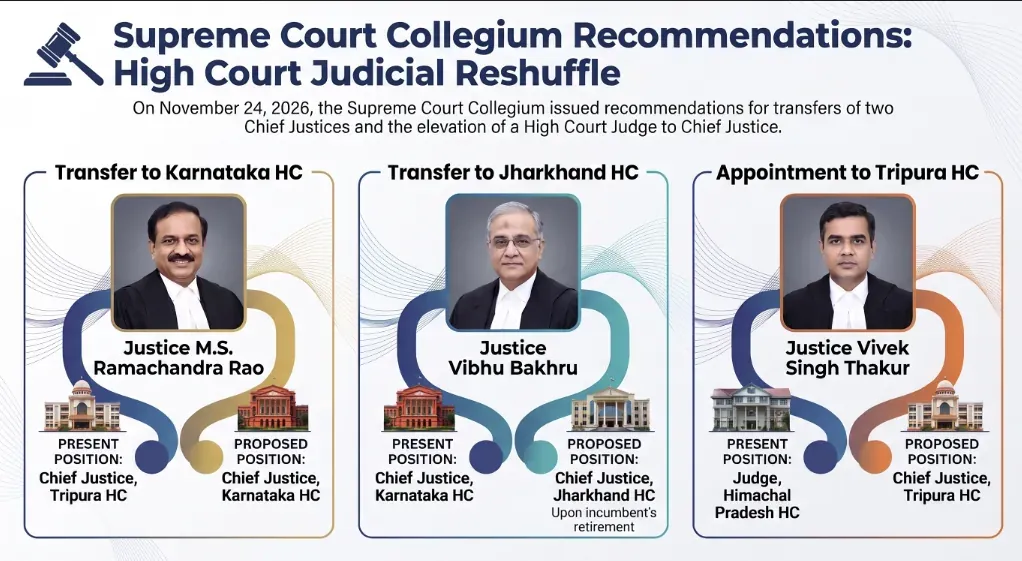
- Justice M.S. Ramachandra Rao (Parent High Court: Telangana): Recommended for transfer from his current post as Chief Justice of the High Court of Tripura to serve as the Chief Justice of the High Court of Karnataka.
- Justice Vibhu Bakhru (Parent High Court: Delhi): Recommended for transfer from his present position as Chief Justice of the High Court of Karnataka to become the Chief Justice of the High Court of Jharkhand, consequent upon the retirement of the incumbent Chief Justice on 27.11.2026.
- Justice Vivek Singh Thakur (High Court of Himachal Pradesh): Recommended for appointment and elevation as the Chief Justice of the High Court of Tripura, consequent upon the transfer of incumbent Chief Justice M.S. Ramachandra Rao to the Karnataka High Court.
1. Hon'ble Mr. Justice M.S. Ramachandra Rao
- Parent High Court: High Court for the State of Telangana.
- Current Role: Chief Justice, High Court of Tripura.
- Proposed Role: Chief Justice, High Court of Karnataka.
- Background & Career:
- Born on August 7, 1966, in Hyderabad, Justice Rao is a third-generation jurist. His father, Justice M. Jagannadha Rao, served as a Judge of the Supreme Court of India and Chairman of the Law Commission of India, while his grandfather, Justice M.S. Ramachandra Rao, was a Judge of the High Court of Andhra Pradesh. - He secured first rank in B.Sc. (Hons) Mathematics at Osmania University, won the CVSS Acharyulu Gold Medal in LL.B., and obtained his LL.M. from the University of Cambridge, UK, as a Cambridge Commonwealth Scholar and BCCI Scholar. - Justice Rao was elevated as an Additional Judge of the Andhra Pradesh High Court in June 2012 and made permanent in December 2013. He previously served as Chief Justice of the High Court of Himachal Pradesh and the High Court of Jharkhand before taking charge as Chief Justice of the Tripura High Court.
2. Hon'ble Mr. Justice Vibhu Bakhru
- Parent High Court: High Court of Delhi.
- Current Role: Chief Justice, High Court of Karnataka.
- Proposed Role: Chief Justice, High Court of Jharkhand (effective upon the retirement of the incumbent on November 27, 2026).
- Background & Career:
- Born on November 2, 1966, in Nagpur, Justice Bakhru completed his schooling at Delhi Public School, Mathura Road, and qualified both as a Chartered Accountant (FCA) and an Advocate. - He enrolled with the Bar Council of Delhi in 1990, building a distinguished practice in commercial, corporate, constitutional, and arbitration laws before the Supreme Court and Delhi High Court. He was designated as a Senior Advocate in July 2011. - Elevated to the Delhi High Court bench in April 2013 and confirmed as a permanent Judge in March 2015, he subsequently served as Acting Chief Justice of the Delhi High Court before being appointed Chief Justice of the Karnataka High Court.
3. Hon'ble Mr. Justice Vivek Singh Thakur
- Parent High Court: High Court of Himachal Pradesh.
- Current Role: Judge, High Court of Himachal Pradesh.
- Proposed Role: Chief Justice, High Court of Tripura.
- Background & Career:
- Born on April 16, 1966, in Bilaspur, Himachal Pradesh, Justice Thakur pursued his legal education and established an extensive practice before the High Court of Himachal Pradesh across civil, criminal, and constitutional domains. - He was elevated to the Bench of the High Court of Himachal Pradesh, where he has served as a senior judge and performed key administrative leadership roles, including serving as Executive Chairman of the Himachal Pradesh State Legal Services Authority (HPSLSA) and member of the Board of Governors of the State Judicial Academy.
Constitutional Process and Next Steps
Under Article 222 of the Constitution of India, transfers of High Court judges and Chief Justices are initiated upon the recommendation of the Supreme Court Collegium. These recommendations now await the formal notification of the Union Ministry of Law and Justice, followed by warrants of appointment issued by the President of India.