
All insights

Can a disciplinary inquiry stand when the adjudicator is the complainant's real brother?

Teacher's Termination Set Aside Due to Familial Bias in Departmental Inquiry

A school teacher was terminated after a departmental inquiry in which the Convenor of the Inquiry Committee was the real brother of the complainant and key witness. The Supreme Court held that such cl

Litigation India Editorial 17 November 2026 1 min read 2026 INSC 1229

Story

Case at a glance1 / 6

Supreme Court of India

Family-Run Inquiry Vitiates Teacher's Termination

Ku. Kiran D/o Purushottam Bhujade vs. Sudhir Shikshan Sanstha & Ors. | 2026 INSC 1229

Court: Supreme Court of India | Date: 17 November 2026Bench: Justice Manoj Misra and Justice ManmohanArea of law: Service Law, Natural Justice, Departmental InquirySchool teacher terminated after inquiry presided over by complainant's real brother as Convenor
Total familial capture of the inquiry apparatus renders disciplinary action unconstitutional.
Teacher's Termination Set Aside Due to Familial Bias in Departmental Inquiry · 2026 INSC 12292026-11-17T18:55:19.915224+00:00
The legal question2 / 6

Does Familial Overlap of Roles Vitiate a Departmental Inquiry?

Core legal issue decided by the Supreme Court

  • Appellant: Inquiry was void — Convenor (Prakash Masurkar) was real brother of complainant, prosecutor and sole witness (Rajesh Masurkar); total familial capture; objections were never waived.
  • Appellant: Doctrine of necessity inapplicable as two unrelated Executive Committee members were available.
  • Respondent: Appellant waived objection by letter dated 8 September 2021 and never raised it thereafter.
  • Respondent: Close kinship alone does not disqualify; actual bias must be specifically proved; doctrine of necessity covers the nomination under Rule 36(2)(a)(i).
The test is not whether bias is proved, but whether a reasonable person would apprehend a real possibility of bias.
Teacher's Termination Set Aside Due to Familial Bias in Departmental Inquiry · 2026 INSC 12292026-11-17T18:55:19.915224+00:00
The Court's reasoning3 / 6

Court's Reasoning: From Facts to Verdict

Steps in the Supreme Court's legal analysis

  1. 1Step 1: Procedural fairness requires the decision-maker to be independent, impartial and not biased — natural justice applies to administrative bodies (A.K. Kraipak).
  2. 2Step 2: Test is 'reasonable likelihood of bias' — not actual bias — from the perspective of a fair-minded person (Ranjit Thakur, Kumaon Mandal).
  3. 3Step 3: Total familial capture found — Convenor (Prakash) is real brother of complainant, sole witness on 11 charges and termination order signatory (Rajesh).
  4. 4Step 4: Doctrine of necessity rejected — two unrelated members were available; waiver rejected — appellant objected at every stage.
  5. 5Step 5: Bias of one member infects group deliberation; procedural compliance cannot cure foundational illegality under Articles 14 and 21.
Teacher's Termination Set Aside Due to Familial Bias in Departmental Inquiry · 2026 INSC 12292026-11-17T18:55:19.915224+00:00
Key points4 / 6

Waiver of Bias: When It Works and When It Does Not

Key distinction drawn by the Court

  • True waiver: parties agree after a breach that it did not matter — retrospective.
  • Prospective consent: parties agree in advance to something that would otherwise breach natural justice.
  • For waiver to be effective it must be voluntary, informed and unequivocal.
  • Here: appellant objected in writing to Prakash Masurkar's appointment at every stage — before the committee, before the Tribunal and before the High Court — no waiver.
  • Letter dated 8 September 2021 addressed only the procedural issue of who should record proceedings, not acceptance of the Convenor's appointment.
Waiver must be voluntary, informed and unequivocal — a procedural letter cannot substitute for acceptance of a biased adjudicator.
Teacher's Termination Set Aside Due to Familial Bias in Departmental Inquiry · 2026 INSC 12292026-11-17T18:55:19.915224+00:00
The verdict5 / 6

The Verdict

What the Supreme Court decided

  • The Fact: Convenor of the Inquiry Committee (Prakash Masurkar) was the real brother of the complainant, prosecutor, sole witness on 11 charges and termination order signatory (Rajesh Masurkar).
  • The Law: Nemo Judex in Causa Sua is a constitutional imperative under Article 14; reasonable likelihood of bias — not actual bias — vitiates the proceedings; procedural compliance cannot cure this foundational illegality.
  • The Result: High Court's judgment set aside; School Tribunal's reinstatement order with full back wages restored; Education Officer directed to consider absorption under Rule 26(2)(iii) of MEPS Rules.
Appeal allowed; Tribunal's reinstatement order with full back wages restored; Education Officer to consider absorption in a 100% grant-in-aid school.
Teacher's Termination Set Aside Due to Familial Bias in Departmental Inquiry · 2026 INSC 12292026-11-17T18:55:19.915224+00:00
Why it matters6 / 6

What This Means for Ordinary Workers

Practical significance of the judgment

  • Employees of family-run aided schools cannot be dismissed through inquiries where family members act as both accusers and judges.
  • You do not need to prove actual bias — a reasonable apprehension of bias from a fair-minded person's viewpoint is enough to invalidate the inquiry.
  • Objecting at every stage of the proceedings ensures your right to challenge bias is preserved — a single procedural letter will not be treated as waiver.
  • Even if all procedural steps were followed, the foundational illegality of a biased adjudicator cannot be cured.
Justice must not only be done but must be seen to be done — a biased inquiry is void, however procedurally correct it appears.
Teacher's Termination Set Aside Due to Familial Bias in Departmental Inquiry · 2026 INSC 12292026-11-17T18:55:19.915224+00:00
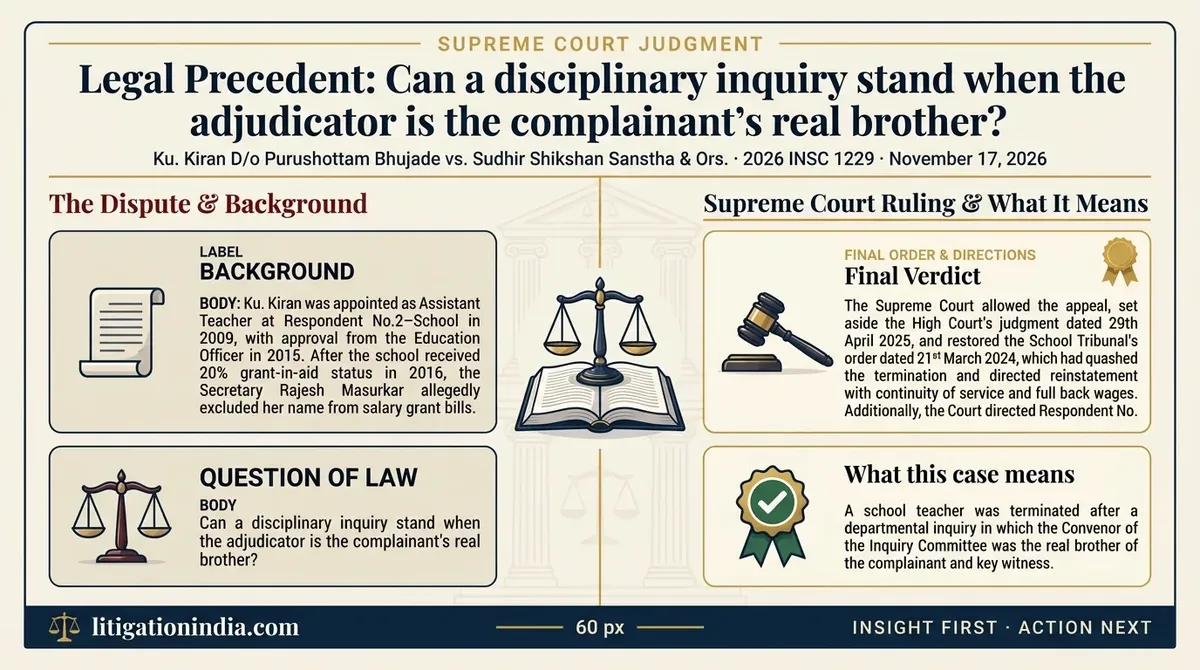
Teacher's Termination Set Aside Due to Familial Bias in Departmental Inquiry — infographic summary

What this case means

A school teacher was terminated after a departmental inquiry in which the Convenor of the Inquiry Committee was the real brother of the complainant and key witness. The Supreme Court held that such close familial overlap of roles — complainant, prosecutor, witness and adjudicator — created a reasonable likelihood of bias vitiating the entire inquiry. The Court restored the School Tribunal's reinstatement order.

What the Supreme Court held

The Supreme Court allowed the appeal, set aside the High Court's judgment dated 29th April 2025, and restored the School Tribunal's order dated 21st March 2024, which had quashed the termination and directed reinstatement with continuity of service and full back wages. Additionally, the Court directed Respondent No.3-Education Officer to consider the feasibility of absorbing the appellant in any 100% grant-in-aid school within its jurisdiction in accordance with Rule 26(2)(iii) of the MEPS Rules.

Case: Ku. Kiran D/o Purushottam Bhujade vs. Sudhir Shikshan Sanstha & Ors. (2026) Citation: 2026 INSC 1229

Want the full legal reasoning, citations and case documents?

Read the full judgment analysis
Ku. Kiran Bhujade
Sudhir Shikshan Sanstha
bias in departmental inquiry
natural justice
MEPS Rules 1981
nemo judex in causa sua
familial bias
reasonable likelihood of bias
school teacher termination
Article 14 Constitution of India
waiver of bias
doctrine of necessity
Rule 36, Rule 36(2)(a)(i), Rule 36(5), Rule 26(2)(iii), Maharashtra Employees of Private Schools (Conditions of Service) Rules, 1981
General provisions, Maharashtra Employees of Private Schools (Conditions of Service) Act, 1977