
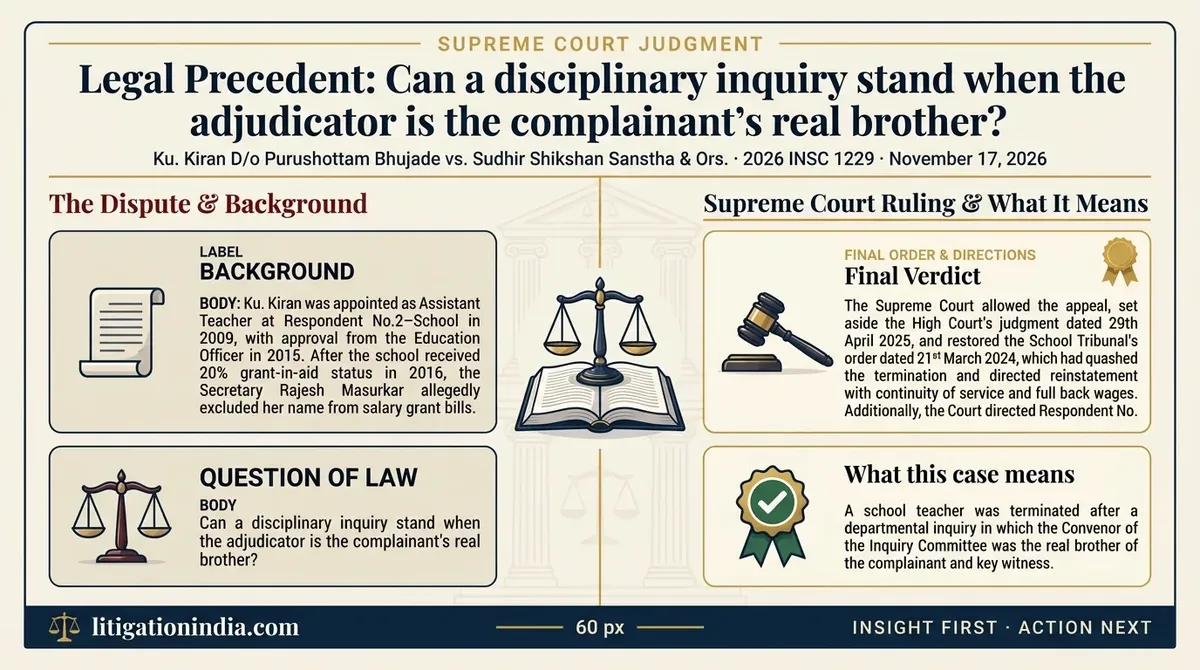
Full text of the judgment
Text extracted from Ku. Kiran D/o Purushottam Bhujade vs. Sudhir Shikshan Sanstha & Ors.. For the authoritative version refer to the Supreme Court of India's official website.
2026 INSC 1229 SLP(C) No. 16636 of 2025 Page 1 of 29
REPORTABLE IN THE SUPREME COURT OF INDIA CIVIL APPELLATE JURISDICTION
CIVIL APPEAL NO.________ OF 2026 (ARISING OUT OF SLP (C) NO.16636 OF 2025)
KU. KIRAN D/O PURUSHOTTAM BHUJADE .…. APPELLANT
SUDHIR SHIKSHAN SANSTHA & ORS. ..…RESPONDENTS
J U D G M E N T MANMOHAN, J. 1. Leave granted. 2. The present Appeal impugns the judgment dated 29th April 2025 passed by the High Court of Bombay, Nagpur Bench, in Writ Petition No. 4965 of 2024, whereby the said High Court allowed the writ petition instituted by Respondent No.1-Sanstha and set aside the order dated 21st March 2024 passed by the School Tribunal, Nagpur. By the said order, the School Tribunal had quashed the termination order issued against the Appellant and had directed the Respondents to reinstate the Appellant in service with continuity of service and full back wages. Digitally signed by SACHIN KUMAR SRIVASTAVA Date: 2026.11.17 17:21:14 IST Reason: Signature Not Verified
SLP(C) No. 16636 of 2025 Page 2 of 29
FACTUAL BACKGROUND 3. Briefly stated, the relevant facts are that the Appellant was appointed as an Assistant Teacher at Respondent No.2-School, vide appointment order dated 26th June 2009, with effect from 1st July 2009. Her appointment was duly approved by the Education Officer, Zilla Parishad, Nagpur, on 5th September 2015, with effect from 1st July 2009, after due verification. 4. On 1st July 2016, a Government Resolution was issued granting twenty per cent (20%) grant-in-aid status to Respondent No.2-School with effect from the academic year 2016-2017. It is the Appellant’s case that, from the said date, the Management, acting through its Secretary, Rajesh Masurkar, excluded her name from the salary grant bills submitted to the Education Department, and that only the names of nine employees were forwarded vide communication dated 1st June 2018. 5. The Appellant avers that she addressed a detailed complaint dated 26th March 2021 to the Education Minister and other concerned authorities, bringing to their notice that the Secretary of Respondent No.1-Sanstha, Rajesh Masurkar, had wilfully and with an ulterior motive excluded her name from the list of employees eligible for the benefit of twenty per cent (20%) and subsequently forty per cent (40%) grant-in-aid, so as to deprive her of her lawful entitlements. Pursuant thereto, a three-member Inquiry Committee was constituted by the Education Officer on 15th April 2021 to inquire into the Appellant’s complaint regarding non-payment of salary.
SLP(C) No. 16636 of 2025 Page 3 of 29
6. It is alleged by the Appellant that being alarmed by the said complaint, the Management subjected her to threats and intimidation, which led her to lodge a further complaint dated 22nd April 2021 before the Education Officer. 7. In the interregnum, the Management of Respondent No.1-Sanstha issued a show cause notice to the Appellant dated 13th May 2021, alleging her involvement in acts of misconduct, including tampering with documents. 8. Acting on the Appellant’s grievance, the Education Officer, vide communication dated 20th May 2021, directed the Deputy Education Officer, Zilla Parishad, Nagpur, to instruct the Headmaster/Secretary to submit a proposal for inclusion of the Appellant’s name in the grant-in-aid list. 9. However, the Executive Committee of Respondent No.1-Sanstha, in its meeting held on 6th June 2021, passed a resolution authorising the Secretary to conduct an inquiry against the Appellant. A statement of allegations was thereafter issued by the Secretary, in his capacity as Chief Executive Officer, on 8th June 2021, to which the Appellant filed her reply on 16th June 2021. The said reply being found unsatisfactory, the Management of Respondent No.1-Sanstha resolved to constitute an Inquiry Committee and to initiate a departmental inquiry against the Appellant. 10. As per Rule 36 of Maharashtra Employees of Private Schools (Conditions of Service) Rules, 1981 (hereinafter referred to as the ‘MEPS Rules’), the Inquiry Committee was required to comprise three members. Respondent No.1-Sanstha appointed Prakash Masurkar, a member of its Executive Committee, as the
SLP(C) No. 16636 of 2025 Page 4 of 29
Convenor, and Bhau Wasnik, a retired Principal figuring in the list of Stateawardee teachers, as a member of the Inquiry Committee. Kamaldas Laxman Deshpande was nominated by the Appellant as the third member of the said Committee. 11. Upon intimation of the departmental inquiry by Respondent No.1-Sanstha, the Appellant, vide letter dated 14th July 2021, communicated to the Deputy Director of Education her strong apprehension of bias and unfairness in the constitution and conduct of the inquiry. 12. The three-member Inquiry Committee constituted by the Education Officer submitted its report on 9th June 2021, wherein it was found that the Headmaster/Secretary had failed to include the Appellant’s name in the list of teachers eligible for the twenty per cent (20%) grant benefit, and accordingly directed inclusion of her name for the said benefit. 13. On 9th August 2021, the Appellant was served by Respondent No.1-Sanstha with a formal charge-sheet, together with the accompanying documents. 14. On 18th February 2022, the Inquiry Committee constituted by Respondent No.1-Sanstha submitted its final findings which were passed by a majority of two out of three members pursuant to which an order of termination with effect from 24th February 2022 was issued against the Appellant on 23rd February 2022. 15. Aggrieved thereby, the Appellant preferred Appeal bearing No. STN 09 of 2022 before the School Tribunal, Nagpur, on 21st March 2022. The Tribunal, vide order dated 25th April 2023, set aside the order of termination. However, the High
SLP(C) No. 16636 of 2025 Page 5 of 29
Court, vide order dated 4th December 2023 passed in Writ Petition No. 2981 of 2023 filed by the Respondents, remanded the matter to the Tribunal for fresh adjudication, on the ground that the Tribunal had failed to discuss material evidence on record. 16. Pursuant to the said remand, the School Tribunal, by a detailed order dated 21st March 2024, quashed and set aside the termination order and directed reinstatement of the Appellant with continuity of service and full back wages. The relevant paragraphs of the order passed by the School Tribunal are reproduced hereinbelow: “261. In view of the order of Hon'ble High Court the evidence led by the witnesses during enquiry is perused, it can be said that the impugned termination order could not stand to the scrutiny of law due to following reasons.
262. For charge No. 1 to 20, Mr. Rajesh Masurkar, is the key witness. Mr. Masurkar has himself issued charge sheet and statement of allegations. Whether his evidence for proving the charges can be accepted? The answer is definitely no. It is the settled principle of law that the person cannot be judge in his own cause.
263. So far rest of the charges and evidence on record is seen it can be said that the alleged charges are not proved by the management.
274 Considering this scenario it is clear that the appellant was made target to harass and without their being any proved serious charge she was terminated by the management.
275.. In the circumstances it is nothing but a farce of enquiry and as such the impugned termination order based on this enquiry cannot stand to the scrutiny of law and accordingly I am recording my findings in affirmative. xxx
The appeal is allowed.
1. Appeal is allowed. 2. Termination order 23/02/2022 is hereby quashed and set aside. 3. Respondent No.1 & 2 are hereby directed to reinstate the appellant with continuity in service with full back wages.
SLP(C) No. 16636 of 2025 Page 6 of 29
4. Parties to bear their own cost. 5. Pronounced in open Court. 6. Dictated on Computer.”
17. Aggrieved by the aforesaid order, the Respondents preferred Writ Petition No.4965 of 2024 before the High Court. The High Court, vide the impugned judgment, allowed the Writ Petition, thereby upholding the order of termination passed against the Appellant. The relevant paragraphs of the impugned judgment are reproduced hereinbelow: “(21)…Without there being any issue with regard to fairness and propriety of enquiry, the School Tribunal has recorded that inquiry was initiated with vindictive mind as the Secretary who was working as Headmaster acted as Chief Executive Officer to the Committee and he himself has acted as a Judge in his own cause. Admittedly, he was not a member of Inquiry Committee. He was authorized to issue chargesheet and statement of allegation as per the Resolution of Management and he has executed the decision of Management as per Rules. …. (22)… The findings recorded by Tribunal that the Chief Executive Officer appointed by the Management acted as a Judge because he issued the chargesheet, statement of allegations and he was made witness in the inquiry and also cross examined the respondent No.1. On perusal of Rule 36 and 37, the Management is empowered to nominate their Chief Executive Officer, there is no bar for the Chief Executive Officer to appear in the enquiry as a witness. As he was not the member of Inquiry Committee, there is no question of acting as a Judge. Moreover, as per rules, the Chief Executive Officer is required to execute the decision of the Management. …. (36) ….I have no hesitation to note that the inquiry was conducted by following all provisions of law and by granting full opportunity to the respondent no.1. Moreover, the Inquiry Committee has minutely considered each and every documents, evidence of witnesses and arrived at conclusion. …… 41. …..After going through the judgment of School Tribunal, there is no finding even after remand, what is the illegality impropriety or perverse finding recorded by Inquiry Committee. There is no issue at all framed to that effect. As such, orders passed is without appreciating the charges levelled nor the evidence and supporting documents on record. The Inquiry Committee has granted due opportunity of hearing to the respondent No.1 and cross examine the witnesses of the petitioner. There is due discussion by the Inquiry Committee as well as it has considered the documents placed on record by the petitioner as well as respondent No.1. The Inquiry Committee had also considered the evidence recorded during the enquiry. There is no any contention that documents are not supplied within time. …..
SLP(C) No. 16636 of 2025 Page 7 of 29
ORDER (1) The Writ Petition is allowed. (2) The judgment and order dated 21.03.2024 passed by the learned School Tribunal, Nagpur in Appeal STN No.09/2022 is hereby quashed and set aside. (3) The order passed by the disciplinary authority is hereby confirmed. (4) The Writ Petition stands disposed of in above terms”
SUBMISSIONS OF THE APPELLANT 18. Mr. Sachin Patil, learned counsel appearing for Appellant submitted that the Executive Committee of Respondent No.1-Sanstha which administers and controls the school is entirely dominated by members of a single family, namely, Masurkars. The composition of the said Executive Committee at the relevant time was as under: Name Position in Sanstha Relationship/Role in Enquiry Shri Rajesh Kashinathji Masurkar Secretary Husband of the President; Father of VP: Brother of Convenor; CEO/Witness/Prosecutor/Terminator in enquiry Smt. Sangita Vishwanathrao Rahate President Wife of Secretary Rajesh Shri Prakash Kashinath Masurkar Member Real Brother of Secretary Rajesh; CONVENOR of Enquiry Committee, the JUDGE Ku. Aishwarya Rajesh Masurkar Vice- President Daughter of Secretary Rajesh Smt. Sunita Laxmanrao Zode Joint Secretary Wife of Convenor Prakash (sister-in-law of Secretary Rajesh) Sau. Bharati Dipankar Khadse Member
Shri Sunil Udaybhan Taywade Member
19. He submitted that the departmental inquiry stood vitiated by bias as well as by structural and legal infirmities. He contended that the charges levelled against the Appellant in the disciplinary proceedings were wholly fabricated, reverse-engineered and actuated by the personal vendetta of one Rajesh
SLP(C) No. 16636 of 2025 Page 8 of 29
Masurkar, who was absorbed in the school only on 4th October 2014 and was, therefore, factually junior to the Appellant. It was further contended that Rajesh Masurkar thereafter manipulated the seniority records so as to project himself as senior and secured the post of Headmaster, thereby infringing the Appellant’s rightful seniority. He emphasised that the Appellant’s service record was clean and unblemished as the Respondent No.2-School had itself issued an Experience Certificate dated 19th March 2013, affirming her satisfactory conduct and performance. 20. Learned counsel submitted that the most fundamental and irredeemable infirmity was the gross violation of the principles of natural justice, inasmuch as, Rajesh Masurkar performed multiple and conflicting roles throughout the disciplinary proceedings having simultaneously occupied the following capacities: Role No. Role/Capacity 1 Secretary of Respondent No.1 Sanstha, the employer/complainant. He authorised the initiation of disciplinary proceedings. 2 Headmaster of Respondent No.2 School issued the Statement of Allegations (08.06.2021) and the Chargesheet (09.08.2021) as CEO 3 Chief Executive Officer (CEO) of the Enquiry Committee, conducted and recorded the chief examination of all management witnesses and cross-examined Petitioner 4 Principal Witness for the Management gave evidence on all 20 charges. He is the sole witness on Charges 1, 3, 5, 6, 7, 8, 11, 14, 16, 18 & 19 5 Signed the Termination Order dated 23.02.2022 as CEO
21. He submitted that one man simultaneously occupying all these roles, rendered the entire inquiry void ab initio. It was additionally submitted that all
SLP(C) No. 16636 of 2025 Page 9 of 29
the witnesses examined by the Inquiry Committee were teaching and nonteaching staff of the Respondent No.2-School functioning under the direct control of Rajesh Masurkar, the Secretary/Headmaster and of the President (his wife). 22. He emphasised that Prakash Masurkar, the Convenor of the Inquiry Committee, is the real brother of Rajesh Masurkar. It was submitted that the Convenor, who acted as the ‘Judge’ in the proceedings, himself acknowledged that he was presiding over an inquiry in which his own brother was simultaneously the complainant, the presenting officer and the key witness on all the charges. He contended that the Appellant had raised a specific objection to the appointment of Prakash Masurkar as Convenor on the ground of personal bias, he being the real brother of the Secretary/complainant/CEO. This objection, according to him, was never decided by the competent authority. It was further submitted that under Article 14 of the Constitution of India, any action, departmental inquiry or proceeding by public or aided body must be free from manifest arbitrariness. SUBMISSIONS ON BEHALF OF RESPONDENTS 23. Per contra, Mr. Sudhanshu Choudhari, learned senior counsel for Respondents stated that Appellant’s objection to the name of Prakash Masurkar and Bhau Wasnik was declined by official communication dated 5th July 2021, subsequent to which, Appellant had accepted the appointment of Prakash
SLP(C) No. 16636 of 2025 Page 10 of 29
Masurkar as the Convenor of the Inquiry Committee vide letter dated 8th September 2021. The letter dated 8th September 2021 reads as under:- “To, Hon’ble Convener (Inquiry Committee) Sarvashree Secondary School, Dighori, Nagpur.
Subject:- Regarding the conduct of the proceedings of the Inquiry Committee under Rule 36 (5) of the Conditions of Service by the Hon’ble Convenor.
Sir, In connection with the above subject, I would like to inform you that it is necessary to conduct the inquiry committee proceedings under the conditions of service Rule 36(5). Not by an awardee teacher. Also, in the "Departmental School Inquiry and Proceedings Volume - 01 Page 92 (13) Inquiry Proceedings and Records" compiled by the awardee teacher Shri. Bhau Wasnik, it is clearly stated that "the Convener should record the inquiry proceedings in his own handwriting." Therefore, the inquiry proceedings against me should not be conducted by Hon’ble awardee retired Principal Shri. Bhau Wasnik but by Hon’ble Convenor.
This is a humble request Date: 08.09.2021 Yours Sincerely, Sd/- (Kiran Bhujade) Delinquent employee”
24. He emphasised that subsequent to the letter dated 8th September 2021, the Appellant had never raised any objection to the appointment of Prakash Masurkar as Convenor of the Inquiry Committee. He submitted that the Appellant by not raising any objection during the inquiry or at any stage thereafter had clearly waived her right to challenge the inquiry proceedings on the ground of bias. 25. He pointed out that the Maharashtra Employees of Private Schools (Conditions of Service) Act, 1977 permits trusts run exclusively by family members to administer schools in Maharashtra and Rule 36(2)(a)(i) of MEPS Rules permits any member of the Executive Committee to be nominated to the
SLP(C) No. 16636 of 2025 Page 11 of 29
Inquiry Committee. Thus, according to him, the nomination of Prakash Masurkar as member of the Inquiry Committee by the management is covered by the doctrine of necessity. Rule 36(2)(a)(i) of MEPS Rules is reproduced hereinbelow:- “RULE – 36 INQUIRY COMMITTEE – ….. (2) If the Chief Executive Officer or the President, as the case may be, finds that the explanation submitted by the employee or the Head referred to in sub-rule (1) is not satisfactory, he shall place it before the Management within fifteen days from the date of receipt of the explanation. The Management shall in turn decide within fifteen days whether an inquiry be conducted against the employee and if it decides to conduct the inquiry, the inquiry shall be conducted by an Inquiry Committee constituted in the following manner, that is to say ;- (a) in the case of an employee - (i) one member from amongst the members of the Management to be nominated by the Management, or by the President of the Management if so authorised by the Management, whose name shall be communicated to the Chief Executive Officer within 15 days from the date of the decision of the Management; …..”
26. He also stated that apart from the testimony of Rajesh Masurkar, testimonies of employees including Sunil Gaikwad, Mithun Meshram, Kalpana Komuzwar, Priyanka Mohod, Anita Ravidas and two independent witnesses as to all the charges also point towards the guilt of the Appellant. He pointed out that the participation of Rajesh Masukar-CEO in the inquiry was limited as he was a formal witness who only filed and proved documents. 27. He further stated that no specific allegations had been levelled against Prakash Masurkar indicating any specific objectionable conduct during the inquiry. He submitted that there was no reason to infer an ‘apprehension’ or ‘likelihood of bias’ simply on the basis of relationship between CEO and Convenor of the Inquiry Committee, as no specific instances of bias or
SLP(C) No. 16636 of 2025 Page 12 of 29
‘barricading Appellant from cross examining’ were averred. He emphasised that close kinship does not disqualify a party from becoming a member of the Inquiry Committee unless and until specific instance of bias is shown. He submitted that assuming without admitting that circumstances existed which created a legitimate apprehension that the inquiry lacked institutional neutrality, the inquiry proceedings did not ipso facto become unsustainable in law. Therefore, according to him, the theory of ‘likelihood of bias’ does not hold water. 28. In any event, he submitted that compliance with principles of natural justice and procedural formalities in the present appeal cured any illegality arising from appearance of bias. 29. In the alternative, he stated that alleged bias of one member of the Inquiry Committee was not enough to set aside the finding of guilt by the Inquiry Committee as it was a three-member committee. REJOINDER SUBMISSIONS ON BEHALF OF THE APPELLANT 30. In rejoinder, Mr. Sachin Patil, learned counsel for the Appellant stated that the Appellant had never waived her objection to the appointment of Prakash Masurkar as Convenor of the Inquiry Committee. He stated that at all stages of the proceedings, the Appellant had objected to the said appointment. 31. He further stated that the doctrine of necessity was not attracted to the present case as the Executive Committee comprised of two independent members, either of whom who could have been appointed as a Convenor of the Inquiry Committee.
SLP(C) No. 16636 of 2025 Page 13 of 29
32. He lastly stated that during the course of Inquiry, Bhau Wasnik recorded the proceedings in his own handwriting. It was for this reason that the Appellant by her letter dated 8th September 2021 had referred to an Article authorised by Bhau Wasnik himself, titled ‘Departmental School Enquiry and Proceedings’, in which he had stated that the proceedings of an inquiry should be recorded in the handwriting of the Convenor of the Committee. He stated that by said letter, the Appellant had merely drawn the attention of the Inquiry Committee to that Article. He further stated that the Appellant was compelled to write the said letter for yet another reason namely, that the handwriting of Bhau Wasnik was illegible.
PRIMARY ISSUE 33. Having heard learned counsel for the parties, this Court is of the view that the issue that arises for consideration in the present appeal is whether the circumstances of the present case give rise to reasonable likelihood of bias from the perspective of a fair-minded person and whether the same renders the inquiry proceedings against the Appellant unsustainable in law?
REASONING PROCEDURAL FAIRNESS ALSO REQUIRES THAT THE DECISION-MAKER SHOULD NOT BE BIASED
34. Procedural fairness or the principle of natural justice is a dynamic concept which has many shades, colours and shapes and is continuously evolving. As matters presently stand, procedural fairness requires that no one shall be a judge in his own cause (nemo debet esse judex propria causa) and an affected party
SLP(C) No. 16636 of 2025 Page 14 of 29
shall be given an adequate opportunity of hearing (audi alteram partem). It further requires that the decision-maker be independent, impartial and not biased or prejudiced in a manner that precludes fair and genuine consideration of the arguments advanced by the parties. In Flaherty vs. National Greyhound Racing Club Ltd. [2005] EWCA Civ 1117, it has been held that a decision-maker is biased if he or she has a ‘predisposition or prejudice against one party’s case or evidence on an issue for reasons unconcerned with the merits of the issue’. RATIONALE BEHIND RULE OF BIAS IS TO PROTECT THE INTEGRITY OF THE DECISION-MAKING PROCESS AND TO ENSURE PUBLIC CONFIDENCE IN THE DECISION-MAKING PROCESS
35. Although perfect objectivity may be an unattainable ideal, the rule against bias is designed primarily to protect the integrity of the decision-making process, by ensuring that, however disinterested the decision-maker may in fact be, the circumstances do not give rise to an appearance or risk of bias. The rationale of the rule is to secure public confidence in the decision-making process. Even where the decision-maker is in fact impartial, the appearance of bias may itself call into question the legitimacy of the process. In general, therefore, the rule against bias looks to the appearance or risk of bias rather than to bias in fact, so that ‘justice should not only be done, but should manifestly and undoubtedly be seen to be done’.1
1 De Smith’s ‘Judicial Review’
SLP(C) No. 16636 of 2025 Page 15 of 29
FORM OF BIAS 36. This Court has consistently recognised that bias may arise in several forms, including personal bias, pecuniary bias and official bias2. 37. In Halsbury’s Laws of England3, it is stated, ‘There is a presumption that any financial interest, however small, in the matter in dispute disqualifies a person from adjudicating.’ The same principle has been accepted by this Court in Manak Lal, Advocate vs. Prem Chand Singhvi & Ors.4. In the said judgment Gajendragadkar J. (as he then was) held, ‘It is obvious that pecuniary interest, however small it may be in a subject-matter of the proceedings, would wholly disqualify a member from acting as a judge’. 38. The second type of bias is personal bias. A number of circumstances may give rise to it. For instance, the adjudicator may be a close relative or business associate of a party. The concept of personal bias has been recognised by this Court. 39. In State of U.P. vs. Mohd. Nooh5, a departmental inquiry was held against A by B. When one of the witnesses against A turned hostile, B left the inquiry, gave evidence against A, resumed the inquiry to complete it and passed an order of dismissal. This Court held that ‘the rules of natural justice were completely discarded and all canons of fair play were grievously violated’ by B. In a
2 Dr. Justice C.K. Thakker in his book ‘Lectures on Administrative Law’. 3 Vol. I (4th Edn.) 82-93, para 68. 4 1957 SCC OnLine SC 10. 5 1957 SCC OnLine SC 21; see also, Rattan Lal Sharma vs. Hari Ram (Co-Education) Higher Secondary School, (1993) 4 SCC 10; Moni Shankar vs. Union of India, (2008) 3 SCC 484: (2008) 1 SCC (L&S) 819.
SLP(C) No. 16636 of 2025 Page 16 of 29
Canadian case, the decision of a tribunal was set aside because its Chairman was the husband of an Executive Officer of a body which was a party to the proceedings before the tribunal6. In the opinion of this Court, that situation is directly analogous to a close blood relationship on an inquiry panel. 40. The third type of bias is official bias or bias as to the subject-matter. It may arise when an adjudicator has a general interest in the subject-matter. In Institute of Chartered Accountants of India vs. L.K. Ratna7, a member of the institute was removed on the ground of misconduct. The question before this Court was whether the finding of the Council holding the member guilty was vitiated by bias, since the Chairman and the Vice-Chairman of the Disciplinary Committee were the ex-officio President and Vice-President of the Council and other members of the Committee were also drawn from the Council. Holding that the decision was vitiated, this Court held: “We do not doubt that the President and the Vice-President and also the three other members of the Disciplinary Committee, should find it possible to act objectively during the decision-making process of the Council. But to the member accused of misconduct, the danger of partisan consideration being accorded to the report would seem very real indeed.8
(emphasis supplied)”
DOCTRINE OF NECESSITY 41. However, the doctrine of bias does not disqualify an officer or authority from deciding a matter where no other person or authority is eligible, competent
6 Ladies of the Sacred Heart of Jesus vs. Armstrong’s Point Association (1961) 29 D.L.R. (2d) 373. 7 (1986) 4 SCC 537 8 Ibid, 555-556; see also, Captain Pramod Kumar Bajaj v. Union of India, 2023 SCC OnLine SC 234.
SLP(C) No. 16636 of 2025 Page 17 of 29
or otherwise available to deal with the dispute. The law permits certain things to be done as a matter of ‘necessity’ which compels a person in office to discharge his duty in an unavoidable situation9. In Krishnadatt Awasthy vs. State of Madhya Pradesh and Ors. (2025) 7 SCC 545, it has been held that the doctrine of necessity serves as an exception to the rule against bias. For example, decisions taken by judges on the administrative side often need to be examined on the judicial side and the fear of bias cannot be a reason for declining to entertain appeals against such administrative decisions on the judicial side. EVOLUTION OF LAW ON BIAS. THE TEST OF BIAS IS REASONABLE LIKLIHOOD OF BIAS
42. The law on bias has never been static. As noted hereinabove, it is always evolving. An illuminating anecdote10 in this regard concerns Justice Badruddin Tyabji, the first Indian barrister in Bombay, who became a Judge of the Bombay High Court in 1895 and acted as the Chief Justice in 1902, being the first Indian to be conferred that honour. Justice Tyabji decided cases fairly and honourably. Two of his sons were members of the Bar. In every case that came before Justic Tyabji, solicitors in Bombay would brief the two sons on behalf of their respective clients, so that one appeared for the plaintiff and the other for the defendant. They lived together. They dined together. The gossip was that they discussed their cases
9 Halsbury’s Laws of England. Vol.I (4th Edn.); De Smith’s Judicial Review of Administrative Action (15th Edn.) 544; Jain and Jain, Principles of Administrative Law (2024) 435; I.P. Massey, Administrative Law (2022); Wade & Forsyth, Administrative Law (2022) 263-264. 10 Article by Dr.Balram K. Gupta, ‘Go tell the Chief Justice to mind his own business’, published in The Indian Express (4th February 2024) as well as late Mr.Fali S. Nariman, Senior Advocate in his autobiography ‘Before Memory Fades…’
SLP(C) No. 16636 of 2025 Page 18 of 29
at the dining table. This was brought to the notice of Chief Justice Sir Lawrence Jenkins, who sent message to Justice Tyabji, asking whether it was appropriate for the two sons to appear in their father’s Court. Tyabji thundered, ‘Go and tell the Chief Justice to mind his own business’. The matter rested there and that Justice Tyabji continued to decide cases, favouring neither side. 43. However, the legal world has taken bias far more seriously and rightly so! In A.K. Kraipak and Ors. vs. Union of India and Ors., (1969) 2 SCC 262, this Court held that concept of natural justice in particular its three rules, namely, nemo debet esse judex propria causa, audi alteram partem and inquiries must be held without bias applies to administrative bodies, including, selection committees. What happened in that case has been succinctly explained by Constitution Bench in Ashok Kumar Yadav & Ors. vs. State of Haryana & Ors., (1985) 4 SCC 417. In A.K. Kraipak (supra), one Naqishbund, the acting Chief Conservator of Forests, Jammu and Kashmir, was a member of the Selection Board constituted to select officers to the Indian Forest Service from among those serving in the Forest Department of Jammu and Kashmir. He was also one of the candidates for selection. Although he did not sit on the Selection Board when his own name was considered, he sat on it and participated in its deliberations when the names of his rival officers were considered and he took part in the deliberations while the list of the selected candidates was prepared in order of preference. This Court held that the presence of Naqishbund vitiated the selection, as there was a reasonable likelihood of bias affecting the process of selection.
SLP(C) No. 16636 of 2025 Page 19 of 29
Hegde, J. speaking for the Court countered the argument that Naquishbund had not taken part in the deliberations when his name was considered, in the following words: “But then the very fact that he was a member of the Selection Board must have had its own impact on the decision of the Selection Board. Further admittedly he participated in the deliberations of the Selection Board when the claims of his rivals ... was considered. He was also party to the preparation of the list of selected candidates in order of preference. At every stage of his participation in the deliberations of the Selection Board there was a conflict between his interest and duty.... The real question is not whether he was biased. It is difficult to prove the state of mind of a person. Therefore what we have to see is whether there is reasonable ground for believing that he was likely to have been biased.... There must be a reasonable likelihood of bias. In deciding the question of bias we have to take into consideration human probabilities and ordinary course of human conduct.”
44. This Court emphasised in A.K. Kraipak (supra) that it is not necessary to establish bias, but it is sufficient to invalidate the selection process if it is shown that there was a reasonable likelihood of bias. The likelihood of bias may arise on account of proprietary interest or on account of personal reasons, such as, hostility to one party or personal friendship or family relationship with the other. Where reasonable likelihood of bias is alleged on the ground of relationship, the question is always how close the relationship or, in other words, whether nearness of relationship is so great as to give rise to reasonable apprehension of bias on the part of the authority making the selection11. 45. But the Constitution Bench in Ashok Kumar Yadav (supra) held that the principle which requires that a member of a Selection Committee whose close relative is appearing for the selection should decline to become a member of the
11 Ashok Kumar Yadav & Ors. vs. State of Haryana & Ors. (1985) 4 SCC 417 (para 16)
SLP(C) No. 16636 of 2025 Page 20 of 29
Selection Committee or withdraw from it does not apply in case of a constitutional authority like the Public Service Commission, whether Central or State, as it may sometimes happen that no other member is available to take the place of such member and the functioning of the Public Service Commission may be affected. However, it made it clear that when a close relative of a member of a Public Service Commission is appearing for interview, such member must withdraw from participation in the interview of that candidate and must not take part in any discussion in regard to the merits of that candidate and even the marks or credits given to that candidate should not be disclosed to him12. 46. This Court in S. Parthasarathi vs. State of Andhra Pradesh, (1974) 3 SCC 459, Dr. G. Sarana vs. University of Lucknow & Ors., (1976) 3 SCC 585 and Ranjit Thakur vs. Union of India & Ors., (1987) 4 SCC 611 has held that in order to determine whether a person is biased, the test to be applied is that of real likelihood of bias, which means at least substantial possibility of bias. It has been repeatedly held that the real likelihood of bias is satisfied when a reasonable person in possession of relevant information would be of the opinion that bias is likely. In Ranjit Thakur (supra), this Court held, ‘As to the tests of the likelihood of bias what is relevant is the reasonableness of the apprehension in that regard in the mind of the party…’
12 Aforesaid ratio was followed in Jaswant Singh Nerwal vs. State of Punjab and Ors. 1991 Supp (1) SCC 313 holding that Public Service Commission, being creatures of the Constitution, stand ‘at a higher pedestal’.
SLP(C) No. 16636 of 2025 Page 21 of 29
47. At the beginning of this century, the House of Lords of the United Kingdom in R vs. Bow Street Magisterate, ex parte Pinochet (No.2) [1999] 1 All ER 577 set aside an earlier decision of that House in the Pinochet extradition case because Lord Hoffmann had not disclosed his links with Amnesty International, a party with an interest in the outcome, while hearing the case. The House of Lords held that ‘automatic disqualification’ applies not only to pecuniary interest but to any interest that creates a reasonable apprehension of bias, even in the absence of proof of actual partiality. 48. After considering the aforesaid decision of the House of Lords this Court in Kumaon Mandal Vikas Nigam Ltd. vs. Girja Shankar Pant & Ors., (2001) 1 SCC 182, R.K. Anand vs. Registrar, Delhi High Court, (2009) 8 SCC 106, P.D. Dinakaran (1) vs. Judges Inquiry Committee, (2011) 8 SCC 380, Supreme Court Advocates-on-Record Assn. vs. Union of India, (2016) 5 SCC 808, Central Organisation For Railway Electrification vs. ECI SPIC SMO MCML (JV) A Joint Venture Company, (2025) 4 SCC 641 and Krishnadatt Awasthy vs. State of Madhya Pradesh & Ors. (Supra) has held that Indian Courts have consistently adopted the test of ‘reasonable likelihood’ to determine bias and that there is no significant difference between the ‘real danger of bias’ test and the ‘real possibility of bias’ test, where the question of bias is considered from the perspective of a reasonable or fair-minded person.
SLP(C) No. 16636 of 2025 Page 22 of 29
NOT NECESSARY TO SHOW ACTUAL BIAS OR PROVE A SPECIFIC INSTANCE OF BIAS
49. Consequently, it is today universally accepted that the test is not whether actual bias is proved, but whether there exists a ‘reasonable likelihood of bias’ or ‘real possibility of bias’, in the mind of a reasonable person as distinguished from a merely fanciful apprehension. The submission of learned senior counsel for the Respondents that it was mandatory for the Appellant to prove a specific instance of bias is, therefore, not legally tenable.
CLOSE KINSHIP DOES DISQUALIFY WHERE THERE IS REASONABLE LIKELIHOOD OF BIAS, SAME TEST APPLIES TO ADMINISTRATIVE BODIES
50. Accordingly, although the incident involving Justice Badruddin Tyabji’s shows that kinship was at one time not treated as a disqualification for a judge, it is now well established that kinship does disqualify wherever it is close enough to give rise to a ‘reasonable likelihood of bias’. As pointed out hereinabove, there is no reason to differentiate between courts and administrative tribunals in the approach to bias.
THERE IS A TOTAL FAMILIAL CAPTURE OF THE INQUIRY APPARATUS WHICH GIVES RISE TO REASONABLE APPREHENSION OF BIAS
51. The admitted position that emerges is that the inquiry apparatus was subjected to a total familial capture. The Convenor of the Inquiry Committee, Prakash Masurkar, is directly related to the key office-bearers of Respondent No.1-Sanstha, being the brother-in-law of the President, the uncle of the Vice- President and the husband of a Committee Member.
SLP(C) No. 16636 of 2025 Page 23 of 29
52. Furthermore, Prakash Masurkar is the real brother of Rajesh Masurkar, who concurrently acted as the complainant, a principal witness and the prosecutor in the instant proceedings. The complainant tendered evidence before his own brother acting as convenor, who accepted the said evidence and held the Appellant guilty. 53. It is pertinent to observe that contrary to the submission advanced by the learned senior counsel for the Respondents, the Inquiry Committee cannot be said to have arrived at its finding of guilt independently of the evidence led by Rajesh Masurkar. He served as the sole witness in respect of eleven (11) of the twenty (20) charges framed against the Appellant. Consequently, he was not a mere formal witness producing records in an official capacity as Chief Executive Officer. In view of the fact that the Rajesh Masurkar secured appointment to the post of Headmaster superseding Appellant’s seniority, his personal interest in the outcome of the proceedings is palpably evident. 54. This Court is of the considered view that where the roles of complainant, prosecutor, witness and adjudicator overlap or intersect, as in the present case, the inquiry suffers from a fundamental vice, as the separation of functions essential to a fair disciplinary proceeding collapses entirely. It is a settled position of law that an inquiry must be fair, transparent and impartial. Concentrating the roles of prosecutor, witness and adjudicator within a single close-knit family deprives the employee of an effective and meaningful hearing. The requirement of impartiality is not restricted to the absence of direct pecuniary interest, but encompasses every
SLP(C) No. 16636 of 2025 Page 24 of 29
circumstance that creates a reasonable apprehension that the proceedings were pre-determined or biased. 55. Permitting immediate family members to simultaneously function as the management, prosecutor, chief witness and adjudicator reduces the inquiry to a pre-arranged farce, rendering the consequential disciplinary action per se arbitrary, capricious and unconstitutional. An immediate blood relative of a person who initiates disciplinary action or who is directly interested in its outcome, is disqualified from acting as an adjudicator. The maxim Nemo Judex in Causa Sua (no one should be a judge in their own cause) constitutes a constitutional imperative under Article 14 of the Constitution of India. Its infraction is not a mere procedural irregularity capable of cure, but a fundamental jurisdictional defect that vitiates the entire proceedings. 56. In the present appeal, the close familial relationship inter se between the adjudicator, the complainant and the key witness give rise to an undeniable apparent bias, as a fair-minded and informed observer would inevitably conclude that a real possibility of bias existed.13 The direct interest of an immediate family member creates a reasonable apprehension of bias, making the interest of the witness, for all practical purposes, indistinguishable from that of adjudicator. Justice must not only be done but also seems to be done. Consequently,
13 For older examples see Vernon v Manners (1572) 2 Plowd. 425; R. v Rand (1865-66) L.R. 1 Q.B. 230 at 232- 233; R. (Murray and Wortley) v Armagh County Justices (1915) 49 I.L.T. 56; and Becquet v Lempriere (1830) 1 Knapp 376 (Jurat of Royal Court of Jersey held by PC to be disqualified from hearing case in which deceased’s wife nephew a party); cf. Auten v Rayner (No.1) [1958] 1 W.L.R. 1300; [1958] 3 All. E.R. 566 CA.
SLP(C) No. 16636 of 2025 Page 25 of 29
irrespective of whether actual prejudice is demonstrated, the participation of an interested person, namely, Prakash Masurkar, in the adjudicatory mechanism vitiates the disciplinary process in its entirety. MERE COMPLIANCE WITH PROCEDURAL FORMALITIES CANNOT CURE FOUNDATIONAL ILLEGALITY ARISING FROM BIAS
57. It is an established position in law that mere compliance with procedural formalities such as holding multiple hearings, examining several witnesses or permitting extensive cross-examination, cannot cure a foundational illegality arising from bias or unfairness in the decision-making process. In the opinion of this Court, bias affecting the root of the disciplinary mechanism is not a curable procedural irregularity but a foundational illegality which vitiates the entire proceedings. Judicial review in disciplinary matters, therefore, extends not merely to examining whether the procedural steps were formally followed, but also to whether the inquiry was conducted fairly, as well as impartially and in accordance with constitutional principles of natural justice under Articles 14 and 21 of the Constitution of India. DOCTRINE OF NECESSITY IS NOT ATTRACTED 58. The nomination of Prakash Masurkar as a member of the Inquiry Committee by the Management is not covered by the doctrine of necessity. Although, in accordance with Rule 36(2)(a)(i), any member of the Executive Committee could have been nominated to the Inquiry Committee, the legal mandate of procedural fairness required that immediate family members of the
SLP(C) No. 16636 of 2025 Page 26 of 29
Masurkar family who controlled the Respondent No.1-Sanstha be avoided, especially when two unrelated members of the Executive Committee were available to adjudicate the dispute. It is pertinent to note that it is not the case of Respondent No.1-Sanstha that those two members were disqualified from being nominated to the Inquiry Committee. BIAS OF EVEN ONE MEMBER IS BOUND TO INFLUENCE THE OTHER MEMBERS OF THE INQUIRY COMMITTEE
59. It is also a settled rule that in a group deliberation, each member of an Inquiry Committee is bound to influence the others, all the more, where the member concerned is closely connected with the School. His bias is likely to operate in a subtle manner, as pointed out by this Court in A.K. Kraipak (supra). This Court is unable to accept the contention that in adjudging the delinquency of the Appellant, the Committee or at least Prakash Masurkar and Bhau Wasnik had no mutual discussion. NO WAIVER 60. According to De Smith’s ‘Judicial Review’, a party may waive his objections to a decision-maker who would otherwise be disqualified on the ground of bias. ‘True waiver’ occurs where a breach of natural justice has taken place, but it is later agreed between the parties that it did not matter. In other cases, the parties may agree ‘in advance to something which, in the absence of that agreement would constitute a breach of natural justice’. Such cases may be more accurately described as cases in which the parties have consented to the
SLP(C) No. 16636 of 2025 Page 27 of 29
proceedings, rather than waived a legal error. Though, they are often analysed as cases of prospective ‘waiver’. Whether operating retrospectively or prospectively, an alleged waiver, in order to be effective, must satisfy three requirements, namely, it must be ‘voluntary, informed and unequivocal’. 14 61. In the present appeal, these requirements are not met, as the Appellant had raised an objection to the appointment of Prakash Masurkar as Convenor of the Inquiry Committee at every stage. This is apparent from the majority report of the Inquiry Committee dated 18th February 2022 in which the Committee not only recorded the objection to the appointment of Prakash Masurkar as Convenor, but also rejected it on the ground that no actual bias or prejudice had been established. The relevant portion of the Inquiry Report dated 18th February 2022 is reproduced hereinbelow:- “As per letter dated 03/06/2021 submitted by Ms. Kiran Bhujade to the Secretary, a letter raising objections against the Convenor and the State Awardee Teacher `was presented before the Inquiry Committee. Based on the objections raised in the said letter:
a) Since the members of the Founding Board are close blood relatives, Mr. Prakash Kashinathji Masurkar cannot be retained as Convenor….. xxx
xxx ….Objection: The appointment of Mr. Prakash Kashinathji Masurkar as Convenor of the Inquiry Committee is illegal because he is the brother of the Institution Secretary.
Clarification: If a familial relationship exists and was not disclosed, this raises concerns about impartiality. However, for it to invalidate the process, actual bias or prejudice must be established, not mere relationship.” (emphasis supplied) 62. Even in the appeal before the School Tribunal, Nagpur, objections were taken to the appointment of Prakash Masurkar as Convenor and of Bhau Wasnik,
14 R. (on the application of Hill) v Institute of Chartered Accountants in England and Wales [2014] 1 W.L.R. 86.
SLP(C) No. 16636 of 2025 Page 28 of 29
a State Awardee Teacher as member of the Inquiry Committee. The relevant ground of appeal is reproduced hereinbelow: “41. The appellant raised objection on 30.06.2021 to the appointment of Prakash Masurkar as Convenor and Bhau Wasnik as State Awardee Teacher as they are acting with biased mind against her as Mr. Prakash Masurkar is the relative of the members of the management which is annexed herewith as Doc.57.”
63. The Presiding Officer, School Tribunal, Nagpur also recorded the said objection in his order dated 21st March 2024. The relevant portion of the order dated 21st March 2024 is reproduced hereinbelow:- “42. The appellant raised objection on 30.06.2021 to the appointment of Prakash Masurkar as Convener and Bhai Wasnik as State Awardee Teacher as they are acting with biased mind against her as Mr. Prakash Masurkar is the relative of the members of the management which is annexed herewith as Doc.57.”
64. This fact by itself shows that the Appellant never accepted the appointment of Prakash Masurkar at any stage. 65. Further, the contention that the Inquiry Committee had acted in violation of principles of natural justice, as one of its office bearers had acted as a Judge in his own cause was squarely raised before and decided by the High Court. However, it appears that the High Court fell into confusion over the names and mistook the Convenor of the Inquiry Committee to be Rajesh Masurkar instead of Prakash Masurkar. In fairness to the High Court, given the number of Masurkars on the Executive Committee of Respondent No.1-Sanstha, some confusion was perhaps inevitable!
SLP(C) No. 16636 of 2025 Page 29 of 29
CONCLUSION 66. Consequently, this Court is of the view that on an objective appreciation of the case, circumstances give rise to a reasonable likelihood of bias from the perspective of a fair-minded person and thus, the inquiry proceedings initiated against the Appellant are unsustainable in law. RELIEF 67. Keeping in view the aforesaid, the present Appeal is allowed and the impugned judgment of the High Court in Writ Petition No. 4965 of 2024 dated 29th April 2025 is set aside. Further, the judgment of the School Tribunal, Nagpur dated 21st March 2024 is restored. This Court also directs Respondent No.3- Education Officer to consider the feasibility of absorbing the Appellant in any other hundred per cent (100%) grant-in-aid School within its jurisdiction in accordance with Rule 26(2)(iii) of MEPS Rules. 68. Pending application(s), if any, also stands disposed of.
……………………J. [MANOJ MISRA]
…………………J. [MANMOHAN]
New Delhi; November 17, 2026