
All insights

Can a High Court under Article 227 override a Trial Court's reasonable interim management order?

Supreme Court Upholds Trial Court's Management Arrangements for Charitable Sangha

The case concerned the administration of Sri Guru Sangha, a registered charitable society, where the Trial Court had removed a Special Officer and constituted an ad hoc committee. The Supreme Court he

Litigation India Editorial 20 November 2026 1 min read 2026 INSC 1250

Story

Case at a glance1 / 6

Supreme Court of India

High Court Supervisory Jurisdiction Over Charitable Society Management Orders

Subhasindu Das & Ors. vs Bacchu Ranjan Das & Ors. — 2026 INSC 1250

Court: Supreme Court of India; Date: November 19, 2026Bench: Justice Vikram Nath, Justice Sandeep Mehta, Justice Aparesh Kumar SinghArea of Law: Civil Law — Charitable Society Administration, Supervisory JurisdictionDispute: Management of Sri Guru Sangha, a registered charitable society in Kolkata
Supreme Court Upholds Trial Court's Management Arrangements for Charitable Sangha · 2026 INSC 12502026-11-20T18:38:04.477662+00:00
The legal question2 / 6

Can a High Court under Article 227 override Trial Court's reasonable interim orders?

Two issues: validity of interim management arrangement and impleadment rejections

  • Appellant: Trial Court properly heard Special Officer before removal and constituted committee on joint application.
  • Appellant: Impleadment applicants gave only vague allegations; Order I Rule 10(2) standard not met.
  • Respondent: Special Officer was removed without adequate opportunity of hearing.
  • Respondent: Representative nature of Section 92 suit entitles other members to be impleaded.
Supreme Court Upholds Trial Court's Management Arrangements for Charitable Sangha · 2026 INSC 12502026-11-20T18:38:04.477662+00:00
Statutory comparison3 / 6

Supervisory Jurisdiction vs. Actual High Court Action

What Article 227 permits vs. what the High Court did

ProvisionWhat it permitsHow High Court erred
Article 227, ConstitutionInterference only for patent jurisdictional error, perversity or grave miscarriage of justiceStayed Trial Court order based on incorrect premise that no hearing was given to Special Officer
Order I Rule 10(2), CPC 1908Impleadment only if presence necessary or proper for complete adjudicationSet aside rejection without identifying perversity; relied solely on representative nature of Section 92 suit
Supreme Court Upholds Trial Court's Management Arrangements for Charitable Sangha · 2026 INSC 12502026-11-20T18:38:04.477662+00:00
The Court's reasoning4 / 6

Court's Step-by-Step Reasoning

From the core legal questions to the final orders

  1. 1Step 1: Trial Court had jurisdiction to make interim management arrangements during pendency of Section 92 suit.
  2. 2Step 2: Special Officer was heard — written explanation called for, received and considered — before removal; ad hoc committee formed on joint application with safeguards.
  3. 3Step 3: High Court's premise of no hearing was factually incorrect; no jurisdictional error or perversity identified — Article 227 interference unwarranted.
  4. 4Step 4: Section 92 suit's representative nature does not automatically satisfy Order I Rule 10(2) test; vague allegations insufficient for impleadment.
  5. 5Step 5: High Court's orders on both management and impleadment set aside; Trial Court's orders restored; Trial Court to proceed independently.
Supreme Court Upholds Trial Court's Management Arrangements for Charitable Sangha · 2026 INSC 12502026-11-20T18:38:04.477662+00:00
The verdict5 / 6

The Final Verdict

All four civil appeals allowed

  • The Fact: Trial Court removed Special Officer after hearing her and formed a 13-member ad hoc committee on joint application; also rejected vague impleadment applications.
  • The Law: High Court supervisory jurisdiction under Article 227 does not permit overturning a subordinate court's order absent perversity or jurisdictional error; Section 92 representative nature alone does not satisfy Order I Rule 10(2).
  • The Result: High Court's interim stay and impleadment orders set aside; Trial Court's orders of 07.06.2022 and 09.09.2025 restored; Trial Court to continue proceedings independently.
High Court's orders dated 26.09.2022 and 04.02.2026 set aside; Trial Court's orders of 07.06.2022 and 09.09.2025 restored and operative.
Supreme Court Upholds Trial Court's Management Arrangements for Charitable Sangha · 2026 INSC 12502026-11-20T18:38:04.477662+00:00
Why it matters6 / 6

What This Means for Ordinary People

Practical significance of the judgment

  • Courts managing charitable societies can remove officers and form committees when parties jointly apply, without fear of easy High Court override.
  • Merely being a member or devotee of a charitable institution does not automatically give you the right to join as a party in an ongoing suit about its management.
  • High Courts cannot use supervisory powers to substitute their own view for a Trial Court's reasonable, procedurally fair decision.
  • Grievances about how a charitable institution is being managed should first be raised before the Trial Court already overseeing the case.
Supervisory jurisdiction under Article 227 is not a second appeal — High Courts must show perversity or jurisdictional error before interfering.
Supreme Court Upholds Trial Court's Management Arrangements for Charitable Sangha · 2026 INSC 12502026-11-20T18:38:04.477662+00:00
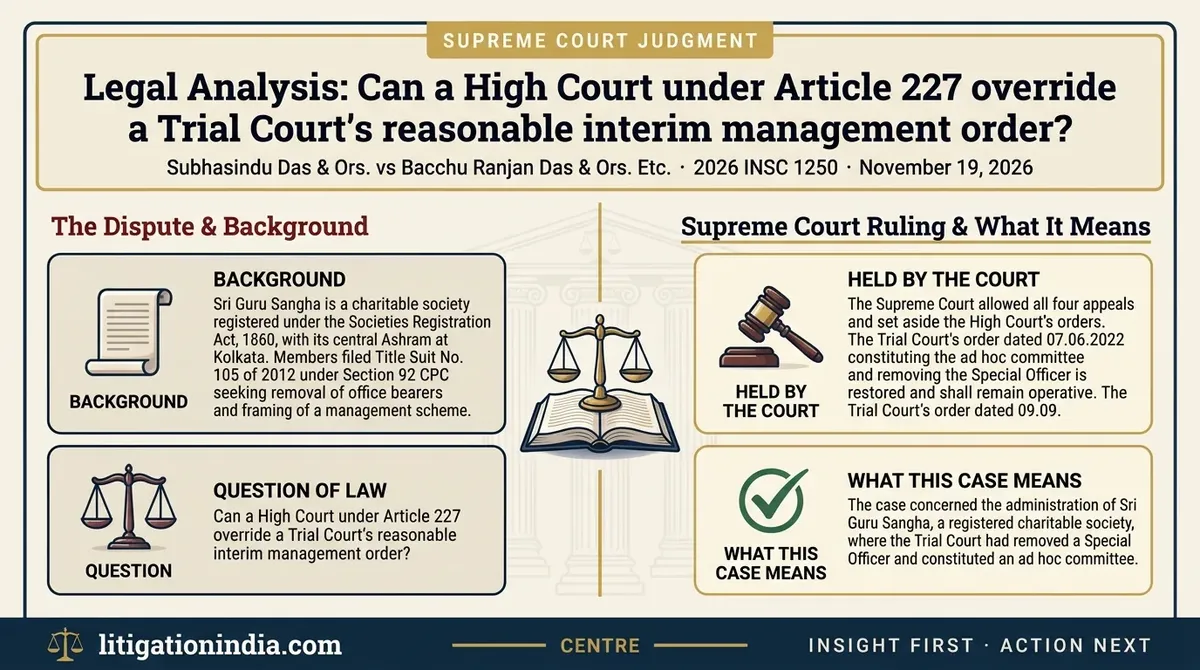
Supreme Court Upholds Trial Court's Management Arrangements for Charitable Sangha — infographic summary

What this case means

The case concerned the administration of Sri Guru Sangha, a registered charitable society, where the Trial Court had removed a Special Officer and constituted an ad hoc committee. The Supreme Court held that the High Court wrongly interfered with the Trial Court's arrangements using its supervisory jurisdiction under Article 227 and restored the Trial Court's orders on both management and impleadment. The judgment clarifies the limits of High Court supervisory jurisdiction and the conditions for impleadment in representative suits.

What the Supreme Court held

The Supreme Court allowed all four appeals and set aside the High Court's orders. The Trial Court's order dated 07.06.2022 constituting the ad hoc committee and removing the Special Officer is restored and shall remain operative. The Trial Court's order dated 09.09.2025 rejecting the impleadment applications of Bachhu Ranjan Das and Bablu Das is also restored, and the Trial Court is directed to proceed with the suit independently and in accordance with law.

Case: Subhasindu Das & Ors. vs Bacchu Ranjan Das & Ors. Etc. (2026) Citation: 2026 INSC 1250

Want the full legal reasoning, citations and case documents?

Read the full judgment analysis
Subhasindu Das
Bacchu Ranjan Das
Sri Guru Sangha
Section 92 CPC
Order I Rule 10(2) CPC
Article 227 Constitution
impleadment
Societies Registration Act 1860
ad hoc committee
Special Officer
supervisory jurisdiction
charitable society
Section 92, Code of Civil Procedure, 1908
Order I Rule 10(2), Code of Civil Procedure, 1908