
Full text of the judgment
Text extracted from Subhasindu Das & Ors. vs Bacchu Ranjan Das & Ors. Etc.. For the authoritative version refer to the Supreme Court of India's official website.
2026 INSC 1250 CIVIL APPEAL NOs.841-842 OF 2023
Page 1 of 10
REPORTABLE IN THE SUPREME COURT OF INDIA CIVIL APPELLATE JURISDICTION
CIVIL APPEAL NOS.841-842 OF 2023
SUBHASINDU DAS & ORS.
…APPELLANT(S) VERSUS BACCHU RANJAN DAS & ORS. ETC. …RESPONDENT(S)
WITH CIVIL APPEAL NO…………………..OF 2026 (@SPECIAL LEAVE PETITION (CIVIL) NO. 9345 OF 2026) WITH CIVIL APPEAL NO…………………..OF 2026 (SPECIAL LEAVE PETITION (CIVIL) NO. 9774 OF 2026)
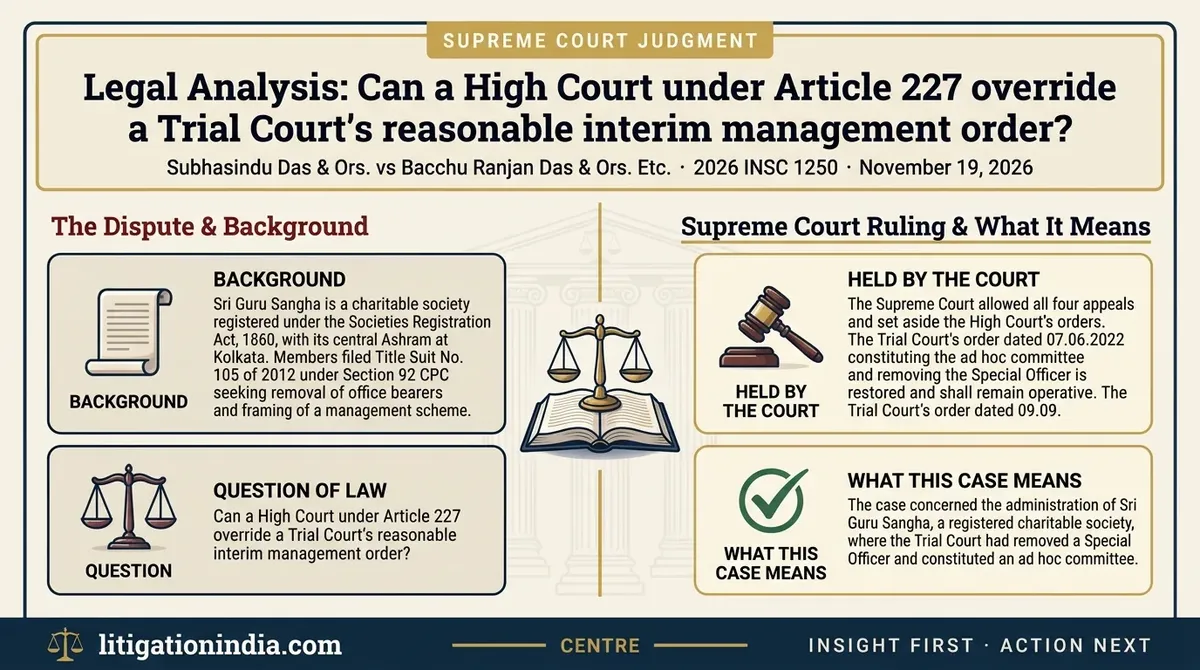
J U D G M E N T VIKRAM NATH, J. 1. Leave granted in Special Leave Petition (Civil) Nos. 9345 and 9774 of 2026. 2. The present batch of appeals arises from proceedings concerning the administration and management of Sri Guru Sangha (hereinafter referred to as the “Sangha”), a charitable society registered under the Societies Registration Act, 1860, having its central Ashram at Kolkata. The appellants, Subhasindu Das and others, are members of the Sangha and plaintiffs in Title Suit No. 105 of 2012, instituted under Section 92 of the Code of Civil Digitally signed by SHIPRA NARANG Date: 2026.11.19 18:01:19 IST Reason: Signature Not Verified
CIVIL APPEAL NOs.841-842 OF 2023
Page 2 of 10
Procedure, 1908 (hereinafter referred to as the “CPC”), seeking, inter alia, removal of certain office bearers, framing of a scheme for the management of the Sangha and appointment of a receiver. Since the present matters arise from interconnected proceedings in the said suit, they are being decided by this common judgment. 3. Civil Appeal Nos. 841 and 842 of 2023 have been preferred by Subhasindu Das and others against the common interim order dated 26.09.2022 passed by the High Court at Calcutta (hereinafter referred to as the “High Court”) in C.O. No. 2726 of 2022 filed by Bachhu Ranjan Das and C.O. No. 2334 of 2022 filed by Banani Ghosh, respectively. While Bachhu Ranjan Das challenged the constitution of an ad hoc committee for the management of the Sangha, Banani Ghosh, who was appointed as the Special Officer, challenged her removal by the Trial Court. By the impugned common order, the High Court stayed the operation of the Trial Court's order dated 07.06.2022. 4. The other two appeals, arising from Special Leave Petition (Civil) Nos. 9345 and 9774 of 2026, have also been preferred by Subhasindu Das and others against the separate orders dated 04.02.2026 passed by the High Court in C.O. No. 18 of 2026 filed by Bachhu Ranjan Das and C.O. No. 19 of 2026 filed by Bablu Das, respectively. By these orders, the High Court set aside the Trial Court's order dated 09.09.2025 rejecting their applications for impleadment in Title Suit No. 105 of 2012 and granted
CIVIL APPEAL NOs.841-842 OF 2023
Page 3 of 10
them liberty to file fresh applications with necessary pleadings. 5. The facts giving rise to the present appeals are briefly stated as follows: 5.1) During the pendency of Title Suit No. 105 of 2012, concerning the administration and management of the Sangha, the Trial Court, by order dated 30.01.2021, appointed Sri Ayanabha Raha as Special Officer to oversee its administration. Upon his resignation, Smt. Banani Ghosh was appointed as Special Officer by order dated 14.07.2021, with directions to discharge her functions in accordance with the arrangement approved by the Trial Court. 5.2) Subsequently, the plaintiffs sought removal of Smt. Banani Ghosh, alleging irregularities in her functioning and non-compliance with the Trial Court's directions. The Trial Court called upon her to furnish an explanation regarding the allegations, which was duly submitted. On a joint application filed by the parties, the Trial Court, by order dated 07.06.2022, removed her as Special Officer and constituted a 13-member ad hoc committee to manage the affairs of the Sangha, with directions to submit quarterly reports and arrange annual audits. 5.3) Aggrieved thereby, Smt. Banani Ghosh and Bachhu Ranjan Das filed separate revision applications before the High Court. By the common interim order dated 26.09.2022, the High Court directed that the
CIVIL APPEAL NOs.841-842 OF 2023
Page 4 of 10
Trial Court's order dated 07.06.2022 shall not be given effect to until the end of November 2022. This Court stayed the operation of the High Court's order on 14.11.2022 and confirmed the interim protection on 03.02.2023, while permitting the High Court to proceed with the pending revisions. 5.4) Meanwhile, applications seeking impleadment in the underlying suit were filed by Bachhu Ranjan Das and others. By order dated 09.09.2025, the Trial Court rejected the applications, holding that the applicants had failed to establish sufficient grounds warranting their addition as parties. The Trial Court found that mere association with the Sangha and general allegations of mismanagement were insufficient to justify impleadment. 5.5) By separate orders dated 04.02.2026, the High Court set aside the Trial Court's order dated 09.09.2025, observing that the suit was representative in nature and that the interests of other persons could be affected. The applicants were granted liberty to file fresh applications with necessary pleadings. Pursuant thereto, Bachhu Ranjan Das filed a fresh application for impleadment before the Trial Court, to which objections were also filed. This Court, by order dated 23.03.2026, stayed the operation of the impugned orders while permitting the Trial Court to continue with the suit.
CIVIL APPEAL NOs.841-842 OF 2023
Page 5 of 10
5.6) During the pendency of these proceedings, further disputes concerning the functioning of the ad hoc committee arose. On 06.04.2026, one of its joint conveners filed an application before the Trial Court alleging financial and administrative irregularities. Subsequent orders dated 08.04.2026 and 13.07.2026 have also been placed on record. Further, Bachhu Ranjan Das and Bablu Das filed Interlocutory Application Nos. 318790 and 319571 of 2026 before this Court, seeking appointment of an independent administrator or constitution of a fresh committee, particularly in view of the anticipated donations during the forthcoming religious celebrations. 6. We have heard learned counsel for the parties and have carefully perused the material placed on record. 7. At the outset, we find that the Trial Court, before which the underlying suit is pending, was competent to make appropriate arrangements for the interim administration and protection of the Sangha. The appointment of a Special Officer was intended to ensure the proper functioning of the institution during the pendency of the suit and did not confer any vested right to continue in that position. In the present case, the Trial Court had called upon Smt. Banani Ghosh to furnish an explanation regarding the allegations against her, which was duly submitted and considered. Upon finding that she had lost the confidence of the parties and that the purpose of her appointment was no longer
CIVIL APPEAL NOs.841-842 OF 2023
Page 6 of 10
being served, the Trial Court directed her removal. The subsequent constitution of the 13-member ad hoc committee was also based on a joint application of the parties, with safeguards requiring periodic reporting and auditing of accounts. In these circumstances, we find no sufficient justification for the High Court to have stayed the arrangement made by the Trial Court. 8. The scope of interference under Article 227 of the Constitution of India is well settled. In M/s Garment Craft v. Prakash Chand Goel1, this Court reiterated that the supervisory jurisdiction of the High Court is not intended to correct every error of fact or law, nor does it permit the High Court to substitute its own conclusions for those of the subordinate court. Such interference is warranted where there is a patent jurisdictional error, perversity or grave miscarriage of justice. In the present case, the High Court proceeded on the premise that Smt. Banani Ghosh had been removed without being afforded an opportunity of hearing. However, the Trial Court's order expressly records that her written explanation was called for, submitted and considered before the decision was taken. The High Court did not examine why the opportunity so afforded was insufficient or identify any other infirmity warranting suspension of the arrangement made by the Trial Court. We are, therefore, of the view that such interim interference was unwarranted.
1 (2022) 4 SCC 181
CIVIL APPEAL NOs.841-842 OF 2023
Page 7 of 10
9. Coming to the applications for impleadment, Order I Rule 10(2) of the CPC requires the Court to determine whether the presence of a proposed party is necessary or proper for the effective and complete adjudication of the questions involved in the suit. Although a suit instituted under Section 92 of the CPC is representative in nature and concerns the interests of persons associated with the institution, this does not confer an automatic right of impleadment upon every devotee or member of the Sangha. The applicants must demonstrate sufficient grounds for their separate participation and explain how their presence is necessary or proper for the adjudication of the controversy. In the present case, the Trial Court, by its reasoned order dated 09.09.2025, found that the applicants had failed to establish such grounds. Their general allegations of collusion and mismanagement, without sufficient particulars demonstrating the necessity of their presence, were found inadequate to justify impleadment. 10. The High Court, however, set aside the said order principally on the ground that the suit was representative in nature and that the interests of other persons might be affected by its outcome. While that consideration is relevant, it cannot, by itself, dispense with the requirements of Order I Rule 10(2) of the CPC. The High Court neither identified any perversity in the Trial Court's findings nor demonstrated why the rejection of the applications was legally unsustainable. Instead, it
CIVIL APPEAL NOs.841-842 OF 2023
Page 8 of 10
permitted the applicants to file fresh applications with necessary pleadings, without adequately addressing the reasons recorded by the Trial Court for rejecting their earlier applications. Such interference, in the absence of any demonstrated legal infirmity in the exercise of discretion by the Trial Court, was not justified. We are, therefore, inclined to restore the order dated 09.09.2025 insofar as it concerns the applicants before us. 11. We have also considered the subsequent developments brought on record, particularly the allegations concerning the functioning and financial management of the ad hoc committee. However, these allegations involve disputed questions which cannot appropriately be determined in the present proceedings. The Trial Court continues to exercise jurisdiction over the underlying suit and is competent to examine any irregularities brought to its notice and issue appropriate directions for the protection and administration of the Sangha. We are, therefore, not inclined to direct the appointment of a fresh committee or administrator at this stage. Any grievance concerning the existing arrangements may be raised before the Trial Court, which shall consider the same independently and in accordance with law. 12. Accordingly, Civil Appeal Nos. 841 and 842 of 2023 are allowed. The common interim order dated 26.09.2022 passed by the High Court in C.O. Nos. 2726 and 2334 of 2022 is set aside. Consequently, the order dated 07.06.2022 passed by the Trial Court shall remain
CIVIL APPEAL NOs.841-842 OF 2023
Page 9 of 10
operative, subject to any further orders passed by the competent court in accordance with law. 13. The appeals arising out of Special Leave Petition (Civil) Nos. 9345 and 9774 of 2026 are also allowed. The respective orders dated 04.02.2026 passed by the High Court in C.O. Nos. 18 and 19 of 2026 are set aside. Consequently, the order dated 09.09.2025 passed by the Trial Court rejecting the applications for impleadment stands restored insofar as it concerns Bachhu Ranjan Das and Bablu Das. Any subsequent application filed pursuant to the High Court's orders dated 04.02.2026, if still pending before the Trial Court, shall be dealt with independently in accordance with law, without treating the liberty granted by those orders as continuing to operate. 14. We clarify that our consideration of the Trial Court's order dated 07.06.2022 has been confined to examining the propriety of the interim interference by the High Court. We have not expressed any final opinion on the merits of Title Suit No. 105 of 2012 or the disputed allegations concerning the administration and financial affairs of the Sangha. The Trial Court shall proceed with the suit and all other pending applications independently and in accordance with law. It shall remain at liberty to pass appropriate orders concerning the management and protection of the Sangha, as may be warranted by the circumstances. The revisional proceedings pending before the High Court, insofar as they remain pending, shall likewise be dealt with
CIVIL APPEAL NOs.841-842 OF 2023
Page 10 of 10
on their own merits and in accordance with law, uninfluenced by the observations made herein. 15. Interlocutory Application Nos. 318790 and 319571 of 2026 filed before this Court, seeking directions concerning the administration of the Sangha, are disposed of with liberty to the applicants to raise their grievances before the Trial Court in accordance with law. 16. Pending applications, if any, stand disposed of.
………………………………………J. [VIKRAM NATH]
………………………………………J. [SANDEEP MEHTA]
………………………………………J. [APARESH KUMAR SINGH] NEW DELHI; NOVEMBER 19, 2026