
Story
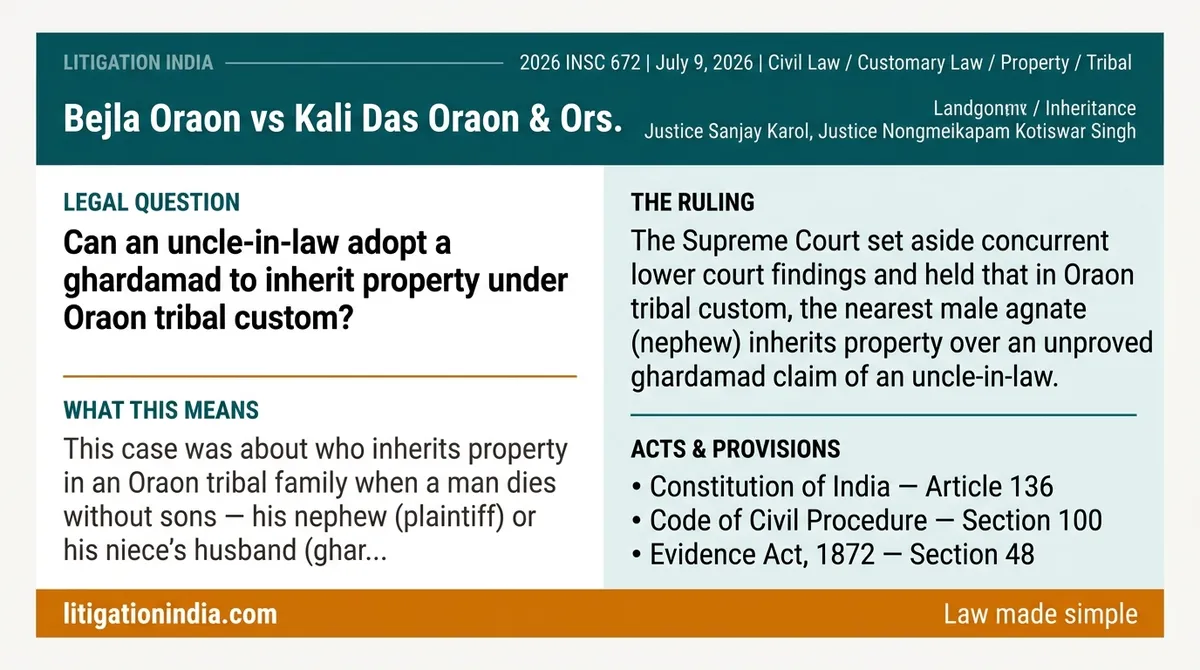
What this case means
This case was about who inherits property in an Oraon tribal family when a man dies without sons — his nephew (plaintiff) or his niece's husband (ghardamad). The Supreme Court set aside the concurrent findings of three lower courts and decreed in favour of the plaintiff-nephew, holding that the custom of a ghardamad inheriting through an uncle-in-law was not proved. It matters because it clarifies how tribal customary law of inheritance is proved and applied.
What the Supreme Court held
The Supreme Court set aside the concurrent findings of all three courts below and decreed the plaintiff's suit. It held that the custom of an uncle-in-law adopting a ghardamad was not proved, and that under the prevalent Oraon customary law, the nearest male agnate (the plaintiff-nephew) is entitled to property in the absence of a proven ghardamad or male heir. Costs were left to be borne by the parties themselves.
Case: Bejla Oraon vs Kali Das Oraon & Ors. (2026) Citation: 2026 INSC 672
Want the full legal reasoning, citations and case documents?
Read the full judgment analysis