Supreme Court Upholds Nephew's Property Rights Over Ghardamad Under Oraon Tribal Custom
Bejla Oraon vs Kali Das Oraon & Ors.
The big legal question
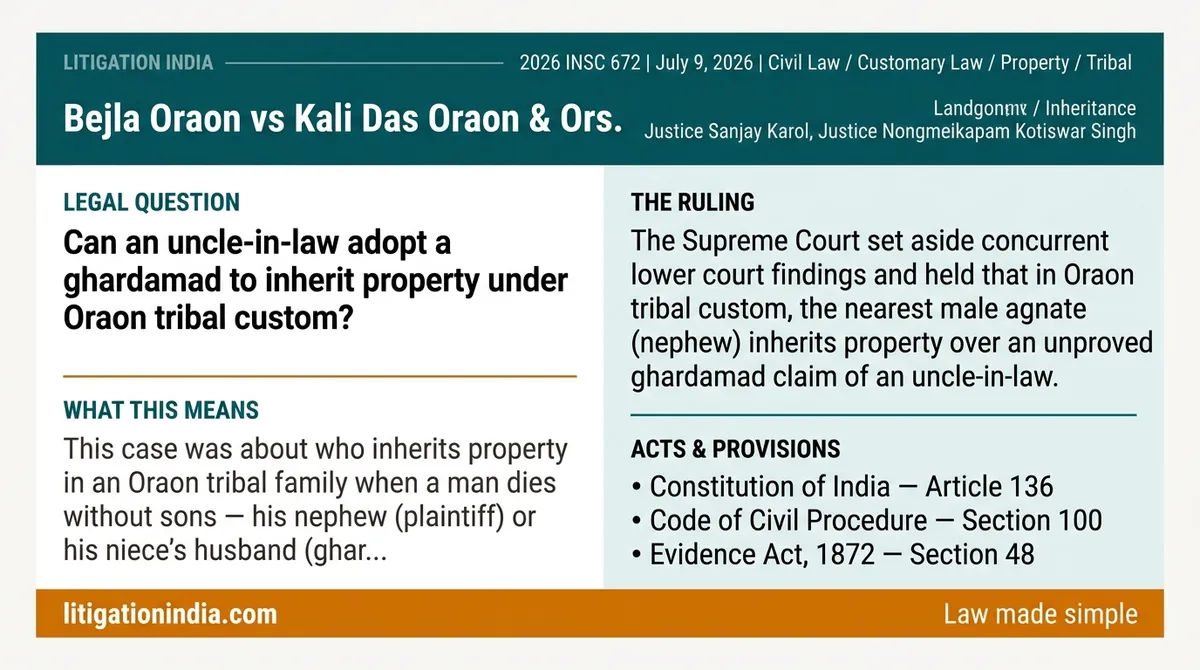
Can an uncle-in-law adopt a ghardamad to inherit property under Oraon tribal custom?
What this case means
This case was about who inherits property in an Oraon tribal family when a man dies without sons — his nephew (plaintiff) or his niece's husband (ghardamad). The Supreme Court set aside the concurrent findings of three lower courts and decreed in favour of the plaintiff-nephew, holding that the custom of a ghardamad inheriting through an uncle-in-law was not proved. It matters because it clarifies how tribal customary law of inheritance is proved and applied.
“The Supreme Court set aside concurrent lower court findings and held that in Oraon tribal custom, the nearest male agnate (nephew) inherits property over an unproved ghardamad claim of an uncle-in-law.”
Story Slides
In short
This civil appeal arose from a property dispute in an Oraon tribal family in Jharkhand. The plaintiff (Bejla Oraon), grandson of one Sukhu Oraon and son of Dhungru, claimed ownership of all land belonging to the grandfather's family after the deaths of his uncles Ledura and Bhoula. The defendants — Bhoula's daughter Budhain and her husband Punai — claimed that Punai had been adopted as Ledura's ghardamad (resident son-in-law) and thus inherited Ledura's property through a lease deed and a partition deed dated 27 February 1975. The trial court and the first appellate court dismissed the plaintiff's suit, accepting the ghardamad relationship. The High Court of Jharkhand in second appeal upheld these concurrent findings while framing but not answering the critical question of whether an uncle-in-law could adopt a ghardamad. The Supreme Court examined the principles for proving a custom, relying on Halsbury's Laws of England and a series of its own precedents. It analysed the testimony of all witnesses on six issues: partition, daughters' inheritance rights, ghardamad rights, who inherits from an issueless Udaon, entitlement after deaths of family members, and validity of the lease deed. The Court found that defendant witnesses were internally inconsistent on most issues, while plaintiff witnesses were consistent. Crucially, it found that the custom of an uncle-in-law adopting a ghardamad was never established. Relying on SC Roy's authoritative book on the Oraon community, the Court held that in the absence of a ghardamad or male heir related to the land owner, the nearest male agnate (the plaintiff-nephew) is entitled. The High Court was criticised for framing a substantial question under Section 100 CPC but not answering it. The concurrent findings were set aside and the plaintiff's suit was decreed.
Background
One Sukhu Oraon had three sons: Dhungru, Ledura, and Bhoula. The plaintiff was Dhungru's son and claimed ownership of all land of the grandfather's family after the deaths of his uncles. The defendants, Bhoula's daughter Budhain and her husband Punai, claimed Punai had been adopted as Ledura's ghardamad and inherited his property through a deed dated 27 February 1975. The Munsif's court, the first appellate court, and the High Court of Jharkhand all concurrently dismissed the plaintiff's suit.
The Decision
The Supreme Court set aside the concurrent findings of all three courts below and decreed the plaintiff's suit. It held that the custom of an uncle-in-law adopting a ghardamad was not proved, and that under the prevalent Oraon customary law, the nearest male agnate (the plaintiff-nephew) is entitled to property in the absence of a proven ghardamad or male heir. Costs were left to be borne by the parties themselves.
Why it matters for you
This judgment clarifies that in tribal customary law disputes, the burden of proving a custom lies on the party asserting it, and inconsistent witness testimony is insufficient. It confirms that the Supreme Court can interfere with concurrent findings when the reasoning of lower courts is flawed. It also establishes that under Oraon customary law, the nearest male agnate has precedence where an alleged ghardamad custom is not duly proved.
Relevant Legal Provisions
Key Acts and sections cited or relied upon in this judgment
“Article 136 confers special leave jurisdiction on the Supreme Court; the Court discussed the limited scope of interference with concurrent findings of fact under this provision and found exceptional circumstances justifying interference in this case.”
“Section 100 CPC governs second appeals on substantial questions of law; the Court held that once the High Court framed a substantial question about an uncle-in-law's power to adopt a ghardamad, it was obliged to answer it rather than simply defer to concurrent findings.”
“Section 48 provides that opinions of persons likely to know of the existence of a custom are relevant; the Court applied this to assess the adequacy of witness testimony in proving the alleged customary rights of a ghardamad.”
AI-assisted summary, reviewed and verified by our editorial team.
In the Court's words
“He who alleges the custom must prove it. He must also prove that he is in fact governed by said custom.”
“A custom once disallowed cannot, once again be revived.”
“It is nowhere established that an uncle-in-law can adopt his niece's husband as his ghardamad within the prevalent customary law.”
“In the absence of a ghardamad or any other male heir directly related to the land owner i.e. the male members of the family, the nearest male agnate will have the right in the property.”
Need help with your case?
Facing a property, eviction, or landlord-tenant dispute? Consult our property lawyers for a free initial review.
Related Supreme Court services