
All insights

Can a husband's false defence of wife's accidental death prove his guilt?

Supreme Court Upholds Husband's Murder Conviction in Dowry Death Case

A wife was strangled to death within nine months of marriage after persistent dowry harassment. The Supreme Court upheld the husband's conviction for murder under Section 302 IPC and all accused's con

Litigation India Editorial 2 November 2026 1 min read 2026 INSC 1187

Story

Case at a glance1 / 6

Supreme Court of India

Husband Convicted of Murder After Wife Dies in Matrimonial Home

Ramkishan Digambar Jadhav vs State of Maharashtra — 2026 INSC 1187

Court: Supreme Court of India; Date: 02 November 2026Bench: Justice Sandeep Mehta and Justice Devendra Kumar UpadhyayaArea of Law: Criminal Law — Dowry Death, Murder, Matrimonial CrueltyWife died within nine months of marriage; post-mortem confirmed strangulation
Supreme Court Upholds Husband's Murder Conviction in Dowry Death Case · 2026 INSC 11872026-11-02T17:58:32.403083+00:00
The legal question2 / 6

Did the accused appellants commit murder and dowry-related offences?

Core legal questions before the Supreme Court

  • Appellant Ramkishan: Wife died accidentally due to epileptic seizure during sexual intercourse; no murder.
  • Appellant Digambar and Venkat: Implicated only due to family ties, no specific role in dowry harassment.
  • Respondent State: Death by strangulation proved; false defence and failure to explain wife's death under Section 106 Evidence Act establishes guilt.
  • Respondent State: All ingredients of Section 304-B IPC and Section 113-B presumption fully satisfied.
Supreme Court Upholds Husband's Murder Conviction in Dowry Death Case · 2026 INSC 11872026-11-02T17:58:32.403083+00:00
Statutory comparison3 / 6

Key Statutory Provisions and Their Application

How each provision operated in this judgment

ProvisionWhat it providesHow the Court applied it
Section 302 IPCPunishment for murderRamkishan convicted; strangulation of wife in matrimonial home established
Section 304-B IPCDowry death within 7 years of marriage after crueltyAll three appellants convicted; death within 9 months after persistent dowry demands
Section 498-A IPCCruelty by husband/relatives over dowryAll three convicted; evidence of beatings, starvation, threats corroborated by multiple witnesses
Section 106, Evidence Act 1872Burden to prove fact within one's special knowledgeRamkishan alone with wife at death; burden on him to explain; false explanation strengthened guilt
Section 113-B, Evidence Act 1872Presumption of dowry deathCruelty and dowry demands before death proved; appellants failed to rebut the presumption
Supreme Court Upholds Husband's Murder Conviction in Dowry Death Case · 2026 INSC 11872026-11-02T17:58:32.403083+00:00
The Court's reasoning4 / 6

Court's Reasoning: From Facts to Conviction

Step-by-step logic leading to dismissal of appeals

  1. 1Step 1: Post-mortem confirmed death by strangulation — homicidal, not accidental.
  2. 2Step 2: Medical evidence rejected defence theory of death by epileptic seizure.
  3. 3Step 3: Section 106 Evidence Act — Ramkishan, alone with wife at death, bore burden to explain; he failed.
  4. 4Step 4: False concocted defence treated as additional incriminating link completing circumstantial chain.
  5. 5Step 5: Multiple witnesses proved cruelty over dowry; Section 113-B presumption arose and was not rebutted.
A false explanation for a wife's unnatural death is itself incriminating evidence — it completes the chain of guilt.
Supreme Court Upholds Husband's Murder Conviction in Dowry Death Case · 2026 INSC 11872026-11-02T17:58:32.403083+00:00
The verdict5 / 6

Supreme Court's Final Verdict

Outcome of Criminal Appeal Nos. 1849/2013 and 962/2014

  • The Fact: Wife Vimalbai died within 9 months of marriage by strangulation at the matrimonial home after persistent dowry harassment.
  • The Law: False defence and failure to explain wife's death under Section 106 Evidence Act completes the chain; Section 113-B presumption not rebutted.
  • The Result: Both appeals dismissed; Ramkishan convicted under Sections 302, 498-A, 304-B IPC; Venkat convicted under Sections 498-A, 304-B read with Section 34 IPC.
Appellants directed to surrender within four weeks; bail bonds cancelled; life imprisonment for Ramkishan confirmed.
Supreme Court Upholds Husband's Murder Conviction in Dowry Death Case · 2026 INSC 11872026-11-02T17:58:32.403083+00:00
Why it matters6 / 6

What This Judgment Means for Ordinary People

Practical significance of this ruling

  • A husband present when his wife dies unnaturally at home must explain the death; silence or a false story worsens his legal position.
  • Dowry-related cruelty followed by an unnatural death within seven years of marriage creates a legal presumption of dowry death that the family must disprove.
  • Multiple corroborating witnesses — including marriage mediators and neighbours — can establish dowry harassment even without direct eyewitnesses to the crime.
  • Courts will not demand impossible levels of proof for crimes committed in the privacy of a home.
When a wife dies unnaturally at home, the husband bears a legal duty to explain — a false story seals his guilt.
Supreme Court Upholds Husband's Murder Conviction in Dowry Death Case · 2026 INSC 11872026-11-02T17:58:32.403083+00:00
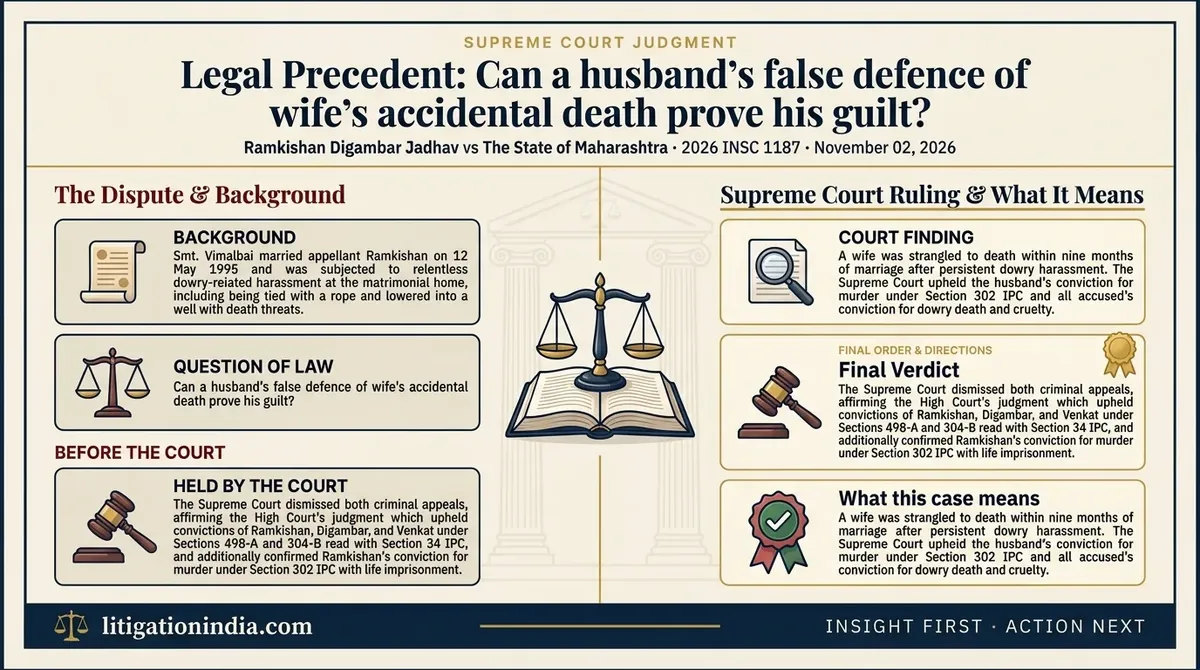
Supreme Court Upholds Husband's Murder Conviction in Dowry Death Case — infographic summary

What this case means

A wife was strangled to death within nine months of marriage after persistent dowry harassment. The Supreme Court upheld the husband's conviction for murder under Section 302 IPC and all accused's conviction for dowry death and cruelty. The ruling reinforces that a false defence and failure to explain a wife's death in matrimonial home strengthens the prosecution case.

What the Supreme Court held

The Supreme Court dismissed both criminal appeals, affirming the High Court's judgment which upheld convictions of Ramkishan, Digambar, and Venkat under Sections 498-A and 304-B read with Section 34 IPC, and additionally confirmed Ramkishan's conviction for murder under Section 302 IPC with life imprisonment. The appellants, who had been released on bail during the pendency of appeals, were directed to surrender before the trial Court within four weeks to serve the remaining sentences.

Case: Ramkishan Digambar Jadhav vs The State of Maharashtra (2026) Citation: 2026 INSC 1187

Want the full legal reasoning, citations and case documents?

Read the full judgment analysis
Ramkishan Jadhav
State of Maharashtra
dowry death
Section 304-B IPC
Section 302 IPC
Section 498-A IPC
Section 106 Evidence Act
Section 113-B Evidence Act
strangulation
circumstantial evidence
matrimonial cruelty
Section 302, Indian Penal Code, 1860
Section 304-B, Indian Penal Code, 1860
Section 498-A, Indian Penal Code, 1860